Homepage Blank Texas 509 PDF Form
Content Overview

The Texas 509 form serves as a crucial tool for individuals and entities seeking to use a name that is similar to an existing registered name in Texas. This form facilitates the process of obtaining written consent from the holder of the existing name, ensuring compliance with state regulations. It is important to note that while the form meets the minimum statutory requirements, it does not replace the need for legal advice. The existing names that require consent include active Texas filing entities, registered foreign entities, and reserved names. A proposed name must not be identical or deceptively similar to an existing name, even with consent. The form must be signed by an authorized individual on behalf of the existing name holder, and it must be submitted alongside the relevant filing instrument. Importantly, once consent is granted and the instrument is filed, it cannot be withdrawn. Additionally, the Texas Secretary of State does not enforce any private agreements related to the consent, nor does it address potential trademark conflicts. For those navigating this process, understanding the implications of the Texas 509 form is essential to ensure compliance and avoid legal complications.


Document Preview

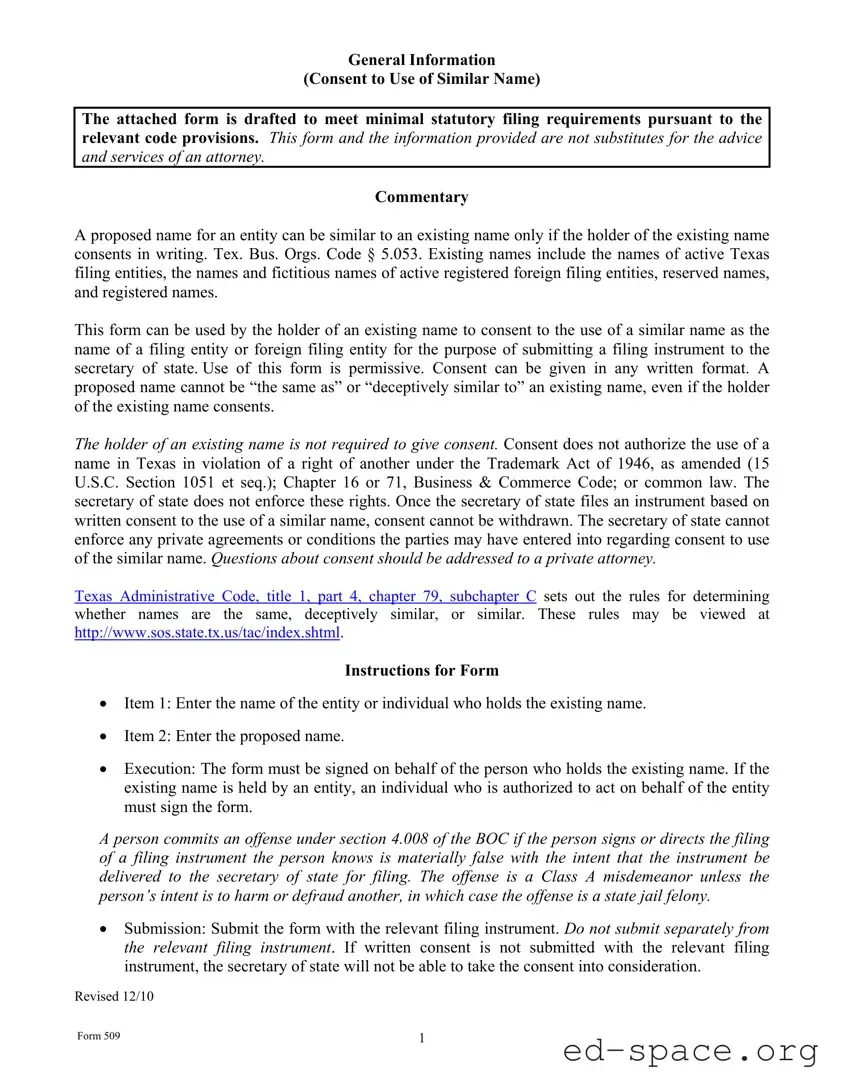
General Information
(Consent to Use of Similar Name)
The attached form is drafted to meet minimal statutory filing requirements pursuant to the
relevant code provisions. This form and the information provided are not substitutes for the advice
and services of an attorney.
Commentary
A proposed name for an entity can be similar to an existing name only if the holder of the existing name
consents in writing. Tex. Bus. Orgs. Code § 5.053. Existing names include the names of active Texas
filing entities, the names and fictitious names of active registered foreign filing entities, reserved names,
and registered names.
This form can be used by the holder of an existing name to consent to the use of a similar name as the
name of a filing entity or foreign filing entity for the purpose of submitting a filing instrument to the
secretary of state. Use of this form is permissive. Consent can be given in any written format. A
proposed name cannot be “the same as” or “deceptively similar to” an existing name, even if the holder
of the existing name consents.
The holder of an existing name is not required to give consent. Consent does not authorize the use of a
name in Texas in violation of a right of another under the Trademark Act of 1946, as amended (15
U.S.C. Section 1051 et seq.); Chapter 16 or 71, Business & Commerce Code; or common law. The
secretary of state does not enforce these rights. Once the secretary of state files an instrument based on
written consent to the use of a similar name, consent cannot be withdrawn. The secretary of state cannot
enforce any private agreements or conditions the parties may have entered into regarding consent to use
of the similar name. Questions about consent should be addressed to a private attorney.
Texas Administrative Code, title 1, part 4, chapter 79, subchapter C sets out the rules for determining
whether names are the same, deceptively similar, or similar. These rules may be viewed at
http://www.sos.state.tx.us/tac/index.shtml.
Instructions for Form
Item 1: Enter the name of the entity or individual who holds the existing name.
Item 2: Enter the proposed name.
Execution: The form must be signed on behalf of the person who holds the existing name. If the
existing name is held by an entity, an individual who is authorized to act on behalf of the entity
must sign the form.
A person commits an offense under section 4.008 of the BOC if the person signs or directs the filing
of a filing instrument the person knows is materially false with the intent that the instrument be
delivered to the secretary of state for filing. The offense is a Class A misdemeanor unless the
person’s intent is to harm or defraud another, in which case the offense is a state jail felony.
Submission: Submit the form with the relevant filing instrument. Do not submit separately from
the relevant filing instrument. If written consent is not submitted with the relevant filing
instrument, the secretary of state will not be able to take the consent into consideration.
Revised 12/10
Form 509
1
Form 509
(Revised 12/10)
Submit with relevant filing
instrument.
Filing Fee: None
Consent to Use
of Similar Name
(1)
Name of the entity or individual who holds the existing name on file with the secretary of state
consents to the use of
(2)
Proposed name
as the name of a filing entity or foreign filing entity in Texas for the purpose of submitting a filing
instrument to the secretary of state. This consent does not authorize the use of the similar name in
violation of a right of another under the Trademark Act of 1946, as amended (15 U.S.C. Section
1051 et seq.); Chapter 16 or 71, Business & Commerce Code; or common law.
(3) The undersigned certifies to being authorized by the holder of the existing name to give this
consent. The undersigned signs this document subject to the penalties imposed by law for the
submission of a materially false or fraudulent instrument.
Date:
By:
Name of existing entity, if any (type or print)
File number of existing entity, if any
Signature of Authorized Person
Name of Authorized Person (type or print)
Title of Authorized Person, if any (type or print)
Form 509
2

Form Specifications

Fact Name Description
Purpose The Texas 509 form is used to obtain consent from the holder of an existing name for the use of a similar name by another entity.
Governing Law This form is governed by the Texas Business Organizations Code, specifically Tex. Bus. Orgs. Code § 5.053.
Written Consent Consent to use a similar name must be given in writing, but it can take any form.
Filing Requirement The form must be submitted along with the relevant filing instrument to the Secretary of State.
Enforcement Limitations The Secretary of State does not enforce private agreements related to the consent for name usage.
Trademark Considerations Using a similar name does not allow for violations of trademark rights under federal and state laws.
Similar Name Definition A proposed name cannot be “the same as” or “deceptively similar to” an existing name, even with consent.
Consent Withdrawal Once filed, consent to use a similar name cannot be withdrawn.
Legal Advice The form and its contents are not substitutes for legal advice; consulting an attorney is recommended.
Penalties for False Information Submitting false information on the form can result in serious legal penalties, including misdemeanors or felonies.

Texas 509: Usage Guidelines

Filling out the Texas 509 form is a straightforward process that requires specific information to ensure compliance with state regulations. After completing the form, it must be submitted alongside the relevant filing instrument. This step is crucial, as the secretary of state will not consider the consent without the accompanying documents.

  1. Start by entering the name of the entity or individual who holds the existing name in the designated space.
  2. Next, provide the proposed name that you wish to use in the appropriate field.
  3. The form must be signed by someone authorized to act on behalf of the existing name holder. If the existing name is held by an entity, ensure that an authorized individual signs the form.
  4. After signing, include the date of the signature.
  5. Type or print the name of the existing entity, if applicable, in the specified area.
  6. If there is a file number associated with the existing entity, enter it in the provided space.
  7. Ensure the signature of the authorized person is clearly written.
  8. Finally, type or print the name of the authorized person and their title, if applicable.

Once all sections are completed, submit the Texas 509 form together with the relevant filing instrument to the secretary of state. This ensures that the consent is taken into account during the filing process.

Your Questions, Answered

What is the Texas 509 form?

The Texas 509 form is a legal document used to obtain consent for the use of a name that is similar to an existing name. This form is required when an entity wants to register a name that may be close to another already registered name in Texas. The consent must come from the holder of the existing name, ensuring that there is no confusion or conflict between the names.

Who needs to use the Texas 509 form?

This form is necessary for individuals or entities who hold an existing name and wish to allow another entity to use a similar name. If you are planning to register a new business name that could be seen as similar to an existing one, you will need to obtain consent from the current name holder using this form.

What information is required on the Texas 509 form?

The form requires specific details, including the name of the entity or individual who holds the existing name and the proposed name that is being requested for use. Additionally, it must be signed by someone authorized to act on behalf of the holder of the existing name.

Is there a fee associated with filing the Texas 509 form?

No, there is no filing fee for submitting the Texas 509 form. However, it must be submitted alongside the relevant filing instrument to the Secretary of State for it to be considered valid.

Can consent be withdrawn after the form is filed?

Once the Texas Secretary of State files an instrument based on the consent provided in the Texas 509 form, that consent cannot be withdrawn. It is important to be certain before submitting the form, as the decision is final once filed.

What happens if consent is not obtained?

If consent is not obtained from the holder of the existing name, the Secretary of State will not be able to consider the proposed name for registration. This could lead to delays or the inability to register the desired name altogether.

Are there any restrictions on the proposed name?

Yes, the proposed name cannot be “the same as” or “deceptively similar to” an existing name, even with consent. This means that even if the holder agrees, the new name must still be distinct enough to avoid confusion with the existing name.

What are the legal implications of signing the Texas 509 form?

By signing the form, the authorized person certifies that they have the authority to give consent. If the form contains materially false information, the signer could face legal penalties, including potential misdemeanor or felony charges, depending on the intent behind the false submission.

Where can I find additional information about name similarity rules?

Further details regarding the rules for determining if names are similar can be found in the Texas Administrative Code, specifically in title 1, part 4, chapter 79, subchapter C. This information can be accessed online at the Secretary of State's website.

Common mistakes

  1. Not providing complete information: Ensure that all required fields are filled out completely. Missing information can lead to delays or rejection of the form.

  2. Incorrectly identifying the existing name holder: Make sure to accurately enter the name of the entity or individual who holds the existing name. Double-check for typos or inaccuracies.

  3. Failing to sign the form: The form must be signed by an authorized individual. If the existing name is held by an entity, ensure that the correct representative signs it.

  4. Submitting without the relevant filing instrument: The form should be submitted alongside the relevant filing instrument. Do not send it separately, as this will result in the consent being disregarded.

  5. Ignoring the consent rules: Understand that consent to use a similar name does not allow for names that are “the same as” or “deceptively similar” to existing names, even with consent.

  6. Not understanding the implications of consent: Consent cannot be withdrawn once the form is filed. Be sure you are ready to allow the use of the similar name permanently.

  7. Overlooking the need for legal advice: This form does not replace the need for legal counsel. If you have questions about consent or the implications, consult an attorney.

  8. Assuming the secretary of state enforces private agreements: The secretary of state does not enforce any private agreements regarding consent. Ensure that all parties understand this before proceeding.

Documents used along the form

The Texas 509 form is an important document that allows an entity or individual to consent to the use of a similar name for a filing entity in Texas. Alongside this form, several other documents are often utilized to ensure compliance with state regulations and to facilitate the proper filing process. Below is a list of related forms and documents that may be required or beneficial when working with the Texas 509 form.

  • Certificate of Formation: This document is essential for establishing a new entity in Texas. It outlines the entity's name, purpose, and structure, and must be filed with the Secretary of State.
  • Assumed Name Certificate: Also known as a DBA (Doing Business As), this certificate is filed when a business operates under a name different from its legal name. It helps to inform the public about the true owner of the business.
  • Registered Agent Appointment: This document designates an individual or business entity as the official point of contact for legal documents and notices. Every business entity in Texas must have a registered agent.
  • Amendment Form: If changes need to be made to an existing entity's information, such as its name or structure, an amendment form must be submitted to the Secretary of State to reflect these updates.
  • Foreign Entity Registration: This form is required for businesses that are formed in another state but wish to conduct business in Texas. It allows them to register as a foreign entity with the Texas Secretary of State.
  • Operating Agreement: While not always required, this internal document outlines the management structure and operating procedures of an LLC. It serves as a guide for members and managers regarding their rights and responsibilities.
  • Bylaws: For corporations, bylaws are crucial as they define the governance structure, roles of officers, and procedures for meetings. This document is essential for maintaining order and compliance within the organization.

Understanding these documents and their purposes can help streamline the process of forming and operating a business in Texas. It is always advisable to seek professional guidance when navigating these forms to ensure compliance with all legal requirements.

Similar forms

The Texas 509 form, which pertains to the consent for the use of a similar name, shares similarities with several other legal documents. Each document serves a specific purpose in the realm of business naming and entity registration. Here are eight documents that are comparable to the Texas 509 form:

  • Certificate of Assumed Name: This document allows a business to operate under a name that differs from its registered name. Like the Texas 509 form, it requires consent from existing name holders if the assumed name is similar.
  • Trademark Registration Application: This application is used to register a trademark with the U.S. Patent and Trademark Office. It also requires consent if the trademark is similar to an existing one, ensuring no infringement occurs.
  • Business Name Reservation Form: This form allows individuals to reserve a business name before officially registering it. It is similar in that it protects against the use of similar names during the reservation period.
  • Foreign Entity Registration Application: When a foreign entity wishes to operate in Texas, it must file this application. Similar to the Texas 509 form, it must ensure that its name does not conflict with existing names in Texas.
  • Partnership Agreement: This document outlines the terms of a partnership and often includes clauses regarding the use of business names. Consent from partners is necessary if the name is similar to an existing business name.
  • DBA (Doing Business As) Registration: A DBA registration allows a business to operate under a name different from its legal name. Like the Texas 509 form, it requires confirmation that the DBA is not deceptively similar to existing names.
  • Articles of Incorporation: When forming a corporation, this document must be filed with the state. It includes the corporation's name and must comply with naming regulations, similar to those outlined in the Texas 509 form.
  • Fictitious Name Registration: This registration is for businesses operating under a name that is not their legal name. It parallels the Texas 509 form by requiring consent from existing name holders if the fictitious name is similar.

Dos and Don'ts

When filling out the Texas 509 form, it is essential to follow specific guidelines to ensure accuracy and compliance. Below is a list of things to do and avoid.

  • Do enter the name of the entity or individual who holds the existing name accurately in Item 1.
  • Do clearly state the proposed name in Item 2, ensuring it is not identical or deceptively similar to an existing name.
  • Do have the form signed by an authorized individual if the existing name is held by an entity.
  • Do submit the form together with the relevant filing instrument; do not submit them separately.
  • Do ensure that all information provided is truthful and complete to avoid potential legal issues.
  • Don't assume that consent from the holder of the existing name guarantees approval; the secretary of state will still evaluate the name.
  • Don't forget to check for any potential trademark conflicts before submitting the proposed name.
  • Don't sign the form unless you are authorized to do so, as this could lead to legal penalties.
  • Don't overlook the importance of the date on the form; it must be current at the time of submission.
  • Don't attempt to withdraw consent once the form has been filed with the secretary of state.

Misconceptions

Here are four common misconceptions about the Texas 509 form:

  • Consent is mandatory for similar names. Many believe that consent from the holder of an existing name is required for any similar name usage. In reality, consent is not mandatory; it is simply a permissive action that can be given in any written format.
  • The Secretary of State enforces trademark rights. Some assume that the Secretary of State will protect trademark rights when filing a similar name. However, the Secretary of State does not enforce these rights, and individuals must ensure they are not infringing on any existing trademarks.
  • Consent can be withdrawn after submission. There is a misconception that consent can be retracted once the form is filed. In fact, once the Secretary of State files the instrument based on written consent, that consent cannot be withdrawn.
  • The form substitutes legal advice. Some people think that the Texas 509 form provides legal guidance. This is incorrect; the form is not a substitute for legal advice, and individuals are encouraged to consult an attorney for questions regarding consent and name usage.

Key takeaways

Here are some key takeaways about filling out and using the Texas 509 form:

  • Purpose: The Texas 509 form is used to obtain consent for a proposed name that is similar to an existing name.
  • Written Consent: Consent from the holder of the existing name must be in writing, but it can be in any format.
  • Existing Names: Existing names include active Texas entities, registered foreign entities, and reserved names.
  • Similar Names: A proposed name cannot be identical or deceptively similar to an existing name, even with consent.
  • Trademark Rights: Consent does not allow the use of a name that violates trademark rights or other legal protections.
  • Filing Process: The form must be submitted along with the relevant filing instrument; do not submit separately.
  • Signature Requirement: An authorized individual must sign the form if the existing name belongs to an entity.
  • Legal Consequences: Signing a materially false instrument can lead to serious legal penalties, including misdemeanor or felony charges.
  • Non-Enforcement: The Secretary of State does not enforce private agreements related to name consent.
  • Consult an Attorney: For specific legal questions regarding consent or name similarity, consult a private attorney.

Understanding these points can help ensure a smooth process when using the Texas 509 form.