Homepage Blank Texas 50 160 PDF Form
Content Overview

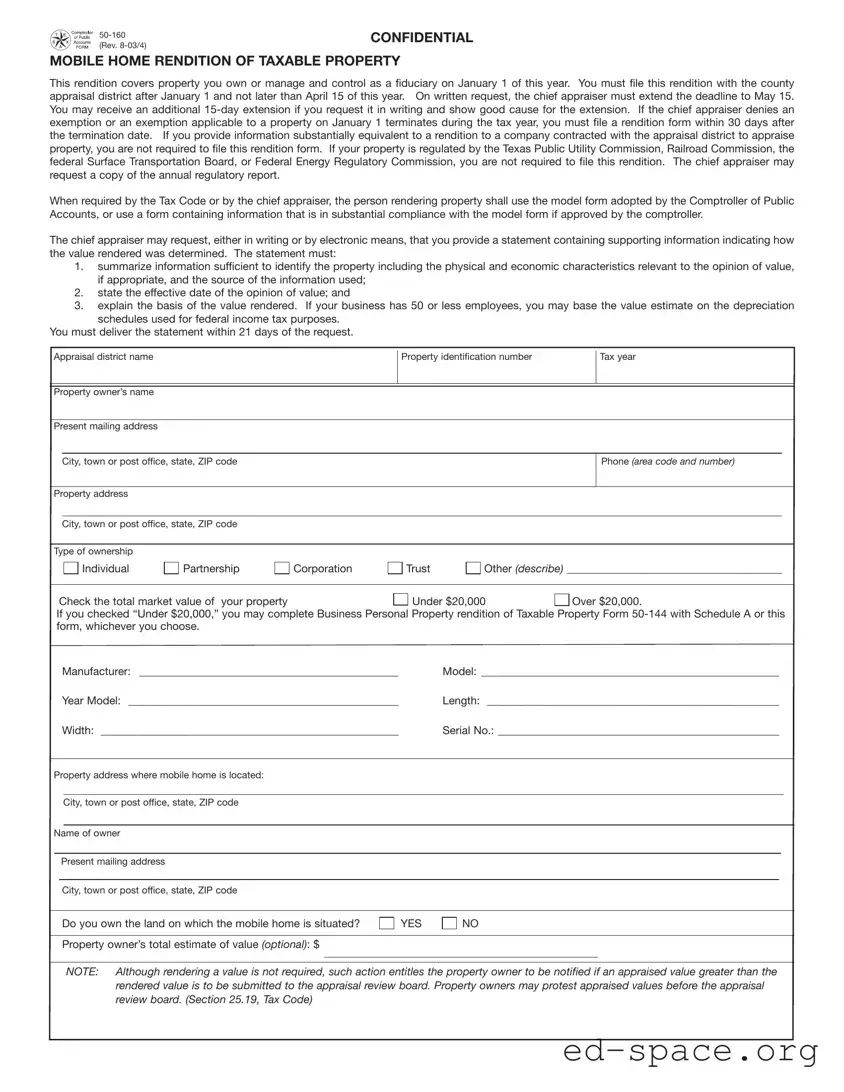
The Texas 50-160 form, also known as the Confidential Mobile Home Rendition of Taxable Property, serves as an essential document for property owners and fiduciaries managing mobile homes. This form must be submitted to the county appraisal district between January 1 and April 15 of the tax year, ensuring that property values are accurately reported for taxation purposes. In certain circumstances, such as when an exemption is denied or terminates, property owners are required to file this form within 30 days of the change. The form collects vital information, including property identification details, ownership type, and market value estimates. For businesses with 50 or fewer employees, the form allows the use of federal depreciation schedules to estimate property value. It is important to note that if a property owner provides information that is equivalent to a rendition to a contracted appraisal company, filing the 50-160 may not be necessary. Additionally, if the property falls under specific regulatory commissions, the requirement to file is waived. The chief appraiser may request further supporting documentation to clarify how the value was determined, reinforcing the need for accuracy and transparency in property reporting. Completing this form correctly can help property owners stay informed about appraised values and exercise their rights to protest if needed.


Document Preview

CONFIDENTIAL
MOBILE HOME RENDITION OF TAXABLE PROPERTY
Type of ownership
City, town or post office, state, ZIP code
Property address
City, town or post office, state, ZIP code Phone (area code and number)
Appraisal district name Property identification number Tax year
Present mailing address
Property owner’s name
Individual Partnership Corporation Trust Other (describe) _______________________________________
NOTE: Although rendering a value is not required, such action entitles the property owner to be notified if an appraised value greater than the
rendered value is to be submitted to the appraisal review board. Property owners may protest appraised values before the appraisal
review board. (Section 25.19, Tax Code)
50-160
(Rev. 8-03/4)
Property owner’s total estimate of value (optional): $
Do you own the land on which the mobile home is situated? YES NO
Property address where mobile home is located:
Manufacturer: _______________________________________________ Model: ______________________________________________________
Year Model: _________________________________________________ Length: _____________________________________________________
Width: ______________________________________________________ Serial No.: ___________________________________________________
City, town or post office, state, ZIP code
Present mailing address
Name of owner
This rendition covers property you own or manage and control as a fiduciary on January 1 of this year. You must file this rendition with the county
appraisal district after January 1 and not later than April 15 of this year. On written request, the chief appraiser must extend the deadline to May 15.
You may receive an additional 15-day extension if you request it in writing and show good cause for the extension. If the chief appraiser denies an
exemption or an exemption applicable to a property on January 1 terminates during the tax year, you must file a rendition form within 30 days after
the termination date. If you provide information substantially equivalent to a rendition to a company contracted with the appraisal district to appraise
property, you are not required to file this rendition form. If your property is regulated by the Texas Public Utility Commission, Railroad Commission, the
federal Surface Transportation Board, or Federal Energy Regulatory Commission, you are not required to file this rendition. The chief appraiser may
request a copy of the annual regulatory report.
When required by the Tax Code or by the chief appraiser, the person rendering property shall use the model form adopted by the Comptroller of Public
Accounts, or use a form containing information that is in substantial compliance with the model form if approved by the comptroller.
The chief appraiser may request, either in writing or by electronic means, that you provide a statement containing supporting information indicating how
the value rendered was determined. The statement must:
1. summarize information sufficient to identify the property including the physical and economic characteristics relevant to the opinion of value,
if appropriate, and the source of the information used;
2. state the effective date of the opinion of value; and
3. explain the basis of the value rendered. If your business has 50 or less employees, you may base the value estimate on the depreciation
schedules used for federal income tax purposes.
You must deliver the statement within 21 days of the request.
City, town or post office, state, ZIP code
Check the total market value of your property Under $20,000 Over $20,000.
If you checked “Under $20,000,” you may complete Business Personal Property rendition of Taxable Property Form 50-144 with Schedule A or this
form, whichever you choose.
50-160-2
(Rev. 8-03/4)
Are you the property owner, an employee of the property owner, or an employee of a property owner on behalf of an affiliated entity of the
property owner? Yes No
This form must be signed and dated. By signing this document, you attest that the information contained on it is true and correct to the best of
your knowledge and belief. If you checked “Yes” above, sign and date on the first signature line below. No notarization is required.
__________________________________________________________________ Date _________________
If you checked “No” above, you must complete the following:
I swear that the information provided on this form is true and correct to the best of my knowledge and belief.
__________________________________________________________________ Date _________________
Subscribed and sworn before me this ____________
day of ____________________________, 20______.
__________________________________________________________
Notary Public, State of Texas
Signature
Section 22.26 of the Tax Code states:
(a) Each rendition statement or property report required or authorized by this chapter must be signed by an individual who is required to file the statement or
report.
(b) When a corporation is required to file a statement or report, an officer of the corporation or an employee or agent who has been designated in writing by the
board of directors or by an authorized officer to sign in behalf of the corporation must sign the statement or report.
If you make a false statement on this form, you could be found guilty of a Class A misdemeanor or a state jail felony under Section 37.10, Penal Code.
If you fail to timely file a rendition or property report required by Texas law, the chief appraiser must impose a penalty in an amount equal to 10 percent of the
total taxes due on the property for the current year. If the court determines that you filed a false rendition or report with the intent to commit fraud or to evade
the tax or you alter, destroy, or conceal any record, document, or thing or present to the chief appraiser any altered or fraudulent record, document, or thing,
or otherwise engage in fraudulent conduct for the purpose of affecting the outcome of an inspection, investigation determination, or other proceeding before
the appraisal district, the chief appraiser must impose an additional penalty equal to 50 percent of the total taxes due on the property for the current year.
Signature

Form Specifications

Fact Name Description
Filing Deadline The Texas 50-160 form must be filed with the county appraisal district after January 1 and no later than April 15 of the current year. An extension to May 15 may be granted upon written request to the chief appraiser.
Extension Policy If a property owner shows good cause, they may receive an additional 15-day extension. This request must also be submitted in writing.
Exemption Reporting Property owners must file a rendition within 30 days if an exemption is denied or if an exemption applicable to the property terminates during the tax year.
Regulatory Exceptions Owners of properties regulated by specific agencies, such as the Texas Public Utility Commission, are not required to file the rendition form.
Legal Authority This form is governed by the Texas Tax Code, specifically Section 25.19, which outlines the requirements and penalties associated with filing a rendition.

Texas 50 160: Usage Guidelines

Completing the Texas 50-160 form requires accurate information about the mobile home you own or manage. After filling out the form, submit it to the county appraisal district by the specified deadline. Be mindful of possible extensions if needed.

  1. Obtain the Texas 50-160 form from the appropriate source.
  2. Fill in the appraisal district name where you are submitting the form.
  3. Enter your name as the property owner.
  4. Provide your present mailing address, including city, state, and ZIP code.
  5. Input the property identification number and tax year.
  6. List the property address, including city, state, and ZIP code.
  7. Select the type of ownership: Individual, Partnership, Corporation, Trust, or Other (describe).
  8. Check the total market value of your property: Under $20,000 or Over $20,000.
  9. If you checked "Under $20,000," decide whether to complete the Business Personal Property rendition of Taxable Property Form 50-144 with Schedule A or this form.
  10. Provide the manufacturer, model, year model, length, width, and serial number of the mobile home.
  11. Enter the property address where the mobile home is located, including city, state, and ZIP code.
  12. Indicate if you own the land on which the mobile home is situated by checking YES or NO.
  13. Optionally, provide the property owner's total estimate of value.
  14. Answer whether you are the property owner, an employee of the property owner, or an employee on behalf of an affiliated entity.
  15. Sign and date the form. If you answered "No" to the previous question, complete the additional signature section and have it notarized.

Your Questions, Answered

What is the Texas 50 160 form?

The Texas 50 160 form is a confidential mobile home rendition of taxable property. It is used to report property that you own, manage, or control as a fiduciary as of January 1 of the current year. This form must be filed with the county appraisal district between January 1 and April 15. Extensions may be requested under certain conditions.

Who needs to file the Texas 50 160 form?

What are the deadlines for filing the Texas 50 160 form?

The form must be filed between January 1 and April 15 of the tax year. If you need more time, you can request an extension from the chief appraiser, which can extend the deadline to May 15. A further 15-day extension may be granted if you show good cause in writing.

What happens if I miss the filing deadline?

If you fail to file the Texas 50 160 form by the deadline, the chief appraiser will impose a penalty. This penalty is equal to 10 percent of the total taxes due on the property for the current year. Additional penalties may apply if fraudulent information is submitted.

Can I base my property value estimate on my federal tax depreciation schedules?

If your business has 50 or fewer employees, you may use the depreciation schedules from your federal income tax returns to estimate the value of your mobile home. This can simplify the process and ensure compliance with the reporting requirements.

What information do I need to provide on the Texas 50 160 form?

The form requires various details, including your name, mailing address, property identification number, and the market value of your property. You must also provide specifics about the mobile home, such as its model, year, length, width, and serial number. Additionally, you may need to explain how you determined the value if requested by the chief appraiser.

What are the consequences of providing false information on the Texas 50 160 form?

Providing false information can lead to severe penalties, including being charged with a Class A misdemeanor or a state jail felony. If the chief appraiser finds that you filed a false rendition with intent to commit fraud, the penalties can escalate significantly, potentially reaching 50 percent of the total taxes due for the year.

Common mistakes

  1. Missing Deadline: Many individuals fail to submit the Texas 50-160 form by the April 15 deadline. While extensions are available, it is crucial to request them in writing and demonstrate good cause.

  2. Incorrect Property Identification: Providing inaccurate or incomplete property identification information can lead to delays or issues with the appraisal process. Ensure that the property identification number and address are correct.

  3. Neglecting to Sign: A common oversight is forgetting to sign and date the form. This step is essential, as the form is not valid without a signature attesting to the truthfulness of the information provided.

  4. Failure to Provide Supporting Information: If requested by the chief appraiser, individuals must submit a statement detailing how the property value was determined. Not providing this information within the specified timeframe can lead to complications.

Documents used along the form

The Texas 50-160 form is essential for reporting mobile home property for tax purposes. However, there are several other forms and documents that often accompany this submission. Each of these documents plays a crucial role in ensuring compliance with state tax regulations and providing necessary information to the appraisal district. Below is a list of commonly used forms alongside the Texas 50-160.

  • Business Personal Property Rendition Form 50-144: This form is used to report personal property owned by businesses. If the total market value of the property is under $20,000, property owners can choose to complete this form instead of the 50-160. It allows for a simplified reporting process.
  • Appraisal Protest Form: If a property owner disagrees with the appraised value determined by the appraisal district, they can file this form to formally protest the value. This document must be submitted within a specific time frame after receiving the appraisal notice.
  • Exemption Application Forms: Various exemption applications may be necessary if a property owner believes their mobile home qualifies for tax exemptions. These forms provide the necessary information to claim exemptions based on criteria set forth by state law.
  • Supporting Statement for Value Determination: When requested by the chief appraiser, this statement must detail how the property value was determined. It includes relevant characteristics of the property and the effective date of the value opinion, ensuring transparency in the valuation process.

Understanding these additional forms can help property owners navigate the tax reporting process more effectively. Each document serves a specific purpose and contributes to a comprehensive approach to property taxation in Texas.

Similar forms

The Texas 50-160 form, which is a rendition of taxable property for mobile homes, shares similarities with several other important documents used in property management and taxation. Below are five documents that are comparable to the Texas 50-160 form, along with an explanation of how they relate.

  • Business Personal Property Rendition (Form 50-144): This form is used by business owners to report personal property that is used in their business. Like the Texas 50-160, it requires the owner to declare the value of their property to the local appraisal district and must be submitted by a specific deadline, typically April 15.
  • Property Tax Exemption Application: This document allows property owners to apply for exemptions that can reduce their property tax burden. Similar to the Texas 50-160, it requires detailed information about the property and must be filed within a specific timeframe to be considered for the current tax year.
  • Real Property Rendition: This form is used to report the value of real estate owned by an individual or business. It is similar to the Texas 50-160 in that both forms require the property owner to disclose the value and characteristics of the property to the appraisal district.
  • Annual Regulatory Report: For properties regulated by certain commissions, this report is required to provide an overview of the property’s operations and value. Like the Texas 50-160, it may necessitate supporting documentation and must be submitted by a deadline set by the relevant authority.
  • Property Tax Protest Form: If a property owner disagrees with the appraised value assigned to their property, they can file this form to protest the value. This process is similar to the Texas 50-160 in that both involve interactions with the appraisal district and can affect the owner’s tax obligations.

Dos and Don'ts

Filling out the Texas 50-160 form can seem daunting, but with a little guidance, you can navigate it smoothly. Here’s a list of what you should and shouldn’t do to ensure your submission is accurate and timely.

  • Do file the form between January 1 and April 15.
  • Do request an extension in writing if you need more time.
  • Do provide accurate information about your property.
  • Do include your property identification number.
  • Do sign and date the form to validate your submission.
  • Don’t forget to check the total market value of your property.
  • Don’t leave out the effective date of your opinion of value.
  • Don’t submit the form late without a valid extension.
  • Don’t provide false information, as it could lead to severe penalties.

By following these guidelines, you can complete the Texas 50-160 form with confidence. Remember, accuracy is key, and timely submission is crucial to avoid penalties. Happy filing!

Misconceptions

  • Misconception 1: The Texas 50-160 form is only for mobile home owners.
  • This form is specifically designed for reporting mobile homes, but it also applies to fiduciaries managing or controlling properties. Thus, various property types may require this form.

  • Misconception 2: Filing the form is optional.
  • Filing the Texas 50-160 form is mandatory for those who own or manage mobile homes as of January 1. Failure to file can result in penalties.

  • Misconception 3: The deadline for filing is fixed and cannot be extended.
  • While the standard deadline is April 15, property owners can request an extension to May 15. Additionally, a further 15-day extension may be granted with a valid reason.

  • Misconception 4: You must always provide a detailed valuation statement.
  • If the property is regulated by certain commissions, such as the Texas Public Utility Commission, a valuation statement may not be necessary. However, the chief appraiser can still request supporting information.

  • Misconception 5: Only large businesses need to file this form.
  • Even businesses with 50 or fewer employees must file the form if they own mobile homes. They can base their value estimates on federal depreciation schedules.

  • Misconception 6: Notarization is required for the form.
  • No notarization is necessary when signing the Texas 50-160 form. The property owner or designated representative simply needs to attest to the truthfulness of the information provided.

  • Misconception 7: There are no consequences for late filing.
  • Late filings incur a penalty of 10 percent of the total taxes due. If fraudulent intent is determined, the penalty can increase significantly.

  • Misconception 8: The form can be submitted at any time throughout the year.
  • The form must be filed after January 1 and before the April 15 deadline, or within 30 days if an exemption is denied or terminated during the tax year.

Key takeaways

When filling out and using the Texas 50-160 form, there are several important points to keep in mind. Here are some key takeaways:

  • Deadline for Submission: You must file the rendition form with the county appraisal district between January 1 and April 15 of the tax year.
  • Possible Extensions: If you need more time, you can request an extension to May 15. A further 15-day extension may be granted if you provide a good reason in writing.
  • Filing After Exemption Changes: If an exemption is denied or terminates during the year, you have 30 days to file the rendition form.
  • Alternative Filing Options: If you have already provided equivalent information to a contracted appraisal company, you may not need to file this form.
  • Regulated Properties: Properties regulated by certain commissions, like the Texas Public Utility Commission, are exempt from filing this form.
  • Value Determination Statement: Be prepared to submit a statement detailing how you determined the property value if requested by the chief appraiser.
  • Employee Count Impact: If your business has 50 or fewer employees, you can base your property value estimate on federal depreciation schedules.
  • Signature Requirement: The form must be signed and dated. If you are not the property owner, you must complete an additional affirmation section.

Understanding these aspects can help ensure that you complete the Texas 50-160 form correctly and on time, avoiding potential penalties and complications.