Homepage Blank Texas 50 141 PDF Form
Content Overview

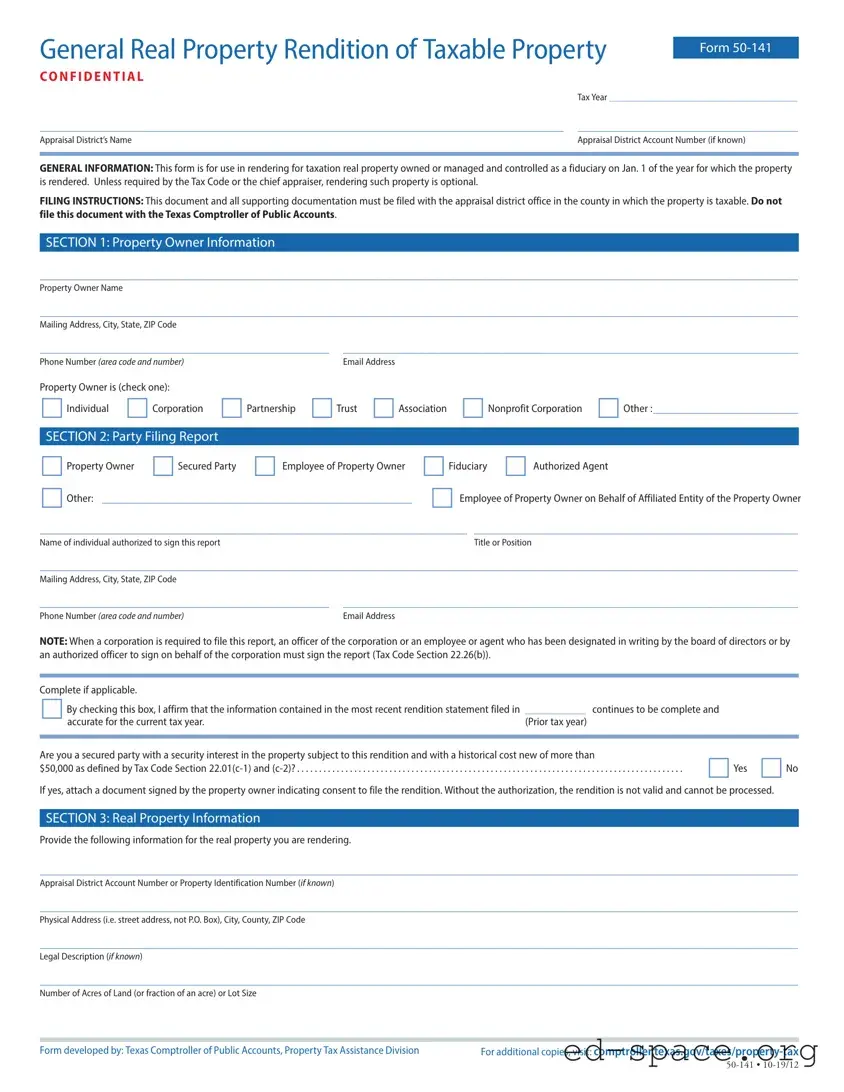
The Texas 50-141 form, officially known as the General Real Property Rendition of Taxable Property, plays a crucial role in the taxation process for real property owned or managed as a fiduciary. This form is designed for use by property owners, including individuals, corporations, and trusts, to report their real property holdings as of January 1 of the tax year. While filing this form is generally optional, it is essential for those who wish to ensure their property is accurately assessed for taxation. The form requires detailed information, including the property owner's name, contact details, and a description of the property being rendered. It also allows for the estimation of the property's market value, which can be beneficial for property owners to receive notifications if the appraised value exceeds their reported value. The completed form must be submitted to the local appraisal district office and not to the Texas Comptroller of Public Accounts. Additionally, the form emphasizes the importance of accuracy, as providing false information can lead to serious legal consequences. Understanding the filing instructions and deadlines is vital for compliance, as these can vary based on property type and regulatory requirements.


Document Preview

Form 50-141
General Real Property Rendition of Taxable Property
CONFIDENTIAL
Tax Year _______________________________________
____________________________________________________________________________ ________________________________
Appraisal District’s Name Appraisal District Account Number (if known)
GENERAL INFORMATION: This form is for use in rendering for taxation real property owned or managed and controlled as a fiduciary on Jan. 1 of the year for which the property
is rendered. Unless required by the Tax Code or the chief appraiser, rendering such property is optional.
FILING INSTRUCTIONS: This document and all supporting documentation must be filed with the appraisal district office in the county in which the property is taxable. Do not
file this document with the T
exas Comptroller of Public Accounts.
SECTION 1: Property Owner Information
______________________________________________________________________________________________________________
Property Owner Name
______________________________________________________________________________________________________________
Mailing Address, City, State, ZIP Code
__________________________________________
Phone Number
Property Owner is (check one):
__________________________________________________________________
_____________________
(area code and number) Email Address
Individual
Corporation
Partnership
Trust
Association
Nonprofit Corporation
Other :
SECTION 2: Party Filing Report
Property Owner
Other:
Secured Party
Employee of Property Owner
_____________________________________________
Fiduciary
Employee of Property Owner on Behalf of Affiliated Entity of the Property Owner
Authorized Agent
______________________________________________________________
Name of individual authorized to sign this report Title or Position
______________________________________________________________________________________________________________
Mailing Address, City, State, ZIP Code
_______________________________________________
__________________________________________
Phone Number
__________________________________________________________________
(area code and number) Email Address
NOTE: When a corporation is required to file this report, an officer of the corporation or an employee or agent who has been designated in writing by the board of directors or by
an authorized officer to sign on behalf of the corporation must sign the report (Tax Code Section 22.26(b)).
Complete if applicable.
By checking this box, I affirm that the information contained in the most recent rendition statement filed in ___________ continues to be complete and
accurate for the current tax year. (Prior tax year)
Are you a secured party with a security interest in the property subject to this rendition and with a historical cost new of more than
$50,000 as defined by Tax Code Section 22.01(c-1) and (c-2)?
........................................................................................
Yes
No
If yes, attach a document signed by the property owner indicating consent to file the rendition. Without the authorization, the rendition is not valid and cannot be processed.
SECTION 3: Real Property Information
Provide the following information for the real property you are rendering.
______________________________________________________________________________________________________________
Appraisal District Account Number or Property Identification Number (
______________________________________________________________________________________________________________
Physical Address (i.e. street address, not P.O. Box), City, County, ZIP Code
if known)
if known)
______________________________________________________________________________________________________________
Legal Description (
______________________________________________________________________________________________________________
Number of Acres of Land (or fraction of an acre) or Lot Size
Form developed by: Texas Comptroller of Public Accounts, Property Tax Assistance Division
For additional copies, visit:
comptroller.texas.gov/taxes/property-tax
50-141 • 10-19/12
General Real Property Rendition of Taxable Property Form 50-141
For additional copies, visit: comptroller.texas.gov/taxes/property-tax Page 2
SECTION 3: Real Property Information (continued)
List and describe all buildings and other improvements on the land:
$ _______________________________________
Property Owners Estimate of Total Market Value
for All the Property Described in this Rendition (Optional)**
** Although rendering a value is not required, such action entitles the property owner to be notified if an appraised value greater than the rendered value is to be submitted to the appraisal review board
(Tax Code Section 25.19).
SECTION 4: Armation and Signature
If you make a false statement on this form, you could be found guilty of a Class A misdemeanor or a state jail felony under Section 37.10, Penal Code.
I,
__________________________________________________________________________,
Printed Name of Authorized Individual
swear or affirm that the information provided in this report is true and accurate to the best of my knowledge and belief.
NOTE: If the person filing and signing this report is not the property owner, an employee of the property owner, an employee of a property owner signing on behalf of an
affiliated entity of the property owner or a secured party as defined by Tax Code Section 22.01, the signature below must be notarized.
____________________________________________________________
Signature of Authorized Individual Date
________________________________________
_________ Subscribed and sworn before me this day of ______________________________, 20_______.
_____________________________________ Notary Public, State of Texas
Important Information
GENERAL INFORMATION: This form is for use in rendering for taxation real property
owned or managed and controlled as a fiduciary on Jan. 1 of the year for which the
property is rendered. Unless required by the Tax Code or the chief appraiser, rendering
such property is optional. This report is confidential and not open to public inspection;
disclosure is permitted pursuant to the terms of Tax Code Section 22.27.
FILING INSTRUCTIONS: This document and all supporting documentation must be
filed with the appraisal district office in the county in which the property is taxable. Do
not file this document with the Texas Comptroller of Public Accounts. Contact
information for appraisal district offices may be found on the Comptroller’s website.
DEADLINES: Rendition statements and property report deadlines depend on property
type. The statements and reports must be delivered to the chief appraiser after Jan. 1
and no later than the deadlines indicated below.
Rendition Statements and Reports Deadlines Allowed Extension(s)
May 15 upon written
request
Property generally
April 15
Additional 15 days for good
cause shown
Property regulated by the
Public Utility Commission of
Texas, the Railroad Commission
of Texas, the federal Surface
Transportation Board or the
Federal Energy Regulatory
Commission. Tax Code 22.23(d).
May 15 upon written
request
April 30
Additional 15 days for good
cause shown

Form Specifications

Fact Name Fact Description
Purpose The Texas 50-141 form is used to render real property for taxation purposes, specifically for properties owned or managed as a fiduciary as of January 1 of the tax year.
Governing Law This form is governed by the Texas Tax Code, particularly Sections 22.01, 22.26, and 25.19.
Confidentiality The information provided on this form is confidential and not open to public inspection, as per Tax Code Section 22.27.
Filing Instructions Submit the completed form and supporting documents to the appraisal district office in the county where the property is taxable. Do not send it to the Texas Comptroller of Public Accounts.
Optional Rendering Rendering property for taxation is generally optional unless mandated by the Tax Code or the chief appraiser.
Deadline The form must be filed by May 15, with an extension of 15 days available upon written request for good cause shown.
Signature Requirement The form must be signed by an authorized individual, and if this individual is not the property owner, notarization is required.
Market Value Estimate Property owners may provide an estimate of the total market value of the property, although this is optional.
Secured Party Notification If a secured party has a security interest in the property, they must obtain the property owner's consent to file the rendition.
Contact Information Contact details for appraisal district offices can be found on the Texas Comptroller’s website for assistance with filing.

Texas 50 141: Usage Guidelines

Filling out the Texas 50-141 form is a straightforward process. This form is used to report real property for taxation purposes, and it requires specific information about the property and the owner. After completing the form, it must be submitted to the appropriate appraisal district office in your county.

  1. Enter the tax year at the top of the form.
  2. Fill in the appraisal district’s name and account number, if known.
  3. Provide the property owner’s name.
  4. Complete the mailing address, including city, state, and ZIP code.
  5. Include a phone number and email address for the property owner.
  6. Select the appropriate box to indicate the type of property owner (e.g., individual, corporation, partnership, etc.).
  7. Identify the party filing the report by checking the relevant box (e.g., property owner, fiduciary, authorized agent, etc.).
  8. Fill in the name and title of the individual authorized to sign the report.
  9. Complete the mailing address, city, state, and ZIP code for the authorized individual.
  10. Provide a phone number and email address for the authorized individual.
  11. If applicable, check the box to affirm that the most recent rendition statement is accurate.
  12. Indicate whether you are a secured party with a security interest in the property and provide the necessary documentation if applicable.
  13. Provide the appraisal district account number or property identification number, if known.
  14. Fill in the physical address of the property, including city, county, and ZIP code.
  15. Enter the legal description of the property, if known.
  16. Specify the number of acres of land or lot size.
  17. List and describe all buildings and other improvements on the land.
  18. Optionally, provide the property owner’s estimate of total market value for all property described in the rendition.
  19. The authorized individual must sign and date the form.
  20. If the signature is not from the property owner or authorized agent, it must be notarized.

Your Questions, Answered

What is the Texas Form 50-141?

The Texas Form 50-141, also known as the General Real Property Rendition of Taxable Property, is a document used to report real property owned or managed as a fiduciary for tax purposes. This form is specifically for properties that are under fiduciary control as of January 1 of the tax year. While filing this form is generally optional, it can be required by the Tax Code or the chief appraiser.

Who needs to file the Form 50-141?

Any individual or entity that owns or manages real property as a fiduciary may need to file this form. This includes individuals, corporations, partnerships, trusts, associations, and nonprofit corporations. If you are managing property on behalf of someone else, you may also be required to file this form.

Where do I file the Form 50-141?

You must file the Form 50-141 with the appraisal district office in the county where the property is located. It is important to note that this form should not be submitted to the Texas Comptroller of Public Accounts. For accurate filing, check the appraisal district's contact information on the Comptroller’s website.

What is the deadline for filing the Form 50-141?

The deadline for submitting the Form 50-141 depends on the type of property being reported. Generally, the form must be filed after January 1 and no later than April 15. However, there are extensions available under certain conditions, such as an additional 15 days upon written request. Specific deadlines may vary for properties regulated by certain commissions, so it’s best to verify based on your property type.

What information is required on the Form 50-141?

The form requires various pieces of information, including the property owner's name, mailing address, and contact details. You must also provide details about the property itself, such as its physical address, legal description, and an estimate of its total market value. Accurate and complete information is crucial for processing your rendition.

What happens if I don’t file the Form 50-141?

If you fail to file the Form 50-141, you may miss out on important notifications regarding the appraised value of your property. Additionally, non-filing could lead to penalties or issues with property tax assessments. It is advisable to file the form to ensure compliance and protect your interests.

Can I amend my Form 50-141 after filing?

Yes, you can amend your Form 50-141 if you discover errors or need to update information. It is essential to contact the appraisal district where you filed the original form to understand their specific procedures for submitting an amendment. Timeliness is key, so act quickly to correct any inaccuracies.

Is the information on Form 50-141 public?

The information provided on the Form 50-141 is confidential and not open to public inspection. Disclosure is only permitted under specific terms outlined in the Tax Code. This confidentiality helps protect sensitive information regarding property ownership and values.

What are the consequences of providing false information on the Form 50-141?

Providing false information on the Form 50-141 can lead to serious legal consequences. Under Texas law, making a false statement on this form may result in being charged with a Class A misdemeanor or a state jail felony. It is crucial to ensure that all information submitted is accurate and truthful.

What if I need assistance with the Form 50-141?

If you need help with the Form 50-141, consider reaching out to a tax professional or an attorney who specializes in property tax law. They can provide guidance on completing the form correctly and ensuring compliance with all relevant regulations. Additionally, the appraisal district may offer resources or assistance for filing the form.

Common mistakes

  1. Omitting Required Information: One common mistake is failing to provide all necessary details, such as the property owner’s name or the appraisal district account number. This omission can lead to processing delays.

  2. Incorrect Mailing Address: Providing an inaccurate mailing address can result in important documents not reaching the property owner. It is crucial to double-check the address for accuracy.

  3. Choosing the Wrong Filing Party: Selecting an incorrect option for the party filing the report can invalidate the submission. Ensure the correct category, such as “Property Owner” or “Authorized Agent,” is checked.

  4. Failure to Sign: Not signing the form is a frequent error. The report must be signed by an authorized individual, or it may not be accepted.

  5. Not Notarizing When Required: If the filer is not the property owner or an authorized employee, the signature must be notarized. Skipping this step can lead to rejection of the form.

  6. Ignoring Deadlines: Missing the submission deadline can have serious consequences. It is essential to be aware of the specific deadlines for filing the form to avoid penalties.

  7. Neglecting Supporting Documentation: Failing to attach required documents, such as consent from the property owner when applicable, can render the form invalid. Always include all necessary attachments.

Documents used along the form

When dealing with the Texas 50-141 form, several other documents may be necessary to ensure proper filing and compliance with tax regulations. Each document plays a specific role in the property tax process, helping property owners and fiduciaries accurately report and manage their real property. Below is a list of related forms and documents commonly used alongside the Texas 50-141 form.

  • Texas Property Tax Exemption Application (Form 50-129) - This form is used to apply for property tax exemptions, such as those for homestead, agricultural, or charitable purposes. It provides essential details about the property and the owner’s eligibility for exemption.
  • Property Tax Rendition (Form 50-144) - Similar to the 50-141, this form is specifically for reporting personal property. It helps ensure that personal property is accurately assessed for taxation.
  • Notice of Protest (Form 50-132) - If a property owner disagrees with the appraised value of their property, this form allows them to formally protest the assessment. It must be filed with the appraisal review board.
  • Appraisal Review Board (ARB) Hearing Request - This document is used to request a hearing before the ARB if a property owner wishes to contest their property’s appraisal. It outlines the reasons for the protest and seeks a resolution.
  • Texas Homestead Exemption Application (Form 50-114) - This form is specifically for homeowners seeking a homestead exemption on their primary residence. It reduces the taxable value of the home, resulting in lower property taxes.
  • Affidavit of Ownership - This document serves as proof of ownership for the property in question. It may be required when filing for exemptions or during disputes regarding property ownership.
  • Certificate of Formation - If the property is owned by a corporation or partnership, this document is necessary to establish the legal existence of the entity and may be required for tax filings.
  • Power of Attorney - This document allows one person to act on behalf of another in legal or financial matters, including property tax filings. It is particularly useful when a fiduciary is involved in the tax process.

Understanding these forms and documents can simplify the process of managing property taxes in Texas. Each plays a vital role in ensuring compliance and protecting the rights of property owners. Always consult with a tax professional or legal expert if there are questions about specific forms or filing requirements.

Similar forms

The Texas 50-141 form is used for rendering real property for taxation purposes. It has similarities with several other documents that serve related functions in property management and taxation. Below are four documents that share characteristics with the Texas 50-141 form:

  • Texas Property Tax Rendition Form (Form 50-114): This form is also used to report property for taxation. Like the 50-141, it requires details about the property owner and the property itself, ensuring that the appraisal district has the necessary information to assess property value accurately.
  • Property Tax Exemption Application (Form 50-129): This document is used to apply for exemptions on property taxes. Similar to the 50-141, it requires information about the property owner and the property. Both forms aim to provide the appraisal district with critical information for tax assessments.
  • Real Property Inventory Report (Form 50-126): This form serves to inventory real property owned by an entity. It shares the same goal of providing detailed information about the property, including its location and description, which is essential for accurate taxation and assessment.
  • Affidavit of Ownership (Form 50-100): This document is used to affirm ownership of a property. Similar to the 50-141, it requires the signature of the property owner or an authorized representative, ensuring that the appraisal district can verify ownership for taxation purposes.

Dos and Don'ts

When filling out the Texas 50-141 form, it is essential to approach the process with care. Below are five important dos and don'ts to consider.

  • Do provide accurate and complete information in all sections of the form.
  • Do ensure that the form is filed with the correct appraisal district office.
  • Do check the deadlines for submission to avoid penalties.
  • Do include all necessary supporting documentation when submitting the form.
  • Do keep a copy of the completed form for your records.
  • Don't file the form with the Texas Comptroller of Public Accounts.
  • Don't leave any required fields blank; incomplete forms may be rejected.
  • Don't forget to sign the form if you are the authorized individual.
  • Don't submit the form after the deadline unless you have received an extension.
  • Don't provide false information, as this can lead to legal consequences.

Misconceptions

Misconception 1: The Texas 50-141 form must be filed every year.

Many people believe that filing the Texas 50-141 form is mandatory each year. However, it is optional unless specifically required by the Tax Code or the chief appraiser. This means that if you are not obligated to file, you can choose not to do so.

Misconception 2: The form should be submitted to the Texas Comptroller of Public Accounts.

It is a common misunderstanding that the Texas 50-141 form should be sent to the Texas Comptroller. In reality, this form must be filed with the appraisal district office in the county where the property is located. Filing with the Comptroller is incorrect and could delay your submission.

Misconception 3: Anyone can sign the form on behalf of the property owner.

Some individuals think that any person can sign the Texas 50-141 form for the property owner. This is not true. Only specific individuals, such as an officer of the corporation or an authorized agent, can sign the form. If the signer is not one of these individuals, their signature must be notarized.

Misconception 4: Providing a property value on the form is required.

There is a belief that property owners must provide an estimate of the property's market value on the Texas 50-141 form. This is incorrect. While you can provide an estimate, it is optional. However, if you do render a value, you will receive notifications if the appraised value exceeds your rendered value.

Key takeaways

Filling out the Texas 50-141 form correctly is essential for property owners and fiduciaries. Here are some key takeaways to keep in mind:

  • Understand the Purpose: The Texas 50-141 form is used to report real property owned or managed as of January 1st for taxation purposes.
  • Filing is Optional: Unless required by the Tax Code or chief appraiser, submitting this form is not mandatory.
  • Where to File: Submit the completed form and any supporting documents to the local appraisal district office, not the Texas Comptroller.
  • Property Owner Information: Fill in accurate details about the property owner, including name, address, and contact information.
  • Filing Party: Indicate who is filing the report, whether it’s the property owner, an employee, or an authorized agent.
  • Market Value: While optional, providing an estimate of the total market value can be beneficial, as it allows for notification if the appraised value exceeds this estimate.
  • Signature Requirements: The form must be signed by an authorized individual, and notarization is required if the signer is not the property owner or their employee.
  • Deadlines Matter: Be aware of the filing deadlines, which vary based on property type. Generally, forms are due by April 15, with potential extensions available.

By following these guidelines, property owners can navigate the process smoothly and ensure compliance with Texas tax regulations.