Homepage Blank Texas 401 PDF Form
Content Overview

The Texas 401 form is a crucial document for any entity looking to update its registered agent or registered office in compliance with state regulations. This form ensures that changes are properly recorded with the Secretary of State, following the guidelines set forth in the Texas Business Organizations Code (BOC). It is essential for entities to understand that submitting this form is not just a procedural step; failure to maintain an accurate registered agent or office can lead to serious consequences, including termination of the entity’s registration. The form requires specific information, such as the legal name of the entity, the current registered agent, and the existing office address. Entities must also ensure that the new registered agent has consented to their appointment, a requirement that has been in effect since January 1, 2010. Additionally, the registered office must be a physical address where legal documents can be served, not just a mailbox or answering service. The Texas 401 form can also be part of broader amendments, but it is specifically designed for changes related solely to the registered agent and office. Timely submission of this form is critical to avoid penalties and maintain compliance with Texas law.


Document Preview

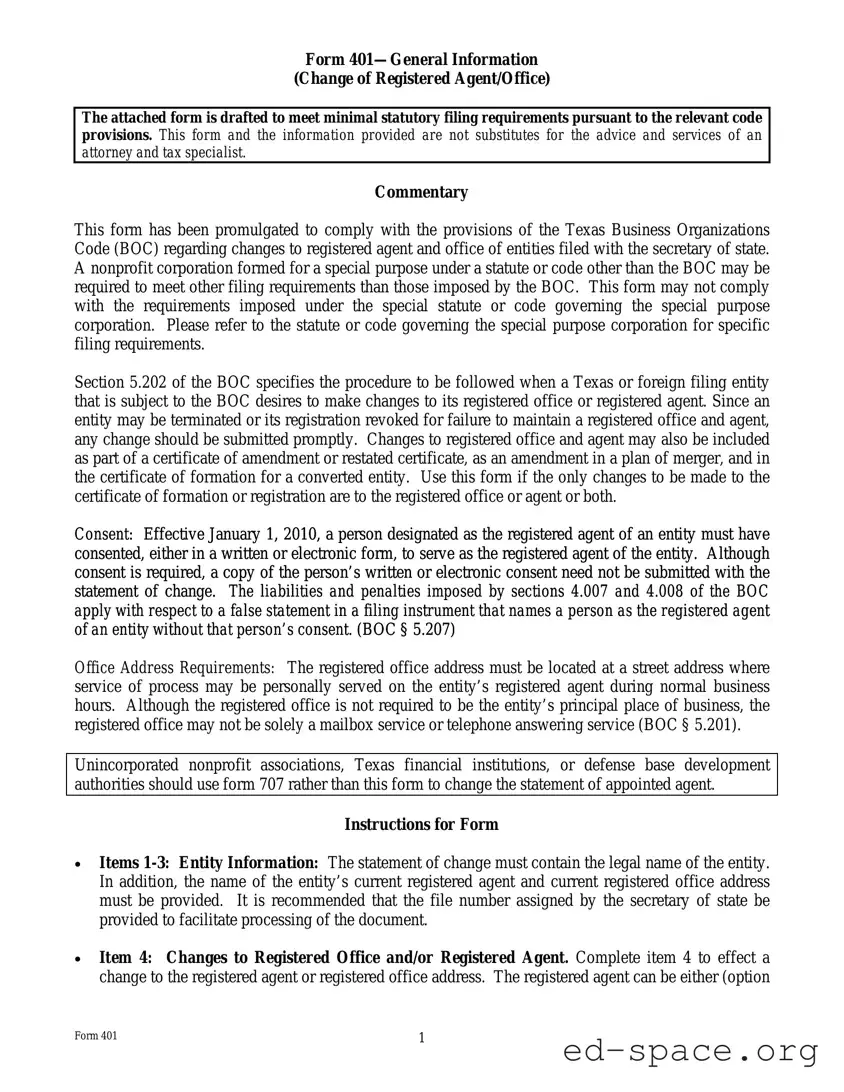
Consent: Effective January 1, 2010, a person designated as the registered agent of an entity must have
consented, either in a written or electronic form, to serve as the registered agent of the entity. Although
consent is required, a copy of the person’s written or electronic consent need not be submitted with the
statement of change. The liabilities and penalties imposed by sections 4.007 and 4.008 of the BOC
apply with respect to a false statement in a filing instrument that names a person as the registered agent
of an entity without that person’s consent. (BOC § 5.207)
Form 401
1
Form 401—General Information
(Change of Registered Agent/Office)
The attached form is drafted to meet minimal statutory filing requirements pursuant to the relevant code
provisions. This form and the information provided are not substitutes for the advice and services of an
attorney and tax specialist.
Commentary
This form has been promulgated to comply with the provisions of the Texas Business Organizations
Code (BOC) regarding changes to registered agent and office of entities filed with the secretary of state.
A nonprofit corporation formed for a special purpose under a statute or code other than the BOC may be
required to meet other filing requirements than those imposed by the BOC. This form may not comply
with the requirements imposed under the special statute or code governing the special purpose
corporation. Please refer to the statute or code governing the special purpose corporation for specific
filing requirements.
Section 5.202 of the BOC specifies the procedure to be followed when a Texas or foreign filing entity
that is subject to the BOC desires to make changes to its registered office or registered agent. Since an
entity may be terminated or its registration revoked for failure to maintain a registered office and agent,
any change should be submitted promptly. Changes to registered office and agent may also be included
as part of a certificate of amendment or restated certificate, as an amendment in a plan of merger, and in
the certificate of formation for a converted entity. Use this form if the only changes to be made to the
certificate of formation or registration are to the registered office or agent or both.
Consent: Effective January 1, 2010, a person designated as the registered agent of an entity must have
consented, either in a written or electronic form, to serve as the registered agent of the entity. Although
consent is required, a copy of the person’s written or electronic consent need not be submitted with the
statement of change. The liabilities and penalties imposed by sections 4.007 and 4.008 of the BOC
apply with respect to a false statement in a filing instrument that names a person as the registered agent
of an entity without that person’s consent. (BOC § 5.207)
Office Address Requirements: The registered office address must be located at a street address where
service of process may be personally served on the entity’s registered agent during normal business
hours. Although the registered office is not required to be the entity’s principal place of business, the
registered office may not be solely a mailbox service or telephone answering service (BOC § 5.201).
Unincorporated nonprofit associations, Texas financial institutions, or defense base development
authorities should use form 707 rather than this form to change the statement of appointed agent.
Instructions for Form
Items 1-3: Entity Information: The statement of change must contain the legal name of the entity.
In addition, the name of the entity’s current registered agent and current registered office address
must be provided. It is recommended that the file number assigned by the secretary of state be
provided to facilitate processing of the document.
Item 4: Changes to Registered Office and/or Registered Agent. Complete item 4 to effect a
change to the registered agent or registered office address. The registered agent can be either (option
Form 401
2
A) a domestic entity or a foreign entity that is registered to do business in Texas or (option B) an
individual resident of the state. The filing entity cannot act as its own registered agent.
If the registered office is changed, complete section C. The registered office must be located at a
street address where service of process may be personally served on the entity’s registered agent
during normal business hours. Although the registered office address is not required to be the
entity’s principal place of business, the registered office may not be solely a mailbox service or a
telephone answering service (BOC § 5.201).
The statement of change must recite that the street address of the registered office is the same as the
registered agent’s business address.
Statement of Approval: As required by section 5.202(b)(6) of the BOC, the form includes a
recitation that the change specified in the statement is authorized by the entity. While the statement
of change has the effect of amending the entity’s certificate of formation or registration, the BOC
does not provide that the procedures to amend the certificate of formation are applicable. In general,
the statement of change should be adopted and approved by the governing persons or by a person
authorized to act on behalf of the entity.
Effectiveness of Filing: A statement of change becomes effective when filed by the secretary of
state (option A). However, pursuant to sections 4.052 and 4.053 of the BOC the effectiveness of the
instrument may be delayed to a date not more than ninety (90) days from the date the instrument is
signed (option B). The effectiveness of the instrument also may be delayed on the occurrence of a
future event or fact, other than the passage of time (option C). If option C is selected, you must state
the manner in which the event or fact will cause the instrument to take effect and the date of the 90
th
day after the date the instrument is signed. In order for the instrument to take effect under option C,
the entity must, within ninety (90) days of the filing of the instrument, file a statement with the
secretary of state regarding the event or fact pursuant to section 4.055 of the BOC.
On the filing of a document with a delayed effective date or condition, the computer records of the
secretary of state will be changed to show the filing of the document, the date of the filing, and the
future date on which the document will be effective or evidence that the effectiveness was
conditioned on the occurrence of a future event or fact.
On acceptance of the statement of change by the secretary of state, the statement is effective as an
amendment to the appropriate provision of the entity’s certificate of formation or the foreign filing
entity’s registration.
Execution: Pursuant to section 4.001 of the BOC, the statement of change must be signed by a
person authorized by the BOC to act on behalf of the entity in regard to the filing instrument.
Generally, a governing person or managerial official of the entity signs a filing instrument.
The statement of change need not be notarized. However, before signing, please read the statements
on this form carefully. The designation or appointment of a person as the registered agent by a
managerial official is an affirmation by that official that the person named in the instrument has
consented to serve as registered agent. (BOC § 5.2011, effective January 1, 2010)
A person commits an offense under section 4.008 of the BOC if the person signs or directs the filing
of a filing instrument the person knows is materially false with the intent that the instrument be
delivered to the secretary of state for filing. The offense is a Class A misdemeanor unless the
person’s intent is to harm or defraud another, in which case the offense is a state jail felony.
Payment and Delivery Instructions: The filing fee for a change of registered office/agent is $15,
unless the filing entity is a nonprofit corporation or a cooperative association. The filing fee for a
nonprofit corporation or a cooperative association is $5. Fees may be paid by personal checks,
money orders, LegalEase debit cards, or American Express, Discover, MasterCard, and Visa credit
cards. Checks or money orders must be payable through a U.S. bank or financial institution and
made payable to the secretary of state. Fees paid by credit card are subject to a statutorily authorized
convenience fee of 2.7 percent of the total fees.
Submit the completed form in duplicate along with the filing fee. The form may be mailed to P.O.
Box 13697, Austin, Texas 78711-3697; faxed to (512) 463-5709; or delivered to the James Earl
Rudder Office Building, 1019 Brazos, Austin, Texas 78701. If a document is transmitted by fax,
credit card information must accompany the transmission (Form 807). On filing the document, the
secretary of state will return the appropriate evidence of filing to the submitter together with a file-
stamped copy of the document, if a duplicate copy was provided as instructed.
Revised 05/11
Form 401
3
This space reserved for office use.
Form 401
(Revised 05/11)
Submit in duplicate to:
Secretary of State
P.O. Box 13697
Austin, TX 78711-3697
Statement of Change of
Registered Office/Agent
512 463-5555
FAX: 512/463-5709
Filing Fee: See instructions
Entity Information
1. The name of the entity is:
State the name of the entity as currently shown in the records of the secretary of state.
2. The file number issued to the filing entity by the secretary of state is:
3. The name of the registered agent as currently shown on the records of the secretary of state is:
Registered Agent Name
The address of the registered office as currently shown on the records of the secretary of state is:
Street Address City State
TX
Zip Code
Change to Registered Agent/Registered Office
4. The certificate of formation or registration is modified to change the registered agent and/or office
of the filing entity as follows:
Registered Agent Change
(Complete either A or B, but not both. Also complete C if the address has changed.)
A. The new registered agent is an organization (cannot be entity named above) by the name of:
OR
B. The new registered agent is an individual resident of the state whose name is:
First Name M.I. Last Name Suffix
Registered Office Change
C. The business address of the registered agent and the registered office address is changed to:
Street Address (No P.O. Box) City State
TX
Zip Code
The street address of the registered office as stated in this instrument is the same as the registered
agent’s business address.
Form 401
4
Form 401
5
Statement of Approval
The change specified in this statement has been authorized by the entity in the manner required by the
BOC or in the manner required by the law governing the filing entity, as applicable.
Effectiveness of Filing (Select either A, B, or C.)
A. This document becomes effective when the document is filed by the secretary of state.
B. This document becomes effective at a later date, which is not more than ninety (90) days from
the date of signing. The delayed effective date is:
C. This document takes effect upon the occurrence of a future event or fact, other than the
th
passage of time. The 90 day after the date of signing is:
The following event or fact will cause the document to take effect in the manner described below:
Execution
The undersigned affirms that the person designated as registered agent has consented to the
appointment. The undersigned signs this document subject to the penalties imposed by law for the
submission of a materially false or fraudulent instrument and certifies under penalty of perjury that the
undersigned is authorized to execute the filing instrument.
Date:
Signature of authorized person
Printed or typed name of authorized person (see instructions)
Print
Reset

Form Specifications

Fact Name Description
Form Purpose The Texas 401 form is used to change the registered agent or office of a business entity.
Governing Law This form is governed by the Texas Business Organizations Code (BOC), specifically sections 5.201 to 5.207.
Filing Fee The filing fee is $15, except for nonprofit corporations or cooperative associations, which pay $5.
Consent Requirement As of January 1, 2010, the registered agent must consent to serve in that capacity, but proof of consent does not need to be submitted with the form.
Office Address Criteria The registered office must be a physical street address, not merely a mailbox or telephone answering service.
Effectiveness of Filing The change becomes effective upon filing by the Secretary of State, or it may be delayed up to 90 days if specified.
Execution The form must be signed by an authorized person, who affirms that the registered agent has consented to the appointment.
Submission Methods Completed forms can be mailed, faxed, or delivered in person to the Secretary of State's office.
Additional Filing Options Changes to the registered agent or office can also be included in a certificate of amendment or restated certificate.

Texas 401: Usage Guidelines

Filling out the Texas 401 form requires careful attention to detail. This form is essential for making changes to the registered agent or office of a business entity in Texas. To ensure a smooth process, follow the steps outlined below.

  1. Entity Information: Provide the legal name of the entity as it appears in the records of the Secretary of State.
  2. Enter the file number assigned to the entity by the Secretary of State. This number helps in processing your document efficiently.
  3. List the name of the current registered agent as it is recorded.
  4. Fill in the current registered office address, including the street address, city, state, and zip code.

Next, you'll need to indicate the changes you wish to make regarding the registered agent or office.

  1. Changes to Registered Agent and/or Registered Office: Complete this section to specify the changes. Choose either:
    • A. A new registered agent that is an organization (note: it cannot be the entity itself).
    • B. A new registered agent that is an individual resident of Texas.
  2. If changing the registered office address, provide the new street address, ensuring it is not a P.O. Box. This address must be where service of process can be delivered during normal business hours.

After detailing the changes, you need to affirm that these changes have been authorized.

  1. Statement of Approval: Confirm that the changes have been approved by the entity in accordance with Texas law.
  2. Effectiveness of Filing: Choose how you want the changes to take effect. Options include:
    • A. Effective upon filing.
    • B. Effective at a later date (not more than 90 days from signing).
    • C. Effective upon the occurrence of a future event.
  3. For options B and C, provide the necessary details regarding the future effective date or event.

Finally, ensure that the form is properly executed.

  1. Execution: The form must be signed by an authorized person. This signature affirms that the registered agent has consented to serve.
  2. Include the date of signing and print or type the name of the authorized person.

Once completed, submit the form along with the required filing fee to the Secretary of State. Be sure to keep a copy for your records.

Your Questions, Answered

What is the Texas 401 form used for?

The Texas 401 form is used to change the registered agent or registered office of a business entity in Texas. This form is required to comply with the Texas Business Organizations Code when an entity needs to update its registered agent or office address. It is crucial for maintaining good standing with the state.

Who needs to file the Texas 401 form?

Any Texas or foreign business entity that wishes to change its registered agent or registered office must file the Texas 401 form. This includes corporations, limited liability companies, and partnerships. Nonprofit organizations and specific associations may have different requirements.

What information is required on the Texas 401 form?

The form requires the legal name of the entity, the current registered agent's name, the current registered office address, and details of the new registered agent or office address. It is also recommended to include the entity's file number assigned by the Secretary of State for easier processing.

Can a business act as its own registered agent?

No, a business entity cannot serve as its own registered agent. The registered agent must be either an individual resident of Texas or a business entity that is authorized to do business in Texas.

What are the consent requirements for a registered agent?

As of January 1, 2010, the designated registered agent must provide consent to serve in that role. This consent can be in written or electronic form, but it does not need to be submitted with the Texas 401 form. However, it is essential to ensure that the agent has indeed consented.

What are the payment options for filing the Texas 401 form?

The filing fee for the Texas 401 form is $15 for most entities. Nonprofit corporations and cooperative associations pay a reduced fee of $5. Payments can be made via personal checks, money orders, or credit cards, with a small convenience fee applied for credit card transactions.

How should the Texas 401 form be submitted?

The completed Texas 401 form should be submitted in duplicate along with the filing fee. It can be mailed to the Secretary of State, faxed, or delivered in person to the appropriate office in Austin, Texas. If faxing, include credit card information for payment.

When does the change become effective?

The change becomes effective when the Texas Secretary of State files the document. However, entities can request a delayed effective date or condition the effectiveness on a future event, as long as it is specified in the form.

What happens if the form is not filed promptly?

If a business fails to maintain a registered agent or office, it risks termination or revocation of its registration. Therefore, it is crucial to submit the Texas 401 form promptly whenever changes are necessary.

Common mistakes

  1. Missing Required Information: One common mistake is not providing all the necessary details. Ensure that the entity's legal name, current registered agent, and registered office address are included. Omitting any of this information can delay processing.

  2. Incorrect Registered Office Address: The registered office must be a physical street address. Using a P.O. Box or a mailbox service is not allowed. If the address does not meet this requirement, the form will be rejected.

  3. Failure to Obtain Consent: The registered agent must have consented to serve in this role. While you don’t need to submit proof of consent, failing to obtain it can lead to penalties. Always confirm that the agent is on board.

  4. Not Following Submission Guidelines: It’s crucial to submit the form correctly. This includes sending it in duplicate and including the appropriate filing fee. If these steps are overlooked, it can result in delays or rejections.

Documents used along the form

When dealing with changes to a registered agent or office in Texas, the Texas 401 form is just one part of the process. There are several other forms and documents that may be required or beneficial to complete the necessary filings. Understanding these documents can help ensure that all requirements are met efficiently.

  • Form 707: This form is specifically designed for unincorporated nonprofit associations, Texas financial institutions, or defense base development authorities. It serves to change the statement of appointed agent for these entities, which have different requirements than those under the Texas Business Organizations Code.
  • Certificate of Amendment: If an entity is making multiple changes, including changes to its registered agent or office, it may opt to file a certificate of amendment. This document allows for broader changes to the entity's formation documents.
  • Restated Certificate of Formation: This document consolidates all amendments made to an entity’s formation documents into a single document. It is particularly useful for entities that have undergone several changes over time, including changes to their registered agent or office.
  • Plan of Merger: If an entity is merging with another, this plan outlines the terms of the merger and may include changes to the registered agent and office. It is essential to ensure that all parties involved are aware of these changes.
  • Statement of Consent: Although not required to be submitted with the Texas 401 form, having a written or electronic consent from the new registered agent is crucial. This document confirms that the designated agent agrees to serve in that capacity.
  • Application for Certificate of Authority: For foreign entities wishing to operate in Texas, this application must be filed. It includes information about the registered agent and office in Texas, ensuring compliance with state regulations.
  • Annual Franchise Tax Report: This report is required for all entities operating in Texas. It includes details about the registered agent and office, and it is essential to keep this information current to avoid penalties.
  • Bylaws or Operating Agreement: While not a filing document, these internal documents often outline procedures for appointing or changing a registered agent. They can provide guidance on how to handle such changes within the entity.
  • Certificate of Formation: This foundational document is filed when an entity is created. If any changes to the registered agent or office occur, the information in this certificate must be updated accordingly.

Being aware of these additional forms and documents can significantly streamline the process of updating your registered agent or office in Texas. Each document serves a specific purpose and ensures compliance with state laws. It is advisable to consult with a legal professional to confirm that all necessary paperwork is completed accurately and submitted promptly.

Similar forms

The Texas 401 form is a specific document used to change the registered agent or office of a business entity. Several other documents serve similar purposes in different contexts. Here’s a list of nine documents that share similarities with the Texas 401 form:

  • Articles of Incorporation: This document establishes a corporation's existence and includes information about the registered agent and office. Like the Texas 401 form, it requires accurate details to ensure compliance with state law.
  • Certificate of Amendment: When a business needs to change its name or other key details, this document is filed. It can also include changes to the registered agent, similar to the Texas 401 form.
  • Statement of Change of Registered Agent: This document specifically addresses the change of a registered agent. It is very similar in purpose to the Texas 401 form, focusing solely on the agent's information.
  • Certificate of Formation: This foundational document is filed when a new entity is created. It includes the initial registered agent and office details, paralleling the information required in the Texas 401 form.
  • Foreign Qualification Application: When a business from another state wishes to operate in Texas, it files this document. It also includes the designation of a registered agent in Texas, similar to the Texas 401 form.
  • Annual Report: Many states require businesses to file annual reports that often include updates on the registered agent and office. This is akin to the updates provided in the Texas 401 form.
  • Bylaws: While primarily governing the internal operations of a corporation, bylaws may specify the registered agent and office. Changes in these details can be documented similarly to the Texas 401 form.
  • Certificate of Merger: When two entities merge, this document is filed and may include changes to the registered agent. It shares the purpose of updating entity information like the Texas 401 form.
  • Nonprofit Corporation Application: For nonprofits, this document establishes the organization and includes the registered agent information. It serves a similar function to the Texas 401 form in that context.

Dos and Don'ts

When filling out the Texas 401 form, it is essential to approach the task with careful attention to detail. The following list outlines ten important dos and don’ts to keep in mind during this process.

  • Do ensure that the legal name of the entity is accurately provided in the designated field.
  • Do include the current registered agent’s name as it appears in the records of the secretary of state.
  • Do provide the current registered office address, ensuring it is a physical street address, not a P.O. Box.
  • Do confirm that the registered agent has consented to serve in that capacity, even though written consent does not need to be submitted.
  • Do submit the form promptly after any changes to avoid potential penalties for failing to maintain a registered office and agent.
  • Don’t attempt to act as your own registered agent; the filing entity cannot serve in this role.
  • Don’t provide a registered office address that is solely a mailbox service or telephone answering service.
  • Don’t forget to check the filing fee requirements, as they differ for nonprofit corporations and cooperative associations.
  • Don’t leave any sections of the form incomplete; ensure all required fields are filled out accurately.
  • Don’t neglect to include the entity’s file number, as this can facilitate the processing of your document.

By adhering to these guidelines, individuals can navigate the complexities of the Texas 401 form with greater ease, ensuring compliance with state requirements while minimizing the risk of errors.

Misconceptions

Understanding the Texas 401 form can be challenging, and there are several misconceptions that may lead to confusion. Here are six common misunderstandings about this form, along with clarifications to help you navigate the process more easily.

  • The Texas 401 form is only for corporations. Many believe that this form is exclusively for corporations, but it is applicable to any entity registered in Texas that needs to change its registered agent or office, including limited liability companies and partnerships.
  • You don’t need consent from the registered agent. Some people think that a registered agent can be named without their consent. In reality, the individual or entity must consent to serve as the registered agent, although you do not need to submit proof of this consent with the form.
  • A P.O. Box is acceptable for the registered office address. There is a misconception that a P.O. Box can be used as the registered office address. However, the registered office must be a physical street address where the registered agent can be served during business hours.
  • Filing the form is optional. Some may think that submitting the Texas 401 form is optional if changes are made to the registered agent or office. This is not true; timely filing is crucial to avoid penalties or even the revocation of the entity's registration.
  • The filing fee is the same for all entities. There is a belief that all entities pay the same filing fee for submitting the Texas 401 form. In fact, the fee differs: it is $15 for most entities, but only $5 for nonprofit corporations and cooperative associations.
  • Changes take effect immediately upon filing. Many assume that once the form is submitted, the changes are effective right away. However, changes can be set to take effect immediately, at a later date, or upon the occurrence of a specific event, as indicated on the form.

By understanding these misconceptions, you can ensure that you correctly navigate the requirements of the Texas 401 form and maintain compliance with state regulations.

Key takeaways

Here are key takeaways regarding the Texas 401 form for changing a registered agent or office:

  • Purpose: The Texas 401 form is used to officially change the registered agent or registered office of a business entity.
  • Legal Compliance: This form complies with the Texas Business Organizations Code (BOC) but may not meet requirements for special purpose corporations.
  • Timeliness: Submit changes promptly to avoid termination or revocation of your entity’s registration.
  • Consent Requirement: The registered agent must consent to their appointment, but this consent does not need to be submitted with the form.
  • Office Address: The registered office must be a physical street address and cannot be a mailbox or answering service.
  • Filing Fee: The fee for filing is typically $15, but it is reduced to $5 for nonprofit corporations or cooperative associations.
  • Effective Date: The change takes effect upon filing, but you can specify a delayed effective date or a future event that triggers the change.
  • Signature Requirement: The form must be signed by someone authorized to act on behalf of the entity, and notarization is not necessary.

Carefully follow the instructions to ensure a smooth process. Always consider consulting a legal professional for personalized guidance.