Homepage Blank Texas 3599 PDF Form
Content Overview

The Texas 3599 form plays a vital role in ensuring that individuals receiving habilitation services are well-supported and cared for. This form is used primarily by habilitation service providers to document their interactions and supervisory visits with clients. It captures essential information, such as the individual's name, health conditions, and specific tasks that need to be performed. The form also outlines the frequency of visits and includes sections for reporting any health and safety concerns. During these visits, providers assess the individual's satisfaction with the services and whether the provider is competent in delivering the necessary care. Additionally, it addresses any training needs for the provider and corrective actions that may be required. By documenting these details, the Texas 3599 form helps ensure that individuals receive consistent and effective support tailored to their unique needs.

Document Preview

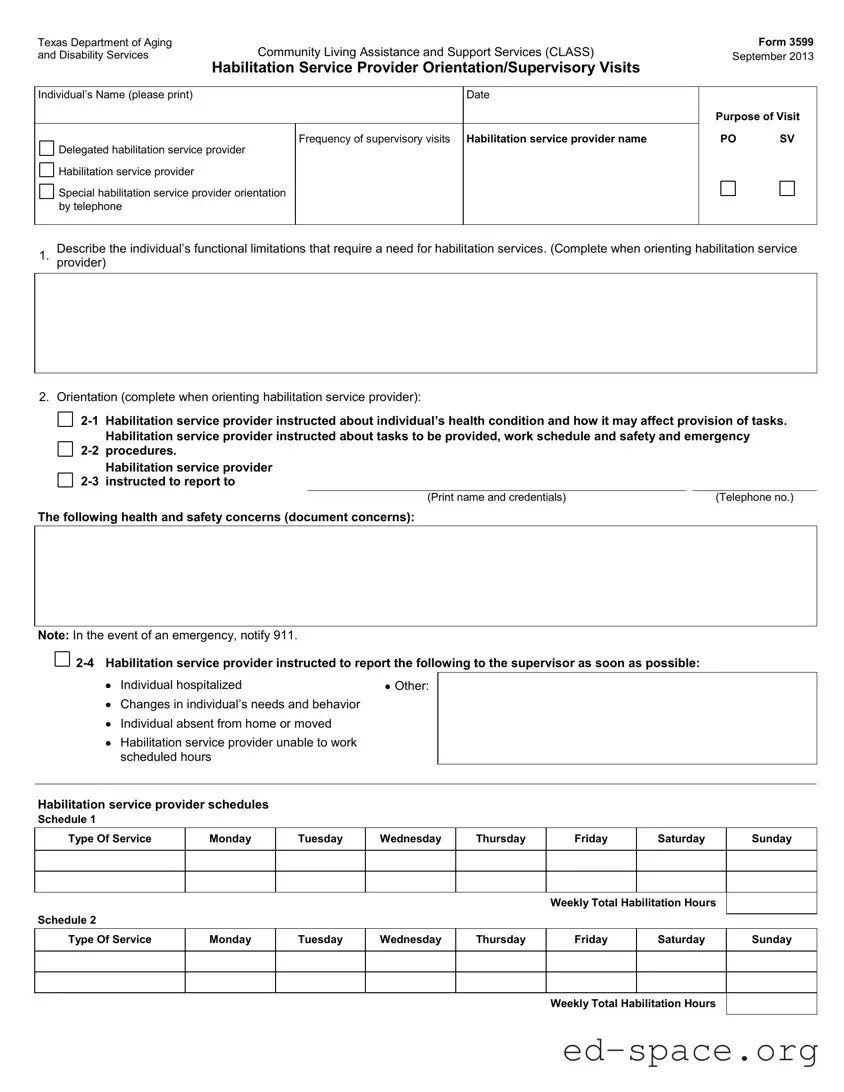
Texas Department of Aging
and Disability Services
Community Living Assistance and Support Services (CLASS)
Habilitation Service Provider Orientation/Supervisory Visits
Form 3599
September 2013
Individual’s Name (please print)
Date
Purpose of Visit
Delegated habilitation service provider
Habilitation service provider
Special habilitation service provider orientation
by telephone
Frequency of supervisory visits
Habilitation service provider name
SV
1.
Describe the individual’s functional limitations that require a need for habilitation services. (Complete when orienting habilitation service
provider)
2.
Orientation (complete when orienting habilitation service provider):
2-1
Habilitation service provider instructed about individual’s health condition and how it may affect provision of tasks.
2-2
Habilitation service provider instructed about tasks to be provided, work schedule and safety and emergency
procedures.
2-3
Habilitation service provider
instructed to report to
(Print name and credentials)
(Telephone no.)
The following health and safety concerns (document concerns):
Note: In the event of an emergency, notify 911.
2-4
Habilitation service provider instructed to report the following to the supervisor as soon as possible:
Individual hospitalized
Changes in individual’s needs and behavior
Individual absent from home or moved
Habilitation service provider unable to work
scheduled hours
Other:
Habilitation service provider schedules
Schedule 1
Type Of Service
Monday
Tuesday
Wednesday
Thursday
Friday
Saturday
Sunday
Weekly Total Habilitation Hours
Schedule 2
Type Of Service
Monday
Tuesday
Wednesday
Thursday
Friday
Saturday
Sunday
Weekly Total Habilitation Hours
Form 3599
Page 2 / 09-2013
Individual’s Name (please print)
3.A.
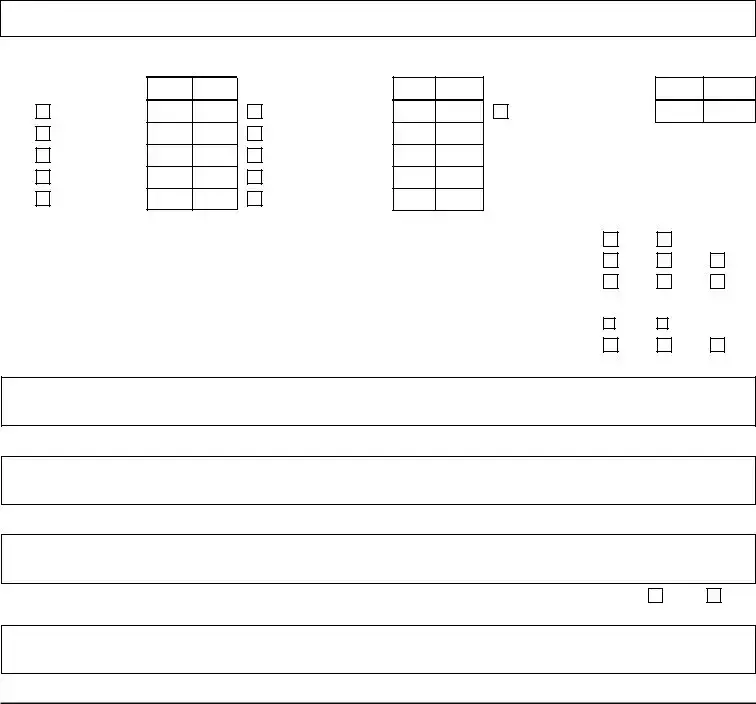
Tasks/Plan of Care: Indicate tasks to be performed (complete on every visit). During supervisory visit, ask individual or LAR what tasks
are provided by the service provider. Observe or ask about performance: S = Satisfactory U = Unsatisfactory
Freq.
Perform.
Freq.
Perform.
Freq.
Perform.
Hygiene ..............
Feeding ..........................
Medically Related Tasks ......
Toileting .............
Exercise .........................
Dressing.............
Transfer/Ambulation ......
Shopping ...........
Cleaning .........................
Meal Preparation
Community Assistance
3.B.
Is the habilitation service provider competent to provide habilitation tasks? ..................................................
Yes
No
3.C.
Is the habilitation service provider competent to provide delegated habilitation tasks? .................................
Yes
No
N/A
3.D.
Is the habilitation service provider competent to provide medically related tasks? ........................................
Yes
No
N/A
Complete the following for Supervisory Visits (N/A for habilitation service provider orientation only).
4.
Is the individual satisfied with the services provided by the habilitation service provider? .............................
Yes
No
5.
Is the habilitation service provider following the schedule?............................................................................
Yes
No
N/A
6.A.
Describe service delivery problems.
6.B.
Describe habilitation service provider training needs.
6.C.
Describe corrective actions taken.
7.
Does the individual continue to need services? ...........................................................................................................
Yes
No
8.
Additional Comments:
Signature Individual/LAR
Date
Signature Habilitation Service Provider
Date
Signature Supervisor
Date

Form Specifications

Fact Name Details
Form Title Texas Department of Aging Community Living Assistance and Support Services (CLASS) and Disability Services Habilitation Service Provider Orientation/Supervisory Visits
Form Number 3599
Governing Law Texas Health and Safety Code, Chapter 533
Purpose of the Form To document the orientation and supervisory visits of habilitation service providers for individuals receiving services.
Frequency of Visits Supervisory visits are to be scheduled regularly, as indicated in the form.
Health and Safety Concerns Providers must document any health and safety concerns that arise during visits.
Competency Assessment The form assesses whether the habilitation service provider is competent in providing various tasks, including medically related tasks.
Individual Satisfaction The individual receiving services can express satisfaction or dissatisfaction with the services provided.
Signature Requirement Signatures from the individual or their legally authorized representative, the habilitation service provider, and the supervisor are required.
Last Revision Date September 2013

Texas 3599: Usage Guidelines

Filling out the Texas 3599 form is an important step in documenting the orientation and supervisory visits related to habilitation services. This process ensures that the necessary information is captured accurately, allowing for effective support for individuals in need. Follow these steps carefully to complete the form.

  1. Individual’s Information: At the top of the form, print the individual’s name and the date of the visit.
  2. Frequency of Visits: Indicate how often the supervisory visits will occur.
  3. Provider Information: Fill in the name of the habilitation service provider and the delegated habilitation service provider.
  4. Orientation Details: Check the box for "Special habilitation service provider orientation by telephone" if applicable.
  5. Functional Limitations: Describe the individual’s functional limitations that require habilitation services.
  6. Provider Instructions: Complete the section on provider instructions, ensuring to note health conditions and tasks to be provided.
  7. Health and Safety Concerns: Document any health and safety concerns that need to be communicated.
  8. Reporting Instructions: List what the habilitation service provider should report to the supervisor.
  9. Service Schedule: Fill out Schedule 1 and Schedule 2 with the type of service and the total habilitation hours for each day of the week.
  10. Tasks/Plan of Care: Indicate the tasks performed during the visit and evaluate their performance as satisfactory or unsatisfactory.
  11. Competency Assessment: Answer the questions regarding the habilitation service provider's competency in providing habilitation and medically related tasks.
  12. Service Satisfaction: Note if the individual is satisfied with the services provided and if the provider is following the schedule.
  13. Service Delivery Issues: Describe any service delivery problems and the training needs of the habilitation service provider.
  14. Corrective Actions: Document any corrective actions that have been taken.
  15. Need for Services: Indicate if the individual continues to need services.
  16. Additional Comments: Provide any further comments that may be relevant.
  17. Signatures: Ensure that the individual or their legally authorized representative (LAR), the habilitation service provider, and the supervisor sign and date the form.

Your Questions, Answered

What is the purpose of the Texas 3599 form?

The Texas 3599 form is used for documenting supervisory visits and orientations for habilitation service providers. It helps ensure that providers are properly informed about the individual’s health conditions, needs, and the tasks they are expected to perform. This form is crucial for maintaining quality care and support for individuals receiving habilitation services.

Who should fill out the Texas 3599 form?

The form should be completed by the habilitation service provider during supervisory visits. It may also involve input from the individual receiving services or their legally authorized representative (LAR). Accurate information is essential for assessing the effectiveness of the services provided and ensuring the individual’s needs are met.

What information is required on the Texas 3599 form?

Key information includes the individual's name, date of the visit, frequency of visits, and details about the habilitation service provider. The form also requires documentation of the individual’s functional limitations, health concerns, and any changes in needs or behavior. Additionally, it captures the tasks performed by the provider and the individual’s satisfaction with the services.

How often should the Texas 3599 form be completed?

The Texas 3599 form should be completed during each supervisory visit. The frequency of these visits may vary based on individual needs and the service provider's schedule. Regular documentation helps track progress and ensures that the care provided remains appropriate and effective.

What should be done if there are issues with service delivery?

If there are any service delivery problems, they must be documented on the Texas 3599 form. This includes describing the issues and identifying any training needs for the habilitation service provider. Corrective actions should also be noted to ensure that necessary improvements are made to enhance the quality of care.

What happens after the Texas 3599 form is completed?

Once the Texas 3599 form is completed, it should be signed by the individual or their LAR, the habilitation service provider, and the supervisor. This signature process confirms that all parties are aware of the information documented. The completed form is then kept on file for future reference and review, ensuring continuity of care.

Common mistakes

  1. Failing to print the individual's name clearly. Legibility is crucial for accurate identification.

  2. Not specifying the date of the visit. This information is essential for record-keeping.

  3. Overlooking the frequency of supervisory visits. This detail helps track the service schedule.

  4. Neglecting to describe the individual's functional limitations. This section is vital for understanding service needs.

  5. Inadequately documenting health and safety concerns. All relevant issues must be recorded for safety compliance.

  6. Failing to report changes in the individual's needs or behavior promptly. Timely updates are necessary for appropriate care.

  7. Not completing the tasks/plan of care section during each visit. This ensures consistent monitoring of services provided.

  8. Inaccurately assessing the habilitation service provider's competencies. Competence evaluations must be thorough and honest.

  9. Forgetting to include the signatures of all required parties. Signatures validate the completion of the form.

  10. Leaving out additional comments that could provide context or clarification. These remarks can be important for future reference.

Documents used along the form

The Texas 3599 form is a key document used in the provision of habilitation services. It serves as a record for supervisory visits and provider orientation, detailing the needs and functional limitations of individuals receiving support. Several other forms and documents are often utilized alongside the Texas 3599 to ensure comprehensive care and compliance with regulations. Below is a list of these related documents.

  • Texas 3617 Form: This form is used to document the assessment of an individual’s needs and eligibility for services under the CLASS program. It includes detailed information about the individual's health conditions and functional abilities.
  • Texas 3600 Form: This document is a service plan that outlines the specific habilitation services to be provided, including goals, timelines, and responsibilities of the service provider.
  • Texas 3601 Form: This form is utilized for tracking the progress of the individual’s habilitation goals. It includes measurable outcomes and adjustments to the service plan as necessary.
  • Texas 3602 Form: This is a reporting form for any incidents or accidents that occur during the provision of services. It ensures that safety protocols are followed and that necessary actions are taken.
  • Individualized Service Plan (ISP): The ISP outlines the unique needs and preferences of the individual, detailing how services will be tailored to meet those needs.
  • Provider Training Documentation: This document records the training received by habilitation service providers, ensuring they are equipped to deliver appropriate care and support.
  • Emergency Contact Information: This form contains critical information about emergency contacts for the individual, including family members, healthcare providers, and other relevant parties.

These documents collectively enhance the quality of care provided to individuals in need of habilitation services. They ensure that all parties involved are informed and that the services delivered align with the individual’s specific requirements and preferences.

Similar forms

The Texas 3599 form serves as a vital document in the context of habilitation services. Several other forms share similarities with it, particularly in purpose and structure. Below is a list of eight documents that are comparable to the Texas 3599 form, along with a brief description of how each relates.

  • Texas Form 3600: This form is used for documenting individual service plans. Like the Texas 3599, it outlines the needs of the individual and the services to be provided, ensuring that the care is tailored to the person's specific circumstances.
  • Texas Form 3610: This document focuses on service provider qualifications. It parallels the Texas 3599 in that it assesses the competency of the service provider, ensuring they are equipped to deliver the necessary support.
  • Texas Form 3620: Similar to the Texas 3599, this form is used for recording progress notes. It tracks the effectiveness of the services provided and the individual's response, helping to adjust care plans as needed.
  • Texas Form 3630: This form is designed for incident reporting. Like the Texas 3599, it emphasizes the importance of communication about health and safety concerns, ensuring that any issues are promptly addressed.
  • Texas Form 3640: Used for client satisfaction surveys, this document shares a similar goal of evaluating the quality of services provided. It collects feedback from individuals to improve service delivery, akin to the satisfaction questions in the Texas 3599.
  • Texas Form 3650: This form is intended for training needs assessments. It aligns with the Texas 3599 by identifying areas where service providers may require additional training to meet the needs of individuals effectively.
  • Texas Form 3660: Similar to the Texas 3599, this document is used for monitoring compliance with service delivery standards. It ensures that providers adhere to established protocols, promoting accountability and quality of care.
  • Texas Form 3670: This form is related to discharge planning. Like the Texas 3599, it considers the ongoing needs of the individual and outlines steps for transitioning out of services, ensuring continuity of care.

Dos and Don'ts

Filling out the Texas 3599 form is an important task that requires careful attention to detail. Here are some key dos and don'ts to keep in mind while completing this form.

  • Do ensure that all information is printed clearly and legibly.
  • Do provide accurate descriptions of the individual's functional limitations.
  • Do confirm that the habilitation service provider is instructed about the individual's health conditions.
  • Do document any health and safety concerns thoroughly.
  • Don't leave any sections of the form blank; every part is important.
  • Don't use abbreviations or shorthand that may confuse the reader.
  • Don't forget to check for any updates or changes in the individual's needs before submitting the form.
  • Don't submit the form without obtaining all necessary signatures.

By following these guidelines, you can help ensure that the Texas 3599 form is completed accurately and effectively, facilitating better support for individuals in need of habilitation services.

Misconceptions

Understanding the Texas 3599 form is crucial for anyone involved in the habilitation services process. However, several misconceptions surround this form. Here’s a breakdown of nine common misunderstandings:

  • It’s only for new service providers. Many believe the Texas 3599 form is only necessary for new habilitation service providers. In reality, it’s also used for ongoing supervision and evaluation of existing providers.
  • All information is optional. Some think that they can skip sections of the form. However, certain parts are mandatory to ensure proper documentation and compliance with regulations.
  • It doesn’t require the individual’s input. A common belief is that the individual receiving services doesn’t need to be involved. In fact, their feedback is essential for assessing satisfaction and service effectiveness.
  • Only health-related tasks are covered. Many assume the form is limited to medical tasks. It actually encompasses a wide range of habilitation services, including daily living activities and community assistance.
  • It’s only for emergencies. Some people think the Texas 3599 form is only relevant during emergencies. In truth, it is a routine part of service provider orientation and supervision.
  • Supervisory visits are infrequent. There’s a misconception that supervisory visits happen rarely. In fact, regular visits are essential for monitoring service quality and provider performance.
  • Competency checks are unnecessary. Some believe that once a provider is trained, competency checks are not needed. However, ongoing evaluations are critical to ensure that providers meet the necessary standards.
  • The form is only for administrative purposes. Many think the Texas 3599 form is just a bureaucratic requirement. In reality, it plays a vital role in enhancing the quality of care and support provided to individuals.
  • It can be completed in any format. Some believe they can submit the form in any format they choose. However, it must be completed as specified to ensure it meets regulatory standards.

By clarifying these misconceptions, individuals and service providers can better navigate the requirements and ensure effective support for those in need of habilitation services.

Key takeaways

The Texas 3599 form is an essential document used in the context of habilitation services. Understanding how to fill it out and utilize it effectively can significantly impact the quality of care provided to individuals. Here are some key takeaways regarding the Texas 3599 form:

  • Purpose of the Form: The Texas 3599 form serves to document supervisory visits and orientations for habilitation service providers. It helps ensure that individuals receive appropriate support tailored to their needs.
  • Detailed Information Required: When filling out the form, it is crucial to provide comprehensive details about the individual’s functional limitations, health conditions, and specific tasks that need to be performed. This information is vital for the habilitation service provider to understand the individual's needs fully.
  • Regular Updates: The form requires regular updates on the individual's status, including any changes in behavior or needs. This ensures that the service provider can adapt their care approach accordingly.
  • Competency Assessment: The form includes sections to assess whether the habilitation service provider is competent in performing specific tasks. This evaluation is essential for maintaining a high standard of care.
  • Feedback Mechanism: The Texas 3599 form allows for feedback from the individual or their legally authorized representative (LAR) regarding their satisfaction with the services provided. This feedback is important for continuous improvement in service delivery.

By keeping these key points in mind, individuals and service providers can work together more effectively to enhance the quality of habilitation services. Properly utilizing the Texas 3599 form fosters better communication and ensures that all parties are aligned in their efforts to support the individual's needs.