Homepage Blank Texas 33 06 PDF Form
Content Overview

The Texas 33 06 form serves as a crucial tool for homeowners aged 65 and over or those with disabilities, allowing them to defer the payment of delinquent property taxes on their homesteads. By submitting this tax deferral affidavit to the Harris County Appraisal District, eligible individuals can postpone tax payments while they continue to own and reside in their homes. It is important to note that this deferral does not eliminate tax liabilities; instead, it merely delays them, with interest accruing at an annual rate of 8%. Should homeowners choose to sell their property or cease to occupy it, all deferred taxes, along with any penalties and interest, become payable within 180 days. The form also requires the homeowner’s personal information, including proof of age, and emphasizes the confidentiality of this data as mandated by Texas law. Additionally, the affidavit can be used to halt any pending tax sales, provided it is delivered to the appropriate authorities in a timely manner. Understanding the nuances of this form is essential for eligible homeowners looking to manage their property tax obligations effectively.
Document Preview

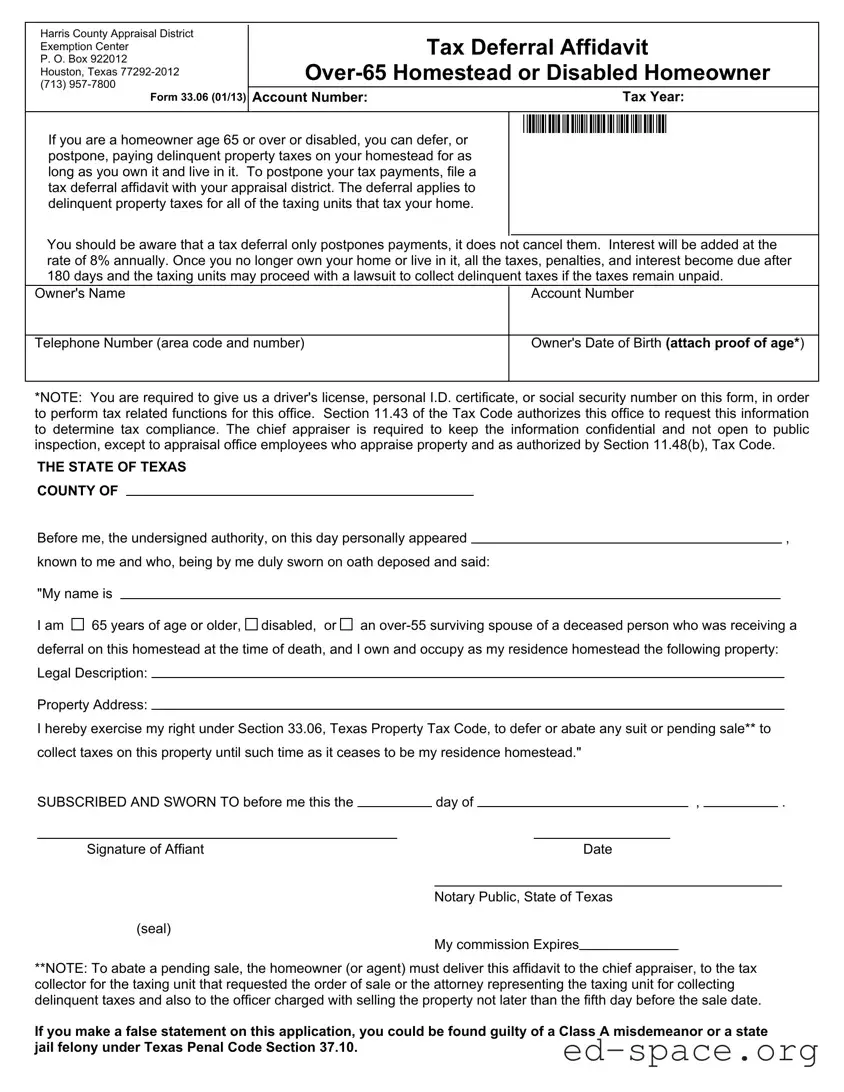
*NEWHS124*
Harris County Appraisal District
Exemption Center
P. O. Box 922012
Houston, Texas 77292-2012
(713) 957-7800
Form 33.06 (01/13)
Tax Deferral Affidavit
Over-65 Homestead or Disabled Homeowner
Account Number:
Tax Year:
If you are a homeowner age 65 or over or disabled, you can defer, or
postpone, paying delinquent property taxes on your homestead for as
long as you own it and live in it. To postpone your tax payments, file a
tax deferral affidavit with your appraisal district. The deferral applies to
delinquent property taxes for all of the taxing units that tax your home.
You should be aware that a tax deferral only postpones payments, it does not cancel them. Interest will be added at the
rate of 8% annually. Once you no longer own your home or live in it, all the taxes, penalties, and interest become due after
180 days and the taxing units may proceed with a lawsuit to collect delinquent taxes if the taxes remain unpaid.
Owner's Name Account Number
Telephone Number (area code and number) Owner's Date of Birth (attach proof of age*)
*NOTE: You are required to give us a driver's license, personal I.D. certificate, or social security number on this form, in order
to perform tax related functions for this office. Section 11.43 of the Tax Code authorizes this office to request this information
to determine tax compliance. The chief appraiser is required to keep the information confidential and not open to public
inspection, except to appraisal office employees who appraise property and as authorized by Section 11.48(b), Tax Code.
SUBSCRIBED AND SWORN TO before me this the day of , .
Signature of Affiant Date
Notary Public, State of Texas
(seal)
My commission Expires
**NOTE: To abate a pending sale, the homeowner (or agent) must deliver this affidavit to the chief appraiser, to the tax
collector for the taxing unit that requested the order of sale or the attorney representing the taxing unit for collecting
delinquent taxes and also to the officer charged with selling the property not later than the fifth day before the sale date.
If you make a false statement on this application, you could be found guilty of a Class A misdemeanor or a state
jail felony under Texas Penal Code Section 37.10.
THE STATE OF TEXAS
COUNTY OF
Before me, the undersigned authority, on this day personally appeared ,
known to me and who, being by me duly sworn on oath deposed and said:
"My name is
I am 65 years of age or older, disabled, or an over-55 surviving spouse of a deceased person who was receiving a
deferral on this homestead at the time of death, and I own and occupy as my residence homestead the following property:
Legal Description:
Property Address:
I hereby exercise my right under Section 33.06, Texas Property Tax Code, to defer or abate any suit or pending sale** to
collect taxes on this property until such time as it ceases to be my residence homestead."

Form Specifications

Fact Name Fact Description
Purpose The Texas 33.06 form allows homeowners aged 65 or over, or disabled individuals, to defer paying delinquent property taxes on their homestead.
Eligibility Homeowners must be either 65 years of age or older, disabled, or a surviving spouse of a deceased person who was receiving a deferral.
Tax Deferral Duration The deferral lasts as long as the homeowner owns and occupies the property as their residence.
Interest Rate Interest accrues at a rate of 8% annually on deferred taxes.
Payment Postponement Filing the form postpones tax payments but does not cancel the taxes owed.
Due Date Once the homeowner no longer occupies the property, all deferred taxes, penalties, and interest become due after 180 days.
Governing Law This form is governed by Section 33.06 of the Texas Property Tax Code.
Confidentiality Information provided on the form is kept confidential, as required by Section 11.43 of the Texas Tax Code.
Filing Requirements The affidavit must be filed with the local appraisal district to initiate the deferral process.
False Statements Making a false statement on the application can result in a Class A misdemeanor or a state jail felony under Texas law.

Texas 33 06: Usage Guidelines

Filling out the Texas 33 06 form is an important step for homeowners who qualify for tax deferral due to age or disability. The form must be completed accurately to ensure that the request is processed smoothly. Once the form is filled out, it should be submitted to the Harris County Appraisal District, where it will be reviewed and acted upon accordingly.

  1. Begin by downloading the Texas 33 06 form from the Harris County Appraisal District website or obtain a physical copy from their office.
  2. Fill in your Owner's Name at the top of the form.
  3. Enter your Account Number as it appears on your property tax statement.
  4. Provide your Telephone Number including the area code.
  5. Input your Date of Birth and attach proof of age, such as a driver's license or personal I.D. certificate.
  6. In the section labeled "THE STATE OF TEXAS COUNTY OF," fill in the current date and the county where you reside.
  7. State your name again in the line that begins with "My name is."
  8. Indicate whether you are 65 years of age or older, disabled, or a surviving spouse of a deceased person who was receiving a deferral.
  9. Provide the Legal Description of your property, which can typically be found on your property tax statement.
  10. Fill in your Property Address where you currently reside.
  11. Sign and date the form in the designated areas.
  12. Find a notary public to witness your signature. The notary will need to sign and stamp the form, confirming your identity and the date.
  13. Make copies of the completed form for your records before submission.
  14. Submit the form to the Harris County Appraisal District at the address provided on the form.

Your Questions, Answered

What is the Texas 33 06 form?

The Texas 33 06 form, also known as the Tax Deferral Affidavit, allows homeowners aged 65 or older or those who are disabled to defer paying delinquent property taxes on their homestead. This form must be filed with the local appraisal district to postpone tax payments while the homeowner continues to live in the property.

Who is eligible to use the Texas 33 06 form?

Homeowners who are 65 years of age or older, disabled, or the surviving spouse of a deceased person over 55 who was receiving a tax deferral are eligible to use this form. The property must be the homeowner's primary residence to qualify for the deferral.

What does deferring property taxes mean?

Deferring property taxes means that the homeowner can postpone the payment of delinquent taxes. However, it's important to note that deferring does not cancel the taxes owed. Interest will accrue at an annual rate of 8% until the taxes are paid in full.

What happens if I sell my home or move out?

If you sell your home or no longer live in it, all deferred taxes, penalties, and interest will become due within 180 days. The local taxing units may initiate legal action to collect any unpaid taxes after this period.

What documentation do I need to provide?

You must provide proof of age, such as a driver's license or personal ID, when submitting the form. Additionally, you will need to include your account number, telephone number, and date of birth on the affidavit.

What are the consequences of providing false information on the form?

Providing false information on the Texas 33 06 form can lead to serious legal consequences. You could be charged with a Class A misdemeanor or a state jail felony under Texas law, which may result in fines or imprisonment.

Common mistakes

  1. Not providing the owner's name correctly. Ensure the name matches the official records to avoid processing delays.

  2. Leaving the account number blank or incorrect. This number is essential for identifying your property in the appraisal district's system.

  3. Failing to include a proof of age document. Attach a copy of your driver's license, personal ID, or social security number as required.

  4. Not signing the affidavit. A missing signature can result in the form being deemed incomplete.

  5. Incorrectly filling out the property address. Double-check for accuracy to ensure it matches the official records.

  6. Neglecting to indicate whether you are disabled or over 65. This information is crucial for eligibility.

  7. Not submitting the form by the deadline. Be aware of the timelines to ensure your application is processed in time.

  8. Ignoring the notary requirement. The affidavit must be notarized to be valid, so don’t skip this step.

Documents used along the form

The Texas 33.06 form is an important document for homeowners aged 65 and older or those who are disabled, allowing them to defer property tax payments on their homestead. While this form is essential for initiating the deferral process, there are several other forms and documents that are often used in conjunction with it. Understanding these documents can help you navigate the process more effectively.

  • Texas Property Tax Exemption Application (Form 50-114): This form is used to apply for exemptions that can reduce the amount of property taxes owed. Homeowners may qualify for exemptions based on age, disability, or other criteria.
  • Texas Homestead Exemption Application (Form 50-114): This document allows homeowners to claim a homestead exemption, which can lower their property taxes. It is typically filed with the local appraisal district.
  • Statement of Ownership and Location (Form 50-129): This form is necessary for mobile home owners to establish ownership and to apply for property tax exemptions specific to mobile homes.
  • Affidavit of Heirship: In cases where property ownership is transferred due to inheritance, this affidavit helps establish the heirs’ rights to the property, which may affect tax responsibilities.
  • Property Tax Payment Plan Agreement: If homeowners are unable to pay their taxes, this agreement outlines a payment plan with the local tax authority, allowing them to pay off delinquent taxes over time.
  • Notice of Foreclosure Sale: If property taxes remain unpaid, this notice informs homeowners of a pending foreclosure sale due to delinquent taxes, which may be important for those utilizing the deferral option.

Each of these documents serves a specific purpose in the property tax process, whether it be applying for exemptions, confirming ownership, or managing payment plans. Being informed about these forms can empower homeowners to make better decisions regarding their property taxes and ensure compliance with local regulations.

Similar forms

  • Texas 33.05 Form: This form allows homeowners who are 65 years or older to apply for a tax exemption on their homestead. Like the 33.06 form, it provides financial relief by reducing the amount of property taxes owed.
  • Texas 34.01 Form: This form is used for filing a property tax exemption for disabled veterans. Similar to the 33.06, it helps defer tax payments, ensuring that eligible veterans receive financial support.
  • Texas 50-114 Form: Known as the Application for a Homestead Exemption, this form allows homeowners to claim exemptions on their primary residence. Both forms aim to alleviate the tax burden for specific groups of homeowners.
  • Texas 50-114A Form: This is the Application for a General Residence Homestead Exemption. It shares the purpose of providing tax relief to homeowners, similar to the 33.06 form, but focuses on general exemptions rather than deferrals.
  • Texas 50-129 Form: This form allows for the exemption of property taxes for the surviving spouse of a disabled veteran. Like the 33.06, it recognizes the unique circumstances of specific homeowners and offers financial relief.
  • Texas 50-130 Form: This is the Application for a Property Tax Exemption for a Surviving Spouse of a First Responder. It is similar to the 33.06 form in that it provides tax benefits to a specific demographic facing financial challenges.
  • Texas 50-131 Form: This form allows for the exemption of property taxes for the surviving spouse of a deceased person who was receiving a deferral. It parallels the 33.06 by offering financial assistance to those who may be facing difficulties after the loss of a spouse.

Dos and Don'ts

When filling out the Texas 33.06 form, it’s crucial to follow certain guidelines to ensure your application is processed smoothly. Here’s a list of things you should and shouldn’t do:

  • Do double-check your personal information for accuracy, including your name and address.
  • Do attach proof of age, such as a driver’s license or personal I.D. certificate.
  • Do submit your application to the correct appraisal district office to avoid delays.
  • Do keep a copy of the completed form for your records.
  • Don’t leave any required fields blank, as this could result in a rejection of your application.
  • Don’t make false statements on the form, as this can lead to serious legal consequences.

By adhering to these guidelines, you can navigate the process with greater ease and confidence. Remember, the goal is to ensure that your tax deferral application is complete and accurate, which will help you avoid any complications down the line.

Misconceptions

There are several misconceptions surrounding the Texas 33.06 form, which can lead to confusion for homeowners who are eligible for tax deferral. Below are some of the most common misunderstandings:

  • Misconception 1: The tax deferral cancels my property taxes.
  • Many homeowners believe that filing the 33.06 form will eliminate their property tax obligations. However, it is important to understand that the deferral only postpones the payment of delinquent taxes. The taxes will still accrue and must be paid eventually.

  • Misconception 2: I can defer my taxes indefinitely.
  • Some individuals think that they can defer their taxes for as long as they own their home. In reality, once the homeowner no longer occupies the residence or passes away, all deferred taxes, penalties, and interest become due within 180 days.

  • Misconception 3: I do not need to file the form if I am over 65.
  • It is a common belief that simply reaching the age of 65 automatically qualifies a homeowner for tax deferral. However, to benefit from this program, the homeowner must actively file the 33.06 form with the appraisal district.

  • Misconception 4: Interest does not accumulate on deferred taxes.
  • Some homeowners may assume that deferring their taxes means they will not incur any additional costs. Unfortunately, interest will accumulate at a rate of 8% annually on the deferred amount, which can significantly increase the total owed over time.

  • Misconception 5: The information I provide is public and can be accessed by anyone.
  • There is a concern that personal information submitted on the 33.06 form is publicly available. In fact, the chief appraiser is required to keep this information confidential, only sharing it with authorized appraisal office employees as necessary.

Key takeaways

Filling out and using the Texas 33.06 form is a critical step for homeowners aged 65 or older or those who are disabled. Here are some key takeaways to consider:

  • Eligibility Requirements: Only homeowners who are 65 years or older, disabled, or surviving spouses of deceased individuals who were receiving a deferral can apply for this tax deferral.
  • Deferral vs. Cancellation: It is essential to understand that the tax deferral merely postpones payment of delinquent property taxes; it does not eliminate the obligation. Interest will accrue at an annual rate of 8%.
  • Timeframe for Payment: Once the homeowner no longer occupies the property as their residence, all deferred taxes, penalties, and interest become due within 180 days.
  • Submission Process: To initiate the deferral, the completed affidavit must be filed with the local appraisal district. This form should also be delivered to relevant tax authorities if there is a pending sale of the property.
  • Confidentiality of Information: Personal information provided on the form is protected under Texas law. The chief appraiser must keep this information confidential, only sharing it with authorized personnel.
  • Consequences of False Information: Providing false information on the application can lead to serious legal repercussions, including charges of a Class A misdemeanor or a state jail felony.

Understanding these points can help ensure that homeowners navigate the process smoothly and make informed decisions regarding their property tax obligations.