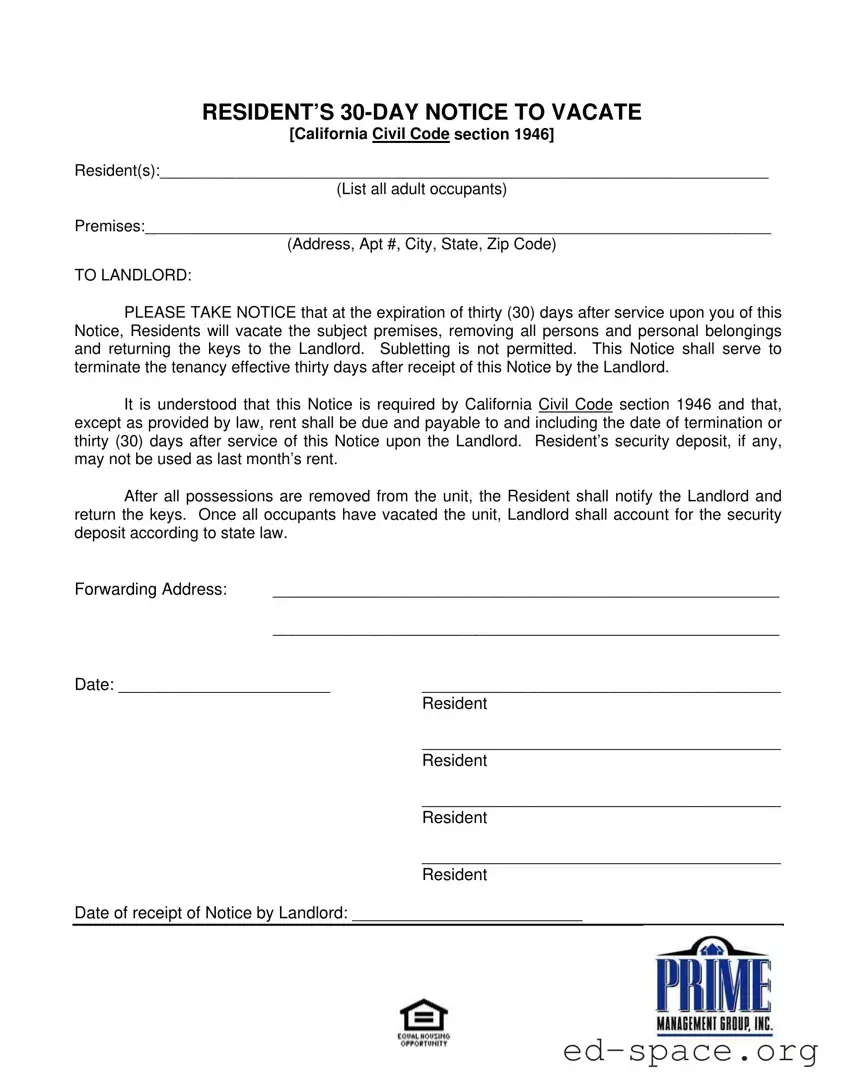
The Texas 30 Day Notice To Vacate form is an essential document for tenants who wish to terminate their lease agreement and vacate their rental property. This notice serves as a formal communication to the landlord, indicating the tenant's intention to leave the premises within thirty days. It must include the names of all adult occupants, the address of the rental unit, and the date on which the notice is provided to the landlord. The form clearly states that tenants must remove all personal belongings and return the keys upon vacating. It also emphasizes that subletting is not permitted during this notice period. Furthermore, the Texas law mandates that rent remains due up until the termination date, and tenants cannot use their security deposit as a substitute for the last month’s rent. After vacating, tenants are required to inform the landlord and ensure that the security deposit is returned according to state regulations. This notice is a vital step in ensuring a smooth transition for both tenants and landlords, setting clear expectations and responsibilities for both parties.

RESIDENT’S
[CALIFORNIA CIVIL CODE SECTION 1946]
Resident(s):_____________________________________________________________________
(List all adult occupants)
Premises:_______________________________________________________________________
(Address, Apt #, City, State, Zip Code)
TO LANDLORD:
PLEASE TAKE NOTICE that at the expiration of thirty (30) days after service upon you of this Notice, Residents will vacate the subject premises, removing all persons and personal belongings and returning the keys to the Landlord. Subletting is not permitted. This Notice shall serve to terminate the tenancy effective thirty days after receipt of this Notice by the Landlord.
It is understood that this Notice is required by California Civil Code section 1946 and that, except as provided by law, rent shall be due and payable to and including the date of termination or thirty (30) days after service of this Notice upon the Landlord. Resident’s security deposit, if any, may not be used as last month’s rent.
After all possessions are removed from the unit, the Resident shall notify the Landlord and return the keys. Once all occupants have vacated the unit, Landlord shall account for the security deposit according to state law.
Forwarding Address: |
_______________________________________________________ |
|
|
_______________________________________________________ |
|
Date: _______________________ |
_______________________________________ |
|
|
|
Resident |
_______________________________________
Resident
_______________________________________
Resident
_______________________________________
Resident
Date of receipt of Notice by Landlord: _________________________
| Fact Name | Description |
|---|---|
| Purpose | The Texas 30 Day Notice To Vacate form informs the landlord that the resident intends to leave the rental property in 30 days. |
| Occupants | All adult occupants must be listed on the form to ensure clarity regarding who is vacating the premises. |
| Governing Law | This notice is governed by Texas Property Code Section 24.005, which outlines the requirements for terminating a month-to-month tenancy. |
| Return of Keys | Residents must return all keys to the landlord upon vacating the property to ensure a smooth transition and avoid potential disputes. |
Completing the Texas 30 Day Notice To Vacate form is an important step when a resident decides to end their tenancy. After filling out this form correctly, the next steps involve serving it to the landlord and ensuring that all parties understand the timeline for vacating the premises.
What is the Texas 30 Day Notice To Vacate form?
The Texas 30 Day Notice To Vacate form is a legal document that a tenant uses to inform their landlord of their intention to vacate the rental property. This notice must be given at least 30 days before the planned move-out date. It serves to terminate the lease agreement and ensures that both the tenant and landlord are aware of the timeline for vacating the premises. By providing this notice, tenants fulfill their legal obligation to inform their landlord in a timely manner.
Who needs to use the Texas 30 Day Notice To Vacate form?
This form is typically used by tenants who are renting residential properties in Texas. If a tenant decides to move out and is required to give notice as per their lease agreement, they should complete and submit this form. It is essential for all adult occupants listed on the lease to sign the notice, as this ensures that all parties are in agreement about vacating the property.
What information is required on the Texas 30 Day Notice To Vacate form?
The form requires specific information to be valid. Tenants must list all adult occupants who reside in the rental unit, along with the complete address of the premises. Additionally, the notice should clearly state the date the notice is served to the landlord. It is also important to include a forwarding address where the landlord can send any remaining correspondence, including the security deposit after the tenant has vacated.
What happens after the Texas 30 Day Notice To Vacate is submitted?
Once the Texas 30 Day Notice To Vacate is submitted, the landlord has 30 days to prepare for the tenant's departure. During this time, the tenant is expected to continue paying rent until the termination date. After vacating, the tenant should notify the landlord and return all keys. The landlord is then responsible for accounting for the security deposit in accordance with Texas law, which includes any deductions for damages or unpaid rent.
Can a tenant use their security deposit as last month's rent?
Omitting All Adult Occupants: One common mistake is failing to list all adult occupants on the form. This can lead to confusion and potential disputes later. Ensure that every adult living in the unit is included to avoid complications.
Incorrect Address Details: Providing the wrong address or leaving out important details like the apartment number can create issues. Double-check the address, including the city, state, and zip code, to ensure accuracy.
Not Specifying the Date: Some residents forget to include the date of the notice. This date is crucial as it marks the beginning of the 30-day notice period. Always include the date you are submitting the notice.
Misunderstanding the Termination Period: Many residents misinterpret the 30-day notice requirement. It’s essential to understand that the 30 days start from the date the landlord receives the notice, not from the date you fill it out.
Using the Security Deposit for Last Month's Rent: Some residents mistakenly believe they can apply their security deposit to cover the last month’s rent. This is not allowed. Be sure to pay rent up until the termination date.
Failing to Notify the Landlord: After removing all personal belongings, residents often forget to notify the landlord. This step is vital to ensure the landlord knows the unit is vacated and can begin the process of returning the security deposit.
Ignoring the Return of Keys: Lastly, residents sometimes neglect to mention the return of keys in the notice. It’s important to state that keys will be returned, as this is part of the vacating process.
When a tenant decides to move out, several important documents may accompany the Texas 30 Day Notice to Vacate form. These documents help clarify the process and ensure that both parties understand their rights and responsibilities. Below is a list of commonly used forms and documents that can be helpful during this transition.
These documents play a vital role in ensuring a clear understanding between tenants and landlords during the moving process. By utilizing them effectively, both parties can help minimize confusion and foster a smoother transition.
The Texas 30 Day Notice To Vacate form has similarities with several other documents used in landlord-tenant relationships. Below are four such documents, each with a brief explanation of their similarities.
When filling out the Texas 30 Day Notice To Vacate form, it is important to follow certain guidelines to ensure that the process is smooth and legally compliant. Below are ten recommendations, divided into actions to take and actions to avoid.
Understanding the Texas 30 Day Notice To Vacate form can be challenging, and there are several misconceptions surrounding it. Here’s a breakdown of nine common misunderstandings:
Being aware of these misconceptions can help ensure a smoother transition when vacating a rental property. Clarity in the process can prevent misunderstandings and potential disputes.
When filling out and using the Texas 30 Day Notice To Vacate form, it is essential to understand the following key points:
These takeaways will help ensure that the notice is filled out correctly and that residents understand their responsibilities during the moving process.