Homepage Blank Texas 1745 PDF Form
Content Overview

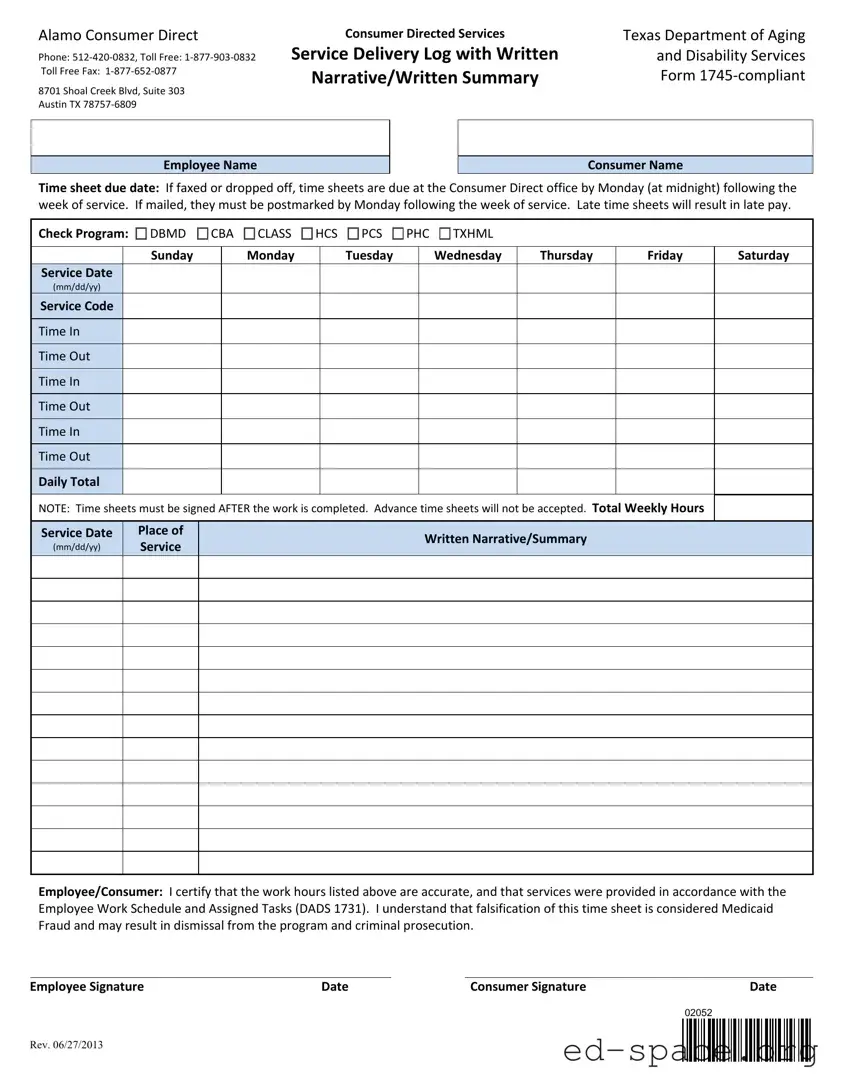
The Texas 1745 form is a crucial document used within the framework of consumer-directed services, particularly for individuals receiving support through various programs administered by the Texas Department of Aging and Disability Services. This form serves multiple purposes, primarily functioning as a service delivery log and a narrative summary that outlines the hours worked by employees who provide care and assistance to consumers. It is essential for ensuring that the services rendered are accurately documented and that employees are compensated in a timely manner. The form requires detailed information, including service dates, codes, and time in and out for each day of the week, allowing for a comprehensive overview of the care provided. Additionally, it emphasizes the importance of submitting completed time sheets by specific deadlines to avoid late payments, underscoring the need for diligence in record-keeping. Both the employee and consumer must certify the accuracy of the reported hours, as any discrepancies could lead to serious consequences, including allegations of Medicaid fraud. This highlights the form's role not just in administrative processes, but also in safeguarding the integrity of the services provided.
Document Preview

Alamo Consumer Direct

Consumer Directed Services

Texas Department of Aging

Phone: 5124200832, Toll Free: 18779030832

Service Delivery Log with Written

and Disability Services

Toll Free Fax: 18776520877

Narrative/Written Summary

Form 1745compliant

8701 Shoal Creek Blvd, Suite 303


Austin TX 787576809


Employee Name

Consumer Name

Time sheet due date: If faxed or dropped off, time sheets are due at the Consumer Direct office by Monday (at midnight) following the week of service. If mailed, they must be postmarked by Monday following the week of service. Late time sheets will result in late pay.

Check Program: DBMD CBA CLASS HCS PCS PHC TXHML

Sunday

Monday

Tuesday

Wednesday

Thursday

Friday

Saturday

Service Date

(mm/dd/yy)

Service Code

Time In

Time Out

Time In

Time Out

Time In

Time Out

Daily Total

NOTE: Time sheets must be signed AFTER the work is completed. Advance time sheets will not be accepted. Total Weekly Hours

Service Date

(mm/dd/yy)

Place of Service

Written Narrative/Summary

Employee/Consumer: I certify that the work hours listed above are accurate, and that services were provided in accordance with the Employee Work Schedule and Assigned Tasks (DADS 1731). I understand that falsification of this time sheet is considered Medicaid Fraud and may result in dismissal from the program and criminal prosecution.

Employee Signature

Date

Consumer Signature

Date

02052

REV. 06/27/2013

Form Specifications

Fact Name Details
Form Title Service Delivery Log with Written and Disability Services
Governing Law Texas Department of Aging and Disability Services (DADS)
Contact Information Phone: 512-420-0832, Toll Free: 1-877-903-0832
Fax Information Toll Free Fax: 1-877-652-0877
Submission Deadline Time sheets are due by Monday at midnight if faxed or dropped off. If mailed, they must be postmarked by Monday following the week of service.
Program Options DBMD, CBA, CLASS, HCS, PCS, PHC, TXHML
Signature Requirement Time sheets must be signed after the work is completed. Advance time sheets will not be accepted.
Fraud Warning Falsification of the time sheet may result in Medicaid Fraud charges and dismissal from the program.

Texas 1745: Usage Guidelines

Filling out the Texas 1745 form requires careful attention to detail to ensure accurate reporting of services rendered. This process is crucial for timely payments and compliance with program requirements. Follow these steps to complete the form correctly.

  1. Begin by entering the Employee Name and Consumer Name at the top of the form.
  2. Fill in the Time sheet due date. Remember that if you fax or drop off the form, it is due by midnight on the Monday following the week of service. If mailing, ensure it is postmarked by the same Monday.
  3. Select the appropriate Check Program by marking the corresponding box (DBMD, CBA, CLASS, HCS, PCS, PHC, TXHML).
  4. For each day of the week, enter the Service Date in the format mm/dd/yy.
  5. Next, record the Service Code for each day.
  6. Document the Time In and Time Out for each service session. Repeat this for each day of the week as necessary.
  7. Calculate and enter the Daily Total hours worked for each day.
  8. At the bottom of the form, total the Weekly Hours for the entire week.
  9. In the Place of Service section, specify where the services were provided.
  10. Complete the Written Narrative/Summary section, certifying that the hours listed are accurate and that services were provided according to the Employee Work Schedule and Assigned Tasks.
  11. Sign and date the form in the Employee Signature and Consumer Signature sections, ensuring that signatures are provided after the work has been completed.

Your Questions, Answered

What is the Texas 1745 form used for?

The Texas 1745 form is used for documenting services provided under the Consumer Directed Services (CDS) program. This form serves as a Service Delivery Log, which records the hours worked by employees who provide care to consumers. It ensures that services are tracked accurately and helps facilitate timely payment for those services. Proper completion of the form is essential for compliance with Medicaid requirements.

What are the deadlines for submitting the Texas 1745 form?

Timely submission of the Texas 1745 form is crucial. If you are faxing or dropping off the form, it must be submitted to the Consumer Direct office by midnight on the Monday following the week of service. If you choose to mail the form, it must be postmarked by the same Monday. Late submissions can lead to delays in payment, so it is important to adhere to these deadlines.

What happens if the Texas 1745 form is submitted late?

If the Texas 1745 form is submitted late, it can result in delayed payment for the services rendered. This can create financial strain for employees who rely on timely compensation. Additionally, repeated late submissions may raise concerns with the program administrators and could lead to further scrutiny or consequences. Therefore, it is advisable to submit the form on time to avoid any issues.

What should I do if I made a mistake on the Texas 1745 form?

If you discover a mistake on the Texas 1745 form after it has been submitted, you should address it immediately. Contact the Consumer Direct office at the provided phone numbers to inform them of the error. Depending on the nature of the mistake, you may need to submit a corrected form or provide additional documentation. Prompt action can help mitigate any potential issues related to payment or compliance.

Common mistakes

  1. Incomplete Information: Failing to fill in all required fields can lead to delays or rejections. Ensure that every section, including employee name and consumer name, is completed accurately.

  2. Incorrect Dates: Entering service dates in the wrong format can cause confusion. Always use the mm/dd/yy format as specified on the form.

  3. Missing Signatures: Time sheets must be signed after the work is completed. Forgetting to include signatures from both the employee and consumer can render the submission invalid.

  4. Late Submission: Submitting time sheets past the due date can result in late pay. Be mindful of the deadlines for faxing, dropping off, or mailing the forms.

  5. Falsification of Information: Providing inaccurate service hours or falsifying information is a serious offense. This can lead to Medicaid fraud charges and potential dismissal from the program.

Documents used along the form

The Texas 1745 form is essential for documenting service hours in consumer-directed services. Along with this form, several other documents are commonly used to ensure compliance and proper record-keeping. Below is a list of these forms, each serving a specific purpose in the service delivery process.

  • Service Delivery Log: This log records the specific services provided to the consumer on a daily basis. It helps track the frequency and type of services delivered, ensuring that all care is documented accurately.
  • Narrative/Written Summary: This document provides a detailed account of the services rendered, including any observations or changes in the consumer's condition. It is crucial for maintaining a comprehensive record of care.
  • Time Sheet: The time sheet captures the hours worked by the employee. It must be completed accurately and submitted on time to ensure proper payment for services rendered.
  • Employee Work Schedule: This schedule outlines the assigned tasks and hours for each employee. It serves as a reference for both the employee and the consumer to ensure that services are provided as planned.
  • Consumer Signature Form: This form verifies that the consumer acknowledges the services provided. It is important for confirming that the consumer is satisfied with the care received.
  • Program Check Form: This document indicates which program the services are being billed under, such as DBMD, CBA, or HCS. It ensures that billing is processed correctly according to the specific program guidelines.

Each of these documents plays a vital role in the overall service delivery process. Proper completion and timely submission are essential to maintain compliance and ensure that both consumers and employees are supported effectively.

Similar forms

  • Texas Form 1731: This form is used to outline the employee work schedule and assigned tasks. Similar to the Texas 1745, it requires signatures from both the employee and the consumer to verify accuracy and compliance with service delivery.
  • Texas Form 1746: This document serves as a summary of services provided and is often used alongside the 1745 form. It ensures that all services rendered are documented and can be referenced for accountability.
  • Texas Form 1747: This form is focused on reporting any changes in the consumer's condition or service needs. Like the 1745, it requires timely submission to ensure continuity of care and services.
  • Texas Form 1748: This is a service delivery log that tracks the hours worked and services provided. It shares similarities with the 1745 in that it documents service details and requires signatures for verification.
  • Texas Form 1749: This form is used for consumer feedback regarding the services received. It complements the 1745 by gathering insights that can improve service delivery and consumer satisfaction.
  • Texas Form 1750: This document is a request for additional services or changes in the service plan. It is similar to the 1745 as it requires clear documentation of needs and services to be provided.
  • Texas Form 1751: This form is utilized for reporting incidents or issues that arise during service delivery. Like the 1745, it emphasizes the importance of accurate and timely reporting to maintain program integrity.

Dos and Don'ts

When filling out the Texas 1745 form, it is essential to adhere to specific guidelines to ensure accuracy and compliance. Below is a list of things you should and shouldn't do:

  • Do ensure that all service dates are recorded accurately in the format mm/dd/yy.
  • Do sign the time sheet only after completing the work. Advance signatures will lead to rejection.
  • Do provide a detailed narrative or summary of the services rendered.
  • Do submit the time sheet by the due date to avoid late pay.
  • Don't falsify any information on the time sheet, as this constitutes Medicaid fraud.
  • Don't forget to include the total weekly hours worked on the form.
  • Don't submit time sheets that are not signed by both the employee and the consumer.

Misconceptions

Misconceptions about the Texas 1745 form can lead to confusion and errors in the service delivery process. Here are nine common misunderstandings:

  • All time sheets can be submitted at any time. Many believe that time sheets can be submitted whenever they choose. In reality, if faxed or dropped off, they are due by midnight on the Monday following the service week. If mailed, they must be postmarked by the same Monday.
  • Late submissions do not have consequences. Some think that submitting time sheets late is acceptable. However, late submissions will result in delayed payments, which can create financial strain for employees.
  • Advance time sheets are allowed. It is a common misconception that workers can submit time sheets in advance. This is incorrect; time sheets must be signed after the work is completed.
  • Any signature is acceptable on the time sheet. Some individuals believe that any signature will suffice. In fact, both the employee and the consumer must sign the time sheet to verify the accuracy of the reported hours.
  • Falsifying time sheets is a minor issue. Many underestimate the seriousness of falsifying information on the time sheet. It is considered Medicaid fraud and can lead to severe consequences, including dismissal and criminal prosecution.
  • All service codes are the same. Some assume that service codes do not vary. Each service code corresponds to specific programs, and using the correct one is essential for proper documentation.
  • The Texas 1745 form is optional. There is a belief that using the Texas 1745 form is optional. This form is mandatory for compliance with the service delivery log requirements.
  • Only the employee needs to keep records. Some think that only employees are responsible for record-keeping. In reality, both employees and consumers must maintain accurate records of services provided.
  • All forms are processed immediately. Many believe that once a time sheet is submitted, it is processed right away. However, processing can take time, and delays may occur, especially if there are errors or missing information.

Understanding these misconceptions can help ensure compliance and smooth operation within the Texas Consumer Directed Services program.

Key takeaways

Here are key takeaways about filling out and using the Texas 1745 form:

  • The Texas 1745 form is essential for documenting services provided under various programs, including DBMD, CBA, CLASS, HCS, PCS, PHC, and TXHML.
  • Time sheets are due at the Consumer Direct office by midnight on the Monday following the week of service if faxed or dropped off.
  • If mailed, time sheets must be postmarked by the Monday following the week of service to be considered on time.
  • Late submissions will lead to delayed payment for services rendered.
  • Each time sheet must be signed only after the work is completed; advance time sheets will not be accepted.
  • Accurate reporting of service hours is crucial. Falsifying information can lead to severe consequences, including Medicaid Fraud charges.
  • Both the employee and the consumer must sign the form to certify that the hours reported are correct and that services were provided as scheduled.
  • Service dates and codes must be filled out accurately to ensure proper documentation of services.
  • For any questions or assistance, you can contact the Texas Department of Aging at 512-420-0832 or toll-free at 1-877-903-0832.