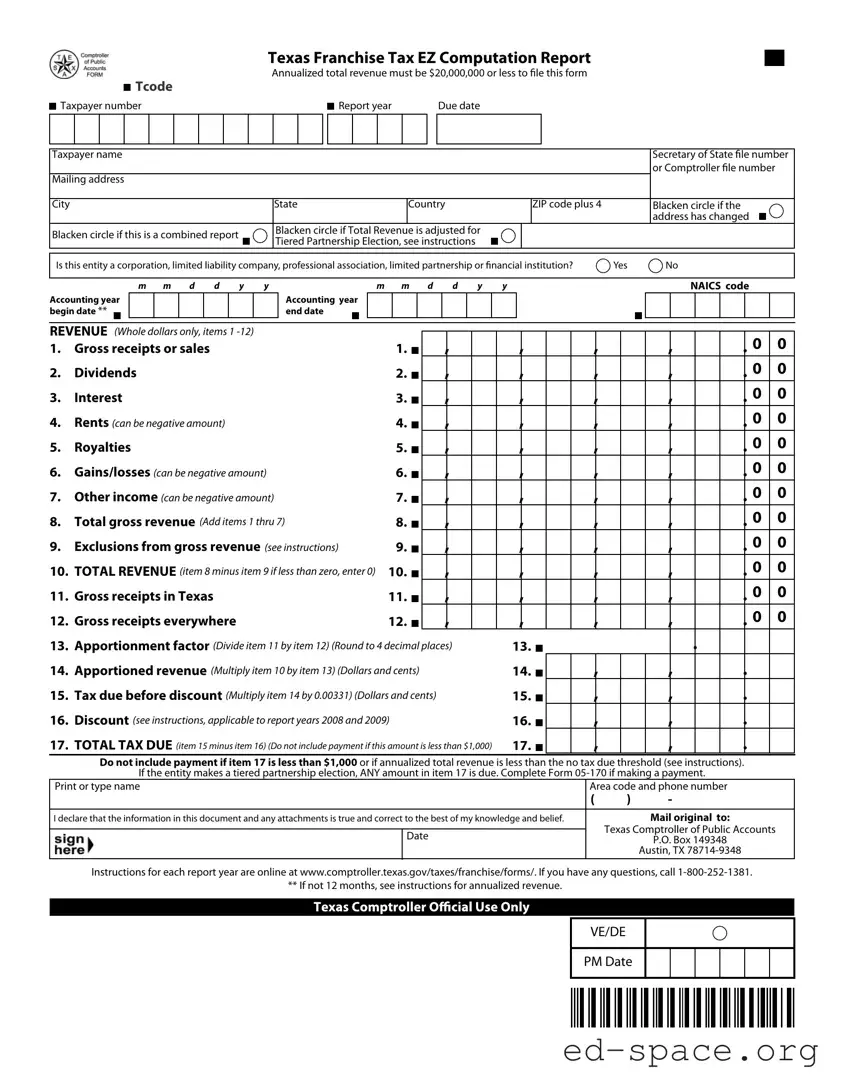
The Texas 05-169 form, known as the Franchise Tax EZ Computation Report, serves as a streamlined method for eligible businesses to report their franchise tax obligations. This form is specifically designed for entities with annualized total revenue of $20 million or less, making it accessible for smaller businesses. Key sections of the form require information such as the taxpayer's name, address, and identification numbers, along with details about revenue sources including gross receipts, dividends, and other income. The form also includes calculations for total revenue and tax due, along with provisions for discounts applicable to certain report years. Businesses must indicate if they are filing a combined report or if their revenue has been adjusted for tiered partnership elections. With clear instructions available online, the form aims to simplify the reporting process while ensuring compliance with state tax regulations. For those who need assistance, a dedicated helpline is available to answer questions and provide guidance.
|
|
|
|
|
|
Texas Franchise Tax EZ Computation Report |
|
|
|
|
|
||||||||||||||||||||||
|
|
|
|
|
|
Annualized total revenue must be $20,000,000 or less to file this form |
|
|
|
|
|
||||||||||||||||||||||
|
|
|
|
|
Tcode 13252 |
Annual |
|
|
|
|
|
|
|
|
|
|
|
Due date |
|
|
|
|
|
|
|
||||||||
|
|
|
|
|
|
|
|
|
|
|
|
|
|
|
|
|
|
|
|
|
|
|
|||||||||||
|
|
|
|
|
|
|
|
|
|
|
|
|
|
|
|
|
|
|
|
|
|
|
|||||||||||
|
Taxpayer number |
|
|
|
|
|
|
|
|
Report year |
|
|
|
|
|
|
|
|
|
|
|||||||||||||
|
|
|
|
|
|
|
|
|
|
|
|
||||||||||||||||||||||
|
|
|
|
|
|
|
|
|
|
|
|
||||||||||||||||||||||
|
|
|
|
|
|
|
|
|
|
|
|
|
|
|
|
|
|
|
|
|
|
|
|
|
|
|
|
|
|
|
|
|
|
|
|
|
|
|
|
|
|
|
|
|
|
|
|
|
|
|
|
|
|
|
|
|
|
|
|
|
|
|
|
|
|
|
|
|
|
|
|
|
|
|
|
|
|
|
|
|
|
|
|
|
|
|
|
|
|
|
|
|
|||||||||
Taxpayer name |
|
|
|
|
|
|
|
|
|
|
|
|
|
|
|
|
|
|
|
|
|
Secretary of State file number |
|||||||||||
|
|
|
|
|
|
|
|
|
|
|
|
|
|
|
|
|
|
|
|
|
|
|
|
|
|
|
|
|
|
or Comptroller file number |
|||
Mailing address |
|
|
|
|
|
|
|
|
|
|
|
|
|
|
|
|
|
|
|
|
|
|
|
|
|
||||||||
|
|
|
|
|
|
|
|
|
|
|
|
|
|
|
|
|
|||||||||||||||||
City |
|
|
|
|
State |
|
Country |
ZIP code plus 4 |
|
Blacken circle if the |
|||||||||||||||||||||||
|
|
|
|
|
|
|
|
|
|
|
|
|
|
|
|
|
|
|
|
|
|
|
|
|
|
|
|
|
|
address has changed |
|
|
|
|
|
|
|
|
|
|
|
|
|
|
|
|
|
|
|
|
|
|
|
|
|
|
|
|
|
|
|
|
|
|
|||
Blacken circle if this is a combined report |
|
|
|
Blacken circle if Total Revenue is adjusted for |
|
|
|
|
|
|
|
|
|||||||||||||||||||||
|
|
|
|
|
|
|
|
|
|
|
|
|
Tiered Partnership Election, see instructions |
|
|
|
|
|
|
|
|
|
|
||||||||||
|
|
|
|
|
|
|
|
|
|
|
|
|
|
|
|
|
|
|
|
|
|
||||||||||||
|
|
|
|
|
|
||||||||||||||||||||||||||||
|
Is this entity a corporation, limited liability company, professional association, limited partnership or financial institution? |
Yes |
No |
||||||||||||||||||||||||||||||
|
|
|
|
|
|
|
|
|
|
|
|
|
|
|
|
|
|
|
|
|
|
|
|
|
|
|
|
|
|
|
|
|
|
m m d d y
Accounting year begin date **
y |
m m d d y y |
NAICS code |
Accounting year end date
REVENUE (Whole dollars only, items 1 |
|
|
|
1. |
Gross receipts or sales |
1. |
|
|
|||
2. |
Dividends |
2. |
|
|
|||
3. |
Interest |
3. |
|
|
|||
4. |
Rents (can be negative amount) |
4. |
|
|
|||
5. |
Royalties |
5. |
|
|
|||
6. |
Gains/losses (can be negative amount) |
6. |
|
|
|||
7. |
Other income (can be negative amount) |
7. |
|
|
|||
8. |
Total gross revenue (Add items 1 thru 7) |
8. |
|
|
|||
9. |
Exclusions from gross revenue (see instructions) |
9. |
|
|
|||
|
|||
10. |
TOTAL REVENUE (item 8 minus item 9 if less than zero, enter 0) |
10. |
|
|
|||
11. |
Gross receipts in Texas |
11. |
|
|
|||
12. |
Gross receipts everywhere |
12. |
|
|
|||
13.Apportionment factor (Divide item 11 by item 12) (Round to 4 decimal places)
14.Apportioned revenue (Multiply item 10 by item 13) (Dollars and cents)
15.Tax due before discount (Multiply item 14 by 0.00331) (Dollars and cents)
16.Discount (see instructions, applicable to report years 2008 and 2009)
17.TOTAL TAX DUE (item 15 minus item 16) (Do not include payment if this amount is less than $1,000)
13.
14.
15.
16.
17.
00
00
00
00
00
00
00
00
00
00
00
00
Do not include payment if item 17 is less than $1,000 or if annualized total revenue is less than the no tax due threshold (see instructions).
If the entity makes a tiered partnership election, ANY amount in item 17 is due. Complete Form
Print or type name |
Area code and phone number |
|||
|
|
( |
) |
- |
|
|
|
|
|
I declare that the information in this document and any attachments is true and correct to the best of my knowledge and belief. |
|
|
Mail original to: |
|
|
|
|
Texas Comptroller of Public Accounts |
|
|
Date |
|
||
|
|
|
P.O. Box 149348 |
|
|
|
|
|
|
|
|
|
|
Austin, TX |
|
|
|
|
|
Instructions for each report year are online at www.comptroller.texas.gov/taxes/franchise/forms/. If you have any questions, call
** If not 12 months, see instructions for annualized revenue.
VE/DE
PM Date
| Fact Name | Description |
|---|---|
| Form Purpose | The Texas 05-169 form is used for the Franchise Tax EZ Computation Report. |
| Eligibility Criteria | To file this form, a business must have an annualized total revenue of $20,000,000 or less. |
| Filing Deadline | The form must be submitted by the annual due date, which is determined by the entity's accounting year. |
| Information Required | Taxpayer details, revenue sources, and total revenue calculations are required to complete the form. |
| Combined Report Option | Taxpayers can indicate if this is a combined report by marking the appropriate circle on the form. |
| Tax Calculation | The tax due is calculated based on apportioned revenue and a specified tax rate. |
| Governing Laws | This form is governed by the Texas Tax Code, specifically related to franchise taxes. |
| Submission Instructions | The completed form must be mailed to the Texas Comptroller of Public Accounts at the specified address. |
Completing the Texas 05-169 form is a critical step in fulfilling your tax obligations. Ensure that you have all the necessary information at hand before starting the process. Follow these steps carefully to fill out the form accurately and efficiently.
Once the form is completed and submitted, you can check for any updates or additional instructions on the Texas Comptroller's website. If you have questions, don't hesitate to reach out to their office for assistance. Timeliness is essential, so ensure you meet the filing deadline to avoid any penalties.
What is the Texas 05-169 form?
The Texas 05-169 form, also known as the Franchise Tax EZ Computation Report, is a simplified tax filing for certain entities operating in Texas. It is designed for those with an annualized total revenue of $20 million or less. This form allows eligible businesses to report their franchise tax in a more straightforward manner compared to other forms.
Who needs to file the Texas 05-169 form?
What information is required on the Texas 05-169 form?
The form requires various pieces of information, including the taxpayer number, report year, taxpayer name, and the Secretary of State or Comptroller file number. Additionally, businesses must provide details about their gross receipts, dividends, interest, rents, royalties, and any gains or losses. This information is used to calculate total revenue and the tax due.
How do I calculate total revenue on the form?
Total revenue is calculated by adding together gross receipts, dividends, interest, rents, royalties, and other income. After summing these figures, any exclusions from gross revenue must be subtracted. If the result is less than zero, you would enter zero in the total revenue section.
What is the due date for filing the Texas 05-169 form?
The Texas 05-169 form is typically due on May 15th of each year. However, if this date falls on a weekend or holiday, the deadline may be adjusted. It's essential to check the Texas Comptroller's website for any updates or changes to the filing schedule.
What happens if I miss the filing deadline?
Failing to file the Texas 05-169 form by the deadline may result in penalties and interest on any unpaid tax. The Texas Comptroller may impose a late filing penalty, which can increase the total amount owed. It is advisable to file as soon as possible to minimize any potential penalties.
Can I amend my Texas 05-169 form after filing?
Yes, if you discover an error after submitting the Texas 05-169 form, you can amend it. You will need to file an amended report and provide the corrected information. Be sure to include any necessary documentation to support the changes you are making.
Is there a minimum tax due even if my revenue is low?
Yes, if your annualized total revenue is less than the no tax due threshold, you do not need to include payment with your form. However, if you are making a tiered partnership election, any amount in the tax due section is required. Always check the specific instructions for your reporting year to confirm your obligations.
Where do I send the completed Texas 05-169 form?
The completed Texas 05-169 form should be mailed to the Texas Comptroller of Public Accounts at P.O. Box 149348, Austin, TX 78714-9348. Ensure that you send the original form and keep a copy for your records.
Incorrect Revenue Reporting: Failing to report gross receipts accurately can lead to significant issues. Ensure that all revenue sources, including sales, dividends, and interest, are included.
Missing Entity Type Selection: Not indicating whether the entity is a corporation, LLC, or another type can cause delays. This information is crucial for processing your form correctly.
Improper Use of Whole Dollars: Reporting amounts in cents instead of whole dollars is a common mistake. Only whole dollar amounts should be entered for revenue items.
Neglecting to Update Address: If your mailing address has changed, you must blacken the circle indicating this change. Failing to do so can result in missed communications from the Comptroller’s office.
Ignoring the Tiered Partnership Election: If applicable, you must blacken the circle for the Tiered Partnership Election. This step is essential for proper tax calculations.
Incorrect Apportionment Factor Calculation: Mistakes in calculating the apportionment factor can lead to incorrect tax amounts. Be sure to divide the gross receipts in Texas by the gross receipts everywhere accurately.
Not Rounding Correctly: When calculating the apportionment factor, rounding to four decimal places is necessary. Failing to do this can affect the final tax amount due.
Missing Signatures: Forgetting to sign the form can lead to rejection. Ensure that the person responsible for the information declares it true and correct.
Submitting Without Payment When Necessary: If the total tax due is less than $1,000, do not include payment. However, if you make a tiered partnership election, any amount due must be paid.
The Texas 05-169 form is essential for businesses in Texas to report their franchise tax. However, several other forms and documents may accompany it to ensure compliance and accurate reporting. Below is a list of commonly used documents that may be relevant when filing the Texas 05-169 form.
Each of these documents plays a vital role in ensuring compliance with Texas tax laws. Businesses should carefully review their requirements and seek assistance if needed to avoid any penalties or issues with their filings.
The Texas 05-169 form, known as the Franchise Tax EZ Computation Report, serves a specific purpose for businesses reporting their franchise tax obligations in Texas. Several other documents share similarities with this form, primarily in terms of their function and the information they require. Below is a list of eight such documents, each accompanied by a brief explanation of how they relate to the Texas 05-169 form.
Each of these documents plays a crucial role in ensuring compliance with Texas tax laws, much like the Texas 05-169 form. Understanding their similarities can help businesses navigate their reporting responsibilities more effectively.
Filling out the Texas 05-169 form can seem daunting, but with careful attention to detail, you can navigate the process smoothly. Here’s a helpful list of dos and don’ts to guide you.
By following these guidelines, you can help ensure that your Texas 05-169 form is completed correctly and submitted on time. Remember, if you have any questions, assistance is just a phone call away.
Here are some common misconceptions about the Texas 05-169 form, along with clarifications to help better understand its requirements and purpose.
When filling out the Texas 05-169 form, it’s important to keep several key points in mind. Below are essential takeaways that will help ensure accurate completion and submission.
For further assistance, refer to the instructions available online or contact the Texas Comptroller's office directly.