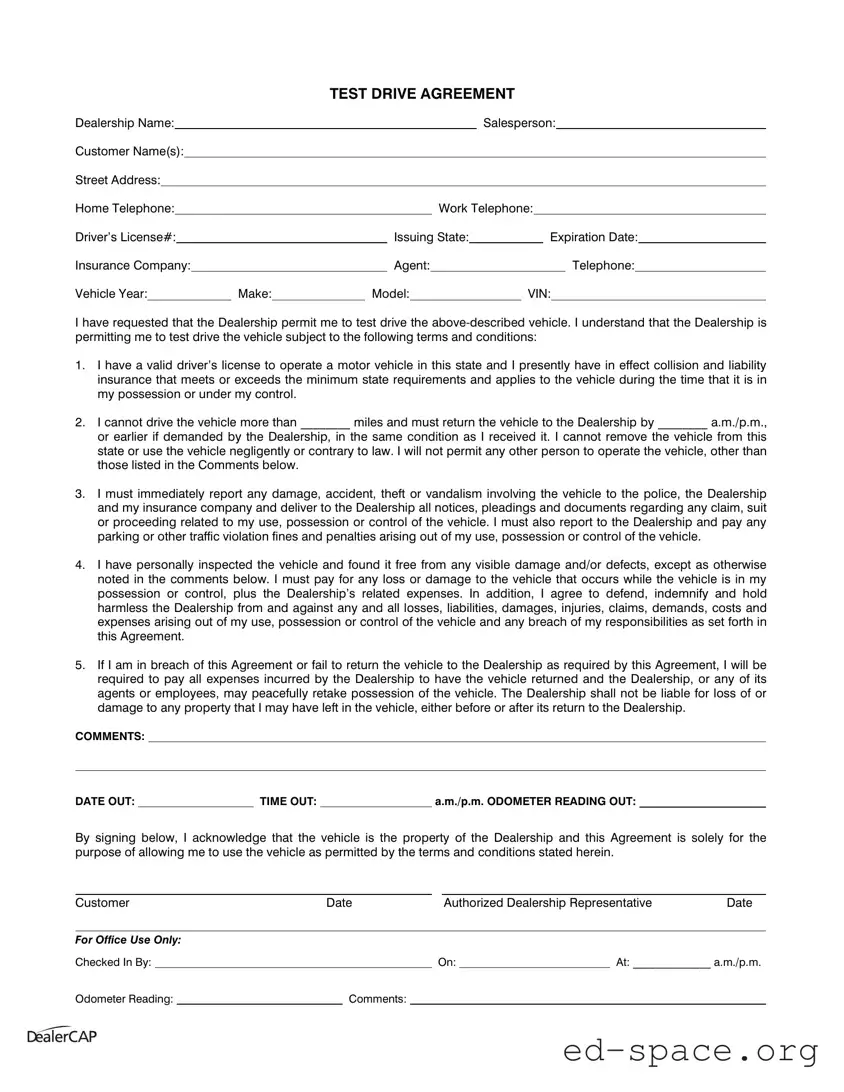
When considering a new vehicle, the excitement of a test drive can be a pivotal moment in the decision-making process. The Test Drive Agreement serves as a crucial document that outlines the responsibilities and expectations for both the customer and the dealership. It begins with essential information, such as the dealership's name, the salesperson involved, and the customer's details, including their address and contact numbers. This form not only captures the vehicle's specifics—year, make, model, and VIN—but also emphasizes the importance of having a valid driver’s license and adequate insurance coverage. Customers are reminded that they must adhere to specific mileage limits and return the vehicle in the same condition as received. Furthermore, the form details the obligations of the customer in the event of damage or an accident, highlighting the need to report any incidents immediately. It also clarifies the dealership's rights regarding the vehicle's possession and the customer's liability for any damages incurred during the test drive. The inclusion of a comments section allows for any pre-existing conditions to be noted, ensuring transparency. Ultimately, this agreement is not just a formality; it is a safeguard that protects both parties, ensuring a smooth and responsible test-driving experience.
TEST DRIVE AGREEMENT
Dealership Name: |
|
|
|
|
|
|
|
|
|
|
Salesperson: |
|
||||||||||||
Customer Name(s): |
|
|
|
|
|
|
|
|
|
|
|
|
|
|
|
|
|
|
|
|||||
Street Address: |
|
|
|
|
|
|
|
|
|
|
|
|
|
|
|
|
|
|
|
|||||
Home Telephone: |
|
|
|
|
|
|
|
|
Work Telephone: |
|
||||||||||||||
Driver’s License#: |
|
|
|
|
|
Issuing State: |
|
|
|
|
Expiration Date: |
|
||||||||||||
Insurance Company: |
|
|
|
|
Agent: |
|
|
|
|
|
|
|
Telephone: |
|
||||||||||
Vehicle Year: |
|
|
Make: |
|
Model: |
|
|
VIN: |
|
|||||||||||||||
I have requested that the Dealership permit me to test drive the
1.I have a valid driver’s license to operate a motor vehicle in this state and I presently have in effect collision and liability insurance that meets or exceeds the minimum state requirements and applies to the vehicle during the time that it is in my possession or under my control.
2.I cannot drive the vehicle more than ________ miles and must return the vehicle to the Dealership by ________ a.m./p.m., or earlier if demanded by the Dealership, in the same condition as I received it. I cannot remove the vehicle from this state or use the vehicle negligently or contrary to law. I will not permit any other person to operate the vehicle, other than those listed in the Comments below.
3.I must immediately report any damage, accident, theft or vandalism involving the vehicle to the police, the Dealership and my insurance company and deliver to the Dealership all notices, pleadings and documents regarding any claim, suit or proceeding related to my use, possession or control of the vehicle. I must also report to the Dealership and pay any parking or other traffic violation fines and penalties arising out of my use, possession or control of the vehicle.
4.I have personally inspected the vehicle and found it free from any visible damage and/or defects, except as otherwise noted in the comments below. I must pay for any loss or damage to the vehicle that occurs while the vehicle is in my possession or control, plus the Dealership’s related expenses. In addition, I agree to defend, indemnify and hold harmless the Dealership from and against any and all losses, liabilities, damages, injuries, claims, demands, costs and expenses arising out of my use, possession or control of the vehicle and any breach of my responsibilities as set forth in this Agreement.
5.If I am in breach of this Agreement or fail to return the vehicle to the Dealership as required by this Agreement, I will be required to pay all expenses incurred by the Dealership to have the vehicle returned and the Dealership, or any of its agents or employees, may peacefully retake possession of the vehicle. The Dealership shall not be liable for loss of or damage to any property that I may have left in the vehicle, either before or after its return to the Dealership.
COMMENTS:
DATE OUT: |
|
TIME OUT: |
|
a.m./p.m. ODOMETER READING OUT: |
By signing below, I acknowledge that the vehicle is the property of the Dealership and this Agreement is solely for the purpose of allowing me to use the vehicle as permitted by the terms and conditions stated herein.
Customer |
Date |
Authorized Dealership Representative |
Date |
|||
|
|
|
|
|
|
|
For Office Use Only: |
|
|
|
|
|
|
Checked In By: |
|
|
On: |
|
At: ______________ a.m./p.m. |
|
Odometer Reading: |
|
Comments: |
| Fact Name | Description |
|---|---|
| Driver's License Requirement | The customer must have a valid driver's license to operate a vehicle in their state. This is crucial for ensuring safety during the test drive. |
| Insurance Coverage | Customers are required to have collision and liability insurance that meets state minimum requirements. This protects both the customer and the dealership. |
| Vehicle Return Conditions | The vehicle must be returned to the dealership by a specified time and in the same condition as received. This helps maintain the vehicle's quality and availability for future customers. |
| State-Specific Laws | Each state may have different laws governing test drives. It's important for customers to be aware of their local regulations to ensure compliance. |
Completing the Test Drive form is a straightforward process that ensures both you and the dealership are on the same page regarding the terms of the test drive. Follow these steps to fill out the form accurately and efficiently.
After completing the form, review all the information for accuracy. Ensure that all required fields are filled out before submitting it to the dealership. This will help avoid any misunderstandings and ensure a smooth test drive experience.
What is the purpose of the Test Drive form?
The Test Drive form is a legal agreement between the customer and the dealership. It outlines the terms and conditions under which a customer can test drive a vehicle. By signing this form, the customer acknowledges their responsibilities and the dealership's rights regarding the use of the vehicle.
What information do I need to provide on the Test Drive form?
You must provide personal information, including your name, address, phone numbers, and driver’s license details. Additionally, you will need to include information about the vehicle you wish to test drive, such as the make, model, and VIN. This information helps the dealership verify your identity and ensure compliance with legal requirements.
Can I let someone else drive the vehicle during the test drive?
What happens if I exceed the mileage limit during the test drive?
What should I do if there is damage to the vehicle during my test drive?
What are my responsibilities regarding insurance during the test drive?
What happens if I do not return the vehicle on time?
What should I do if I have questions about the Test Drive form?
Incomplete Personal Information: Many people forget to fill in all required personal details, such as their full name, address, or contact numbers. Omitting this information can lead to delays in processing the test drive request.
Driver’s License Issues: Some individuals may not provide their driver’s license number or fail to indicate the issuing state and expiration date. This oversight can raise concerns about eligibility to drive the vehicle.
Insurance Information: It’s crucial to include accurate details about insurance coverage. Failing to provide the name of the insurance company, agent, or their contact number can complicate matters in case of an incident during the test drive.
Comments Section Neglect: The comments section is often overlooked. Not noting any existing damage or concerns about the vehicle can lead to disputes later. It’s important to document everything to avoid misunderstandings.
When preparing for a test drive, several additional documents may be necessary to ensure a smooth process. These documents help clarify responsibilities, protect both parties, and provide necessary information. Below is a list of forms commonly used alongside the Test Drive Agreement.
These forms and documents work together to ensure that both the customer and dealership have a clear understanding of their rights and responsibilities during the test drive process. Proper documentation helps prevent misunderstandings and promotes a positive experience for everyone involved.
When filling out the Test Drive form, there are important guidelines to follow. Here is a list of what you should and shouldn't do:
Following these guidelines will help ensure a smooth and compliant test drive experience.
This is incorrect. The Test Drive form outlines specific responsibilities and liabilities for the customer. By signing, the customer agrees to abide by the terms, which can have legal consequences if violated.
This is misleading. The agreement explicitly states that only the individuals listed in the comments section are permitted to operate the vehicle. Allowing others to drive the vehicle can lead to liability issues for the customer.
This is false. The form clearly indicates that the customer is liable for any loss or damage to the vehicle while it is in their possession. This includes costs related to repairs and any expenses incurred by the dealership.
This is a misconception. The agreement specifies that the vehicle must be returned by a certain time. Failing to do so may result in additional fees and the dealership has the right to retake possession of the vehicle if necessary.
When filling out and using the Test Drive form, keep the following key points in mind:
By following these guidelines, you can ensure a smooth and responsible test drive experience.