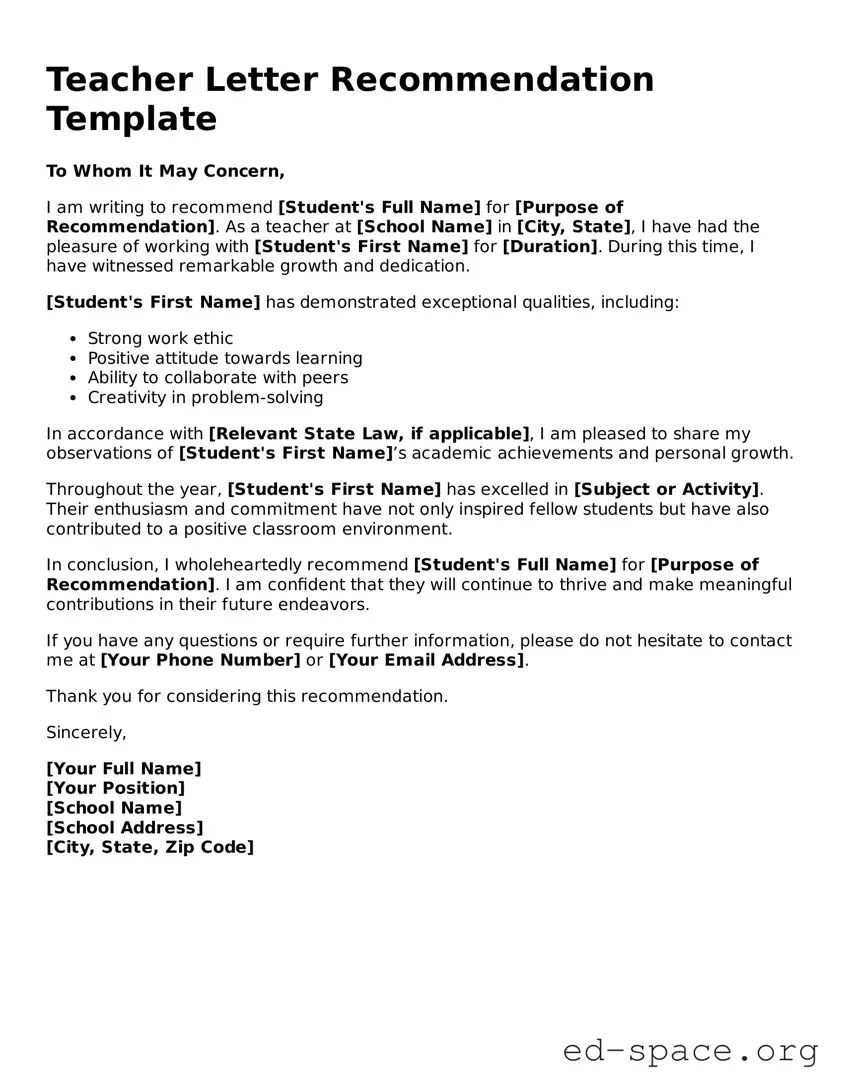
The Teacher Letter Recommendation form serves as a crucial tool in the educational landscape, facilitating the process by which educators provide insights into a student’s abilities, character, and potential. This form typically includes sections for the teacher to detail their relationship with the student, observations regarding academic performance, and personal attributes that may contribute to the student’s future success. Additionally, it often prompts educators to address specific qualities, such as leadership, resilience, and interpersonal skills, which are valuable in both academic and extracurricular pursuits. By gathering this information, the form helps colleges, scholarship committees, and other organizations make informed decisions about applicants. In a competitive environment, a well-crafted recommendation can significantly impact a student's opportunities, making the completion of this form an important responsibility for teachers. It is essential that educators approach this task thoughtfully, as their insights can shape a student's future trajectory.
Teacher Letter Recommendation Template
To Whom It May Concern,
I am writing to recommend [Student's Full Name] for [Purpose of Recommendation]. As a teacher at [School Name] in [City, State], I have had the pleasure of working with [Student's First Name] for [Duration]. During this time, I have witnessed remarkable growth and dedication.
[Student's First Name] has demonstrated exceptional qualities, including:
In accordance with [Relevant State Law, if applicable], I am pleased to share my observations of [Student's First Name]’s academic achievements and personal growth.
Throughout the year, [Student's First Name] has excelled in [Subject or Activity]. Their enthusiasm and commitment have not only inspired fellow students but have also contributed to a positive classroom environment.
In conclusion, I wholeheartedly recommend [Student's Full Name] for [Purpose of Recommendation]. I am confident that they will continue to thrive and make meaningful contributions in their future endeavors.
If you have any questions or require further information, please do not hesitate to contact me at [Your Phone Number] or [Your Email Address].
Thank you for considering this recommendation.
Sincerely,
[Your Full Name]
[Your Position]
[School Name]
[School Address]
[City, State, Zip Code]
| Fact Name | Description |
|---|---|
| Purpose | The Teacher Letter Recommendation form is used to provide a formal recommendation for a student applying to colleges or scholarships. |
| Who Can Write | Typically, teachers who have directly interacted with the student in an academic setting can write this recommendation. |
| Content Requirements | The letter should include specific examples of the student’s skills, achievements, and character traits. |
| Submission Process | Recommendations are often submitted directly to the educational institution or through a centralized application system. |
| Confidentiality | Some forms may allow for confidentiality, meaning the student may not see the letter unless waived. |
| State-Specific Laws | In California, for example, the Family Educational Rights and Privacy Act (FERPA) governs the privacy of student education records. |
Once you have the Teacher Letter Recommendation form, you will need to complete it accurately to ensure it meets the requirements. Follow the steps below to fill out the form correctly.
After completing the form, you will need to submit it according to the specified instructions, which may include mailing it or sending it electronically. Ensure you meet any deadlines provided.
What is the Teacher Letter Recommendation form?
The Teacher Letter Recommendation form is a document that allows teachers to provide insights about a student’s abilities, character, and potential. This form is often used for college applications, scholarship opportunities, or special programs where a teacher's perspective can enhance a student's profile.
Who should fill out the Teacher Letter Recommendation form?
Typically, teachers who have taught the student in an academic setting should complete the form. It is ideal for teachers who know the student well and can provide meaningful feedback on their skills, work ethic, and contributions in the classroom.
How can a student request a recommendation?
Students should approach their teachers politely, ideally well in advance of any deadlines. A face-to-face conversation is often best, followed by a formal request via email or a printed note. It’s helpful for students to provide context about the recommendation’s purpose and any specific points they would like the teacher to address.
What information is typically included in a Teacher Letter Recommendation?
The recommendation generally includes the teacher's observations about the student’s academic performance, personal qualities, and extracurricular involvement. It may also highlight specific instances that demonstrate the student’s strengths, such as leadership, resilience, or creativity.
Is there a deadline for submitting the Teacher Letter Recommendation form?
Yes, deadlines vary depending on the institution or program for which the recommendation is being submitted. Students should communicate these deadlines clearly to their teachers and ensure that they allow ample time for the teacher to complete the form.
Can a teacher submit the form electronically?
Many institutions now allow electronic submissions of recommendation letters. However, it is essential for students to check the specific requirements of the application process. If electronic submission is permitted, teachers will typically receive a link or portal to upload their recommendation directly.
What if a teacher feels they cannot provide a positive recommendation?
If a teacher feels they cannot write a positive recommendation, it is best for them to communicate this to the student. Students should seek recommendations from teachers who can genuinely support their application. A recommendation that lacks enthusiasm or is lukewarm may do more harm than good.
Can a student see their Teacher Letter Recommendation?
This depends on the policies of the institution or program. Some schools allow students to view their recommendations, while others maintain confidentiality. Students should inquire about this when requesting the recommendation.
What should a student do after receiving the recommendation?
Once the recommendation has been submitted, students should express their gratitude to the teacher. A simple thank-you note or email can go a long way in showing appreciation for the time and effort the teacher invested in writing the recommendation.
Inadequate Personalization: Many individuals fail to personalize the letter. A generic recommendation does not highlight the unique qualities of the candidate. Specific examples of achievements and characteristics are essential to create a compelling narrative.
Ignoring Guidelines: Some people overlook the specific guidelines provided for the recommendation form. Each institution may have different requirements regarding length, format, and content. Ignoring these can lead to a disqualification of the recommendation.
Neglecting to Proofread: Errors in spelling or grammar can undermine the credibility of the recommendation. A lack of attention to detail may suggest carelessness, which can reflect poorly on the candidate.
Failure to Communicate Effectively: Some recommenders do not convey their thoughts clearly. Ambiguous language or vague statements can confuse the reader. Clear, concise, and direct communication is vital for an effective recommendation.
The Teacher Letter of Recommendation form is a valuable tool in the educational process, often used to support a student's application for college, scholarships, or specialized programs. In conjunction with this form, several other documents can enhance the application and provide a comprehensive view of the student's abilities and character. Below is a list of related forms and documents commonly used alongside the Teacher Letter of Recommendation form.
These documents collectively create a more complete picture of the student, aiding educators and admissions committees in making informed decisions. Each form serves a unique purpose, contributing to the overall narrative of the student’s academic and personal journey.
When filling out a Teacher Letter Recommendation form, it is important to approach the task thoughtfully. Here are five essential tips to consider, along with some common pitfalls to avoid.
Understanding the Teacher Letter Recommendation form can be challenging. Here are eight common misconceptions that often arise:
By clarifying these misconceptions, students can better navigate the recommendation process and ensure they receive strong letters that support their goals.
Filling out a Teacher Letter Recommendation form can be a crucial step in supporting a student's application process. Here are some key takeaways to consider:
By keeping these points in mind, you can enhance the effectiveness of the Teacher Letter Recommendation form and support the student in their endeavors.