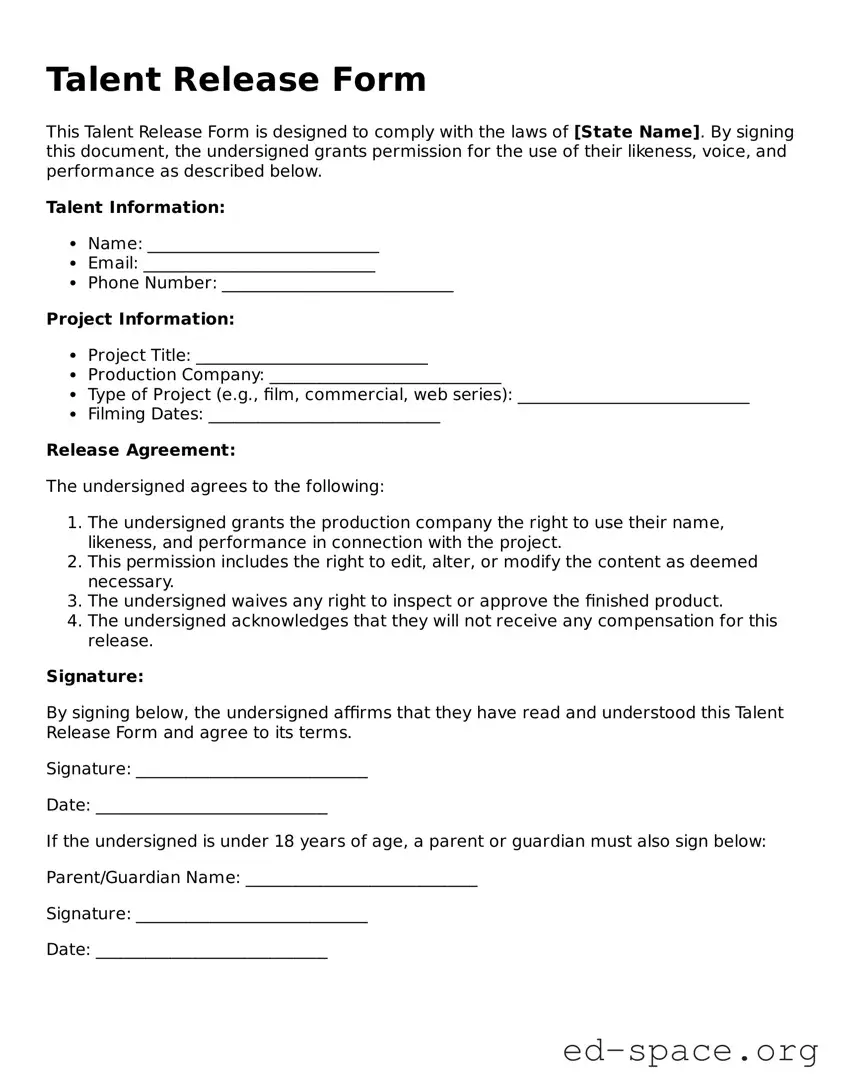
In the world of creative projects, whether they involve film, photography, or other forms of media, the importance of securing a Talent Release form cannot be overstated. This essential document serves as a formal agreement between the talent—such as actors, models, or musicians—and the producers or creators of the project. It grants permission for the use of the talent's likeness, voice, and performance in various media formats. By outlining the rights and obligations of both parties, the Talent Release form helps to protect the interests of everyone involved. It typically includes details about the scope of use, duration, and compensation, ensuring that all expectations are clear. Additionally, the form may address issues related to copyright and ownership, providing peace of mind for the creators while allowing the talent to retain certain rights. In essence, this form not only facilitates a smooth collaboration but also fosters a respectful relationship between the talent and the production team.
Talent Release Form
This Talent Release Form is designed to comply with the laws of [State Name]. By signing this document, the undersigned grants permission for the use of their likeness, voice, and performance as described below.
Talent Information:
Project Information:
Release Agreement:
The undersigned agrees to the following:
Signature:
By signing below, the undersigned affirms that they have read and understood this Talent Release Form and agree to its terms.
Signature: ____________________________
Date: ____________________________
If the undersigned is under 18 years of age, a parent or guardian must also sign below:
Parent/Guardian Name: ____________________________
Signature: ____________________________
Date: ____________________________
| Fact Name | Description |
|---|---|
| Purpose | A Talent Release form is used to obtain permission from individuals to use their likeness, voice, or performance in various media. |
| Key Components | The form typically includes the talent's name, the scope of the release, and the duration of permission granted. |
| State-Specific Forms | Some states have specific requirements for Talent Release forms. For example, California law emphasizes the need for clear consent. |
| Governing Law | In California, the governing law for Talent Releases includes Civil Code Section 3344, which addresses the right of publicity. |
| Considerations | It's important to ensure that the form is signed voluntarily and that the talent understands the rights they are relinquishing. |
| Revocation | Generally, once signed, a Talent Release cannot be revoked unless specified in the agreement itself. |
Once you have the Talent Release form in hand, you are ready to begin filling it out. This form is essential for ensuring that all parties understand the permissions and rights related to the use of talent's likeness and performance. Follow the steps below to complete the form accurately.
What is a Talent Release form?
A Talent Release form is a legal document that grants permission for the use of an individual’s likeness, voice, or performance in various media, such as film, television, and online content. This form ensures that the talent consents to the recording and distribution of their image or performance, protecting both the talent and the production team from potential legal disputes in the future.
Why is a Talent Release form important?
The importance of a Talent Release form cannot be overstated. It serves to clarify the rights of all parties involved. By signing this document, the talent agrees that the production can use their performance without fear of claims for compensation or rights infringement later on. This clarity helps to foster a professional relationship and ensures that the project can move forward smoothly.
Who needs to sign the Talent Release form?
Typically, any individual who appears on camera or whose voice is recorded will need to sign the Talent Release form. This includes actors, extras, and even behind-the-scenes personnel if their likeness may be captured in the final product. In some cases, if the talent is a minor, a parent or guardian must sign on their behalf to provide consent.
What happens if a Talent Release form is not signed?
If a Talent Release form is not signed, the production team may face significant challenges. Without this consent, the use of the talent’s likeness could lead to legal issues, including claims for unauthorized use. This situation can result in costly delays, potential lawsuits, and the inability to distribute the finished product, as the talent may revoke permission at any time.
Can a Talent Release form be revoked?
Once signed, a Talent Release form is generally binding. However, under certain circumstances, a talent may wish to revoke their consent. If this occurs, it is crucial to consult legal guidance to understand the implications. Revocation could lead to complications, especially if the project is already in production or post-production. Clear communication and a mutual understanding are essential in these situations.
Is there a standard format for a Talent Release form?
While there is no single standard format for a Talent Release form, most include key elements such as the names of the parties involved, a description of the project, the scope of the rights granted, and any compensation details. It is advisable for production teams to tailor the form to meet specific project needs while ensuring it covers all necessary legal bases. Consulting with a legal professional can help create a comprehensive and effective document.
Incomplete Information: Many individuals forget to fill out all required fields. Missing details can lead to delays or complications.
Incorrect Signatures: Some people sign the form without verifying that they are the correct signatory. This can invalidate the release.
Misunderstanding Terms: Not fully understanding the terms of the release can result in unintentional agreements. It's crucial to read everything carefully.
Omitting Date: Failing to include the date of signing is a common oversight. This detail is important for legal validity.
Not Keeping a Copy: Many forget to keep a copy of the signed form for their records. Having a copy can be helpful for future reference.
Ignoring Age Requirements: Minors must have a parent or guardian sign the form. Neglecting this can lead to issues with consent.
Failing to Specify Usage: Some individuals do not clarify how their likeness or performance will be used. This can lead to misunderstandings later.
Not Asking Questions: People often hesitate to ask for clarification on the form. It’s important to seek help if something is unclear.
Assuming All Releases are the Same: Each talent release form may have different terms. Assuming uniformity can lead to unexpected obligations.
A Talent Release form is an important document in the entertainment industry, ensuring that a performer gives permission for their likeness and performance to be used in a project. Along with this form, several other documents are often needed to protect all parties involved. Here’s a list of related forms and documents that are commonly used:
Having these documents in place helps to create a smooth production process. They provide clarity and legal protection for everyone involved, ensuring that rights are respected and responsibilities are understood.
The Talent Release form is a crucial document in the entertainment industry, particularly for securing permission from individuals featured in a project. Several other documents serve similar purposes, ensuring that rights and permissions are clearly established. Below are eight documents that share similarities with the Talent Release form:
When filling out a Talent Release form, it is important to approach the task with care. Here are four things you should and shouldn't do:
The Talent Release form is an essential document in the entertainment industry, but several misconceptions can lead to confusion. Below are six common misconceptions about this form, along with explanations to clarify each point.
This is not true. Anyone who appears in a film, video, or photograph, whether a professional or an amateur, should sign a Talent Release form to protect the rights of both the talent and the producer.
While a Talent Release allows the producer to use the talent's image, it does not mean the talent loses all rights. They may still have rights regarding how their image is used, depending on the terms outlined in the release.
Verbal agreements can lead to misunderstandings and disputes. A written Talent Release provides clear documentation of consent, which is crucial for legal protection.
Even for non-commercial projects, such as student films or personal videos, obtaining a Talent Release is wise. This helps avoid potential legal issues down the line.
In some cases, talents may have the right to withdraw consent, especially if the project deviates significantly from what was originally agreed upon. The specific terms of the release will dictate this.
While commonly associated with film and photography, Talent Releases can also apply to audio recordings and other forms of media. They ensure that the talent's rights are respected across various platforms.
Understanding these misconceptions can help both talent and producers navigate the complexities of media production more effectively.
When it comes to using a Talent Release form, understanding its importance is crucial. Here are some key takeaways to consider:
By following these key points, you can navigate the Talent Release process with confidence and ensure that all parties are protected and informed.