When it comes to applying for colleges or scholarships, a strong recommendation letter can make a significant difference in a student's application. The Student Recommendation Letter form serves as a vital tool for educators, mentors, or employers to provide insights into a student's character, achievements, and potential. This form typically includes sections for the recommender's contact information, the relationship to the student, and specific prompts that guide the recommender in highlighting the student's strengths. It often asks for examples of the student's skills, work ethic, and contributions to the community or school. By filling out this form, recommenders can help paint a comprehensive picture of the student, showcasing not just academic prowess but also personal qualities that set them apart. Understanding the importance of this form can empower students to seek out the right individuals to write their recommendations, ultimately enhancing their chances of success in their future endeavors.
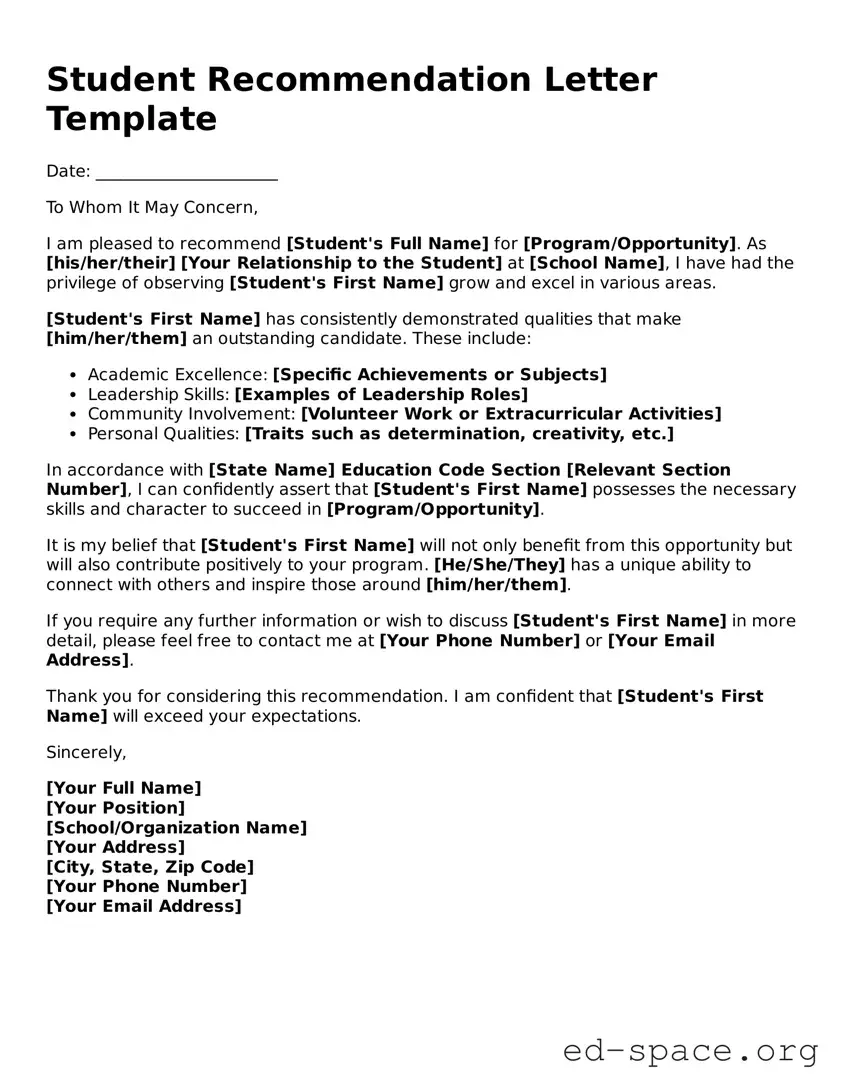
Student Recommendation Letter Template
Date: ______________________
To Whom It May Concern,
I am pleased to recommend [Student's Full Name] for [Program/Opportunity]. As [his/her/their] [Your Relationship to the Student] at [School Name], I have had the privilege of observing [Student's First Name] grow and excel in various areas.
[Student's First Name] has consistently demonstrated qualities that make [him/her/them] an outstanding candidate. These include:
In accordance with [State Name] Education Code Section [Relevant Section Number], I can confidently assert that [Student's First Name] possesses the necessary skills and character to succeed in [Program/Opportunity].
It is my belief that [Student's First Name] will not only benefit from this opportunity but will also contribute positively to your program. [He/She/They] has a unique ability to connect with others and inspire those around [him/her/them].
If you require any further information or wish to discuss [Student's First Name] in more detail, please feel free to contact me at [Your Phone Number] or [Your Email Address].
Thank you for considering this recommendation. I am confident that [Student's First Name] will exceed your expectations.
Sincerely,
[Your Full Name]
[Your Position]
[School/Organization Name]
[Your Address]
[City, State, Zip Code]
[Your Phone Number]
[Your Email Address]
| Fact Name | Description |
|---|---|
| Purpose | The Student Recommendation Letter form is used to provide a formal endorsement of a student’s abilities and character. |
| Common Use | This form is typically required for college applications, scholarship opportunities, and certain job applications. |
| Format | The form can be submitted in both digital and paper formats, depending on the institution's requirements. |
| Content Requirements | It usually includes sections for the recommender's information, the student's information, and the recommendation itself. |
| Confidentiality | Some forms allow for confidentiality, meaning the student may not see the recommendation once submitted. |
| Signature Requirement | A signature from the recommender is often required to validate the recommendation. |
| State-Specific Forms | Some states have specific guidelines governing the use of recommendation letters, including privacy laws. |
| Governing Law (California) | California Education Code Section 49063 governs the handling of student records, including recommendations. |
| Governing Law (New York) | New York Education Law Section 2-d addresses the confidentiality of student data, impacting recommendation letters. |
| Submission Deadlines | It is crucial to adhere to submission deadlines set by the institution to ensure the recommendation is considered. |
Once you have the Student Recommendation Letter form in hand, it's time to get started on filling it out. This process is straightforward, and following these steps will ensure that you provide all the necessary information clearly and accurately.
After completing the form, ensure that it is submitted according to the instructions provided. This might involve mailing it, emailing it, or submitting it online, depending on the requirements of the institution requesting the recommendation.
What is the purpose of the Student Recommendation Letter form?
The Student Recommendation Letter form is designed to facilitate the process of gathering recommendations from teachers, mentors, or other individuals who can attest to a student's qualifications, character, and achievements. This form provides a structured way for recommenders to share their insights and observations, ensuring that students receive comprehensive support in their academic or professional pursuits.
Who should I ask to complete my recommendation letter?
It is advisable to choose individuals who know you well and can speak to your strengths and abilities. Teachers from relevant subjects, coaches, or supervisors from volunteer work or internships are excellent choices. Ideally, select someone who can provide specific examples of your skills, work ethic, and contributions. This personal touch can significantly enhance the quality of your recommendation.
How do I submit the Student Recommendation Letter form?
Submission methods may vary depending on your institution's guidelines. Typically, you will either provide the recommender with a printed copy of the form or direct them to an online portal. Ensure that you communicate clearly with your recommenders about the submission process and deadlines. Follow up respectfully to confirm that they have submitted their letters on time.
What should I do if my recommender is unable to complete the form?
If a recommender is unable to complete the form for any reason, it is important to address the situation promptly. Consider asking another individual who can provide a strong recommendation. If time allows, you might also offer to assist your original recommender by providing additional information or context about your accomplishments and goals. Open communication is key to finding a suitable solution.
Incomplete Information: Many individuals forget to provide all required details, such as the student's full name, the institution they are applying to, or the specific program. Missing this information can delay the process or even render the recommendation invalid.
Generic Responses: A common mistake is writing a letter that lacks personal anecdotes or specific examples of the student's achievements. A generic recommendation does not effectively showcase the student's unique qualities and strengths.
Failure to Follow Instructions: Each institution may have different requirements for recommendation letters. Ignoring these guidelines can lead to issues. It is essential to carefully read and follow any instructions provided.
Overly Formal or Informal Tone: Striking the right balance in tone is crucial. A letter that is too formal may come off as stiff, while an overly casual tone can seem unprofessional. Aim for a tone that reflects the relationship with the student while remaining respectful.
Neglecting to Proofread: Spelling and grammatical errors can undermine the credibility of the recommendation. Taking the time to carefully proofread the letter helps ensure clarity and professionalism.
Not Highlighting Relevant Skills: Failing to emphasize the skills and qualities that are particularly relevant to the program or position can weaken the recommendation. Tailoring the letter to align with the student's goals is important.
Missing a Personal Touch: A recommendation letter should reflect the writer's genuine feelings about the student. Including personal insights or observations can make the letter more impactful and memorable.
When applying for educational opportunities, students often need to submit various documents alongside the Student Recommendation Letter. Each of these documents serves a specific purpose and can enhance the overall application. Below is a list of commonly used forms and documents that complement the Student Recommendation Letter.
These documents, when submitted together with the Student Recommendation Letter, create a comprehensive picture of the applicant. Each piece contributes valuable information that can influence the decision-making process of educational institutions.
Letter of Intent: This document outlines a person's goals and intentions, often for educational programs or job applications. Like a recommendation letter, it provides insight into the individual's aspirations and qualifications.
Personal Statement: A personal statement allows individuals to express their experiences and motivations. Similar to a recommendation letter, it offers a narrative that highlights personal strengths and suitability for a program.
Curriculum Vitae (CV): A CV details a person's educational background and work experience. While it is more factual, it complements a recommendation letter by providing a comprehensive view of qualifications.
Transcript: A transcript records a student's academic performance. It serves as a factual basis that can support claims made in a recommendation letter regarding a student's abilities and achievements.
Application Form: This document collects essential information from applicants. Similar to a recommendation letter, it is a critical component of the application process, providing context for the candidate's qualifications.
When it comes to filling out a Student Recommendation Letter form, there are some important dos and don'ts to keep in mind. A well-prepared recommendation can open doors for students, while a poorly filled form can have the opposite effect. Here’s a helpful list to guide you through the process.
By following these guidelines, you can create a strong recommendation that truly reflects the student's potential. A thoughtful recommendation can make a significant impact on their future opportunities.
Understanding the Student Recommendation Letter form can be challenging. Here are six common misconceptions that people often have:
All recommendation letters are the same. Many believe that a recommendation letter can be generic. In reality, each letter should be tailored to the specific student and the opportunity they are pursuing. Personalized details make a significant impact.
Teachers are obligated to write letters. Some students think that teachers must provide recommendations. However, teachers are not required to write these letters and may decline if they feel they cannot provide a strong endorsement.
Length determines quality. There is a misconception that longer letters are better. A concise, well-written letter that highlights key strengths can be more effective than a lengthy one filled with fluff.
Only academic performance matters. Many assume that only grades and test scores are relevant. While academic performance is important, personal qualities, extracurricular activities, and character traits are equally significant in a recommendation.
Submitting a letter is all that is required. Some students think that simply providing a recommendation letter is sufficient. In many cases, schools or organizations may require additional information or context to fully evaluate the letter.
All recommenders have the same perspective. It is a common belief that any teacher or mentor can provide a similar viewpoint. However, different recommenders may highlight various aspects of a student's abilities, making diverse perspectives valuable.
By clarifying these misconceptions, students can better navigate the process of obtaining effective recommendation letters.
When it comes to filling out and using the Student Recommendation Letter form, there are several important points to keep in mind. These tips will help ensure that the process goes smoothly and that the letter serves its intended purpose effectively.
By keeping these key takeaways in mind, you can navigate the recommendation letter process with confidence and clarity.