When engaging in the buying or selling of company stock, a Stock Purchase Agreement (SPA) plays a crucial role in outlining the terms and conditions of the transaction. This legally binding document serves as a roadmap for both the buyer and the seller, ensuring that all parties are on the same page regarding the sale. Key components of the SPA typically include details about the number of shares being sold, the purchase price, and the payment terms. Additionally, the agreement often addresses representations and warranties made by both parties, which can protect against potential risks. Other important aspects may involve conditions precedent, which outline any requirements that must be met before the sale can be finalized, as well as provisions for confidentiality and dispute resolution. By clearly defining these elements, the Stock Purchase Agreement helps to facilitate a smoother transaction and minimizes the potential for misunderstandings down the line.
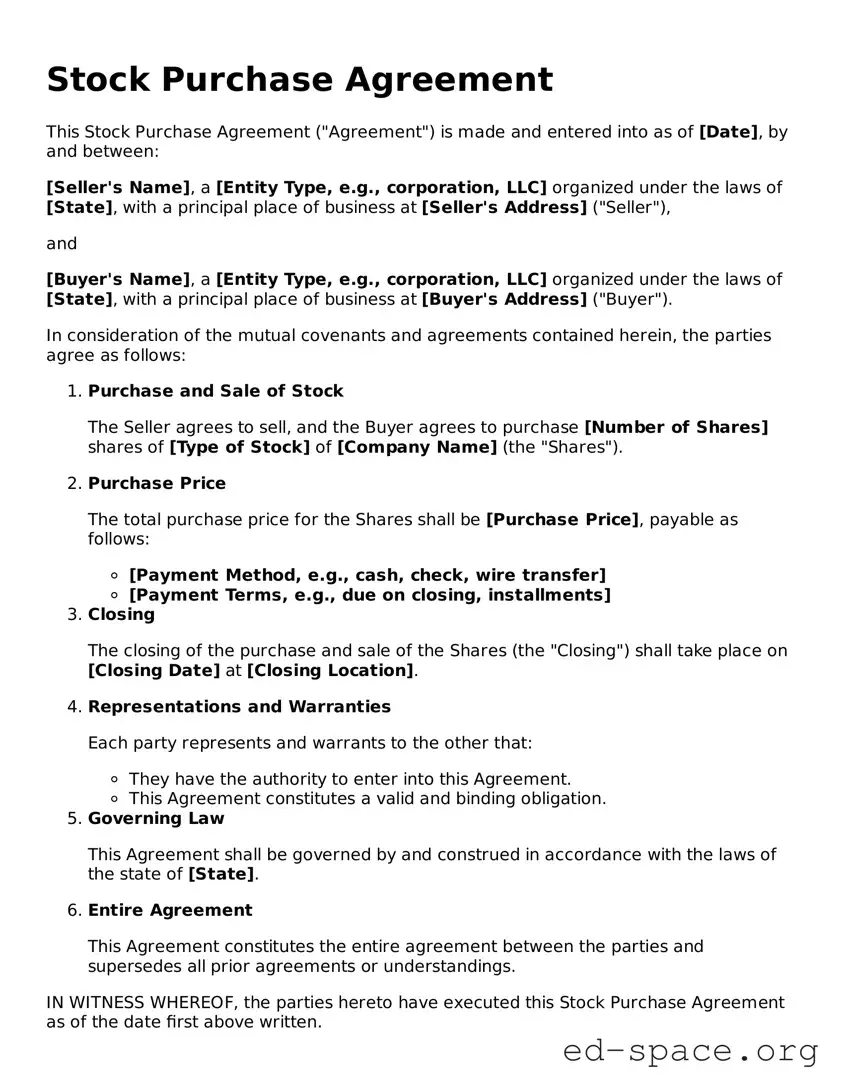
Stock Purchase Agreement
This Stock Purchase Agreement ("Agreement") is made and entered into as of [Date], by and between:
[Seller's Name], a [Entity Type, e.g., corporation, LLC] organized under the laws of [State], with a principal place of business at [Seller's Address] ("Seller"),
and
[Buyer's Name], a [Entity Type, e.g., corporation, LLC] organized under the laws of [State], with a principal place of business at [Buyer's Address] ("Buyer").
In consideration of the mutual covenants and agreements contained herein, the parties agree as follows:
The Seller agrees to sell, and the Buyer agrees to purchase [Number of Shares] shares of [Type of Stock] of [Company Name] (the "Shares").
The total purchase price for the Shares shall be [Purchase Price], payable as follows:
The closing of the purchase and sale of the Shares (the "Closing") shall take place on [Closing Date] at [Closing Location].
Each party represents and warrants to the other that:
This Agreement shall be governed by and construed in accordance with the laws of the state of [State].
This Agreement constitutes the entire agreement between the parties and supersedes all prior agreements or understandings.
IN WITNESS WHEREOF, the parties hereto have executed this Stock Purchase Agreement as of the date first above written.
Seller:
_____________________________
[Seller's Name]
Buyer:
_____________________________
[Buyer's Name]
| Fact Name | Description |
|---|---|
| Definition | A Stock Purchase Agreement is a legal document outlining the terms under which an individual or entity buys stock from a company. |
| Parties Involved | The agreement typically involves a seller (the current stockholder) and a buyer (the individual or entity purchasing the stock). |
| Governing Law | The governing law varies by state. For example, agreements executed in Delaware are often governed by Delaware law. |
| Key Components | Important elements include purchase price, number of shares, representations and warranties, and closing conditions. |
| Confidentiality Clause | Many agreements include a confidentiality clause to protect sensitive information shared during the transaction. |
| Dispute Resolution | Provisions for dispute resolution, such as arbitration or mediation, are often included to address potential conflicts arising from the agreement. |
Once you have the Stock Purchase Agreement form in hand, it is essential to complete it accurately to ensure a smooth transaction. The following steps will guide you through the process of filling out the form correctly.
What is a Stock Purchase Agreement?
A Stock Purchase Agreement is a legal document that outlines the terms and conditions under which one party agrees to buy shares of stock from another party. It serves to protect both the buyer and the seller by clearly defining the rights and obligations of each party involved in the transaction.
Who typically uses a Stock Purchase Agreement?
This agreement is commonly used by companies looking to sell shares of stock to investors or other businesses. It is also utilized by individuals purchasing shares in private companies. Anyone involved in the buying or selling of stock should consider using this document to ensure clarity and legal protection.
What are the key components of a Stock Purchase Agreement?
Key components typically include the purchase price, number of shares being sold, representations and warranties of both parties, closing conditions, and any contingencies. These elements help to ensure that both parties understand the specifics of the transaction.
Is a Stock Purchase Agreement legally binding?
Yes, once signed by both parties, a Stock Purchase Agreement becomes a legally binding contract. This means that both the buyer and the seller are obligated to fulfill the terms outlined in the agreement. It's crucial to review the document carefully before signing.
Do I need a lawyer to draft a Stock Purchase Agreement?
While it is possible to draft a Stock Purchase Agreement without a lawyer, it is highly recommended to seek legal assistance. A lawyer can help ensure that the agreement meets all legal requirements and adequately protects your interests.
What happens if one party breaches the Stock Purchase Agreement?
If one party fails to uphold their end of the agreement, the other party may have legal grounds to pursue remedies. This could include seeking damages or enforcing the terms of the agreement in court. The specific actions depend on the nature of the breach and the terms outlined in the agreement.
Can a Stock Purchase Agreement be modified after it is signed?
Yes, a Stock Purchase Agreement can be modified after it is signed, but both parties must agree to the changes. Modifications should be documented in writing and signed by both parties to ensure they are enforceable.
What is the difference between a Stock Purchase Agreement and an Asset Purchase Agreement?
A Stock Purchase Agreement involves the sale of shares in a company, while an Asset Purchase Agreement involves the sale of specific assets of a business, such as equipment, inventory, or intellectual property. The choice between the two depends on the goals of the buyer and seller.
When should I use a Stock Purchase Agreement?
You should use a Stock Purchase Agreement whenever you are buying or selling shares of stock. This includes transactions involving private companies, startups, or any situation where ownership of stock is being transferred. Having a formal agreement helps prevent misunderstandings.
Where can I obtain a Stock Purchase Agreement template?
Stock Purchase Agreement templates can be found online through legal websites, or you can consult with a legal professional to create a customized agreement that meets your specific needs. Ensure that any template you use complies with state laws and regulations.
Inaccurate Information: One common mistake is providing incorrect or outdated information. This can include misspelled names, wrong addresses, or incorrect numbers. Always double-check your details before submitting.
Missing Signatures: Failing to sign the agreement is another frequent error. All parties involved must sign the document. Make sure everyone has reviewed and agreed to the terms before signing.
Not Reviewing Terms: Many individuals overlook the importance of understanding the terms outlined in the agreement. Take the time to read through each section carefully. If something is unclear, seek clarification.
Ignoring State Regulations: Each state may have specific regulations regarding stock purchases. Ignoring these can lead to complications. Research local laws to ensure compliance.
A Stock Purchase Agreement is an important document in the sale of shares between parties. Along with this agreement, there are several other forms and documents that are often used to ensure a smooth transaction. Below is a list of these documents, each serving a specific purpose in the process.
These documents work together to create a comprehensive framework for the stock purchase process. Understanding each one can help ensure that both parties are informed and protected throughout the transaction.
When filling out the Stock Purchase Agreement form, it is important to follow certain guidelines to ensure accuracy and compliance. Here are four key do's and don'ts:
Understanding the Stock Purchase Agreement (SPA) is crucial for anyone involved in buying or selling stock in a company. However, several misconceptions often arise. Here is a list of ten common misconceptions about SPAs, along with clarifications to help demystify this important document.
By addressing these misconceptions, individuals can approach Stock Purchase Agreements with a clearer understanding, leading to better-informed decisions and smoother transactions.
When filling out and using the Stock Purchase Agreement form, consider the following key takeaways:
Understanding these elements can facilitate a smoother transaction and help prevent future disputes.