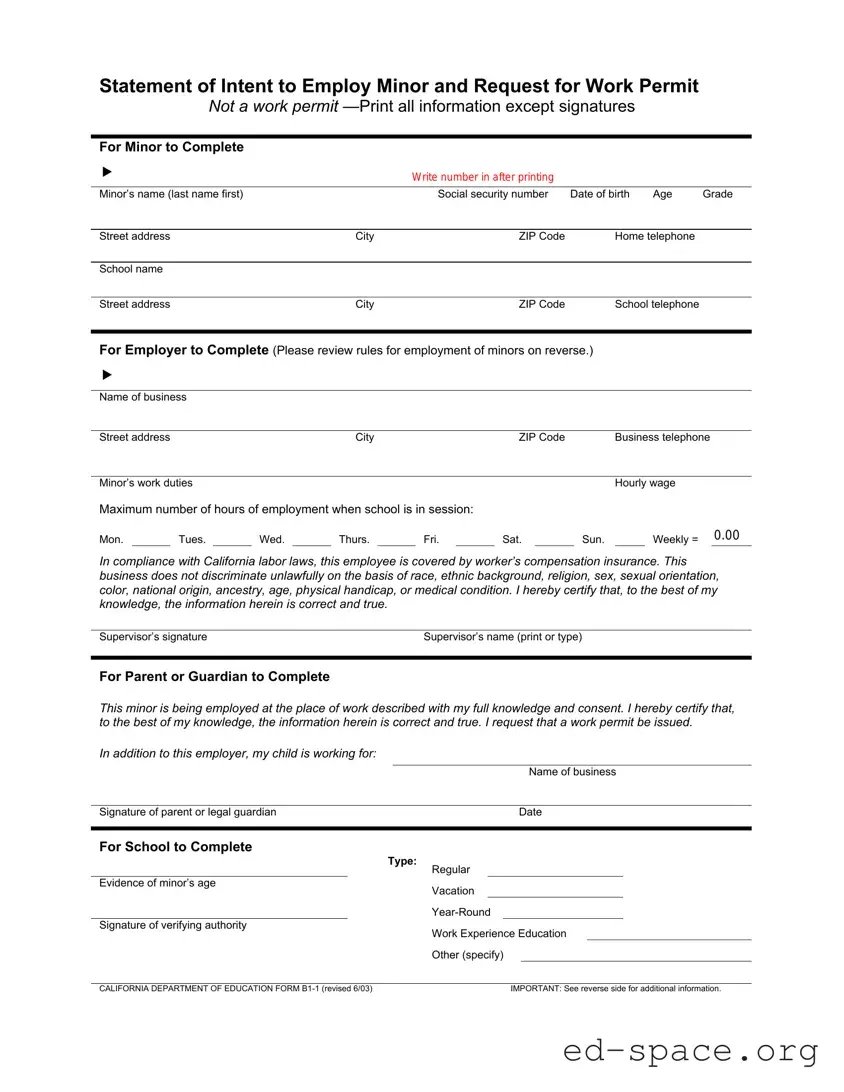
In the dynamic landscape of youth employment, the Statement of Intent to Employ Minor and Request for Work Permit form serves as a crucial gateway for minors seeking to enter the workforce legally. This form is not merely a bureaucratic requirement; it embodies the intersection of labor law and child welfare, ensuring that young workers are protected while gaining valuable experience. It outlines the responsibilities of both the employer and the minor, detailing the necessary information that must be submitted, such as the minor's personal details, the nature of the job, and the hours they are permitted to work. Additionally, it requires the signature of a parent or guardian, underscoring the importance of parental involvement in a minor's employment decisions. By necessitating this documentation, states aim to regulate the employment of minors, preventing exploitation while promoting a safe and supportive work environment. Understanding this form is essential for employers, parents, and minors alike, as it encapsulates the legal framework governing youth employment and highlights the balance between opportunity and protection.

Statement of Intent to Employ Minor and Request for Work Permit
Not a work permit
For Minor to Complete
• |
|
Write number in after printing |
|
|
|
|
|
|
|
|
|
Minor’s name (last name first) |
|
Social security number |
Date of birth |
Age |
Grade |
|
|
|
|
|
|
Street address |
City |
ZIP Code |
Home telephone |
|
|
|
|
|
|
|
|
School name |
|
|
|
|
|
|
|
|
|
|
|
Street address |
City |
ZIP Code |
School telephone |
|
|
For Employer to Complete (Please review rules for employment of minors on reverse.)
•
Name of business
Street address |
City |
ZIP Code |
Business telephone |
|
|
|
|
Minor’s work duties |
|
|
Hourly wage |
Maximum number of hours of employment when school is in session:
Mon. |
|
Tues. |
|
Wed. |
|
Thurs. |
|
Fri. |
|
Sat. |
|
Sun. |
|
Weekly = 0.00 |
|
|
|
|
|
|
|
|
|
|
|
|
|
|
|
|
|
In compliance with California labor laws, this employee is covered by worker’s compensation insurance. This business does not discriminate unlawfully on the basis of race, ethnic background, religion, sex, sexual orientation, color, national origin, ancestry, age, physical handicap, or medical condition. I hereby certify that, to the best of my knowledge, the information herein is correct and true.
Supervisor’s signature |
Supervisor’s name (print or type) |
For Parent or Guardian to Complete
This minor is being employed at the place of work described with my full knowledge and consent. I hereby certify that, to the best of my knowledge, the information herein is correct and true. I request that a work permit be issued.
In addition to this employer, my child is working for:
Name of business
Signature of parent or legal guardian |
Date |
|
|
For School to Complete
Type: Regular
Evidence of minor’s age
Vacation
Signature of verifying authority
Work Experience Education
Other (specify)
CALIFORNIA DEPARTMENT OF EDUCATION FORM |
IMPORTANT: See reverse side for additional information. |

General Summary of Minors’ Work Regulations
•If federal laws, state laws and school district policies conflict, the more restrictive law (the one most protective of the employee) prevails.
•Generally, minors must attend school until age 18 unless they are 16 years or older and have graduated from high school or received a state Certificate of Proficiency.
•Employers of minors required to attend school must complete a “Statement of Intent to Employ Minor and Request for Work Permit” (form
•Employers must retain a “Permit to Employ and Work” (form
•Work permits
•A work permit
Minors under the age of 18 may not work in environments declared hazardous or dangerous for young workers as listed below:
1.Explosive exposure
2.Motor vehicle driving/outside helper
3.Coal mining
4.Logging and sawmilling
5.
6.Radiation exposure
7.
8.
9.Other mining
10.
11.
12.
13.Manufacturing brick, tile products
14.Power saws and shears
15.Wrecking, demolition
16.Roofing
17.Excavation operation
For more complete information about hazardous occupations, contact the U.S. Department of Labor (Child Labor Bulletins 101 and 102) and the California Department of Industrial Relations, Division of Labor Standards Enforcement. Regional offices are located in several California cities. They are listed in the “Government Listings” sections of telephone directories.
•Minors younger than 16 years are allowed to work only in limited, specified occupations that exclude baking, manufacturing, processing, construction, warehouse, and transportation occupations.
•In addition to safety regulations, labor laws applicable to adult employees also generally apply to minor employees, including workers’ compensation insurance requirements.
•Child labor laws do not generally apply to minors who deliver newspapers or work at odd jobs, such as yard
work and
•A day of rest from work is required if the total hours worked per week exceed 30 or if more than 6 hours are worked on any one day during the week.
Ages |
Hours of Work |
16 – 17 When school is in session: Daily maximum of 4 hours, Monday through Thursday. May work up to 8 hours on any
When school not in session: May work up to 48 hours per week but no more than 8 hours in any one day.
Work must be performed no earlier than 5 a.m. or later than 10 p.m. except that work may extend to 12:30 a.m. on nights preceding non- school days. Students in Work Experience Education or cooperative vocational education programs may be authorized to work until 12:30 a.m. on nights preceding school days with specified written permission.
14 – 15 When school is in session: On school days daily maximum 3 hours. On
When school is not in session: Daily maximum 8 hours and weekly maximum 40 hours.
May not work during public school hours except students in Work Experience Education or career exploration programs.
Work must be performed no earlier than 7 a.m. nor later than 7 p.m. any day of the week. From June 1 to Labor Day work hours may be extended to 9 p.m.
Younger Labor laws generally prohibit nonfarm than 14 employment of children younger than 14.
Special rules apply to agricultural work, domestic work and the entertainment industry.
| Fact Name | Description |
|---|---|
| Purpose | The Statement of Intent to Employ Minor and Request for Work Permit form is designed to ensure that minors are legally allowed to work and that their employment complies with state regulations. |
| Eligibility | This form is typically required for minors under the age of 18 who seek employment. Each state has specific age requirements and restrictions for different types of work. |
| Governing Laws | In many states, including California and New York, the issuance of work permits for minors is governed by state labor laws, which set forth the conditions under which minors can be employed. |
| Submission Process | After completing the form, it must be submitted to the appropriate state agency or school official for approval before the minor can begin working. |
After completing the Statement of Intent to Employ Minor and Request for Work Permit form, the next step involves submitting it to the appropriate authority for approval. Ensure that all sections are filled out accurately to avoid delays in processing.
What is the Statement of Intent to Employ Minor and Request for Work Permit form?
The Statement of Intent to Employ Minor and Request for Work Permit form is a document that employers must complete to legally hire minors. This form ensures that the employment complies with state and federal labor laws, protecting the rights of young workers. It outlines the employer's intention to hire a minor and requests the necessary work permit from the appropriate authority.
Who needs to fill out this form?
Employers who wish to hire individuals under the age of 18 must complete this form. Additionally, the minor’s parent or guardian may need to provide consent, depending on state regulations. This process helps to ensure that the minor's working conditions are safe and that their education is not adversely affected by their employment.
What information is required on the form?
The form typically requires details such as the employer's name and contact information, the minor's name, age, and address, as well as the type of work the minor will be doing. It may also ask for the hours the minor is expected to work and the parental consent signature if applicable. Providing accurate information is crucial for the approval of the work permit.
How do I submit the form?
Is there a fee associated with the work permit?
In many cases, there is no fee for submitting the Statement of Intent to Employ Minor and Request for Work Permit form. However, some states may charge a nominal fee for processing the work permit. It’s advisable to review your state’s regulations for any potential costs involved.
How long does it take to receive the work permit?
The processing time for a work permit can vary by state and the volume of applications being processed. Typically, you can expect to receive the permit within a few days to a couple of weeks after submission. It’s important to plan ahead and submit the form as early as possible to avoid delays in the minor's employment start date.
What are the consequences of not using this form?
Failing to complete the Statement of Intent to Employ Minor and Request for Work Permit form can lead to serious legal consequences for both the employer and the minor. Employers may face fines or penalties for violating child labor laws, and minors may be at risk of working in unsafe conditions or being employed in jobs that are inappropriate for their age.
Can the work permit be revoked?
Yes, a work permit can be revoked if the minor is found to be working in violation of labor laws or if the employer fails to adhere to the conditions outlined in the permit. This may include issues such as exceeding allowed work hours or failing to provide a safe working environment. It’s essential for both employers and minors to understand and follow the regulations to maintain the validity of the work permit.
Not providing complete information. It's essential to fill out every section of the form. Missing details can lead to delays or denials.
Incorrectly listing the minor's age. Double-check the birth date to ensure it accurately reflects the minor's current age.
Failing to include the employer's information. Make sure to provide the correct name and address of the business hiring the minor.
Omitting the job description. Clearly describe the duties and responsibilities associated with the minor's position.
Not obtaining the necessary signatures. Ensure that both the employer and the parent or guardian sign the form before submission.
Using outdated forms. Always check for the most current version of the form to avoid using obsolete information.
Ignoring local laws and regulations. Familiarize yourself with state-specific requirements for employing minors.
Submitting the form without reviewing it. Take the time to proofread the entire document for errors before sending it in.
The Statement of Intent to Employ Minor and Request for Work Permit form is an important document for employers who wish to hire minors. Along with this form, several other documents are often required to ensure compliance with labor laws. Below is a list of related forms and documents commonly used in this process.
These documents work together with the Statement of Intent to ensure that the employment of minors is handled properly and legally. Keeping these forms organized and up to date is crucial for compliance with labor regulations.
The Statement of Intent to Employ Minor and Request for Work Permit form is an important document for employers seeking to hire minors. Several other documents serve similar purposes in ensuring compliance with labor laws and protecting the rights of young workers. Below is a list of eight documents that share similarities with this form:
When filling out the Statement of Intent to Employ Minor and Request for Work Permit form, it is essential to follow certain guidelines to ensure accuracy and compliance. Below is a list of things you should and shouldn't do.
The Statement of Intent to Employ Minor and Request for Work Permit form is often misunderstood. Here are ten common misconceptions about this form:
Understanding these misconceptions can help ensure compliance with labor laws and promote a safe working environment for minors.
Before completing the Statement of Intent to Employ Minor and Request for Work Permit form, ensure you understand the specific labor laws regarding minors in your state.
The form must be filled out accurately and completely to avoid delays in processing. Double-check all information provided.
Both the employer and the minor's parent or guardian must sign the form. This ensures that all parties are aware of the employment terms.
Submit the completed form to the appropriate state agency or local office, as required by your state’s regulations.
Keep a copy of the submitted form for your records. This can be useful for future reference or in case of any disputes.
Once the work permit is issued, it is valid for a specific period. Monitor expiration dates to ensure compliance with labor laws.
Employers should maintain a safe working environment for minors, adhering to all safety regulations and guidelines.