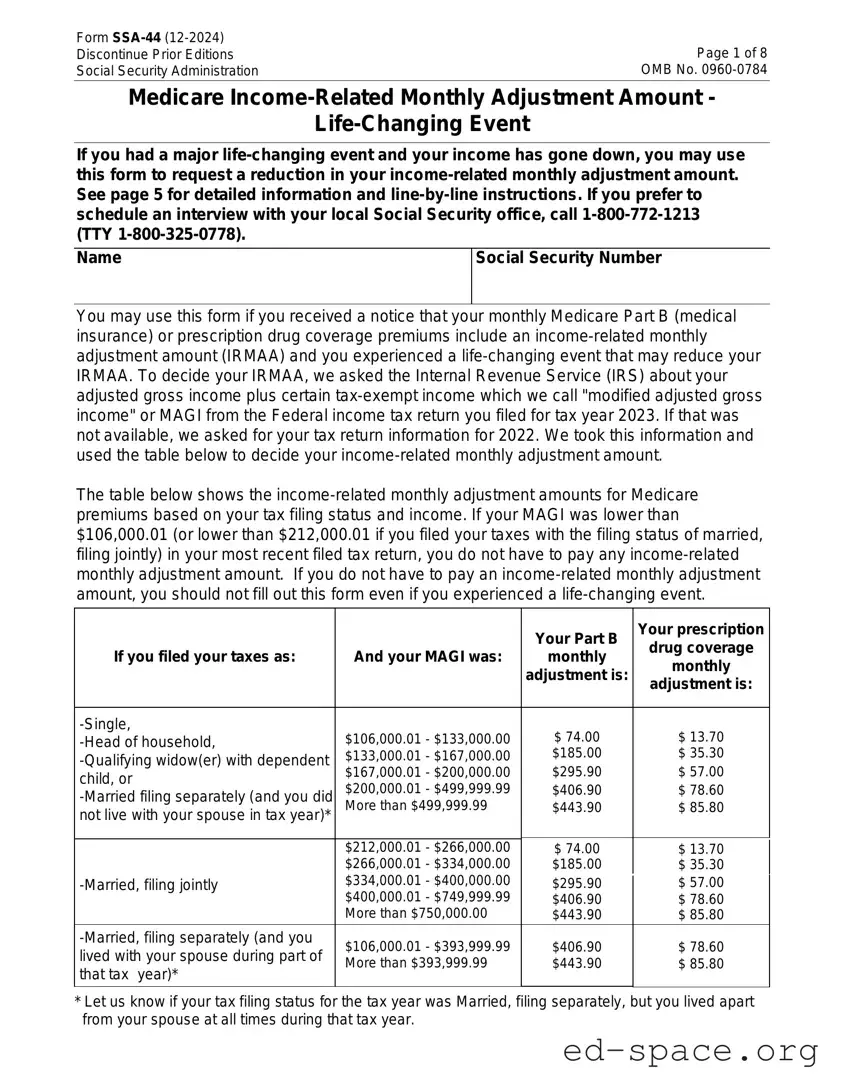
The SSA SSA-44 form plays a crucial role in the Social Security Administration's efforts to assist individuals who may be experiencing financial hardships. This form is primarily used to request a reduction in the income-related monthly adjustment amount (IRMAA) for Medicare premiums. Many people may not realize that their income can fluctuate, impacting their ability to afford healthcare costs. By completing the SSA-44, beneficiaries can provide evidence of qualifying life changes, such as a significant decrease in earnings, which may warrant a reassessment of their premium rates. This form not only serves as a means of communication with the Social Security Administration but also empowers individuals to advocate for their financial well-being. Understanding the nuances of the SSA-44 is essential for anyone navigating the complexities of Medicare costs, especially as they relate to income changes. The application process, while straightforward, requires careful attention to detail to ensure that all necessary information is included for a successful review.

Form |
Page 1 of 8 |
Discontinue Prior Editions |
|
Social Security Administration |
OMB No. |
Medicare
If you had a major
Name
Social Security Number
You may use this form if you received a notice that your monthly Medicare Part B (medical insurance) or prescription drug coverage premiums include an
The table below shows the
|
|
Your Part B |
Your prescription |
|
|
|
drug coverage |
||
If you filed your taxes as: |
And your MAGI was: |
monthly |
||
monthly |
||||
|
|
adjustment is: |
||
|
|
adjustment is: |
||
|
|
|
||
|
|
|
|
|
$106,000.01 - $133,000.00 |
$ 74.00 |
$ 13.70 |
||
$133,000.01 - $167,000.00 |
$185.00 |
$ 35.30 |
||
child, or |
$167,000.01 - $200,000.00 |
$295.90 |
$ 57.00 |
|
$200,000.01 - $499,999.99 |
$406.90 |
$ 78.60 |
||
More than $499,999.99 |
$443.90 |
$ 85.80 |
||
not live with your spouse in tax year)* |
|
|
|
|
|
|
|
|
|
|
$212,000.01 - $266,000.00 |
$ 74.00 |
$ 13.70 |
|
|
$266,000.01 - $334,000.00 |
$185.00 |
$ 35.30 |
|
$334,000.01 - $400,000.00 |
$295.90 |
$ 57.00 |
||
|
$400,000.01 - $749,999.99 |
$406.90 |
$ 78.60 |
|
|
More than $750,000.00 |
$443.90 |
$ 85.80 |
|
$106,000.01 - $393,999.99 |
$406.90 |
$ 78.60 |
||
lived with your spouse during part of |
||||
More than $393,999.99 |
$443.90 |
$ 85.80 |
||
that tax year)* |
||||
|
|
|
||
|
|
|
|
*Let us know if your tax filing status for the tax year was Married, filing separately, but you lived apart from your spouse at all times during that tax year.

Form |
Page 2 of 8 |
STEP 1: Type of
Check any
Marriage |
Work Reduction |
Divorce/Annulment |
Loss of |
Death of Your Spouse |
Loss of Pension Income |
Work Stoppage |
Employer Settlement Payment |
Date(s) of |
|
|
|
|
(mm/yyyy) |
If you have had or anticipate having a
STEP 2: Reductions in Income that have Already Occurred
If your income has already been reduced by the
Tax Year |
|
Adjusted Gross Income |
|
2 0 __ __ |
$ __ __ __ __ __ __ . __ __ |
$ __ __ __ __ __ __ . __ __ |
|
|
|
|
|
Tax Filing Status for this Tax Year (choose ONE ): |
|
||
Single |
|
Head of Household |
Qualifying Widow(er) |
|
with Dependent Child |
||
|
|
|
|
Married, Filing Jointly |
Married, Filing Separately |
|
|
|
|
|
|
STEP 3: Anticipated Reductions in Modified Adjusted Gross Income Next Year
Will your modified adjusted gross income be lower next year than the year in Step 2?
No - Skip to STEP 4
Yes - Complete the blocks below for next year
Tax Year |
Estimated Adjusted Gross Income |
|
Estimated |
|
2 0 __ __ |
$ __ __ __ __ __ __. __ __ |
|
$ __ __ __ __ __ __. __ __ |
|
|
|
|
|
|
Expected Tax Filing Status for this Tax Year (choose |
ONE ): |
|||
Single |
|
Head of Household |
|
Qualifying Widow(er) |
|
|
|
|
with Dependent Child |
Married, Filing Jointly |
Married, Filing Separately |
|||
|
|
|
|
|

Form |
Page 3 of 8 |
STEP 4: Documentation
Provide evidence of your modified adjusted gross income (MAGI) and your
1.Attach the required evidence and we will mail your original documents or certified copies back to you;
OR
2.Show your original documents or certified copies of evidence of your
Note: You must sign in Step 5 and attach all required evidence. Make sure that you provide your current address and a phone number so that we can contact you if we have any questions about your request.
STEP 5: Signature
PLEASE READ THE FOLLOWING INFORMATION CAREFULLY BEFORE SIGNING THIS FORM.
I understand that the Social Security Administration (SSA) will check my statements with records from the Internal Revenue Service to make sure the determination is correct.
I declare under penalty of perjury that I have examined the information on this form and it is true and correct to the best of my knowledge.
I understand that signing this form does not constitute a request for SSA to use more recent tax year information unless it is accompanied by:
•Evidence that I have had the
•A copy of my Federal tax return; or
•Other evidence of the more recent tax year's modified adjusted gross income
Signature
Phone Number
Mailing Address
Apartment Number
City
State
ZIP Code

Form |
Page 4 of 8 |
Privacy Act Statement
Collection and Use of Personal Information
Sections 1839(i) and
We will use the information you provide to determine if you qualify for a reduction in or elimination of IRMAA. We may also share the information for the following purposes, called routine uses:
•To contractors and other Federal agencies, as necessary, for the purpose of assisting SSA in the efficient administration of its programs. We contemplate disclosing information under this routine use only in situations in which SSA may enter into a contractual or similar agreement with a third party to assist in accomplishing an agency function relating to this system of records; and
•To applicants, claimants, prospective applicants or claimants (other than the data subjects and their authorized representatives) to the extent necessary for the purpose of administering Medicare Part A, Part B, Medicare Advantage Part C, and Medicare Part D, including but not limited to pursuing Medicare Part B, Part C and Part D premium collection.
In addition, we may share this information in accordance with the Privacy Act and other Federal laws. For example, where authorized, we may use and disclose this information in computer matching programs, in which our records are compared with other records to establish or verify a person's eligibility for Federal benefit programs and for repayment of incorrect or delinquent debts under these programs.
A list of additional routine uses is available in our Privacy Act System of Records Notice (SORN)
Paperwork Reduction Act Statement
This information collection meets the requirements of 44 U.S.C. § 3507, as amended by section 2 of the Paperwork Reduction Act of 1995. You do not need to answer these questions unless we display a valid Office of Management and Budget (OMB) control number. We estimate that it will take about 45 minutes to read the instructions, gather the facts, and answer the questions. Send only comments relating this burden estimate or any other aspect of this collection, including suggestions for reducing this burden to: SSA, 6401 Security Blvd, Baltimore, MD

Form |
Page 5 of 8 |
INSTRUCTIONS FOR COMPLETING FORM
Medicare
You do not have to complete this form in order to ask that we use your information about your modified adjusted gross income for a more recent tax year. If you prefer, you may call
Identifying Information
Print your full name and your own Social Security Number as they appear on your Social Security card. Your Social Security Number may be different from the number on your Medicare card.
STEP 1
You should choose any
|
Use this category if... |
|
|
|
Marriage |
You entered into a legal marriage. |
|
|
|
|
|
|
Divorce/Annulment |
Your legal marriage ended, and you will not file a joint return |
|
|
with your spouse for the year. |
|
|
|
|
|
|
|
Death of Your Spouse |
Your spouse died. |
|
|
|
|
|
|
Work Stoppage or Reduction |
You or your spouse stopped working or reduced the hours |
|
|
that you work. |
|
|
|
|
|
|
|
|
You or your spouse experienced a loss of |
|
|
|
property that was not at your direction (e.g., not due to the |
|
|
Loss of |
sale or transfer of the property). This includes loss of real |
|
|
property in a Presidentially or |
|
|
|
Property |
|
|
|
disaster area, destruction of livestock or crops due to natural |
|
|
|
|
|
|
|
|
disaster or disease, or loss of property due to arson, or loss |
|
|
|
of investment property due to fraud or theft. |
|
|
|
|
|
|
Loss of Pension Income |
You or your spouse experienced a scheduled cessation, |
|
|
termination, or reorganization of an employer's pension plan. |
|
|
|
|
|
|
|
|
You or your spouse receive a settlement from an employer |
|
|
Employer Settlement Payment |
or former employer because of the employer's bankruptcy or |
|
|
|
reorganization. |
|
|
|
|
|

Form |
Page 6 of 8 |
INSTRUCTIONS FOR COMPLETING FORM
STEP 2
Supply information about the more recent year's modified adjusted gross income (MAGI). Note that this year must reflect a reduction in your income due to the
Tax Year
•Fill in both empty spaces in the box that says “20_ _". The year you choose must be more recent than the year of the tax return information we used. The letter that we sent you tells you what tax year we used.
•Choose this year (the "premium year") - if your modified adjusted gross income is lower this year than last year. For example, if you request that we adjust your
1.Your income was not reduced until 2025; or
2.Your income was reduced in 2024, but will be lower in 2025.
•Choose last year (the year before the "premium year," which is the year for which you want us to adjust your IRMAA) - if your MAGI is not lower this year than last year. For example, if you request that we adjust your 2025
•Exception: If we used IRS information about your MAGI 3 years before the premium year, you may ask us to use information from 2 years before the premium year. For example, if we used your income tax return for 2022 to decide your 2025 IRMAA, you can ask us to use your 2023 information.
•If you have any questions about what year you should use, you should call SSA.
Adjusted Gross Income
•Fill in your actual or estimated adjusted gross income for the year you wrote in the “tax year” box. Adjusted gross income is the amount on line 11 of IRS form 1040. If you are providing an estimate, your estimate should be what you expect to enter on your tax return for that year.
•Fill in your actual or estimated
Filing Status
•Check the box in front of your actual or expected tax filing status for the year you wrote in the “tax year” box.

Form |
Page 7 of 8 |
INSTRUCTIONS FOR COMPLETING FORM
STEP 3
Complete this step only if you expect that your MAGI for next year will be even lower. We will record this information and use it next year to determine your Medicare
Tax Year
•Fill in both empty spaces in the box that says “20 _ _ ” with the year following the year you wrote in Step 2. For example, if you wrote "2025" in Step 2, then write "2026" in Step 3.
Adjusted Gross Income
•Fill in your estimated adjusted gross income for the year you wrote in the “tax year” box. Adjusted gross income is the amount you expect to enter on line 11 of IRS form 1040 when you file your tax return for that year.
•Fill in your estimated
Filing Status
•Check the box in front of your expected tax filing status for the year you wrote in the “tax year” box.
STEP 4
Provide your required evidence of your MAGI and your
Modified Adjusted Gross Income Evidence
If you have filed your Federal Income tax return for the year you wrote in Step 2, then you must provide us with your signed copy of your tax return or a transcript from IRS. If you provided an estimate in Step 2, you must show us a signed copy of your tax return when you file your Federal income tax return for that year.
We must see original documents or certified copies of evidence that the

Form |
Page 8 of 8 |
|
Life Changing Event |
Evidence |
|
|
|
|
Marriage |
An original marriage certificate: or a certified copy of a public record of marriage. |
|
|
|
|
Divorce/Annulment |
A certified copy of the decree of divorce or annulment. |
|
|
|
|
Death of Your Spouse |
A certified copy of a death certificate, certified copy of the public record of death, or |
|
a certified copy of a coroner's certificate. |
||
|
||
|
|
|
|
An original signed statement from your employer; copies of pay stubs; original or |
|
Work Stoppage or |
certified documents that show a transfer of your business. |
|
|
||
Reduction |
Note: In the absence of such proof, we will accept your signed statement, under |
|
|
penalty of perjury, on this form, that you parially or dully stopped working or |
|
|
accepted a job with reduced compensation. |
|
|
|
|
Loss of Income |
An original copy of an insurance company adjuster's statement of loss or a letter |
|
from a State or Federal government about the uncompensated loss. If the loss was |
||
Producing Property |
due to investment fraud (theft), we also require proof of conviction for the theft, |
|
|
such as a court document citing theft or fraud relating to your or your spouse's loss. |
|
|
|
|
Loss of Pension Income |
A letter or statement from your pension fund administrator that explains the |
|
|
reduction or termination of your benefits. |
|
|
|
|
Employer Settlement |
A letter from the employer stating the settlement terms of the bankruptcy court and |
|
Payment |
how it affects you or your spouse. |
|
|
|
STEP 5
Read the information above the signature line, and sign the form. Fill in your phone number and current mailing address. It is very important that we have this information so that we can contact you if we have any questions about your request.
Important Facts
•When we use your estimated MAGI information to make a decision about your income- related monthly adjustment amount, we will later check with the IRS to verify your report.
•If you provide an estimate of your MAGI rather than a copy of your Federal tax return, we will ask you to provide a copy of your tax return when you file your taxes.
•If your estimate of your MAGI changes, or you amend your tax return for that reason, you will need to contact us to update our records. If you do not contact us, we may have to make corrections later including retroactive assessments or refunds.
•We will use your estimate provided in Step 2 to make a decision about the amount of your
•IRS sends us your tax return information for the year used in Step 2; or
•You provide a signed copy of your filed Federal Income tax return or amended Federal Income tax return with a different amount; or
•You provide an updated estimate.
•If we used information from IRS about a tax year when your filing status was Married filing separately, but you lived apart from your spouse at all times during that year, you should contact us at
| Fact Name | Description |
|---|---|
| Form Purpose | The SSA-44 form is used to request a reduction in income-related monthly adjustment amounts (IRMAA) for Medicare premiums. |
| Eligibility Criteria | Individuals may qualify for a reduction if their income has decreased due to certain life events, such as retirement or a significant medical expense. |
| Filing Deadline | There is no specific deadline for submitting the SSA-44 form, but it is recommended to file as soon as the qualifying event occurs to ensure timely adjustments. |
| Required Information | Applicants must provide personal information, details of the income change, and any supporting documentation to verify their claim. |
| Processing Time | Typically, it takes about 30 days for the Social Security Administration to process the SSA-44 form and notify the applicant of the decision. |
| State-Specific Forms | Some states may have additional forms or requirements. Check with local Social Security offices for state-specific guidelines. |
| Governing Law | The SSA-44 form is governed by federal laws related to Social Security and Medicare, primarily outlined in the Social Security Act. |
| Submission Methods | The form can be submitted online through the Social Security Administration's website, by mail, or in person at a local office. |
| Impact on Benefits | Filing the SSA-44 can lead to lower Medicare premiums, which can significantly ease financial burdens for eligible individuals. |
Filling out the SSA SSA-44 form is an important step in managing your Social Security benefits. After completing the form, you will submit it to the Social Security Administration (SSA) for review. The SSA will process your application and notify you of any changes to your benefits.
What is the SSA SSA-44 form?
The SSA SSA-44 form is a request for the Social Security Administration (SSA) to reconsider an earlier decision regarding your eligibility for Social Security benefits. This form is specifically used to appeal decisions related to the amount of benefits you receive, particularly in cases where your income or resources have changed significantly.
Who should use the SSA SSA-44 form?
This form is intended for individuals who have experienced a change in their financial situation that may affect their Social Security benefits. If your income has decreased or your living situation has changed, you may want to consider using the SSA SSA-44 form to request a reevaluation of your benefits.
How do I complete the SSA SSA-44 form?
To complete the SSA SSA-44 form, you will need to provide personal information such as your name, Social Security number, and details about your current financial situation. Be sure to include any relevant documentation that supports your request for reconsideration. It is essential to be thorough and accurate when filling out the form to avoid delays in processing.
Where can I obtain the SSA SSA-44 form?
You can obtain the SSA SSA-44 form directly from the Social Security Administration's website. Additionally, you may request a paper form by calling the SSA or visiting your local SSA office. Ensure you have the most current version of the form to avoid any issues during submission.
What is the deadline for submitting the SSA SSA-44 form?
There is no specific deadline for submitting the SSA SSA-44 form; however, it is advisable to submit your request as soon as you experience a change in your financial situation. Prompt submission helps ensure that your benefits are adjusted in a timely manner, minimizing any potential gaps in support.
Can I appeal a decision if I am not satisfied with the outcome?
Yes, if you are not satisfied with the outcome after submitting the SSA SSA-44 form, you have the right to appeal the decision. The SSA provides a clear process for appeals, which may include requesting a hearing before an administrative law judge. Follow the instructions provided in the decision letter you receive from the SSA to initiate the appeal process.
Is there assistance available for completing the SSA SSA-44 form?
Yes, assistance is available for individuals who need help completing the SSA SSA-44 form. You can reach out to local advocacy organizations, legal aid services, or your local SSA office for guidance. These resources can provide valuable support and ensure that your form is filled out correctly.
Not providing accurate personal information. It’s crucial to ensure that your name, Social Security number, and other identifying details are correct. Any discrepancies can delay processing.
Failing to sign the form. Many people forget to sign the SSA-44. Without a signature, the form is considered incomplete and will not be processed.
Missing required documentation. Applicants often overlook the need to include supporting documents, which can lead to delays or denials.
Using outdated information. Ensure that all information is current. Changes in income or circumstances should be reflected accurately on the form.
Not reading the instructions carefully. Each section of the form has specific guidelines. Skipping these can result in errors.
Providing vague or unclear answers. Be as specific as possible when answering questions. Ambiguities can lead to misunderstandings and complications.
Neglecting to keep a copy of the submitted form. Always make a copy for your records. This can be helpful if there are questions or issues later on.
Waiting too long to submit the form. Timeliness is key. Delays in submission can impact benefits, so it’s best to submit as soon as possible.
The SSA-44 form, also known as the "Request for Reconsideration," is an important document for individuals seeking to appeal a decision made by the Social Security Administration (SSA) regarding their benefits. When filing this form, there are several other documents and forms that may be necessary to support your request. Below is a list of commonly used forms and documents that often accompany the SSA-44.
When preparing your appeal, ensure that you gather all necessary documents to strengthen your case. Each of these forms and documents plays a vital role in providing the SSA with a complete picture of your situation. Properly completing and submitting these materials can enhance your chances of a favorable outcome in your appeal process.
The SSA-44 form, officially known as the "Request for Reduction of Special Benefits," is a crucial document for individuals seeking adjustments to their Social Security benefits. Several other forms serve similar purposes, each tailored to specific situations. Below is a list of six documents that share similarities with the SSA-44 form:
Understanding these forms can help individuals navigate the complexities of Social Security benefits more effectively. Each document plays a role in ensuring that the rights and needs of beneficiaries are adequately addressed.
When filling out the SSA SSA-44 form, it is important to follow certain guidelines to ensure accuracy and completeness. Here is a list of things you should and shouldn't do:
The SSA-44 form, also known as the "Request for Reconsideration of Social Security Benefits," is often misunderstood. Here are eight common misconceptions about this important document:
Understanding these misconceptions can help you navigate the process more effectively. If you have questions about the SSA-44 or your benefits, it’s crucial to seek accurate information and guidance.
The SSA-44 form, also known as the “Request for Reconsideration of the Social Security Administration (SSA) Decision,” is an important document for individuals seeking to appeal a decision made by the SSA. Here are some key takeaways to keep in mind when filling out and using this form:
Filling out the SSA-44 form can be a crucial step in securing the benefits you deserve. By following these takeaways, individuals can navigate the process with greater confidence and clarity.