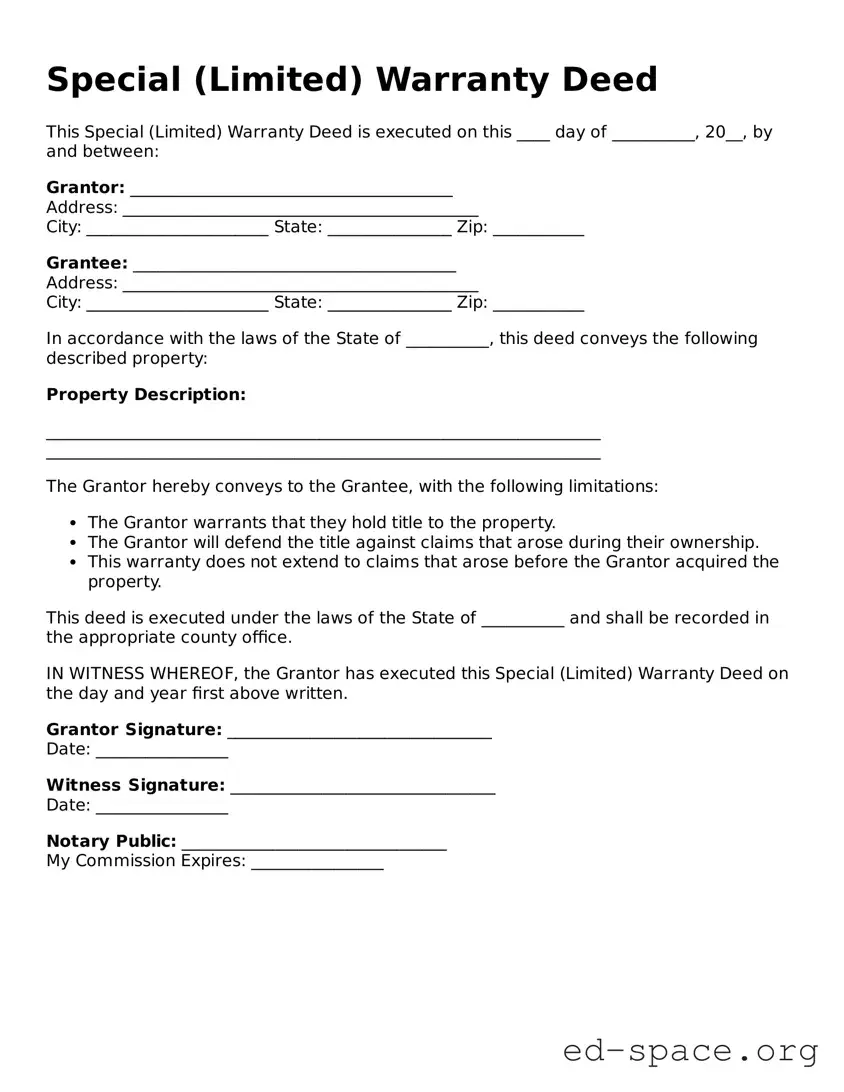
The Special (Limited) Warranty Deed is a crucial legal document used in real estate transactions, providing specific protections and assurances to the buyer regarding the property being transferred. Unlike a general warranty deed, which offers broad guarantees against any title defects, the special warranty deed limits the seller's liability to issues that may have arisen during their ownership of the property. This form typically includes essential details such as the names of the grantor and grantee, a description of the property, and the terms under which the transfer occurs. It serves to clarify the extent of the seller's warranty, ensuring that the buyer understands they are only protected from claims that originated while the seller owned the property. Additionally, the special warranty deed must be executed properly and may require notarization to be legally binding. Understanding the implications of this deed is vital for both parties involved, as it establishes the foundation for the buyer's rights and the seller's responsibilities in the transaction.
Special (Limited) Warranty Deed
This Special (Limited) Warranty Deed is executed on this ____ day of __________, 20__, by and between:
Grantor: _______________________________________
Address: ___________________________________________
City: ______________________ State: _______________ Zip: ___________
Grantee: _______________________________________
Address: ___________________________________________
City: ______________________ State: _______________ Zip: ___________
In accordance with the laws of the State of __________, this deed conveys the following described property:
Property Description:
___________________________________________________________________
___________________________________________________________________
The Grantor hereby conveys to the Grantee, with the following limitations:
This deed is executed under the laws of the State of __________ and shall be recorded in the appropriate county office.
IN WITNESS WHEREOF, the Grantor has executed this Special (Limited) Warranty Deed on the day and year first above written.
Grantor Signature: ________________________________
Date: ________________
Witness Signature: ________________________________
Date: ________________
Notary Public: ________________________________
My Commission Expires: ________________
| Fact Name | Description |
|---|---|
| Definition | A Special (Limited) Warranty Deed is a legal document used to transfer real estate ownership, providing limited guarantees about the property's title. |
| Purpose | This deed protects the buyer by ensuring that the seller is only liable for claims arising during their ownership of the property. |
| Limitations | Unlike a general warranty deed, it does not cover issues that may have arisen before the seller acquired the property. |
| Common Use | Often used in commercial real estate transactions or when properties are sold by banks or other entities that cannot provide full warranties. |
| State-Specific Forms | Each state may have its own version of the form, reflecting local laws and requirements. For example, in California, the form is governed by the California Civil Code. |
| Execution Requirements | Typically, the deed must be signed by the seller and notarized to be legally binding. |
| Recording | To protect the buyer's interest, the deed should be recorded with the local county recorder's office after execution. |
| Tax Implications | Transfer taxes may apply when a property is conveyed using a Special Warranty Deed, depending on state and local laws. |
When preparing to fill out the Special (Limited) Warranty Deed form, it is important to gather all necessary information and documents related to the property. This form is used to transfer ownership while providing limited guarantees about the property’s title. Once completed, the form will need to be signed and possibly notarized before it can be filed with the appropriate local government office.
What is a Special (Limited) Warranty Deed?
A Special (Limited) Warranty Deed is a legal document used in real estate transactions. It transfers ownership of property from one party to another while providing limited guarantees regarding the title. The seller, or grantor, only warrants that they have not caused any title issues during their ownership. This differs from a general warranty deed, which offers broader protections to the buyer.
What are the main features of a Special (Limited) Warranty Deed?
This type of deed includes specific features. Firstly, it limits the seller's liability to only the time they owned the property. Secondly, it typically includes language that assures the buyer there are no claims or encumbrances made by the seller during their ownership. However, it does not protect against issues that arose before the seller acquired the property.
When should I use a Special (Limited) Warranty Deed?
A Special (Limited) Warranty Deed is often used in transactions involving commercial properties or properties sold by banks and other financial institutions. It is also common in situations where the seller is not willing to provide full warranties, such as in estate sales or foreclosures. Buyers should carefully consider their level of risk before agreeing to this type of deed.
What are the risks associated with a Special (Limited) Warranty Deed?
One of the main risks is that the buyer may not be fully protected against title defects that existed before the seller's ownership. If a claim arises related to prior ownership, the buyer may have limited recourse. Therefore, conducting a thorough title search and obtaining title insurance is advisable to mitigate these risks.
How does a Special (Limited) Warranty Deed differ from other types of deeds?
Compared to a General Warranty Deed, a Special (Limited) Warranty Deed offers less protection. A General Warranty Deed provides guarantees for the entire history of the property, while the Special Warranty only covers the period during which the seller owned it. Additionally, a Quitclaim Deed transfers ownership without any warranties or guarantees, making it even less protective than a Special Warranty Deed.
Is a Special (Limited) Warranty Deed legally binding?
Yes, a Special (Limited) Warranty Deed is a legally binding document once it is executed and delivered. It must also be recorded in the appropriate government office to provide public notice of the transfer. Both parties should ensure that the deed is properly executed to avoid future disputes regarding ownership or title issues.
Failing to include all necessary parties. It's crucial to ensure that all individuals or entities involved in the transaction are listed accurately. Omitting a party can lead to legal complications.
Incorrectly identifying the property. The legal description of the property must be precise. Errors in the description can result in disputes over ownership.
Not signing the document. All required parties must sign the deed. A missing signature can invalidate the entire document.
Using outdated forms. Ensure that the form being used is the most current version. Using outdated forms may lead to acceptance issues or legal challenges.
Neglecting to have the deed notarized. Most jurisdictions require notarization for the deed to be legally binding. Failing to do so can result in the deed being unenforceable.
Forgetting to record the deed. After the deed is executed, it should be recorded with the appropriate local government office. This protects the buyer’s interests and provides public notice of the transaction.
Leaving out the warranty clause. The special warranty deed includes specific warranties about the property. Omitting this clause can lead to misunderstandings regarding the seller's obligations.
Not consulting with a professional. Many individuals attempt to fill out the form without seeking legal advice. This can lead to mistakes that may have been avoided with professional guidance.
When dealing with real estate transactions, various forms and documents complement the Special (Limited) Warranty Deed. Each serves a unique purpose in ensuring a smooth transfer of property ownership. Here’s a list of commonly used documents that you may encounter:
Understanding these documents can greatly assist you in navigating the complexities of real estate transactions. Each plays a vital role in ensuring that both parties are protected and that the transfer of property is executed smoothly.
When filling out a Special (Limited) Warranty Deed form, it is essential to follow certain guidelines to ensure accuracy and legality. Below is a list of things to do and avoid during this process.
Things You Should Do:
Things You Shouldn't Do:
Here are some common misconceptions about the Special (Limited) Warranty Deed form:
A Special Warranty Deed only covers the period during which the seller owned the property. It does not protect against issues that arose before the seller's ownership.
A General Warranty Deed offers broader protection, covering the entire history of the property, while a Special Warranty Deed is limited to the seller's ownership period.
Different types of warranty deeds exist, each offering varying levels of protection and assurances. Understanding these differences is crucial.
This type of deed does not eliminate all risks. Buyers should still conduct due diligence to uncover any potential issues.
A Special Warranty Deed does not guarantee that the title is clear. It only assures that the seller has not caused any issues during their ownership.
While usage may vary, Special Warranty Deeds are recognized in many states across the U.S., not just a select few.
This type of deed is legally binding and enforceable, just like other forms of property transfer documents.
Special Warranty Deeds are typically used for residential property transfers, but they may not be suitable for all situations.
While it is difficult to revoke a deed once it is executed, there are legal processes available that can challenge or void a deed under certain circumstances.
Filling out and using a Special (Limited) Warranty Deed can seem daunting, but understanding its key aspects can make the process smoother. Here are some essential takeaways to keep in mind:
Understanding these key points can help you navigate the process of using a Special (Limited) Warranty Deed with confidence.