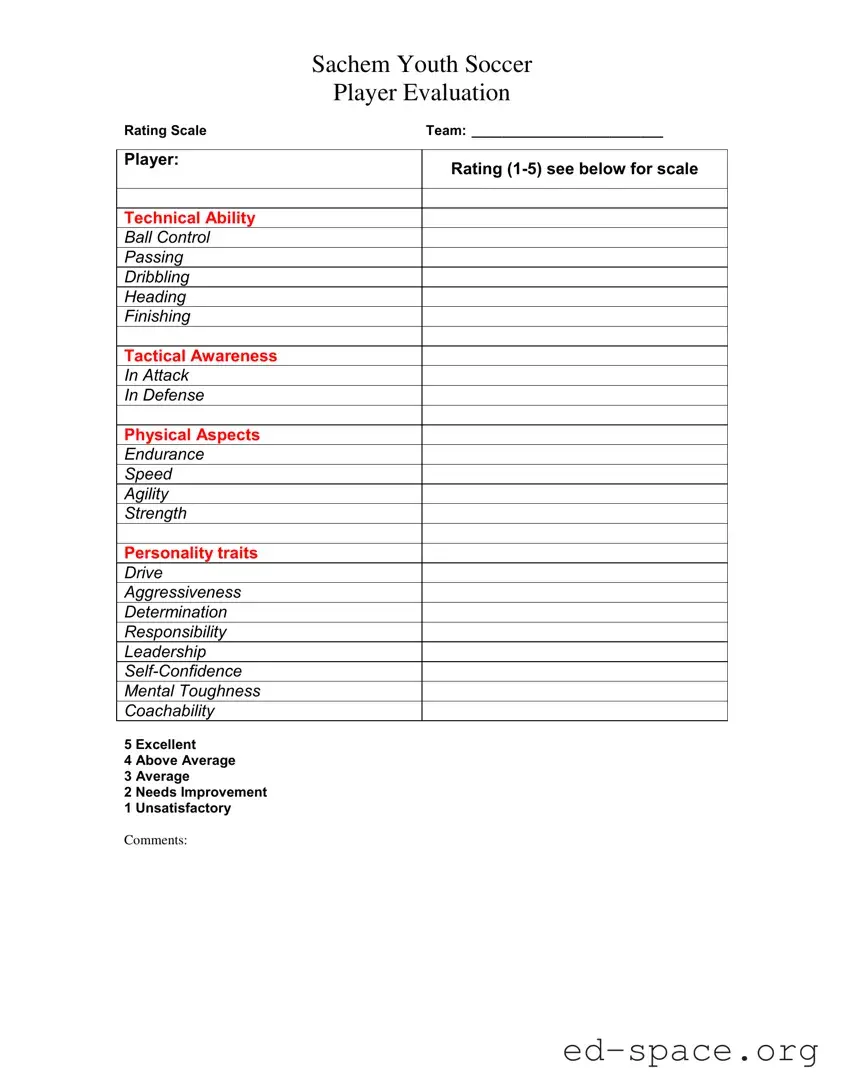
The Soccer Player Evaluation form serves as a comprehensive tool for coaches to assess and enhance the skills and attributes of young athletes. It covers several key aspects that are crucial for player development, including technical ability, tactical awareness, physical aspects, and personality traits. Coaches evaluate players on a scale from one to five, allowing for a nuanced understanding of each athlete's strengths and areas for improvement. Technical ability encompasses critical skills such as ball control, passing, dribbling, heading, and finishing. Tactical awareness examines a player's understanding of game dynamics, both in attack and defense. Physical aspects focus on endurance, speed, agility, and strength, while personality traits highlight essential qualities like drive, aggressiveness, determination, and leadership. By utilizing this form, coaches can provide targeted feedback and foster a positive environment for growth, ensuring that each player can reach their full potential.

|
Sachem Youth Soccer |
|
|
Player Evaluation |
|
Rating Scale |
|
Team: _________________________ |
|
|
|
Player: |
|
Rating |
|
|
|
|
|
|
|
|
|
Technical Ability |
|
|
Ball Control |
|
|
Passing |
|
|
Dribbling |
|
|
Heading |
|
|
Finishing |
|
|
|
|
|
Tactical Awareness |
|
|
In Attack |
|
|
In Defense |
|
|
|
|
|
Physical Aspects |
|
|
Endurance |
|
|
Speed |
|
|
Agility |
|
|
Strength |
|
|
|
|
|
Personality traits |
|
|
Drive |
|
|
Aggressiveness |
|
|
Determination |
|
|
Responsibility |
|
|
Leadership |
|
|
|
|
|
Mental Toughness |
|
|
Coachability |
|
|
5 Excellent |
|
|
4 Above Average |
|
|
3 Average |
|
|
2 Needs Improvement |
|
|
1 Unsatisfactory |
|
|
Comments:
Sachem Youth Soccer
Player Evaluation
DEFINITIONS
Technical Ability
Ball Control:
You must be able to bring a ball played to you under control instantly and smoothly. This is the ability to collect and move in a different direction without stopping the ball completely, yet still maintaining it securely. Develop the technique of receiving a pass at top speed. This means not slowing down to collect a ball coming on the ground, bouncing, or in the air. You must be able to protect the ball by shielding it and developing deception in order to get rid of your opponent.
Passing:
You must be able to successfully complete short and long range passes. This incorporates all of your ball skills, including heading, bending, chipping, and the ability to drive the ball to a partner. You will find that at a high level, it is easier to control and make quick decisions with a ball that is driven to you, rather than weakly played. Develop the skill of
Dribbling:
This is the ability to feint, burst past opponents, change directions and speed at will, and break through packed defensive lines. Can you exhibit quick feet, combined with a sense of comfort under pressure, to penetrate into space to open opportunities for yourself or a partner?
Heading:
The ability to head at goal after crosses, heading high, wide, and deep for defensive clearances, heading balls as a
shooting chances. Can you effectively demonstrate the ability to do this under the duress of the game?
Finishing:
Nothing makes more of an impression on people than the skill of goal scoring. This aspect takes in the correct technique of striking the ball in various ways; driving low balls, hitting volleys, half- volleys,
Tactical Awareness
Tactical insight incorporates the anticipation, reading, and execution of certain clues that happen during possession and
In Attack:
A. Player not in possession:
1.Makes themselves available for the ball, perhaps by a diagonal run or a crossover run.
2.Realizes when it is crucial to offer close support and when to stay away.
3.Recognizes the proper time to execute
B. Player in possession:
1.Has good peripheral vision, recognizing the correct time to switch the ball to the other side of the field.
2.Has good penetrating vision, allowing them to see and utilize players who are far down the field.
3.Recognizes the correct time to play directly, and when it is important to hold the ball (shielding
or dribbling), or when to run at top speed past players opening up passing angles for his team.
4.Sees opportunities to play
In Defense:
Sachem Youth Soccer
Player Evaluation
During the immediate pursuit, and desire to regain possession of the ball, the player should recognize:
1.When to race forward to intercept the pass.
2.When to mark the opponent tight in order to discourage the ball from being passed to them (pressure).
3.When, where, and how (posture) to tackle.
4.When to jockey the ball carrier and force them away from the goal (patience).
5.The quickest avenue of attack upon regaining the ball.
Physical Aspects
Endurance:
The ability of a player to commit themselves diligently throughout the game in attack and defense with no sign of fatigue and impaired ball control. That player must constantly be running into open spaces demanding the ball or pulling and committing opposing players to create openings. Even though this is also a tactical commitment, it will only be successful if you have the endurance capabilities to run for 60 to 90 minutes. The coach will be examining your physical exertion as you are being exposed to tactical problems you are trying to solve in the game.
Speed:
The ability to accelerate quickly and maintain that acceleration of the various lengths that player’s position demands. As an example, the forwards need acceleration with changes of speed over three to twenty yards. Elements include:
1.Pure
2.Lateral speed (changing direction).
3.Change of speed (slow to fast, fast to half speed).
4.Deceleration (“stopping on a dime”).
After these basics are attained, speed must be practiced with the ball!
Agility:
The ability to change directions quickly. Twisting, turning while dribbling, readjusting your body to control an awkwardly bouncing ball, and getting up quickly after a tackle are a few examples. This area is enhanced by flexibility exercises such as stretching, ball gymnastics, and skill training with the ball. Conditioning training must be combined with skill and tactical training!
Strength:
The ability to effectively use your body to win physical confrontations. Strength is exhibited during tackling (1 vs. 1), winning the aerial duel (heading), and changing directions effectively (explosion). It is also important to learn how to effectively use that strength to your advantage as is demonstrated in using your arms to hold a player off while running at top speed with the ball or in shooting for power. Much of your strength and power training can be combined with technique training!
Sachem Youth Soccer
Player Evaluation
Personality traits
Each coach loves to identify key players with personalities and qualities that cause them to become team leaders. The following personality traits are the most recognizable:
1.Drive: Pure will power, eager to achieve goals, a burning desire to achieve success, strong
2.Aggressiveness:
3.Determination: Seeks the direct way towards goal, no compromising, doesn’t hesitate when making decisions, willingness, fully concentrated, success oriented.
4.Responsibility: Intelligent, can read the game tactically (anticipation), conscientious, reliable, wants security, cooperative, ready for compromise, stable and skillful player.
5.Leadership: Intelligence, dedication, pride, bears responsibility for the team, influences the environment, anticipation, intuition, independent and spontaneous, convincing and dominating player, hard worker, no surrender, composed,
6.
7.Mental Toughness: Persistency, consistency, and commitment throughout the game, no surrender, tough
8.Coachability: Ready to learn and to achieve goals,
| Fact Name | Description |
|---|---|
| Rating Scale | The evaluation uses a scale from 1 to 5, where 5 is excellent and 1 is unsatisfactory. This helps coaches assess player performance across various skills. |
| Technical Ability Focus | Key technical skills evaluated include ball control, passing, dribbling, heading, and finishing. These are critical for a player's success on the field. |
| Tactical Awareness | The form assesses a player's ability to read the game, both in attack and defense. This includes recognizing when to support teammates or mark opponents. |
| Personality Traits | Coaches look for traits like drive, determination, and leadership. These characteristics are essential for fostering team dynamics and success. |
Completing the Soccer Player Evaluation form is an important step in assessing a player's skills and attributes. By carefully filling out the form, coaches can provide valuable feedback to help players improve. Follow the steps below to ensure you complete the evaluation accurately.
What is the purpose of the Soccer Player Evaluation form?
The Soccer Player Evaluation form is designed to assess a player's skills, abilities, and personality traits in various aspects of soccer. Coaches use this form to evaluate technical abilities such as ball control, passing, and dribbling, as well as tactical awareness, physical aspects, and personality traits. This comprehensive evaluation helps coaches make informed decisions about team placements and player development.
How is the rating scale structured on the evaluation form?
The rating scale on the evaluation form ranges from 1 to 5. A score of 5 indicates excellent performance, while a score of 1 signifies unsatisfactory performance. The ratings are broken down into specific categories, including technical ability, tactical awareness, physical aspects, and personality traits. This structured approach allows for a clear and concise assessment of each player’s strengths and areas for improvement.
What categories are included in the evaluation?
The evaluation includes several key categories: technical ability, tactical awareness, physical aspects, and personality traits. Technical ability encompasses skills like ball control, passing, and finishing. Tactical awareness evaluates a player's understanding of game dynamics in both offensive and defensive situations. Physical aspects assess endurance, speed, agility, and strength. Finally, personality traits look at qualities such as drive, determination, and leadership, which are crucial for team dynamics.
Can coaches provide comments on the evaluation form?
Yes, coaches are encouraged to provide comments on the evaluation form. This section allows for personalized feedback and specific observations about a player's performance. Comments can highlight strengths, suggest areas for improvement, and provide context to the numerical ratings. This qualitative feedback is invaluable for players and their development.
How can players use the feedback from the evaluation?
Players can use the feedback from the evaluation to identify their strengths and weaknesses. Understanding where they excel can boost confidence, while recognizing areas for improvement can guide their training efforts. Players should take the comments and ratings seriously, using them as a roadmap for personal development and skill enhancement in soccer.
Is the evaluation form used for all age groups?
The Soccer Player Evaluation form is applicable to all age groups within the Sachem Youth Soccer program. It provides a standardized method for assessing players at different skill levels. By using the same evaluation criteria, coaches can ensure consistency in their assessments, which helps in creating balanced teams and fostering player development across all ages.
Incomplete Information: Failing to fill out all required fields, such as the player's name or team, can lead to delays in processing evaluations.
Inconsistent Ratings: Providing ratings that do not align with the comments made can create confusion. Ensure that the numerical scores reflect the written feedback.
Neglecting Comments: Skipping the comments section limits the evaluation's effectiveness. Detailed feedback helps coaches understand strengths and areas for improvement.
Misunderstanding the Rating Scale: Not adhering to the defined rating scale (1-5) can result in misleading evaluations. Familiarize yourself with what each rating represents.
Overlooking Tactical Awareness: Failing to assess a player's tactical understanding can lead to an incomplete evaluation. Consider both offensive and defensive awareness.
Ignoring Personality Traits: Underestimating the importance of personality traits can skew the evaluation. Traits like leadership and determination are crucial for team dynamics.
Rushing the Evaluation: Taking shortcuts or rushing through the evaluation can lead to errors. Take the time to observe and assess each player's performance thoroughly.
The Soccer Player Evaluation form is a crucial tool for assessing the skills and attributes of young athletes. However, it is often accompanied by several other forms and documents that provide a more comprehensive view of a player's abilities and potential. Below is a list of commonly used forms that enhance the evaluation process.
These documents work together to create a holistic view of each player, ensuring that evaluations are thorough and effective. By utilizing these forms, coaches can better understand their athletes and foster an environment that promotes development and success.
When filling out the Soccer Player Evaluation form, it is essential to approach the task thoughtfully. Here are some guidelines to ensure that the evaluation is both accurate and helpful.
Here are ten common misconceptions about the Soccer Player Evaluation form, along with explanations to clarify each point:
When utilizing the Soccer Player Evaluation form, there are several key points to keep in mind to ensure a comprehensive assessment of each player. Understanding these aspects can significantly enhance the evaluation process.