The Small Estate Affidavit form serves as a valuable tool for individuals navigating the complexities of settling a deceased person's estate when the total value of the estate falls below a certain threshold, typically defined by state law. This process simplifies the transfer of assets, allowing heirs to bypass the lengthy and often costly probate process. By using this affidavit, heirs can assert their rights to inherit property and assets without the need for formal court proceedings. Essential information, such as the decedent's details, a list of assets, and the names of the heirs, must be included in the affidavit. Additionally, the form often requires the signatures of the heirs, affirming their consent and understanding of the distribution of the estate. Understanding the requirements and implications of the Small Estate Affidavit can empower families to manage their loved one's affairs with greater ease and efficiency during a challenging time.
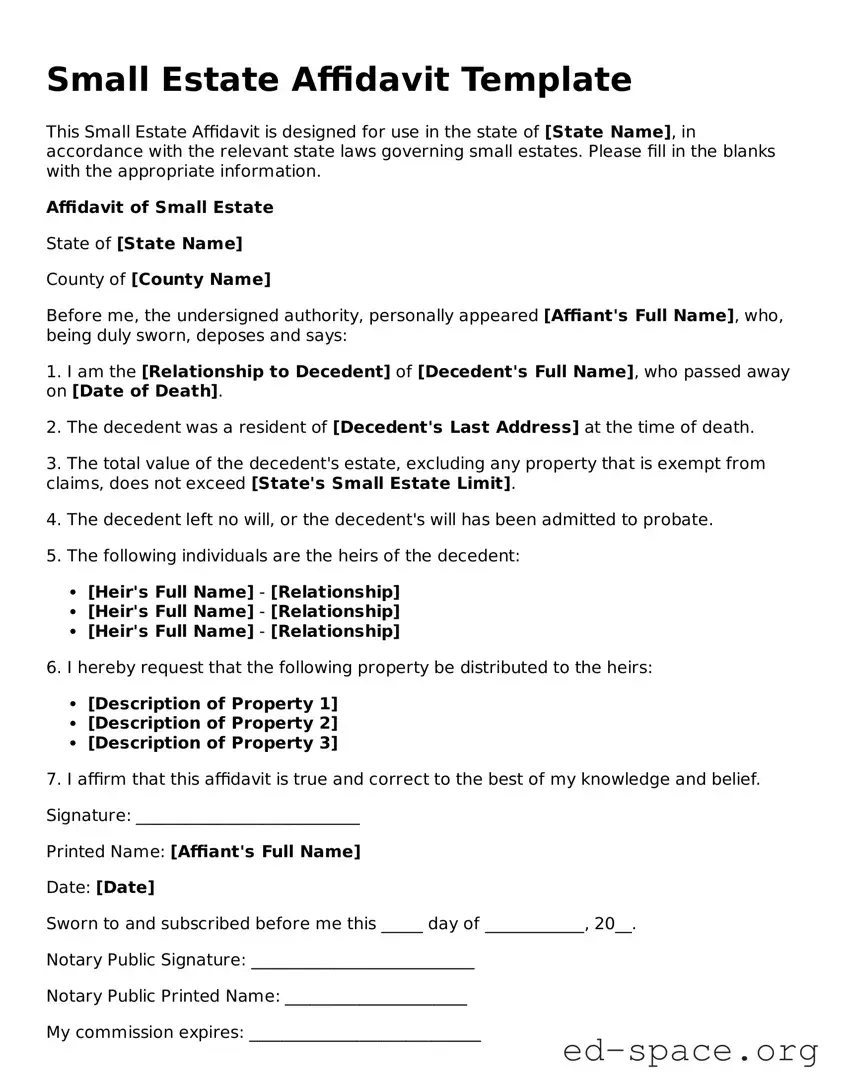
Small Estate Affidavit Template
This Small Estate Affidavit is designed for use in the state of [State Name], in accordance with the relevant state laws governing small estates. Please fill in the blanks with the appropriate information.
Affidavit of Small Estate
State of [State Name]
County of [County Name]
Before me, the undersigned authority, personally appeared [Affiant's Full Name], who, being duly sworn, deposes and says:
1. I am the [Relationship to Decedent] of [Decedent's Full Name], who passed away on [Date of Death].
2. The decedent was a resident of [Decedent's Last Address] at the time of death.
3. The total value of the decedent's estate, excluding any property that is exempt from claims, does not exceed [State's Small Estate Limit].
4. The decedent left no will, or the decedent's will has been admitted to probate.
5. The following individuals are the heirs of the decedent:
6. I hereby request that the following property be distributed to the heirs:
7. I affirm that this affidavit is true and correct to the best of my knowledge and belief.
Signature: ___________________________
Printed Name: [Affiant's Full Name]
Date: [Date]
Sworn to and subscribed before me this _____ day of ____________, 20__.
Notary Public Signature: ___________________________
Notary Public Printed Name: ______________________
My commission expires: ____________________________
| Fact Name | Description |
|---|---|
| Purpose | The Small Estate Affidavit allows heirs to claim assets without going through formal probate. |
| Eligibility | Typically, estates valued below a certain threshold qualify for this process, which varies by state. |
| State-Specific Forms | Each state has its own version of the Small Estate Affidavit, tailored to local laws. |
| Governing Law | The use of Small Estate Affidavits is governed by state probate laws, which dictate the eligibility and process. |
| Filing Process | Heirs must complete the affidavit and file it with the appropriate court or agency to access the estate's assets. |
| Signature Requirements | Most states require the affidavit to be signed by the heirs and sometimes notarized. |
| Asset Types | Common assets that can be claimed include bank accounts, vehicles, and personal property. |
| Time Frame | The process can be quicker than traditional probate, often taking just a few weeks. |
| Limitations | Some states may restrict the types of assets that can be claimed through this affidavit. |
| Legal Advice | While not always necessary, consulting with a legal professional can help navigate the process smoothly. |
Once you have obtained the Small Estate Affidavit form, the next step involves carefully filling it out to ensure all necessary information is accurately provided. This document will facilitate the transfer of assets from a deceased individual to their rightful heirs without the need for formal probate proceedings.
What is a Small Estate Affidavit?
A Small Estate Affidavit is a legal document that allows heirs to claim property and assets of a deceased person without going through the lengthy and often expensive probate process. This form is typically used when the total value of the estate falls below a certain threshold, which varies by state.
Who can use a Small Estate Affidavit?
Generally, the surviving spouse, children, or other close relatives of the deceased can use the Small Estate Affidavit. Each state has specific rules about who qualifies, so it's important to check local laws to ensure eligibility.
What is the threshold value for a Small Estate Affidavit?
The threshold value for using a Small Estate Affidavit varies by state. Some states may set the limit at $50,000, while others may allow up to $100,000 or more. Be sure to verify the current limit in your state to determine if this option is available for your situation.
How do I complete a Small Estate Affidavit?
To complete a Small Estate Affidavit, you will need to gather information about the deceased, including their assets and debts. Fill out the affidavit form with this information, ensuring that all details are accurate. You may also need to have the document notarized. Each state may have its own specific form, so check for the correct version.
Do I need to file the Small Estate Affidavit with the court?
In most cases, you do not need to file the Small Estate Affidavit with the court. However, some states may require you to submit it when claiming certain assets, such as bank accounts or real estate. Always check your state’s requirements to ensure compliance.
What happens if the estate exceeds the Small Estate Affidavit limit?
If the estate exceeds the Small Estate Affidavit limit, you will need to go through the probate process. This process is more complex and may involve court hearings, so it's advisable to consult with a legal professional to navigate this situation effectively.
Not including all necessary information. It's crucial to provide complete details about the deceased and the estate.
Failing to identify all heirs. All rightful heirs must be listed to avoid future disputes.
Ignoring state-specific requirements. Each state has its own rules regarding small estate affidavits, and overlooking these can lead to rejection.
Not signing the affidavit. An unsigned affidavit is not valid and will not be accepted.
Forgetting to date the affidavit. A date is essential to establish the timeline of the estate's administration.
Using outdated forms. Always ensure you are using the most current version of the form.
Providing incorrect or incomplete asset information. Be thorough when listing the assets of the estate.
Not having witnesses or not meeting witness requirements. Some states require the affidavit to be witnessed, and failing to do so can invalidate it.
Neglecting to file the affidavit with the appropriate court. Filing is a crucial step in the process.
Not keeping copies of the submitted affidavit. Retaining copies is important for future reference and potential disputes.
The Small Estate Affidavit is a useful legal document that allows individuals to settle the estate of a deceased person without going through the lengthy probate process. In many cases, this form is accompanied by several other documents that help facilitate the transfer of assets and ensure compliance with state laws. Below is a list of some common forms and documents that may be used alongside the Small Estate Affidavit.
Understanding these documents and their purposes can help streamline the process of settling a small estate. Each state may have specific requirements, so it is essential to consult local laws and regulations when preparing these forms.
The Small Estate Affidavit is a useful legal tool for settling the affairs of a deceased person's estate without going through the lengthy probate process. Several other documents serve similar purposes in estate management. Here are four documents that share similarities with the Small Estate Affidavit:
When filling out the Small Estate Affidavit form, it's important to follow certain guidelines. Here’s a list of what you should and shouldn’t do:
Many people have misconceptions about the Small Estate Affidavit form, which can lead to confusion and potential legal issues. Here are five common misunderstandings:
While it's true that many states set a value limit for estates eligible for this process, the specific threshold varies by state. It's crucial to check local laws to determine the applicable limit.
This is not accurate. Certain assets, like those held in a trust or jointly owned property, may not qualify. Understanding what assets are included is essential.
This misconception can lead to significant misunderstandings. A Small Estate Affidavit is a simplified process that bypasses formal probate, making it quicker and less costly.
Only specific individuals, typically heirs or beneficiaries, can file this affidavit. It's important to ensure that the person filing has the legal right to do so.
This is misleading. While the affidavit simplifies the transfer of assets, it does not absolve the estate from settling debts and taxes. Those obligations must still be addressed before assets can be distributed.
When dealing with the Small Estate Affidavit form, it is important to understand several key aspects to ensure proper use and compliance. Below are essential takeaways regarding this form: