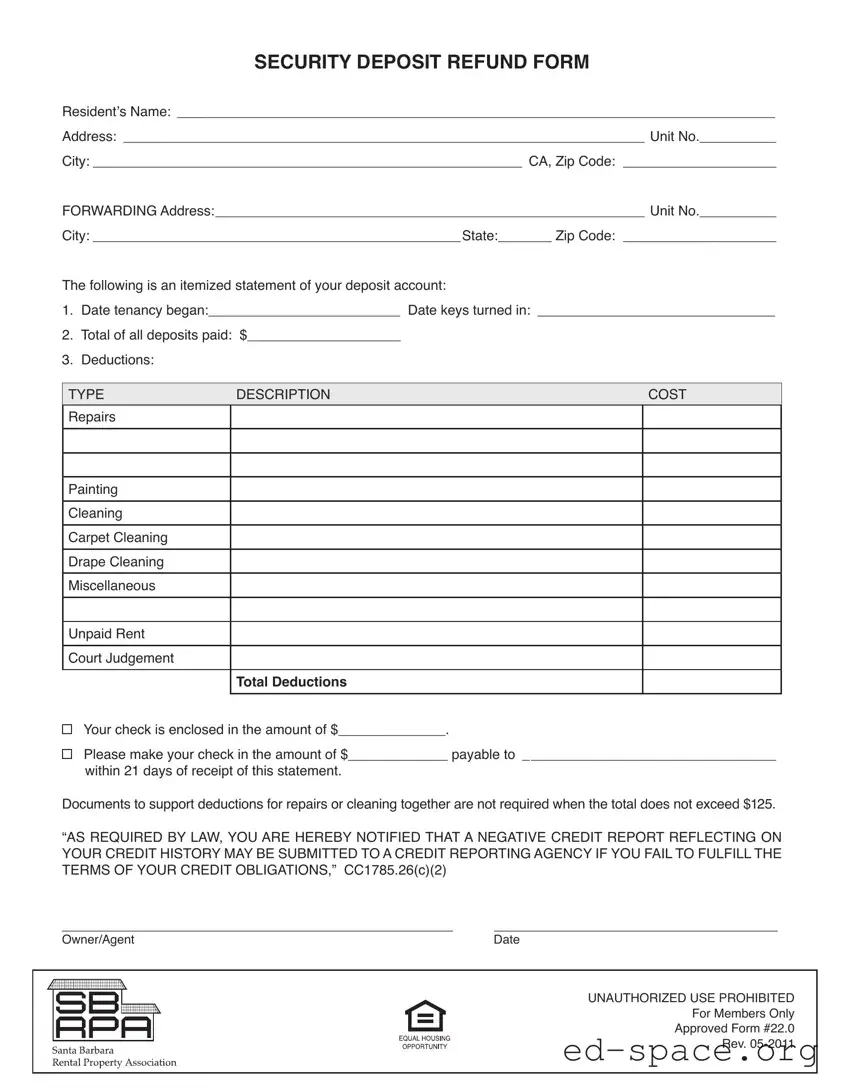
When moving out of a rental property, understanding the Security Deposit Deductions form is essential for both tenants and landlords. This form serves as a crucial document that outlines how a security deposit will be returned, detailing any deductions made for repairs, cleaning, or unpaid rent. Tenants must fill in their personal information, including their name, address, and forwarding address, ensuring that all details are accurate for the return of funds. The form also requires an itemized statement of the deposit account, listing the total deposits paid and any deductions taken. Categories for deductions include repairs, painting, cleaning, and even court judgments. Importantly, if the total deductions do not exceed $125, tenants are not required to provide supporting documents. The form emphasizes the importance of timely payment, stating that checks should be issued within 21 days of receipt. Additionally, it includes a legal notice regarding credit reporting, alerting tenants to the potential consequences of failing to meet their financial obligations. Understanding these aspects can help ensure a smooth transition when concluding a rental agreement.
SECURITY DEPOSIT REFUND FORM
Resident’s Name: ______________________________________________________________________________
Address: ____________________________________________________________________ Unit No.__________
City: ________________________________________________________ CA, Zip Code: ____________________
FORWARDING Address:________________________________________________________ Unit No.__________
City: ________________________________________________State:_______ Zip Code: ____________________
The following is an itemized statement of your deposit account:
1.Date tenancy began:_________________________ Date keys turned in: _______________________________
2.Total of all deposits paid: $____________________
3.Deductions:
TYPE |
DESCRIPTION |
COST |
|
|
|
Repairs
Painting
Cleaning
Carpet Cleaning
Drape Cleaning
Miscellaneous
Unpaid Rent
Court Judgement
TOTAL DEDUCTIONS
Your check is enclosed in the amount of $______________.
Please make your check in the amount of $_____________ payable to _________________________________
within 21 days of receipt of this statement.
Documents to support deductions for repairs or cleaning together are not required when the total does not exceed $125.
“AS REQUIRED BY LAW, YOU ARE HEREBY NOTIFIED THAT A NEGATIVE CREDIT REPORT REFLECTING ON YOUR CREDIT HISTORY MAY BE SUBMITTED TO A CREDIT REPORTING AGENCY IF YOU FAIL TO FULFILL THE TERMS OF YOUR CREDIT OBLIGATIONS,” CC1785.26(c)(2)
___________________________________________________ |
_____________________________________ |
Owner/Agent |
Date |
UNAUTHORIZED USE PROHIBITED
For Members Only
Approved Form #22.0
Rev.
| Fact Name | Description |
|---|---|
| Purpose of the Form | The Security Deposit Refund Form is used by landlords to itemize deductions from a tenant's security deposit and to inform the tenant of the refund amount due. |
| Tenant Information | The form requires the tenant's name, address, and forwarding address to ensure proper communication regarding the refund. |
| Itemized Deductions | Landlords must provide a detailed list of deductions, including costs for repairs, cleaning, and any unpaid rent. |
| Documentation Requirement | If total deductions do not exceed $125, landlords are not required to provide supporting documents for repairs or cleaning. |
| Legal Notification | The form includes a legal notice informing tenants that a negative credit report may be filed if they do not meet their credit obligations, as per California Civil Code § 1785.26(c)(2). |
| Timeframe for Refund | Landlords must issue the refund check within 21 days of providing the itemized statement to the tenant. |
Filling out the Security Deposit Deductions form requires careful attention to detail. After completing the form, it will be submitted to the appropriate party for processing. This will initiate the review of your deductions and the issuance of any remaining funds from your security deposit.
What is the purpose of the Security Deposit Deductions form?
The Security Deposit Deductions form is designed to provide residents with a clear breakdown of any deductions made from their security deposit after they move out. It helps ensure transparency regarding the costs associated with repairs, cleaning, or unpaid rent, making it easier for residents to understand how their deposit was handled.
What information do I need to fill out on the form?
Residents are required to provide their name, address, unit number, and forwarding address. Additionally, you will need to include the dates your tenancy began and when you turned in your keys. This information is crucial for accurately processing your security deposit refund.
How are deductions calculated?
Deductions are itemized on the form and can include costs for repairs, cleaning, and any unpaid rent. Each type of deduction will have a description and a corresponding cost. The total deductions will be summed up at the bottom of the statement, giving you a clear picture of how much will be deducted from your deposit.
What happens if the total deductions are less than $125?
If the total deductions for repairs or cleaning do not exceed $125, you will not be required to provide documents to support those deductions. This rule simplifies the process for both residents and property management.
When can I expect to receive my refund?
Once you receive the Security Deposit Deductions form, the property management is required to issue your refund check within 21 days. This ensures that you receive your remaining deposit in a timely manner, following the completion of the deductions.
Who should I make the check payable to?
The form will specify the name of the owner or agent to whom the check should be made payable. It is important to follow this instruction to ensure that your refund is processed correctly.
What if I disagree with the deductions listed?
If you believe that the deductions are unjustified or incorrect, you should reach out to the property management to discuss your concerns. It's advisable to document your communication and any supporting evidence you may have to support your case.
Will a negative credit report affect my credit history?
Yes, as stated in the form, if you fail to fulfill your credit obligations, a negative credit report may be submitted to a credit reporting agency. It is crucial to address any outstanding amounts to avoid potential harm to your credit history.
Is this form only for residents of a specific property?
This form is intended for use by residents of properties managed by the entity that issued it. It is important to check with your property management to ensure you are using the correct form for your specific situation.
Incomplete Information: Failing to fill out all required fields, such as the resident's name or forwarding address, can lead to delays in processing the refund. Ensure every section is complete.
Incorrect Deductions: Listing deductions that do not correspond with the actual costs incurred can result in disputes. Double-check the amounts and descriptions of repairs or cleaning before submitting.
Missing Documentation: Not providing necessary documents for deductions exceeding $125 can lead to rejection of those deductions. Always include supporting documents if applicable.
Failure to Sign: Forgetting to sign the form can render it invalid. Make sure to sign and date the form before submission to ensure it is processed correctly.
When dealing with security deposits, several forms and documents may accompany the Security Deposit Deductions form. Each of these plays a crucial role in ensuring transparency and clarity in the process. Below is a brief overview of commonly used documents.
Understanding these documents can help tenants and landlords navigate the security deposit process with confidence. Each form plays a significant role in ensuring that all parties are informed and that any deductions are justified and clearly communicated.
The Security Deposit Deductions form shares similarities with several other documents commonly used in rental and leasing situations. Each of these documents serves a specific purpose related to financial transactions and tenant-landlord relationships. Below are six documents that are similar to the Security Deposit Deductions form:
When filling out the Security Deposit Deductions form, it’s essential to follow certain guidelines to ensure a smooth process. Here are five things you should and shouldn’t do:
Understanding the Security Deposit Deductions form can help ensure a smooth process when it comes to receiving your security deposit back. Here are some key takeaways to keep in mind:
By following these guidelines, you can navigate the process of filling out the Security Deposit Deductions form more effectively. Keeping thorough records and being clear in your communication can make a significant difference in the outcome.