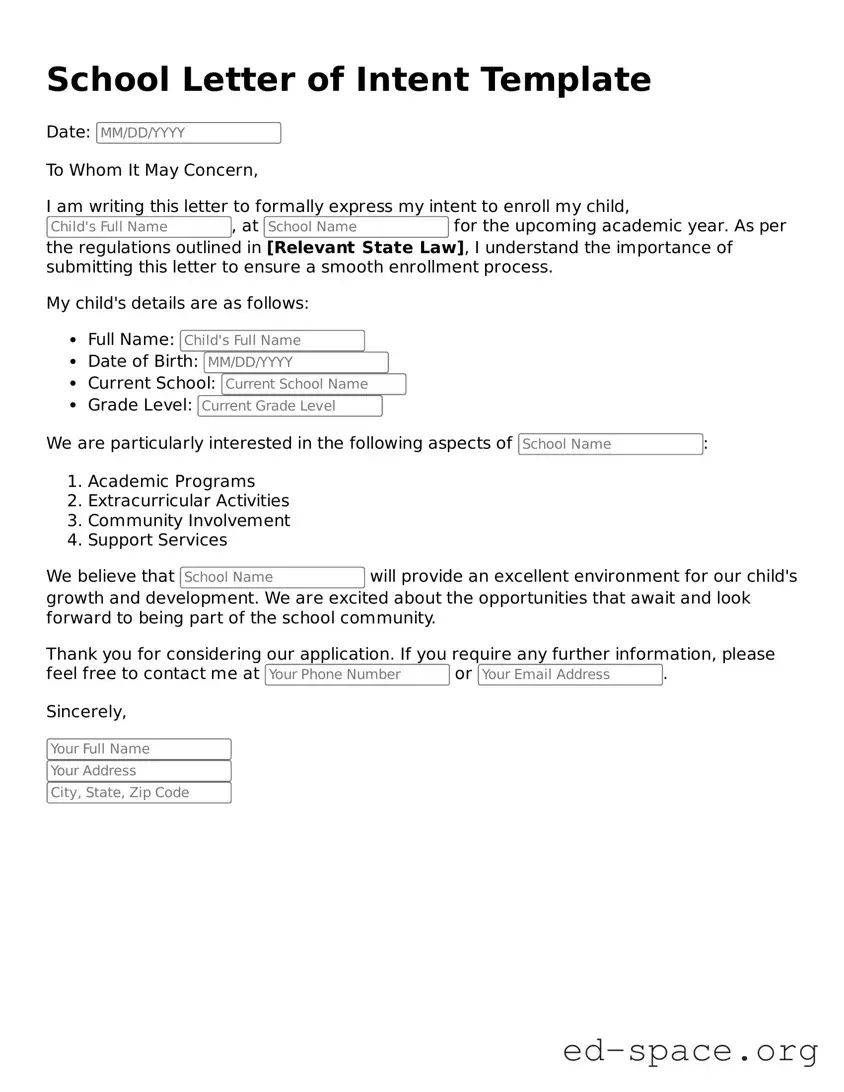
The School Letter of Intent form serves as an important document for students and parents navigating the educational landscape. This form is typically used to express a student's intention to enroll in a specific school or program, signaling commitment and interest. It often includes essential information such as the student's name, the intended school or program, and relevant dates. By submitting this letter, families can communicate their educational goals clearly, allowing schools to plan accordingly. Additionally, the form may outline any specific requirements or conditions that need to be met prior to enrollment. Understanding the nuances of this document can help ensure a smooth transition into the desired educational environment.
School Letter of Intent Template
Date:
To Whom It May Concern,
I am writing this letter to formally express my intent to enroll my child, , at for the upcoming academic year. As per the regulations outlined in [Relevant State Law], I understand the importance of submitting this letter to ensure a smooth enrollment process.
My child's details are as follows:
We are particularly interested in the following aspects of :
We believe that will provide an excellent environment for our child's growth and development. We are excited about the opportunities that await and look forward to being part of the school community.
Thank you for considering our application. If you require any further information, please feel free to contact me at or .
Sincerely,
| Fact Name | Description |
|---|---|
| Purpose | The School Letter of Intent form is used by parents or guardians to express their intention to enroll a child in a specific school. |
| Content Requirements | This form typically requires the child's name, date of birth, and the name of the school where enrollment is intended. |
| Submission Timeline | It is essential to submit the form within the school district's designated enrollment period to secure a spot for the child. |
| State-Specific Variations | Different states may have specific requirements or additional documents needed alongside the letter of intent. |
| Governing Laws | The governing laws for the School Letter of Intent may vary by state. For example, in California, it is governed by the Education Code Section 48000. |
| Importance of Accuracy | Providing accurate information on the form is crucial, as incorrect details may lead to delays or denial of enrollment. |
After obtaining the School Letter of Intent form, you will need to complete it accurately to ensure a smooth process. Once submitted, the school will review your information and respond accordingly.
What is the purpose of the School Letter of Intent form?
The School Letter of Intent form serves as a formal declaration of a student's intention to enroll in a specific school. It helps schools plan for incoming students and ensures that families communicate their choices clearly. This form can be particularly important for schools that need to manage class sizes and resources effectively.
Who needs to complete the School Letter of Intent form?
When should the School Letter of Intent form be submitted?
What information is typically required on the form?
Is there a deadline for submitting the School Letter of Intent form?
What happens after the form is submitted?
Can the School Letter of Intent be revoked or changed?
What if I have more questions about the School Letter of Intent form?
Are there any consequences for not submitting the form?
Not including all required personal information. Make sure to fill out your full name, address, and contact details accurately.
Failing to specify the intended school or program. Clearly indicate which school or program you are applying to.
Neglecting to sign the form. A signature is essential to validate your intent and make the document official.
Using vague language. Be clear and specific about your intentions and reasons for choosing the school.
Submitting the form late. Ensure you are aware of deadlines and submit your form on time to avoid complications.
Overlooking the need for additional documents. Sometimes, you may need to attach other paperwork, such as transcripts or recommendation letters.
Ignoring formatting guidelines. Pay attention to any specific instructions regarding font size, spacing, and overall presentation.
Not proofreading for errors. Typos or grammatical mistakes can undermine the professionalism of your letter.
When submitting a School Letter of Intent, several other forms and documents may be required to ensure a complete application. Each document serves a specific purpose in the application process, helping to provide necessary information about the student and their educational plans.
Gathering these documents in advance can streamline the application process. Each piece of information contributes to a comprehensive view of the student's qualifications and aspirations, enhancing their chances of acceptance.
The School Letter of Intent form shares similarities with several other documents that serve various purposes in educational and legal contexts. Here are nine documents that resemble the School Letter of Intent, along with a brief explanation of how they are alike:
Each of these documents plays a crucial role in the educational journey, helping to clarify intentions and formalize commitments within the academic landscape.
When filling out the School Letter of Intent form, it's important to follow certain guidelines to ensure your submission is clear and effective. Here are six things to keep in mind:
By following these guidelines, you can create a strong Letter of Intent that effectively communicates your intentions and supports your child's educational journey.
Understanding the School Letter of Intent form is crucial for parents and students. However, several misconceptions can lead to confusion. Here are seven common misunderstandings:
Many believe that signing the letter commits them to the school. In reality, it expresses intent but does not legally bind the student to attend.
Some think submitting the letter ensures their child will be accepted. Admission is still subject to the school's criteria and available space.
This form is often associated with private institutions, but many public schools also use it to gauge interest.
There are specific deadlines for submission. Missing these dates may affect the chances of enrollment.
Some people think a fee is necessary to submit the letter. Typically, there is no cost involved in this process.
Notarization is not a requirement for the School Letter of Intent. A simple signature is usually sufficient.
While changes may be possible, they can complicate the process. It's best to finalize your decision before submitting.
Clearing up these misconceptions can help families navigate the school selection process more effectively. Ensure you have the correct information to make informed decisions.
Filling out and using the School Letter of Intent form is an important step in the enrollment process. Here are some key takeaways to keep in mind: