Applying for scholarships can be a pivotal moment in a student's academic journey, often requiring a strong recommendation letter to enhance their application. The Scholarship Recommendation Letter form serves as a vital tool in this process, allowing recommenders to provide insights into a student's character, achievements, and potential. This form typically includes sections for the recommender's contact information, their relationship to the student, and specific prompts guiding them to highlight the student's strengths and accomplishments. By detailing academic performance, extracurricular involvement, and personal qualities, the letter helps scholarship committees gauge the applicant's suitability for funding. Furthermore, the form may also request a rating scale or additional comments, giving recommenders the opportunity to elaborate on the student's unique attributes. Ultimately, this form is not just a requirement; it is an opportunity for advocates to champion the deserving candidates and help them secure the financial support they need to pursue their educational goals.
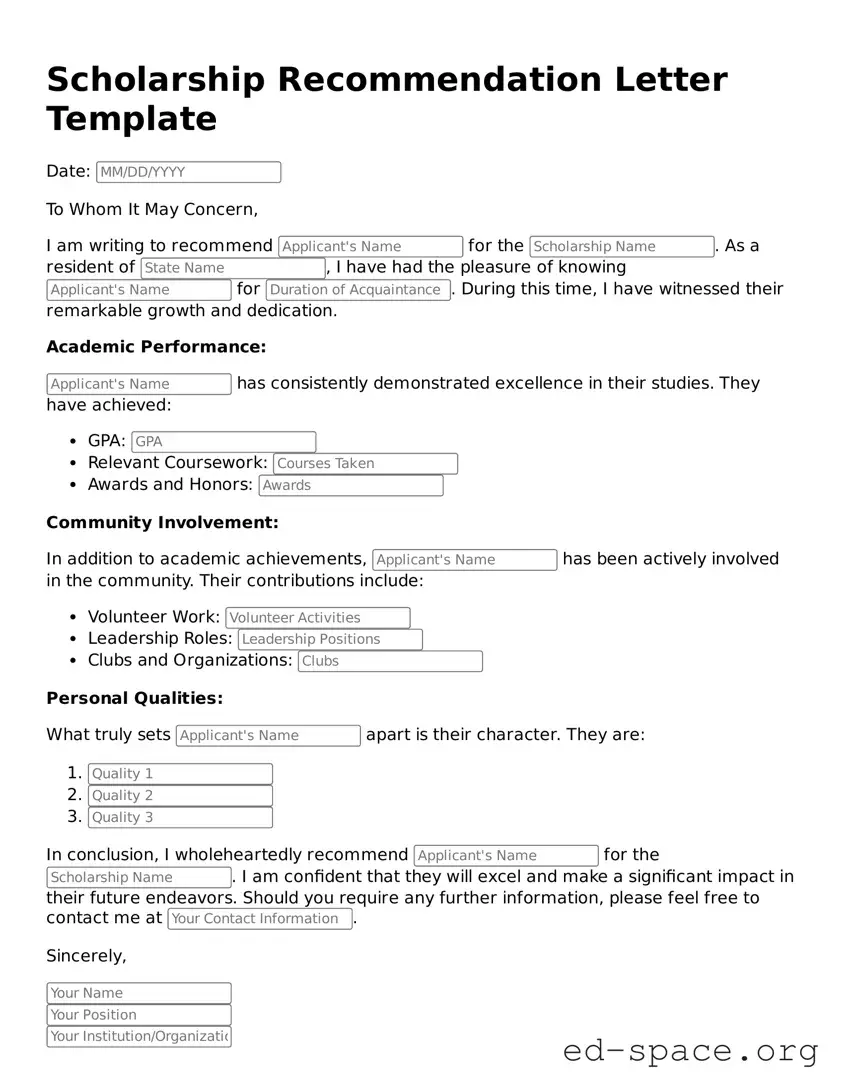
Scholarship Recommendation Letter Template
Date:
To Whom It May Concern,
I am writing to recommend for the . As a resident of , I have had the pleasure of knowing for . During this time, I have witnessed their remarkable growth and dedication.
Academic Performance:
has consistently demonstrated excellence in their studies. They have achieved:
Community Involvement:
In addition to academic achievements, has been actively involved in the community. Their contributions include:
Personal Qualities:
What truly sets apart is their character. They are:
In conclusion, I wholeheartedly recommend for the . I am confident that they will excel and make a significant impact in their future endeavors. Should you require any further information, please feel free to contact me at .
Sincerely,
| Fact Name | Description |
|---|---|
| Purpose | A Scholarship Recommendation Letter form is used to gather insights about a student's character, achievements, and potential from a third-party recommender. |
| Importance | These letters play a crucial role in the scholarship application process, helping committees assess candidates beyond their grades and test scores. |
| Format | The form typically includes sections for the recommender's information, the relationship to the student, and a narrative about the student's qualifications. |
| State-Specific Laws | In some states, such as California, the governing law regarding scholarship applications may include the California Education Code, which outlines requirements for financial aid and scholarship programs. |
Completing the Scholarship Recommendation Letter form is an important step in supporting a candidate's application. This form allows you to share insights about the applicant's abilities, character, and potential for success. Follow the steps below to ensure you provide a comprehensive and thoughtful recommendation.
What is a Scholarship Recommendation Letter?
A Scholarship Recommendation Letter is a document written by someone who can speak to a student’s qualifications, character, and potential for success. This letter is often required as part of the scholarship application process and serves to provide insight into the applicant's abilities and achievements from a third-party perspective.
Who should write the recommendation letter?
The ideal writer for a Scholarship Recommendation Letter is someone who knows the student well and can provide specific examples of their strengths. This could be a teacher, school counselor, employer, or community leader. It is important that the writer can articulate the student's skills, accomplishments, and character in a meaningful way.
What should be included in the recommendation letter?
A strong recommendation letter should include an introduction of the writer, a clear statement of their relationship to the student, and specific examples that illustrate the student’s strengths and achievements. It should also discuss the student’s potential for success in their future endeavors, especially in relation to the scholarship for which they are applying.
How long should the recommendation letter be?
Typically, a recommendation letter should be one to two pages in length. This allows the writer to provide enough detail to support their claims without overwhelming the reader. Clarity and conciseness are key; the letter should be long enough to cover essential points but short enough to maintain the reader’s interest.
Is there a specific format for the recommendation letter?
While there may not be a strict format, it is advisable to follow a standard business letter format. This includes the writer’s contact information, the date, and the recipient’s information at the top. The letter should have a clear opening, body, and conclusion, and it should be typed and printed on professional letterhead if possible.
How should the letter be submitted?
The submission method for the recommendation letter can vary depending on the scholarship program. Some programs may require the letter to be submitted online through a specific portal, while others may ask for it to be mailed directly to them. It is important to follow the specific instructions provided by the scholarship program to ensure that the letter is received on time.
Can the student read the recommendation letter before it is submitted?
Generally, it is considered best practice for the writer to keep the letter confidential. This means that the student should not read the letter before it is submitted. However, students can discuss their accomplishments and goals with the writer to help them craft a more personalized letter. Some scholarship programs may allow students to view the letter, so it is wise to check the specific guidelines.
What if the writer is unable to complete the letter on time?
If a writer is unable to complete the recommendation letter by the deadline, it is crucial for the student to communicate this as soon as possible. They may need to seek another writer or ask for an extension from the scholarship committee. Open communication is essential to ensure that the application is submitted on time.
What are common mistakes to avoid in a recommendation letter?
Common mistakes in recommendation letters include being overly vague, failing to provide specific examples, and using generic language that does not reflect the student's unique qualities. Additionally, letters that are poorly formatted or contain grammatical errors can detract from the overall impression. It is important for the writer to take the time to craft a thoughtful and well-structured letter.
Not providing enough specific examples of the student’s achievements. Generic praise lacks impact.
Failing to address the scholarship criteria directly. Each recommendation should align with what the scholarship committee values.
Using overly formal language or jargon. A natural tone makes the letter more relatable and engaging.
Neglecting to proofread for spelling and grammatical errors. Mistakes can undermine the credibility of the recommendation.
Writing too much or too little. A concise letter, typically one page, is often ideal. Too lengthy may lose the reader’s attention.
Not including personal anecdotes. Personal stories can illustrate the student’s character and strengths effectively.
Forgetting to mention how long and in what capacity the writer knows the student. This context is crucial for establishing credibility.
Being overly critical or negative. Focus on the student’s strengths and potential rather than weaknesses.
Submitting the letter late. Timeliness is essential in the scholarship application process.
Not following the specific instructions provided by the scholarship committee. Each scholarship may have unique requirements that must be met.
When applying for scholarships, several important documents are typically required alongside the Scholarship Recommendation Letter. These documents help provide a comprehensive view of the applicant’s qualifications and character. Below is a list of commonly used forms and documents in scholarship applications.
Each of these documents plays a vital role in the scholarship application process. Together, they create a complete picture of the applicant, showcasing their achievements, character, and potential. Having all these documents prepared can significantly enhance an applicant's chances of receiving a scholarship.
Job Recommendation Letter: Like a scholarship recommendation, this letter supports an individual's qualifications and character for a job. It highlights skills and experiences relevant to the position.
College Admission Letter: This document provides insights into a student's academic abilities and personal qualities. It serves to advocate for the applicant's acceptance into a college or university.
Internship Recommendation Letter: Similar to a scholarship letter, this type of recommendation emphasizes a candidate's potential for success in an internship role, focusing on relevant skills and experiences.
Volunteer Recommendation Letter: This letter attests to an individual's character and contributions in a volunteer setting. It highlights the person's commitment and impact on the community.
Graduate School Recommendation Letter: This document is used for students applying to graduate programs. It details academic performance and personal attributes that predict success in advanced studies.
When filling out a Scholarship Recommendation Letter form, it is crucial to approach the task thoughtfully. Here are five essential dos and don'ts to consider:
When it comes to Scholarship Recommendation Letters, many people hold misconceptions that can lead to confusion. Here are ten common misunderstandings:
Understanding these misconceptions can help applicants and their recommenders create more effective and personalized letters.
When filling out and using the Scholarship Recommendation Letter form, keep these key takeaways in mind:
These points will help ensure that the recommendation letter is effective and serves its intended purpose.