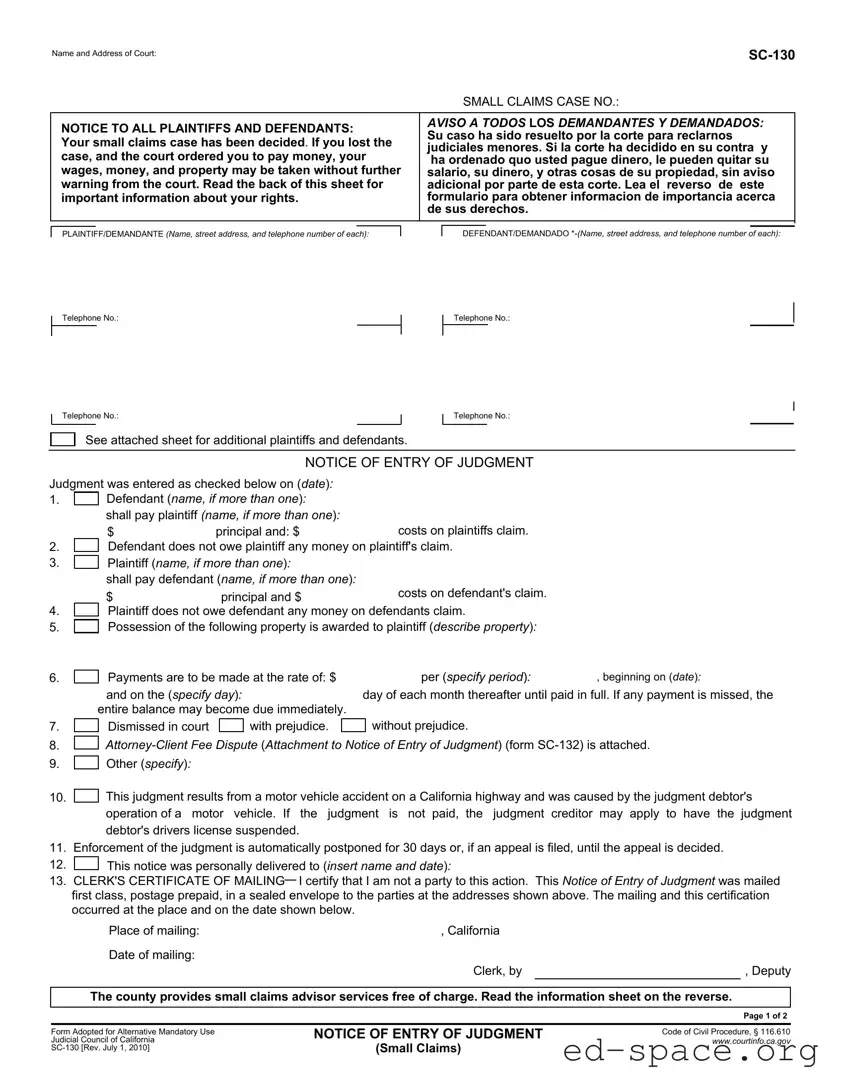
The SC-130 form is a critical document in California's small claims process, serving as the official notice of entry of judgment. It outlines the court's decision regarding the case, indicating whether the defendant owes money to the plaintiff or vice versa. This form includes essential details such as the names and addresses of the parties involved, the case number, and the court's ruling. If the court has ordered payment, it specifies the amount due, the payment schedule, and any additional costs. Importantly, it also informs both parties of their rights and obligations following the judgment, including the implications of failing to comply with the court's order. For those who lost the case, the SC-130 highlights options like appealing the decision or requesting a payment plan. On the other hand, for those who won, it provides guidance on how to collect the awarded amount. The form also includes a section for acknowledging satisfaction of the judgment once payment has been made, ensuring that all parties are clear on the resolution of the case. Understanding the SC-130 is essential for anyone involved in a small claims dispute in California, as it lays out the next steps and the legal ramifications of the court's decision.
Name and Address of Court:
SMALL CLAIMS CASE NO.:
NOTICE TO ALL PLAINTIFFS AND DEFENDANTS: |
AVISO A TODOS LOS DEMANDANTES Y DEMANDADOS: |
||
Su caso ha sido resuelto por la corte para reclarnos |
|||
Your small claims case has been decided. If you lost the |
|||
judiciales menores. Si la corte ha decidido en su contra y |
|||
case, and the court ordered you to pay money, your |
|||
ha ordenado quo usted pague dinero, le pueden quitar su |
|||
wages, money, and property may be taken without further |
|||
salario, su dinero, y otras cosas de su propiedad, sin aviso |
|||
warning from the court. Read the back of this sheet for |
adicional por parte de esta corte. Lea el reverso de este |
||
important information about your rights. |
formulario para obtener informacion de importancia acerca |
||
|
de sus derechos. |
||
|
|
|
|
|
|
|
|
PLAINTIFF/DEMANDANTE (Name, street address, and telephone number of each):
DEFENDANT/DEMANDADO
Telephone No.:
Telephone No.:
Telephone No.:
See attached sheet for additional plaintiffs and defendants.
Telephone No.:
|
|
|
|
|
NOTICE OF ENTRY OF JUDGMENT |
|
|||
Judgment was entered as checked below on (date): |
|
|
|
||||||
1. |
|
Defendant (name, if more than one): |
|
|
|
||||
|
|
shall pay plaintiff (name, if more than one): |
|
|
|
||||
|
$ |
principal and: $ |
|
costs on plaintiffs claim. |
|
||||
2. |
|
Defendant does not owe plaintiff any money on plaintiff's claim. |
|
||||||
3. |
|
Plaintiff (name, if more than one): |
|
|
|
||||
|
|
|
|
||||||
|
|
shall pay defendant (name, if more than one): |
|
|
|
||||
|
$ |
|
principal and $ |
|
costs on defendant's claim. |
|
|||
|
|
|
|
|
|||||
4. |
|
Plaintiff does not owe defendant any money on defendants claim. |
|
||||||
5. |
|
Possession of the following property is awarded to plaintiff (describe property): |
|
||||||
|
|
||||||||
6. |
|
Payments are to be made at the rate of: $ |
|
per (specify period): |
, beginning on (date): |
||||
|
|
||||||||
|
|
and on the (specify day): |
day of each month thereafter until paid in full. If any payment is missed, the |
||||||
|
|
entire balance may become due immediately. |
|
|
|
||||
7. |
|
Dismissed in court |
|
|
with prejudice. |
|
|
without prejudice. |
|
|
|
|
|
|
|
||||
8. |
|
||||||||
|
|||||||||
|
|||||||||
9. |
|
Other (specify): |
|
|
|
|
|
|
|
|
|
|
|
|
|
|
|
||
This judgment results from a motor vehicle accident on a California highway and was caused by the judgment debtor's operation of a motor vehicle. If the judgment is not paid, the judgment creditor may apply to have the judgment debtor's drivers license suspended.
11.Enforcement of the judgment is automatically postponed for 30 days or, if an appeal is filed, until the appeal is decided.
12. This notice was personally delivered to (insert name and date):
13. CLERK'S CERTIFICATE OF MAILING |
|
I certify that I am not a party to this action. This Notice of Entry of Judgment was mailed |
||
|
||||
first class, postage prepaid, in a sealed envelope to the parties at the addresses shown above. The mailing and this certification |
||||
occurred at the place and on the date shown below. |
|
|
||
Place of mailing: |
|
, California |
|
|
Date of mailing: |
|
|
|
|
|
|
Clerk, by |
|
, Deputy |
|
|
|
|
|
The county provides small claims advisor services free of charge. Read the information sheet on the reverse.
Page 1 of 2
Form Adopted for Alternative Mandatory Use Judicial Council of California
NOTICE OF ENTRY OF JUDGMENT
(Small Claims)
Code of Civil Procedure, § 116.610
www.courtinfo.ca.gov
|
|
INFORMATION AFTER JUDGMENT |
INFORMACION DESPUES DEL FALLO DE LA CORTE |
|
|
Your small claims case has been decided. The judgment or decision of the court appears on the front of this sheet. The court may have ordered one party to pay money to the other party. The person (or business) who won the case and who can collect the money is called the judgment creditor. The person (or business) who lost the case and who owes the money is called the judgment debtor.
Enforcement of the judgment is postponed until the time for appeal ends or until the appeal is decided. This means that the judgment creditor cannot collect any money or take any action until this period is over. Generally, both parties may be represented by lawyers after judgment.
IF YOU LOST THE CASE . . .
1 . If you lost the case on your own claim and the court did not award you any money, the court's decision on your claim is FINAL. You may not appeal your own claim.
2 . If you lost the case and the court ordered you to pay money,
your money and property may be taken to pay the claim unless you do one of the following things:
a. PAY THE JUDGMENT
The law requires you to pay the amount of the judgment. You may pay the judgment creditor directly, or pay the judgment to the court for an additional fee. You may also ask the court to order monthly payments you can afford.
Ask the clerk for information about these procedures.
b.APPEAL
If you disagree with the court's decision, you may appeal the decision on the other party's claim. You may not
appeal the decision on your own claim. However, if any party appeals, there will be a new trial on all the claims. If you appeared at the trial, you must begin your appeal by filing a form called a Notice of Appeal (form
you. Your appeal will be in the superior court. You will
have a new trial and you must present your evidence again. You may be represented by a lawyer.
c.VACATE OR CANCEL THE JUDGMENT
If you did not go to the trial, you may ask the court to vacate or cancel the judgment. To make this request, you must file a Motion to Vacate the Judgment (form
IF YOU WON THE CASE . . .
1.If you were sued by the other party and you won the case, then the other party may not appeal the court's decision.
2.If you won the case and the court awarded you money, here are some steps you may take to collect your money or get possession of your property:
a.COLLECTING FEES AND INTEREST
Sometimes fees are charged for filing court papers or for serving the judgment debtor. These extra costs can become part of your original judgment. To claim these fees, ask the clerk for a Memorandum of Costs.
b.VOLUNTARY PAYMENT
Ask the judgment debtor to pay the money. If your claim was for possession of property, ask the judgment debtor to return the property to you. THE COURT WILL NOT COLLECT THE
MONEY OR ENFORCE THE JUDGMENT FOR YOU.
c.STATEMENT OF ASSETS
If the judgment debtor does not pay the money, the law requires the debtor to fill out a form called the Judgment Debtor's Statement of Assets (form
d.ORDER OF EXAMINATION
You may also make the debtor come to court to answer questions about income and property. To do this, ask the clerk for an Application and Order for Appearance and Examination (Enforcement of Judgment) (form
e.WRIT OF EXECUTION
After you find out about the judgment debtor's property, you may ask the court for a Writ of Execution (form
f.ABSTRACT OF JUDGMENT
The judgment debtor may own land or a house or other buildings. You may want to put a lien on the property so that you will be paid if the property is sold. You can get a lien by filing an Abstract of Judgment (form
NOTICE TO THE PARTY WHO WON: As soon as you have been paid in full, you must fill out the form below and mail it to the court immediately or you may be fined. If an Abstract of Judgment has been recorded, you must use another form; see the clerk for the proper form.
SMALL CLAIMS CASE NO.:
ACKNOWLEDGMENT OF SATISFACTION OF JUDGMENT (Do not
use this form if an Abstract of Judgment has been recorded.)
To the Clerk of the Court:
I am the
judgment creditor
assignee of record.
I agree that the judgment in this action has been paid in full or otherwise satisfied.
Date:
(TYPE OR PRINT NAME) |
(SIGNATURE) |
NOTICE OF ENTRY OF JUDGMENT |
Page 2 of 2
(Small Claims)
| Fact Name | Description |
|---|---|
| Form Title | SC-130 Notice of Entry of Judgment is used in California small claims cases. |
| Governing Law | This form is governed by the California Code of Civil Procedure, § 116.610. |
| Judgment Notification | The form informs parties of the court's decision regarding their small claims case. |
| Judgment Enforcement | Enforcement of the judgment is postponed for 30 days or until an appeal is resolved. |
| Parties Involved | The form identifies the plaintiff(s) and defendant(s) in the small claims case. |
| Payment Terms | The judgment may specify payment amounts and schedules for fulfilling the court's decision. |
Filling out the SC-130 form is a straightforward process that requires careful attention to detail. This form serves as a notice regarding the judgment in a small claims case. The following steps will guide you through completing the form accurately.
After completing the form, ensure all information is accurate before submitting it to the court. Be mindful of any deadlines associated with the judgment and follow up as necessary.
What is the SC-130 form used for?
The SC-130 form is a Notice of Entry of Judgment used in small claims cases in California. It informs both plaintiffs and defendants about the court's decision regarding their case. This includes details on whether money is owed, the amount, and any property awarded. The form also provides information on the next steps for both parties following the judgment.
Who are the parties involved in the SC-130 form?
In the context of the SC-130 form, the plaintiff is the person or business who filed the claim, seeking compensation or resolution. The defendant is the individual or entity being accused or sued. After the court's decision, the plaintiff becomes the judgment creditor, entitled to collect any awarded amount, while the defendant becomes the judgment debtor, responsible for paying the owed amount.
What happens if I lose my small claims case?
If you lose your case, the court may order you to pay money to the other party. This judgment is final, and the court can enforce it without further notice. Your wages, bank accounts, or other property may be taken to satisfy the judgment unless you take action, such as paying the judgment or filing an appeal.
Can I appeal the court's decision?
You can only appeal the decision on the other party's claim if you lost the case. If you disagree with the court's ruling, you must file a Notice of Appeal within 30 days of receiving the SC-130 form. This process allows you to have a new trial in superior court, where you can present your evidence again.
What should I do if I win my small claims case?
If you win, the other party cannot appeal the decision. If the court awarded you money, you can take steps to collect it. This may include asking the judgment debtor for payment or filing for a Writ of Execution to seize their property to satisfy the judgment. The court does not collect the money for you, so proactive measures are necessary.
How can I enforce a judgment if the debtor does not pay?
If the judgment debtor fails to pay, you can request a Judgment Debtor's Statement of Assets to learn about their financial situation. Additionally, you may file an Application and Order for Appearance and Examination to compel the debtor to disclose their income and assets in court. If necessary, you can also obtain a Writ of Execution to have property seized to satisfy the debt.
What is the time frame for enforcing a judgment?
Enforcement of the judgment is automatically postponed for 30 days after the judgment is entered. If an appeal is filed, enforcement is delayed until the appeal is resolved. This means you cannot collect any money or take further action until this period has expired.
What should I do once I have been paid in full?
Once you have received full payment for the judgment, you must complete and submit an Acknowledgment of Satisfaction of Judgment to the court immediately. Failing to do so may result in fines. If you recorded an Abstract of Judgment, you must use a different form to acknowledge the satisfaction of the judgment.
Failing to include all required contact information for plaintiffs and defendants. Ensure that you provide full names, street addresses, and telephone numbers for everyone involved.
Not specifying the correct judgment amount. Be precise when entering the principal amount and any additional costs. Errors can lead to confusion and delays.
Neglecting to check the appropriate boxes regarding the judgment outcome. Indicate clearly whether the defendant owes money or if the case was dismissed.
Omitting the date of judgment. This date is crucial for tracking the timeline of the case and any potential appeals.
Forgetting to include a description of property awarded to the plaintiff. If applicable, provide a clear description to avoid disputes later.
Not understanding the implications of missing a payment. Make sure to note that missed payments may result in the entire balance becoming due immediately.
Failing to file the Motion to Vacate within the required timeframe. If you did not attend the trial, you have specific deadlines to act.
Using incorrect forms or failing to attach necessary documents. Ensure that all relevant attachments, like the Attachment to Notice of Entry of Judgment, are included.
Not seeking assistance from a small claims advisor. The county offers free services that can help clarify the process and ensure accuracy.
The SC-130 form is a crucial document in California's small claims process, serving as a notice of entry of judgment. Alongside this form, several other documents may be utilized to facilitate the legal proceedings or post-judgment actions. Below are five common forms that are often associated with the SC-130.
Understanding these forms can significantly aid in navigating the small claims process. Each document serves a specific purpose, whether it be to appeal a decision, disclose assets, or enforce a judgment. Familiarity with these forms can empower individuals to take appropriate actions following a small claims judgment.
The SC-130 form, used in California small claims cases, shares similarities with several other legal documents. Each of these forms serves a specific purpose related to the small claims process. Here’s a breakdown of eight documents that are comparable to the SC-130 form:
Understanding these documents can help navigate the complexities of small claims court. Each form plays a role in ensuring that judgments are enforced and that parties understand their rights and responsibilities following a court decision.
When filling out the SC-130 California form, keep these important dos and don'ts in mind:
Misconceptions about the SC-130 California form can lead to confusion regarding small claims court procedures. Here are six common misunderstandings:
This form is relevant for both plaintiffs and defendants. It notifies all parties about the court's decision, regardless of who initiated the case.
In small claims court, you cannot appeal a decision on your own claim. You can only appeal the other party's claim if you win.
The court does not collect money on your behalf. It is the responsibility of the winning party to pursue collection methods.
You can request a payment plan if the judgment imposes financial strain. The court may allow you to pay in installments based on your ability to pay.
While judgments are final, there are options to vacate or appeal under certain circumstances. Specific procedures must be followed to initiate these actions.
When using the SC-130 form in California for small claims, it is essential to keep the following key points in mind: