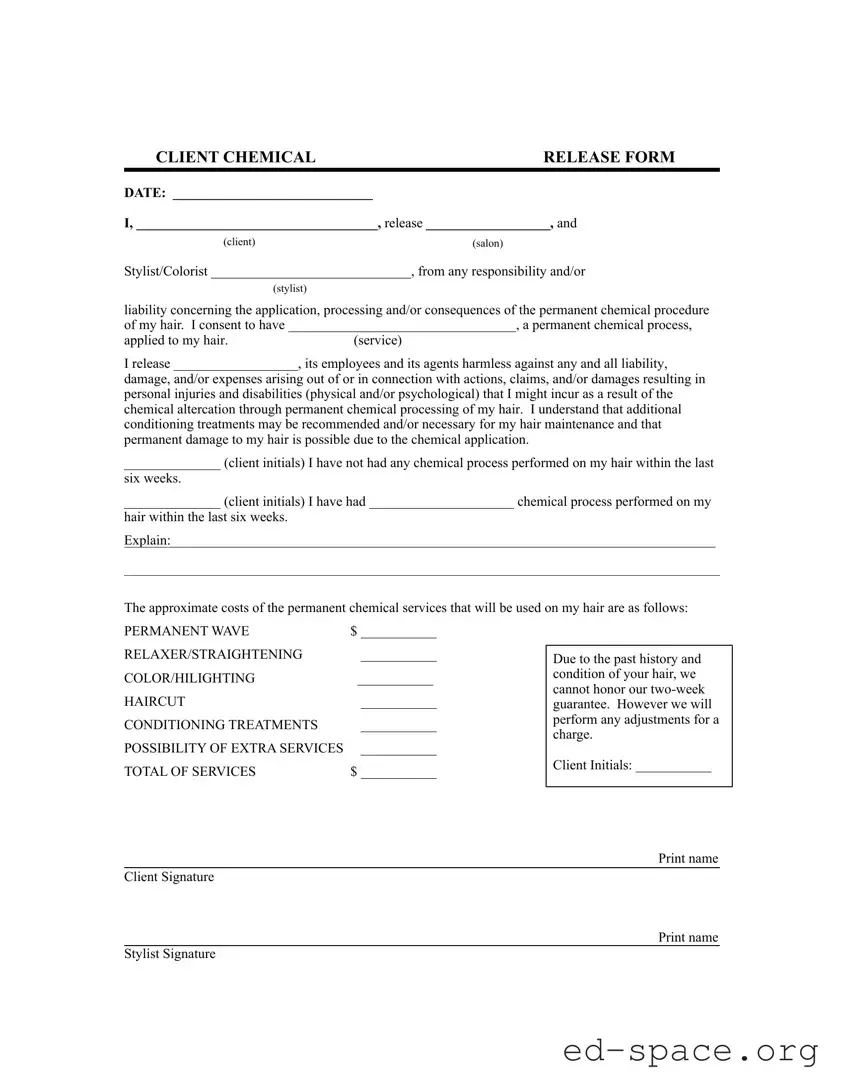
The Salon Chemical Waiver form is an essential document for anyone considering a permanent chemical treatment for their hair. This form serves to protect both the client and the salon by clearly outlining the responsibilities and potential risks involved in the procedure. Clients must provide their name, the date, and the name of the stylist performing the service. By signing, they release the salon and its employees from liability related to any injuries or damages that may arise from the chemical application. The form also requires clients to disclose their recent chemical treatment history, ensuring that stylists have all necessary information to proceed safely. Cost estimates for various services, such as permanent waves, relaxers, and conditioning treatments, are included, along with a note about the salon's guarantee policy. Clients are encouraged to understand that while the salon aims for the best results, permanent damage to hair is a possibility. This waiver is a crucial step in ensuring informed consent and a smooth salon experience.

CLIENT CHEMICALRELEASE FORM
DATE: _____________________________
I, ___________________________________, release __________________, and
(client)(salon)
Stylist/Colorist _____________________________, from any responsibility and/or
(stylist)
liability concerning the application, processing and/or consequences of the permanent chemical procedure of my hair. I consent to have _________________________________, a permanent chemical process,
applied to my hair.(service)
I release __________________, its employees and its agents harmless against any and all liability,
damage, and/or expenses arising out of or in connection with actions, claims, and/or damages resulting in personal injuries and disabilities (physical and/or psychological) that I might incur as a result of the chemical altercation through permanent chemical processing of my hair. I understand that additional conditioning treatments may be recommended and/or necessary for my hair maintenance and that permanent damage to my hair is possible due to the chemical application.
______________ (client initials) I have not had any chemical process performed on my hair within the last
six weeks.
______________ (client initials) I have had _____________________ chemical process performed on my
hair within the last six weeks.
Explain: ______________________________________________________________________________
The approximate costs of the permanent chemical services that will be used on my hair are as follows:
PERMANENT WAVE |
$ ___________ |
|
|
RELAXER/STRAIGHTENING |
___________ |
|
|
Due to the past history and |
|||
COLOR/HILIGHTING |
___________ |
condition of your hair, we |
|
HAIRCUT |
___________ |
cannot honor our |
|
guarantee. However we will |
|||
CONDITIONING TREATMENTS |
___________ |
perform any adjustments for a |
|
charge. |
|||
POSSIBILITY OF EXTRA SERVICES |
___________ |
||
Client Initials: ___________ |
|||
TOTAL OF SERVICES |
$ ___________ |
||
|
|||
|
|
|
Print name
Client Signature
Print name
Stylist Signature
| Fact Name | Description |
|---|---|
| Purpose | The Salon Chemical Waiver form is designed to protect the salon and its staff from liability related to chemical hair treatments. |
| Client Consent | Clients must provide explicit consent for the application of chemical processes, acknowledging potential risks involved. |
| Release of Liability | By signing the form, clients release the salon and its employees from any responsibility for injuries or damages resulting from the treatment. |
| Prior Treatments | Clients must disclose any chemical processes performed on their hair within the last six weeks to ensure safe application. |
| Cost Disclosure | The form outlines the approximate costs associated with various permanent chemical services, ensuring transparency for clients. |
| State-Specific Regulations | In some states, such as California, the governing law includes the California Business and Professions Code, which regulates cosmetology practices. |
Completing the Salon Chemical Waiver form is an important step before undergoing any chemical hair treatment. This process ensures that both you and the salon understand the terms and conditions of the service. Follow the steps below to fill out the form accurately.
Once the form is completed, it will be reviewed by the salon staff. This ensures that all necessary information is provided before proceeding with the chemical treatment. Keep a copy for your records if possible.
What is the purpose of the Salon Chemical Waiver form?
The Salon Chemical Waiver form is designed to protect both the client and the salon. By signing this form, clients acknowledge the risks associated with permanent chemical treatments, such as hair coloring or straightening. It ensures that clients are aware of these risks and agree to release the salon and its staff from liability for any adverse effects that may arise from the procedure.
What should I include when filling out the form?
When completing the form, you will need to provide your name, the date, and details about the specific chemical treatment you are receiving. Additionally, you will need to indicate whether you have had any chemical processes done on your hair in the last six weeks. This information helps the stylist assess the condition of your hair and determine the best approach for your treatment.
What happens if I have had a chemical treatment recently?
If you have had a chemical treatment within the last six weeks, you must disclose this on the form. The stylist will then evaluate your hair's condition and may advise against proceeding with the new treatment. This precaution helps prevent potential damage to your hair and ensures your safety during the process.
Are there any potential risks involved with chemical treatments?
Yes, there are risks associated with chemical treatments. These can include hair damage, changes in hair texture, or allergic reactions. The waiver form highlights these risks, emphasizing that clients should be aware of them before proceeding. Clients are encouraged to discuss any concerns with their stylist prior to signing the waiver.
Will I need additional treatments after my chemical service?
It is common for stylists to recommend additional conditioning treatments following a chemical service. These treatments can help maintain the health and appearance of your hair. The waiver form indicates that such treatments may be necessary, and clients should be prepared for potential extra costs associated with them.
What if I experience damage to my hair after the treatment?
If you experience any damage to your hair after the treatment, it is essential to communicate this with your stylist. While the waiver releases the salon from liability, they may still offer adjustments or recommendations for care. However, be aware that there may be additional charges for these services, especially if they fall outside the salon's two-week guarantee.
How are the costs for chemical services determined?
The costs for chemical services are typically outlined on the waiver form. Each service, such as permanent waves, relaxers, or haircuts, will have a designated price. Clients should review these costs and ensure they understand the total expenses before signing the waiver.
What does it mean to release the salon from liability?
Releasing the salon from liability means that you agree not to hold them responsible for any adverse effects or injuries that may occur as a result of the chemical treatment. This includes physical or psychological impacts. By signing the waiver, you acknowledge the risks and accept that you are participating in the treatment voluntarily.
Can I refuse to sign the waiver?
Yes, you have the right to refuse to sign the waiver. However, keep in mind that most salons require this form to be signed before proceeding with any chemical treatments. If you do not sign, the salon may not be able to perform the service you desire, as they need to protect themselves from potential liability.
Failing to fill in the date at the top of the form. This is crucial for record-keeping and liability purposes.
Not providing a complete client name. Ensure that your full name is written clearly to avoid any confusion.
Leaving the salon name blank. This can lead to misunderstandings about where the services are being performed.
Neglecting to specify the stylist or colorist's name. This information is essential for accountability and communication.
Overlooking the service type you are consenting to. Clearly indicate the chemical process to ensure proper application.
Not initialing the sections regarding previous chemical processes. This information helps the stylist assess your hair’s condition accurately.
Forgetting to include cost estimates for the services. This could lead to unexpected charges later on.
Not signing the form. Your signature is necessary to validate your consent and release the salon from liability.
Failing to read the entire form before signing. Understanding the terms and conditions is vital for your safety and satisfaction.
When preparing for a salon appointment involving chemical treatments, several important documents may be required in addition to the Salon Chemical Waiver form. Each of these documents serves a specific purpose and helps ensure that both the client and the salon are protected throughout the process.
Being aware of these additional documents can help clients navigate their salon experience more smoothly. Each form plays a vital role in ensuring a safe and satisfactory service for everyone involved.
The Salon Chemical Waiver form serves an important role in protecting both clients and salons during chemical hair treatments. It is similar to several other documents that aim to manage risk and outline responsibilities. Here’s a look at eight such documents:
Each of these documents serves to create a clear understanding between clients and service providers, helping to manage expectations and mitigate risks.
When filling out the Salon Chemical Waiver form, it's important to be careful and thorough. Here’s a list of things to do and avoid:
Understanding the Salon Chemical Waiver form can be challenging, especially with the various misconceptions surrounding it. Here are eight common misunderstandings:
This is not entirely true. While the waiver releases the salon from certain liabilities, it does not protect them from gross negligence or misconduct.
The waiver acknowledges that chemical processes can lead to unpredictable results. It does not guarantee satisfaction or perfect outcomes.
Consultations are crucial. They help assess your hair's condition and discuss potential risks before signing the waiver.
The waiver covers a range of potential issues, including minor damage or unexpected results, not just severe reactions.
While the waiver releases the salon from some liability, it emphasizes that clients are still responsible for their hair's condition before the treatment.
Clients are encouraged to ask questions. Understanding the waiver fully is essential before signing it.
Waivers can vary significantly between salons. Each salon may have different policies and procedures reflected in their forms.
While the waiver is a legal document, clients may discuss modifications or clarifications with the salon before signing.
When filling out and using the Salon Chemical Waiver form, keep these key takeaways in mind: