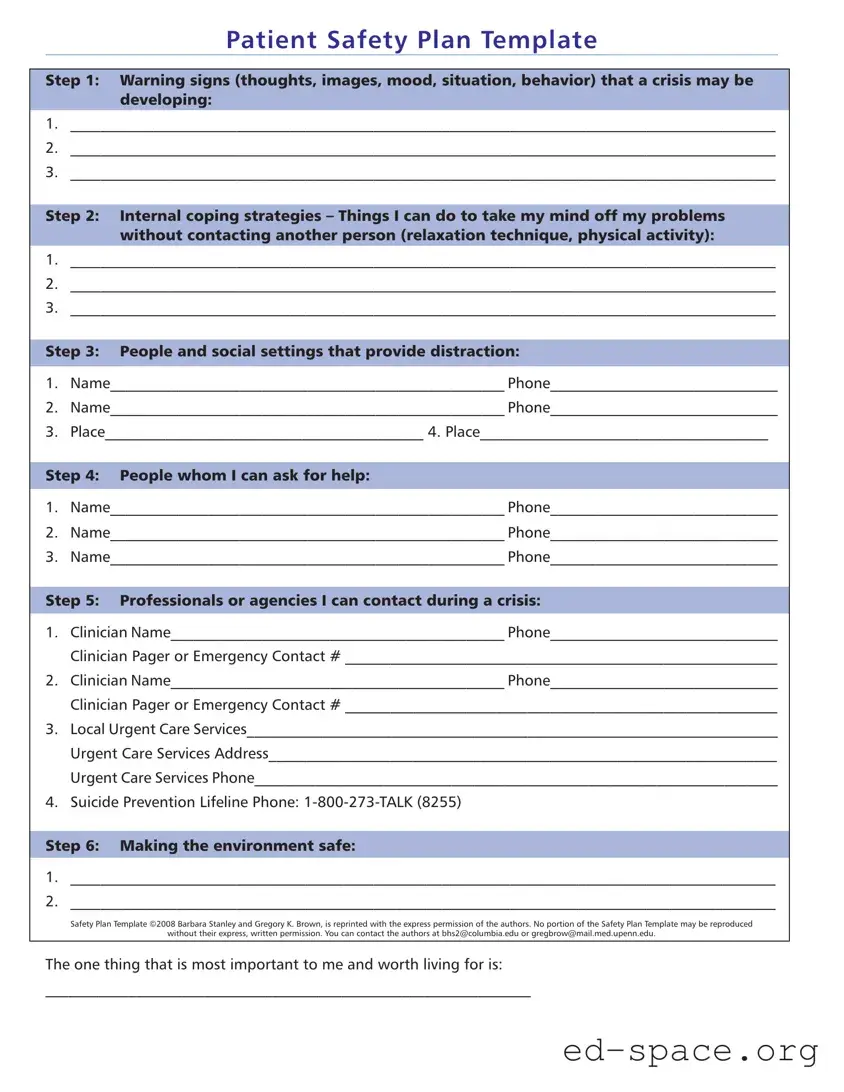
The Safety Plan form serves as a crucial tool for individuals seeking to navigate and manage potential crises effectively. It is structured to guide users through a series of steps designed to identify warning signs, develop coping strategies, and establish a network of support. The first step involves recognizing personal warning signs, such as specific thoughts or behaviors that may indicate a crisis is approaching. Following this, individuals are encouraged to explore internal coping strategies—activities that can provide distraction without needing to reach out to others. The form also prompts users to list supportive people and social settings that can offer comfort and distraction during tough times. Additionally, it emphasizes the importance of identifying trusted individuals who can provide help when needed, as well as professionals or agencies that can be contacted in a crisis. Lastly, the form addresses the need for creating a safe environment, ensuring that individuals can take proactive steps to protect themselves. By filling out this form, individuals can clarify their thoughts and feelings, ultimately fostering a sense of empowerment and preparedness.

Patient Safety Plan Template
Step 1: Warning signs (thoughts, images, mood, situation, behavior) that a crisis may be developing:
1._____________________________________________________________________________________________
2._____________________________________________________________________________________________
3._____________________________________________________________________________________________
Step 2: Internal coping strategies – Things I can do to take my mind off my problems without contacting another person (relaxation technique, physical activity):
1._____________________________________________________________________________________________
2._____________________________________________________________________________________________
3._____________________________________________________________________________________________
Step 3: People and social settings that provide distraction:
1.Name____________________________________________________ Phone______________________________
2.Name____________________________________________________ Phone______________________________
3.Place__________________________________________ 4. Place______________________________________
Step 4: People whom I can ask for help:
1.Name____________________________________________________ Phone______________________________
2.Name____________________________________________________ Phone______________________________
3.Name____________________________________________________ Phone______________________________
Step 5: Professionals or agencies I can contact during a crisis:
1.Clinician Name____________________________________________ Phone______________________________
Clinician Pager or Emergency Contact # _________________________________________________________
2.Clinician Name____________________________________________ Phone______________________________
Clinician Pager or Emergency Contact # _________________________________________________________
3.Local Urgent Care Services______________________________________________________________________
Urgent Care Services Address___________________________________________________________________
Urgent Care Services Phone_____________________________________________________________________
4.Suicide Prevention Lifeline Phone:
Step 6: Making the environment safe:
1._____________________________________________________________________________________________
2._____________________________________________________________________________________________
Safety Plan Template ©2008 Barbara Stanley and Gregory K. Brown, is reprinted with the express permission of the authors. No portion of the Safety Plan Template may be reproduced
without their express, written permission. You can contact the authors at [email protected] or [email protected].
The one thing that is most important to me and worth living for is:
________________________________________________________________
| Fact Name | Description |
|---|---|
| Purpose | The Safety Plan form is designed to help individuals identify warning signs of a crisis and develop coping strategies. |
| Steps Involved | The form consists of six steps, including identifying warning signs, coping strategies, and support systems. |
| Confidentiality | The information provided in the Safety Plan is confidential and should be shared only with trusted individuals or professionals. |
| Emergency Contacts | Individuals are encouraged to list emergency contacts, including clinicians and crisis services, for immediate support. |
| Accessibility | The Safety Plan form is widely available and can often be obtained from mental health professionals or online resources. |
| State-Specific Forms | Some states may have specific forms or requirements based on local laws, such as mental health statutes. |
| Legal Protection | In many states, the information in the Safety Plan may be protected under mental health privacy laws. |
| Author Rights | The Safety Plan Template ©2008 is protected by copyright, and reproduction requires permission from the authors. |
Filling out the Safety Plan form is an important step in preparing for potential crises. This form helps individuals identify warning signs, coping strategies, and resources for support. Completing it thoroughly can provide clarity and direction in times of need.
What is the purpose of the Safety Plan form?
The Safety Plan form is designed to help individuals identify warning signs that indicate a potential crisis. It provides a structured approach to coping strategies, support systems, and resources that can be utilized during difficult times. The form encourages proactive planning to enhance personal safety and well-being.
How can I identify warning signs in Step 1?
In Step 1, individuals are encouraged to reflect on their personal experiences to identify specific thoughts, feelings, or behaviors that may signal an impending crisis. This can include changes in mood, troubling thoughts, or specific situations that have previously led to distress. Listing these warning signs can help increase awareness and facilitate timely intervention.
What types of internal coping strategies should I consider in Step 2?
Step 2 focuses on internal coping strategies that can be employed independently. Examples include relaxation techniques, such as deep breathing or meditation, and physical activities like walking or exercising. The goal is to find methods that effectively divert attention from distressing thoughts and promote emotional regulation without needing to reach out to others.
Who should I include in Step 3 for social support?
In Step 3, individuals should identify people and social settings that provide positive distractions. This may include friends, family members, or community groups. It is important to consider individuals who are supportive and understanding, as well as places that foster a sense of safety and comfort.
What information should I gather in Step 4 regarding people I can ask for help?
Step 4 emphasizes the importance of having a support network. Individuals should list names and contact information for trusted friends, family members, or mentors who can provide assistance during a crisis. This information is crucial for quick access when support is needed most.
What professionals or agencies should I include in Step 5?
In Step 5, it is essential to identify mental health professionals or agencies that can be contacted during a crisis. This may include clinicians, therapists, or local urgent care services. It is also advisable to include hotlines, such as the Suicide Prevention Lifeline, to ensure immediate support is accessible if necessary.
How can I ensure my environment is safe in Step 6?
Step 6 involves assessing and modifying your environment to enhance safety. This may include removing harmful objects, securing medications, or creating a designated safe space. Individuals should consider what changes can be made to minimize risk and promote a sense of security in their surroundings.
Failing to identify specific warning signs. Individuals often leave this section blank or provide vague descriptions, making it difficult to recognize when a crisis is approaching.
Not listing internal coping strategies. Some people do not include effective techniques that can help distract them from their problems, which are crucial during a crisis.
Omitting names and contact information for people and social settings. This can lead to a lack of support when distraction is needed, as individuals may not remember who to reach out to.
Not providing complete details for people to ask for help. Leaving out phone numbers or not including enough contacts can hinder access to support during critical moments.
Neglecting to list professionals or agencies that can be contacted during a crisis. This omission can result in missed opportunities for timely assistance.
Failing to specify urgent care services and their contact information. Without this information, individuals may struggle to find immediate help when needed.
Not making the environment safe. Individuals may skip this step, which is essential for preventing potential harm during a crisis.
Leaving the section about the most important thing worth living for blank. This reflection can provide motivation and purpose, especially during difficult times.
Rushing through the form without taking time to reflect. This can lead to incomplete or inaccurate information, which diminishes the effectiveness of the Safety Plan.
When creating a comprehensive Safety Plan, several other forms and documents can complement the process. These documents can provide additional support and structure, ensuring that individuals have the necessary resources and strategies to manage crises effectively. Below is a list of commonly used forms that may accompany the Safety Plan.
Utilizing these forms alongside the Safety Plan can enhance an individual’s ability to navigate crises effectively. Each document serves a unique purpose, contributing to a holistic approach to safety and well-being.
The Safety Plan form shares similarities with several other documents designed to support individuals in crisis situations. Below are four documents that serve similar purposes:
When filling out the Safety Plan form, it is essential to approach the task thoughtfully. Here are six guidelines to consider:
Following these guidelines can enhance the effectiveness of the Safety Plan and ensure it serves its intended purpose.
Understanding the Safety Plan form is crucial for individuals seeking to navigate their mental health challenges effectively. However, several misconceptions can cloud its purpose and utility. Here are eight common misunderstandings:
By addressing these misconceptions, individuals can better utilize the Safety Plan to support their mental health and well-being.
Filling out and using a Safety Plan form is a vital step in managing crises effectively. Here are some key takeaways to keep in mind:
By following these steps, you can create a personalized Safety Plan that empowers you to manage crises more effectively. Remember, the plan is a tool to help you feel safer and more in control.