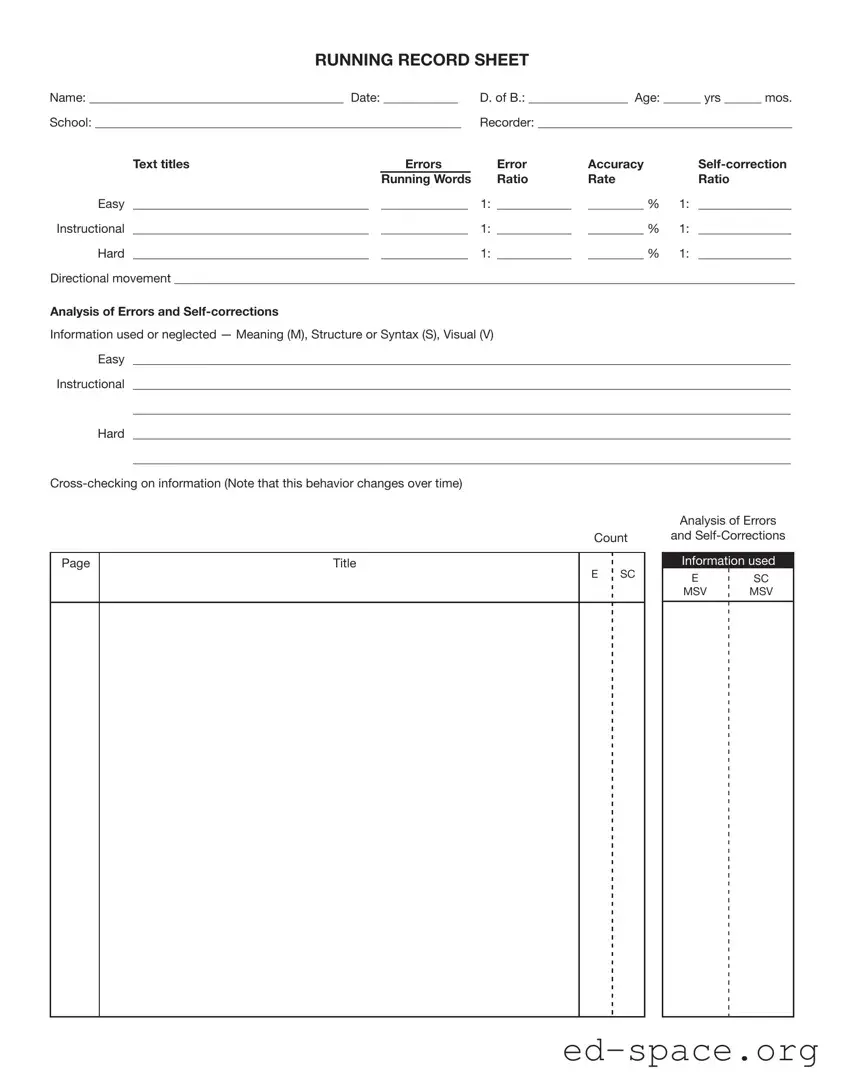
The Running Record Sheet is an essential tool for educators, providing a structured way to assess a student's reading abilities. This form captures key information such as the student's name, date of assessment, date of birth, age, and school. It allows the recorder to document various text titles alongside the errors made during reading, which are crucial for understanding a student's reading level. The form also includes sections for calculating error accuracy, self-correction rates, and running words ratio, helping educators gauge how well a student is comprehending and processing text. Additionally, the Running Record Sheet categorizes texts into easy, instructional, and hard levels, facilitating targeted instruction. An analysis section provides space for educators to reflect on the types of errors made and the strategies used by students, including meaning, structure, and visual cues. This comprehensive approach not only highlights areas for improvement but also supports the development of effective reading strategies tailored to individual needs.

RUNNING RECORD SHEET
Name: _________________________________________ Date: ____________ |
D. of B.: ________________ Age: ______ yrs ______ mos. |
|||||
School: ___________________________________________________________ |
Recorder: _________________________________________ |
|||||
|
Text titles |
Errors |
|
Error |
Accuracy |
|
|
|
Running Words |
Ratio |
Rate |
Ratio |
|
Easy |
______________________________________ |
______________ |
|
1: ____________ |
_________ % |
1: _______________ |
Instructional |
______________________________________ |
______________ |
|
1: ____________ |
_________ % |
1: _______________ |
Hard |
______________________________________ |
______________ |
|
1: ____________ |
_________ % |
1: _______________ |
Directional movement ____________________________________________________________________________________________________
Analysis of Errors and
Information used or neglected — Meaning (M), Structure or Syntax (S), Visual (V)
Easy __________________________________________________________________________________________________________
Instructional __________________________________________________________________________________________________________
__________________________________________________________________________________________________________
Hard __________________________________________________________________________________________________________
__________________________________________________________________________________________________________
Page
Title
Count
ESC
Analysis of Errors
and
Information used
ESC
MSV MSV

Page
Title
Count
ESC
Analysis of Errors
and
Information used
ESC
MSV MSV
| Fact Name | Details |
|---|---|
| Purpose | The Running Record Sheet is used to assess a student's reading abilities, including errors and self-corrections. |
| Components | The form includes sections for the student's name, date, date of birth, age, school, and recorder's name. |
| Error Tracking | It tracks errors, accuracy rates, and self-corrections for different reading levels: easy, instructional, and hard. |
| Ratio Calculations | The form calculates the running words ratio and the error accuracy percentage for each reading level. |
| Directional Movement | A section is included to note the directional movement during reading, which can provide insights into reading habits. |
| Analysis of Errors | There is space for analyzing errors and self-corrections, focusing on meaning, structure, and visual cues. |
| Cross-Checking | The form encourages cross-checking information, noting that this behavior can change over time. |
| State-Specific Laws | In some states, the use of the Running Record Sheet may be governed by educational assessment standards or guidelines. |
After gathering the necessary information, you are ready to fill out the Running Record Sheet. This form will help you document important details about a reading session, including errors, self-corrections, and overall reading accuracy. Following these steps will ensure that you complete the form accurately and effectively.
What is a Running Record Sheet?
A Running Record Sheet is a tool used primarily in educational settings to assess a student’s reading abilities. It helps educators document a student’s reading performance, including errors, self-corrections, and overall comprehension. This form captures critical data that can inform instructional decisions and guide future teaching strategies.
How do I fill out the Running Record Sheet?
To complete the Running Record Sheet, start by entering the student's name, date, date of birth, age, school, and the recorder's name at the top. As the student reads a selected text, note any errors they make, self-corrections, and the overall accuracy of their reading. You will also calculate ratios such as the running words ratio and error accuracy, which provide insight into the student's reading level—easy, instructional, or hard.
What do the terms 'Errors' and 'Self-corrections' mean?
'Errors' refer to instances where a student misreads a word or phrase, which can include omissions, substitutions, or mispronunciations. 'Self-corrections' occur when a student recognizes their mistake and corrects it without prompting. Both metrics are crucial for understanding how a student processes text and where they may need additional support.
What is the significance of the 'Error Accuracy' percentage?
The 'Error Accuracy' percentage indicates how accurately a student reads the text. This percentage is calculated by comparing the number of errors to the total number of words read. A higher percentage suggests a better understanding and fluency in reading, while a lower percentage may highlight areas for improvement.
How can I analyze the errors made by the student?
The Running Record Sheet includes sections for analyzing errors based on meaning (M), structure (S), and visual (V) cues. By categorizing errors in this way, educators can identify patterns in a student’s reading behavior. For example, if a student frequently makes errors related to meaning, they may need help with comprehension strategies.
What do the different reading levels (Easy, Instructional, Hard) mean?
Reading levels categorize texts based on their complexity and the student’s ability to read them successfully. An 'Easy' text is one that a student can read with minimal errors, promoting confidence. 'Instructional' texts present a challenge but are still manageable with some support. 'Hard' texts often exceed a student's current reading capability, indicating that they may require more intensive instruction before attempting such materials.
How can the Running Record Sheet inform my teaching?
Utilizing the data gathered from the Running Record Sheet allows educators to tailor their instruction to meet individual student needs. By identifying specific areas of difficulty, teachers can design targeted interventions, select appropriate reading materials, and monitor progress over time. This focused approach can significantly enhance a student's reading development.
Not filling in all required fields: Many people forget to complete essential sections like the name, date, or age. Missing this information can lead to confusion later.
Incorrectly marking errors: Some individuals misidentify errors in the text. This can affect the accuracy of the running record and lead to misleading conclusions about a student’s reading abilities.
Overlooking self-corrections: It's common to miss noting when a student self-corrects. Ignoring this can skew the understanding of their reading strategies and skills.
Failing to analyze errors: Skipping the analysis section is a frequent mistake. This part is crucial for understanding why errors occurred and how to support the reader effectively.
The Running Record Sheet form is a valuable tool for educators to assess students' reading abilities. However, it is often used in conjunction with several other documents that enhance the evaluation process. Below is a list of commonly used forms and documents that complement the Running Record Sheet.
Utilizing these forms and documents alongside the Running Record Sheet can provide a more complete picture of a student's reading skills. Together, they enable educators to make informed decisions and implement effective instructional strategies.
When filling out the Running Record Sheet form, it's essential to approach the task with both care and clarity. Here’s a guide to help you navigate this process effectively.
By following these guidelines, you can ensure that the Running Record Sheet serves its intended purpose, providing a clear and accurate representation of a student’s reading abilities.
Misconceptions about the Running Record Sheet form can hinder its effective use in educational settings. Understanding these misconceptions is essential for educators who rely on this tool for assessing student reading abilities. Below are four common misconceptions:
By addressing these misconceptions, educators can better utilize the Running Record Sheet to enhance their teaching strategies and support student growth.
When utilizing the Running Record Sheet form, several key points can enhance the effectiveness of the assessment process. Below are important takeaways to consider: