Homepage Blank Rst Army PDF Form
Content Overview

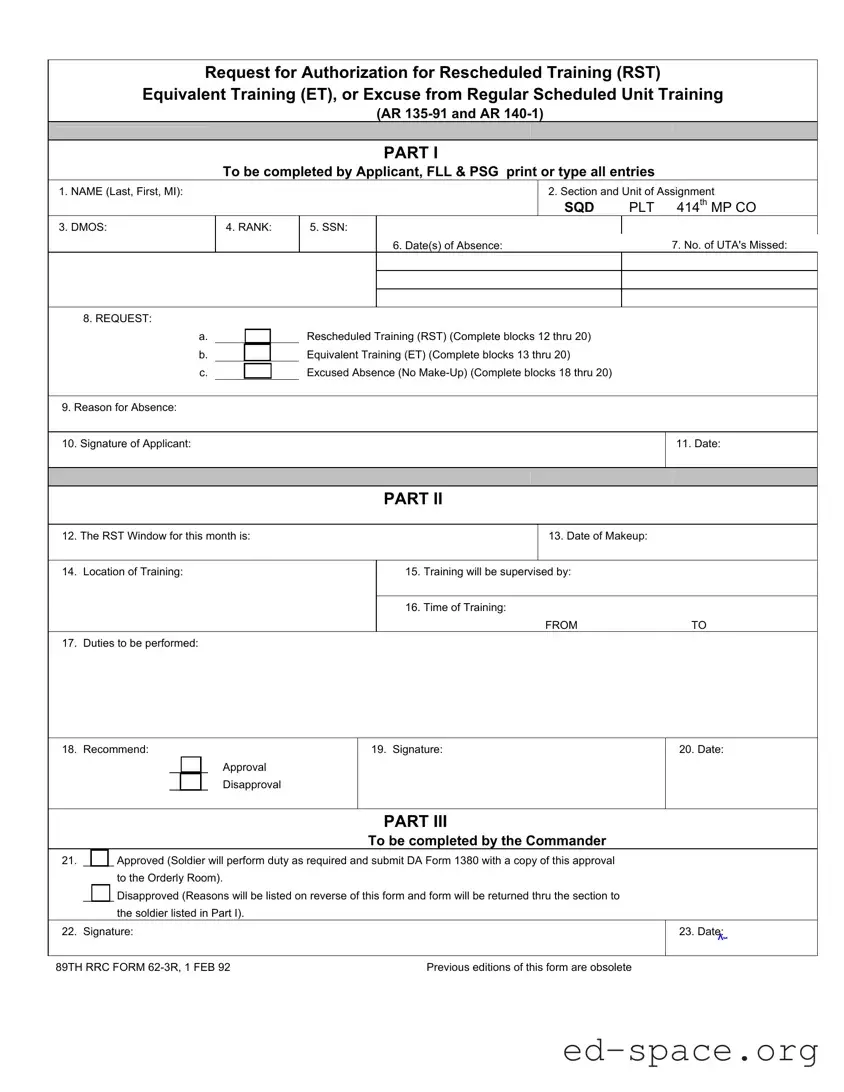
The Request for Authorization for Rescheduled Training (RST), Equivalent Training (ET), or Excuse from Regular Scheduled Unit Training serves as a vital tool for military personnel who find themselves unable to attend their scheduled training sessions. This form is particularly relevant for soldiers who may need to reschedule their training due to various circumstances. It consists of three parts, each designed to capture essential information regarding the applicant's situation. In Part I, the applicant provides personal details such as their name, rank, and the specific dates of absence. Additionally, they must indicate the reason for their absence and select the type of request they are submitting, whether it be for rescheduled training, equivalent training, or an excused absence without the need for make-up. Part II focuses on logistical aspects, including the RST window for the month, the date and location of the make-up training, and details about the supervising officer. Finally, Part III is reserved for the commander’s approval or disapproval, ensuring that all requests are thoroughly reviewed before any decisions are made. This structured approach not only streamlines the process but also ensures that all necessary information is collected to facilitate effective training management.
Document Preview

Request for Authorization for Rescheduled Training (RST)

Equivalent Training (ET), or Excuse from Regular Scheduled Unit Training

(AR 135-91 and AR 140-1)

PART I

To be completed by Applicant, FLL & PSG print or type all entries

1. NAME (Last, First, MI):

2. Section and Unit of Assignment

SQD

PLT 414th MP CO

3. DMOS:

4. RANK:

5. SSN:

6. Date(s) of Absence:

7. No. of UTA's Missed:

8. REQUEST:

a.

b.

c.

Rescheduled Training (RST) (Complete blocks 12 thru 20) Equivalent Training (ET) (Complete blocks 13 thru 20) Excused Absence (No Make-Up) (Complete blocks 18 thru 20)

9. Reason for Absence:

10. Signature of Applicant:

11. Date:

PART II

12. The RST Window for this month is:

13. Date of Makeup:

14. Location of Training:

15. Training will be supervised by:

16. Time of Training:

FROMTO

17. Duties to be performed:

18. Recommend:

_____ Approval

_____ Disapproval

19. Signature:

20. Date:

PART III

To be completed by the Commander

21._____ Approved (Soldier will perform duty as required and submit DA Form 1380 with a copy of this approval to the Orderly Room).

_____ Disapproved (Reasons will be listed on reverse of this form and form will be returned thru the section to

the soldier listed in Part I).

22. Signature:


23. Date:


89TH RRC FORM 62-3R, 1 FEB 92

Previous editions of this form are obsolete

Form Specifications

Fact Name Description
Form Title Request for Authorization for Rescheduled Training (RST), Equivalent Training (ET), or Excuse from Regular Scheduled Unit Training.
Governing Laws AR 135-91 and AR 140-1 govern the use of this form.
Part I Purpose This section is to be completed by the applicant, FLL, and PSG, requiring printed or typed entries.
Applicant Information Includes details such as name, section, unit of assignment, DMOS, rank, and SSN.
Absence Details Applicants must specify the date(s) of absence and the number of UTAs missed.
Request Types Three types of requests can be made: RST, ET, or Excused Absence.
Part II Requirements This section includes details about the RST window, date of makeup, location, and supervision of training.
Part III Commander Review The commander approves or disapproves the request, providing reasons if disapproved.

Rst Army: Usage Guidelines

After gathering the necessary information, you can begin filling out the RST Army form. Make sure to complete each section accurately to ensure a smooth processing of your request.

  1. PART I: Fill out the applicant's information.
  2. Enter your NAME (Last, First, MI).
  3. Provide your Section and Unit of Assignment (e.g., SQD PLT 414th MP CO).
  4. List your DMOS.
  5. Indicate your RANK.
  6. Write your SSN.
  7. Specify the Date(s) of Absence.
  8. State the No. of UTA's Missed.
  9. Choose your REQUEST type:
    • Rescheduled Training (RST) - Complete blocks 12 thru 20
    • Equivalent Training (ET) - Complete blocks 13 thru 20
    • Excused Absence (No Make-Up) - Complete blocks 18 thru 20
  10. Explain your Reason for Absence.
  11. Sign and date the form in the Signature of Applicant and Date fields.
  1. PART II: Complete the training details.
  2. Fill in the RST Window for this month.
  3. Provide the Date of Makeup.
  4. State the Location of Training.
  5. Identify who will supervise the training.
  6. Specify the Time of Training (FROM and TO).
  7. List the Duties to be performed.
  8. Indicate your recommendation for Approval or Disapproval.
  9. Sign and date the form in the Signature and Date fields.
  1. PART III: To be completed by the Commander.
  2. Mark whether the request is Approved or Disapproved.
  3. If disapproved, provide reasons on the reverse side of the form.
  4. Commander must sign and date the form in the Signature and Date fields.

Your Questions, Answered

What is the RST Army form used for?

The RST Army form is utilized to request authorization for rescheduled training, equivalent training, or an excuse from regular scheduled unit training. It ensures that service members can formally document their absences and request appropriate accommodations under Army regulations.

Who needs to complete the RST Army form?

The form must be completed by the applicant, which typically includes the service member requesting the training change. Additionally, the First Line Leader (FLL) and Platoon Sergeant (PSG) are required to print or type all entries in the designated sections.

What information is required in Part I of the form?

Part I requires several key pieces of information, including the applicant's name, section and unit of assignment, duty military occupational specialty (DMOS), rank, social security number (SSN), dates of absence, number of Unit Training Assemblies (UTAs) missed, the type of request (RST, ET, or excused absence), reason for absence, and the applicant's signature and date.

What are the different types of requests that can be made on the form?

The form allows for three types of requests: Rescheduled Training (RST), Equivalent Training (ET), and Excused Absence (No Make-Up). Each type requires specific sections to be completed to ensure proper processing.

What details are needed in Part II of the form?

In Part II, the applicant must provide details about the RST window for the month, the date and location of the makeup training, the supervising individual, the time of training, and the duties to be performed. Additionally, the applicant must indicate whether they recommend approval or disapproval and provide their signature and date.

How does the approval process work for the RST Army form?

Once the form is completed, it is reviewed by the Commander in Part III. The Commander will either approve or disapprove the request. If approved, the soldier will perform the required duties and submit a DA Form 1380 with a copy of the approval to the Orderly Room. If disapproved, reasons will be provided on the reverse side of the form, and it will be returned to the soldier through their section.

What should a soldier do if their request is disapproved?

If a soldier's request is disapproved, they should review the reasons provided on the reverse side of the form. This information can help them understand the decision and guide any future requests. They may also seek clarification from their leadership if needed.

What is the importance of providing accurate information on the form?

Providing accurate information on the RST Army form is crucial for ensuring that requests are processed efficiently. Inaccurate or incomplete information can lead to delays or denials of the request, which may affect the soldier's training and readiness.

Are previous editions of the RST Army form still valid?

No, previous editions of the RST Army form are considered obsolete. It is important to use the current version, which is the 89TH RRC FORM 62-3R, dated 1 FEB 92, to ensure compliance with the latest regulations.

Common mistakes

  1. Incomplete Information: Many applicants forget to fill out all required fields, such as their rank or SSN. Missing this information can delay the processing of the request.

  2. Incorrect Dates: Some people mistakenly enter the wrong dates for their absence or the makeup training. Double-checking these dates is crucial.

  3. Signature Issues: Failing to sign the form or providing an illegible signature can lead to rejection. Always ensure your signature is clear and present.

  4. Choosing the Wrong Request Type: Applicants sometimes select the incorrect option for their request, such as choosing Excused Absence when they meant to request Rescheduled Training.

  5. Missing Justification: Not providing a detailed reason for absence can raise questions. A clear explanation helps in understanding the context of the request.

  6. Not Following Up: After submission, some individuals fail to check the status of their request. Following up can prevent unnecessary delays.

  7. Ignoring the Commander’s Section: Many forget that the form requires approval from the commander. Ensure that all sections are completed before submission.

Documents used along the form

The RST Army form is a key document for service members seeking authorization for rescheduled training or an excuse from regular scheduled unit training. Several other forms and documents may accompany the RST Army form, each serving a specific purpose in the training and administrative processes. Below is a list of commonly used forms that may be relevant.

  • DA Form 1380: This form is used to document training that has been completed by a soldier. It provides a record of training events and is often submitted alongside the RST Army form for verification.
  • DA Form 1059: This is the academic evaluation report for soldiers who have completed a course of instruction. It assesses the soldier's performance and is important for career progression.
  • DA Form 4187: This form is a personnel action request. It is used to request various actions, such as promotions, transfers, or changes in duty status, which may be relevant when rescheduling training.
  • AR 135-91: This Army regulation outlines policies for training and attendance requirements. It serves as a reference for soldiers regarding their training obligations and the process for requesting exceptions.
  • AR 140-1: This regulation governs the training and service requirements for Army Reserve members. It provides guidance on the expectations for attendance and participation in training.
  • DA Form 4856: This is a developmental counseling form used by leaders to document counseling sessions with soldiers. It can be useful for addressing training-related issues or performance concerns.
  • Unit Training Plan: This document outlines the training schedule and objectives for the unit. It helps soldiers understand their training commitments and may assist in planning rescheduled training.
  • Leave Form (DA Form 31): This form is used to request leave from duty. If a soldier is unable to attend training due to personal reasons, this form may be submitted alongside the RST Army form.
  • Medical Profile (DA Form 3349): A medical profile outlines any physical limitations a soldier may have. This document can be important when requesting an excuse from training due to medical reasons.

Understanding these forms and documents can help service members navigate the administrative processes associated with training. Each document plays a role in ensuring that training requirements are met while accommodating individual circumstances.

Similar forms

The RST Army form is similar to several other documents used in military and training contexts. Each of these documents serves a specific purpose related to training, attendance, or absence. Below are ten documents that share similarities with the RST Army form:

  • DA Form 1380: This form is used to document missed training and requires the soldier to provide details about the absence. Like the RST form, it emphasizes the importance of accountability in training attendance.
  • DA Form 1059: This is a Service School Academic Evaluation Report. It captures a soldier's performance during training, similar to how the RST form assesses attendance and participation in training activities.
  • DA Form 4187: This form is a request for personnel action, which can include requests for leave or training changes. Both forms require detailed personal information and justification for the request.
  • AR 135-91: This regulation outlines policies for attendance and training requirements for Reserve Component members. It provides the framework within which the RST form operates, ensuring compliance with training mandates.
  • AR 140-1: Similar to AR 135-91, this regulation governs training for the Army National Guard. It also addresses absences and training requirements, aligning with the objectives of the RST form.
  • DA Form 4856: This form is used for counseling sessions. It can address attendance issues and training performance, paralleling the RST form's focus on accountability and training compliance.
  • DA Form 7500: This is a request for an extension of training or duty. It requires justification for the request, much like the RST form, which asks for reasons behind absences.
  • Unit Training Plan (UTP): This document outlines the training schedule for a unit. It serves as a reference for training requirements, similar to how the RST form specifies training sessions and responsibilities.
  • Leave Request Form: This form is used by soldiers to request time off from duty. Both documents require a clear explanation of the reason for absence and are submitted for approval.
  • Training Attendance Roster: This document tracks who attended training sessions. It complements the RST form by providing a record of attendance and participation, ensuring accountability within the unit.

Dos and Don'ts

When filling out the RST Army form, there are important guidelines to follow. Adhering to these can help ensure your request is processed smoothly.

  • Do print or type all entries clearly to avoid confusion.
  • Do include your full name, unit, and rank in the designated sections.
  • Do provide accurate dates and details regarding your absence.
  • Do sign and date the form to validate your request.
  • Don't leave any required fields blank; all sections must be completed.
  • Don't use abbreviations that may not be understood by the reviewing officer.
  • Don't submit the form without ensuring all information is accurate and up-to-date.
  • Don't forget to check the RST window dates to ensure your request aligns with available training opportunities.

Misconceptions

Misconceptions about the Request for Authorization for Rescheduled Training (RST) form can lead to confusion and improper submissions. Here are some common misunderstandings explained:

  • The RST form is only for missed training. Many believe that the RST form can only be used when training is missed. In reality, it can also be used to request rescheduled training or equivalent training, providing flexibility for soldiers who face scheduling conflicts.
  • Only high-ranking officials can fill out the form. While it is true that the form requires signatures from both the applicant and the commander, any soldier can initiate the process by completing Part I. This includes filling in their personal information and the reason for their absence.
  • Submitting the form guarantees approval. Some may think that submitting the RST form will automatically result in approval. However, approval is contingent on the commander’s review and discretion. The reasons for absence and the proposed rescheduled training will be evaluated carefully.
  • All absences are excused if the form is submitted. This is a common misconception. Not all absences qualify for an excused status. The commander will determine whether the absence is excused based on the provided reasons and the regulations outlined in AR 135-91 and AR 140-1.
  • The form must be submitted before the absence occurs. While it is ideal to submit the RST form in advance, there are circumstances where it can be submitted after the absence. It is important to communicate with leadership about the situation to avoid misunderstandings.
  • Only certain types of training can be rescheduled. Some individuals believe that only specific training sessions can be rescheduled using the RST form. In fact, the form can be used for various types of training, including equivalent training, as long as it meets the necessary criteria.
  • There is no deadline for submitting the form. Many assume that there are no time constraints for submitting the RST form. However, each unit may have specific timelines for submission, and delays can affect the approval process.
  • Once approved, training details cannot change. It is a misconception that approved training schedules are set in stone. If circumstances change, soldiers can communicate with their commanders to discuss adjustments or rescheduling.
  • The RST form is the only document needed for rescheduled training. While the RST form is crucial, soldiers may also need to submit additional documentation, such as the DA Form 1380, depending on their unit’s requirements and the nature of the training.

Understanding these misconceptions can help ensure that soldiers navigate the RST process smoothly and effectively. Clear communication with leadership is key to addressing any concerns or questions that may arise.

Key takeaways

When filling out the RST Army form, it is important to follow certain guidelines to ensure accuracy and clarity. Here are key takeaways to keep in mind:

  • Complete All Sections: Ensure that every part of the form is filled out completely. Missing information can delay processing.
  • Print or Type Entries: Use clear print or typing for all entries. This makes the information easy to read and understand.
  • Provide Accurate Dates: Clearly indicate the date(s) of absence. This is crucial for tracking and scheduling purposes.
  • Specify the Reason for Absence: Include a detailed reason for your absence. This helps the reviewing authority understand your situation.
  • Choose the Correct Request Type: Indicate whether you are requesting Rescheduled Training (RST), Equivalent Training (ET), or an Excused Absence. Complete the relevant sections accordingly.
  • Obtain Necessary Signatures: Ensure that both you and your supervisor sign the form. This confirms that all parties are aware of the request.
  • Follow Submission Guidelines: Submit the completed form as directed by your unit. Adhering to these guidelines helps avoid delays.
  • Keep a Copy: Always keep a copy of the completed form for your records. This can be helpful for future reference.

By following these steps, you can help ensure that your request is processed smoothly and efficiently.