Homepage Blank Roofing Installation Certification PDF Form
Content Overview

The Roofing Installation Certification form serves as an essential document for homeowners seeking to lower their residential insurance premiums. By completing this form, property owners can qualify for a credit, making it a valuable tool for those who have recently installed a new roof. The form requires specific information about the roofing company, including its name, address, and license number, if applicable. Additionally, it collects details about the homeowner and the property, ensuring that all necessary parties are identified. An authorized representative from the roofing company must certify that the installation adheres to the manufacturer’s specifications and complies with Underwriters' Laboratory Standard 2218, which assesses the impact resistance of roofing materials. Homeowners will find that the form also necessitates information regarding the classification of the roof covering, which ranges from Class 1 to Class 4, indicating varying levels of impact resistance. Furthermore, the form includes a section where the roofing company must confirm that the product packaging meets specific labeling requirements, ensuring transparency and compliance. Once completed, the form must be signed by both the roofing company's representative and the policyholder, with copies distributed to the insurance company and the homeowner. This certification not only facilitates potential savings on insurance premiums but also reinforces the importance of quality roofing installations.
Document Preview

Clear All Fields

Print Form

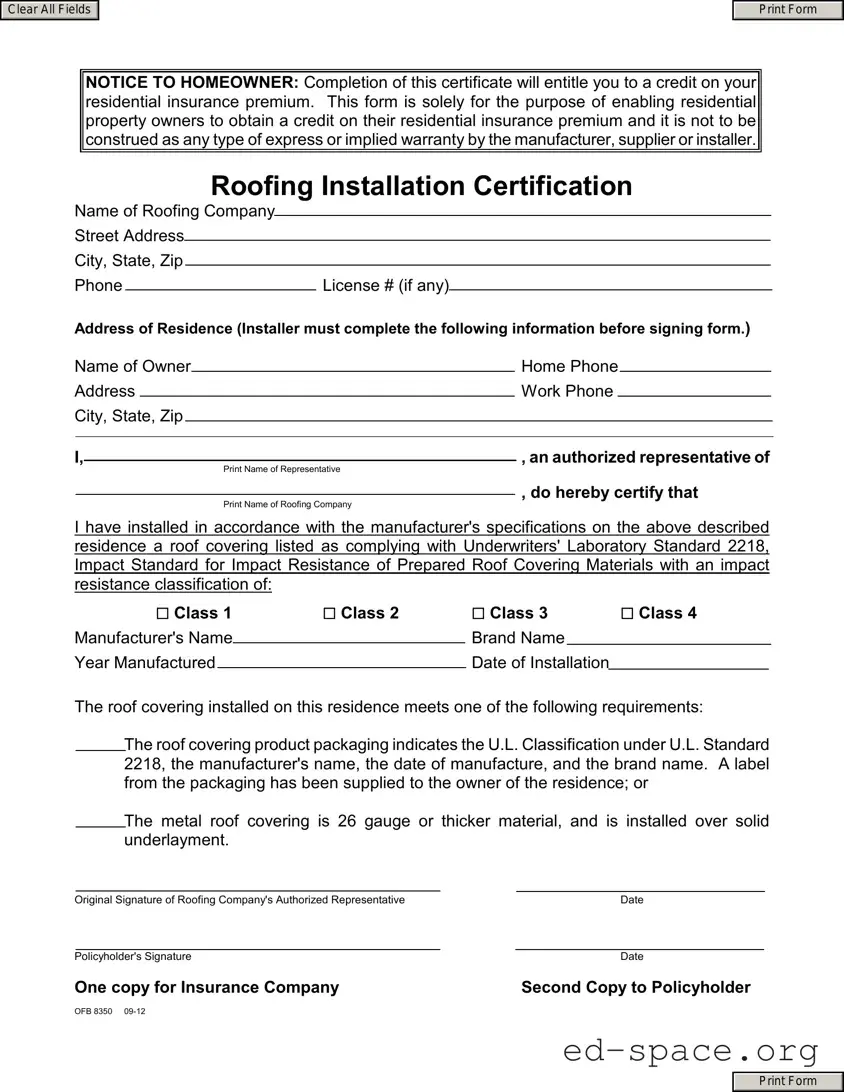
NOTICE TO HOMEOWNER: Completion of this certificate will entitle you to a credit on your residential insurance premium. This form is solely for the purpose of enabling residential property owners to obtain a credit on their residential insurance premium and it is not to be construed as any type of express or implied warranty by the manufacturer, supplier or installer.

Roofing Installation Certification

Name of Roofing Company

Street Address

City, State, Zip

PhoneLicense # (if any)

Address of Residence (Installer must complete the following information before signing form.)

Name of Owner


Home Phone


Address


Work Phone


City, State, Zip


I,


, an authorized representative of


Print Name of Representative


, do hereby certify that


Print Name of Roofing Company

I have installed in accordance with the manufacturer's specifications on the above described residence a roof covering listed as complying with Underwriters' Laboratory Standard 2218, Impact Standard for Impact Resistance of Prepared Roof Covering Materials with an impact resistance classification of:

Class 1

Class 2


Class 3

Class 4

Manufacturer's Name


Brand Name


Year Manufactured


Date of Installation


The roof covering installed on this residence meets one of the following requirements:

The roof covering product packaging indicates the U.L. Classification under U.L. Standard 2218, the manufacturer's name, the date of manufacture, and the brand name. A label from the packaging has been supplied to the owner of the residence; or

The metal roof covering is 26 gauge or thicker material, and is installed over solid underlayment.


Original Signature of Roofing Company's Authorized Representative


Date


Policyholder's Signature


Date


One copy for Insurance Company


Second Copy to Policyholder

OFB 8350 09-12


Print Form

Form Specifications

Fact Name Description
Purpose of the Form This form allows homeowners to receive a credit on their residential insurance premiums after roofing installation.
Certification Requirement The roofing company must certify that the installation meets the manufacturer's specifications and complies with Underwriters' Laboratory Standard 2218.
Impact Resistance Classification The installed roof covering must have an impact resistance classification of Class 1, 2, 3, or 4, as defined by U.L. Standard 2218.
State-Specific Laws In states like California, this form is governed by the California Business and Professions Code, Section 7160.

Roofing Installation Certification: Usage Guidelines

After completing the Roofing Installation Certification form, the next steps involve ensuring that all necessary signatures are obtained and copies are distributed appropriately. This will help facilitate the credit on the residential insurance premium.

  1. Begin by entering the Name of Roofing Company at the top of the form.
  2. Fill in the Street Address, City, State, Zip, and Phone number of the roofing company.
  3. If applicable, include the License # of the roofing company.
  4. Provide the Address of Residence where the roofing work was completed.
  5. The installer must complete the following information:
    • Name of Owner
    • Home Phone
    • Address
    • Work Phone
    • City, State, Zip
  6. The authorized representative of the roofing company must print their name in the designated area.
  7. Indicate the Name of Roofing Company once again in the certification statement.
  8. Check the appropriate box for the impact resistance classification of the roof covering installed (Class 1, Class 2, Class 3, or Class 4).
  9. Fill in the Manufacturer's Name and Brand Name of the roofing material.
  10. Provide the Year Manufactured and Date of Installation.
  11. Confirm that the roof covering meets one of the specified requirements by checking the relevant option.
  12. The authorized representative must provide their Original Signature and the Date of signing.
  13. Ensure the Policyholder's Signature and the Date are also included.
  14. Make two copies of the completed form: one for the insurance company and one for the policyholder.

Your Questions, Answered

What is the purpose of the Roofing Installation Certification form?

The Roofing Installation Certification form is designed to help residential property owners obtain a credit on their insurance premiums. By completing this form, homeowners can demonstrate that their roof installation meets specific standards, potentially resulting in reduced insurance costs. It is important to note that this form does not serve as a warranty from the manufacturer, supplier, or installer.

Who needs to fill out the Roofing Installation Certification form?

The form must be completed by an authorized representative of the roofing company that performed the installation. This individual is responsible for certifying that the roof was installed according to the manufacturer's specifications. Homeowners should also provide their information and sign the form to validate the certification.

What information is required on the form?

Key information includes the name and address of the roofing company, the homeowner's details, and specifics about the roof installation. This includes the impact resistance classification of the roof covering, the manufacturer's name, brand name, year manufactured, and the date of installation. Accurate completion of these details is essential for the certification to be valid.

What are the impact resistance classifications mentioned in the form?

The form references four classifications of impact resistance as defined by Underwriters' Laboratory Standard 2218. These classifications are Class 1, Class 2, Class 3, and Class 4, with Class 4 being the highest level of impact resistance. The roofing company must indicate which classification applies to the installed roof covering.

What should homeowners do with the completed form?

Once the form is completed and signed by both the roofing company's representative and the homeowner, it should be submitted to the homeowner's insurance company. Homeowners should also retain a copy for their records. This documentation can be crucial for securing the insurance premium credit.

Is there a specific format for the signature on the form?

The form requires the original signature of the roofing company's authorized representative, as well as the homeowner's signature. Digital signatures may not be accepted, so it is advisable to ensure that all signatures are handwritten to meet the form's requirements.

Common mistakes

Filling out the Roofing Installation Certification form can be a straightforward task, but many individuals make common mistakes that can lead to delays or complications. Below is a list of ten frequent errors to avoid when completing this important document:

  1. Neglecting to Clear All Fields: Before starting, it’s essential to clear any pre-filled information. Leaving old data can cause confusion.
  2. Incorrectly Filling Out Contact Information: Ensure that the name, address, and phone numbers of both the roofing company and the homeowner are accurate. Mistakes can hinder communication.
  3. Missing License Number: If the roofing company has a license number, it should be included. Omitting this information can raise questions about legitimacy.
  4. Not Specifying the Roof Covering Type: Clearly indicate the type of roof covering installed. This detail is crucial for insurance purposes.
  5. Failing to Provide Manufacturer Details: The manufacturer’s name and brand name must be included. Without this, the certification may be considered incomplete.
  6. Overlooking Impact Resistance Classification: Select the appropriate impact resistance classification. This classification is vital for determining insurance credits.
  7. Inaccurate Installation Date: The date of installation should reflect when the work was completed. An incorrect date can lead to disputes.
  8. Not Including the Signature: Both the roofing company’s authorized representative and the policyholder must sign the form. A missing signature invalidates the certification.
  9. Failing to Provide Copies: Remember to make copies for both the insurance company and the policyholder. Keeping a record is essential.
  10. Ignoring the Importance of the U.L. Classification: Ensure that the roof covering product packaging indicates the U.L. Classification. This is crucial for compliance and insurance credits.

By avoiding these common mistakes, homeowners can ensure that their Roofing Installation Certification form is completed accurately, paving the way for potential insurance premium credits. Taking the time to review each section carefully can save a lot of hassle down the road.

Documents used along the form

When completing a Roofing Installation Certification form, several other documents may be needed to ensure compliance and facilitate the insurance credit process. Below is a list of related forms and documents that are commonly used in conjunction with the certification.

  • Building Permit: This document is typically required before any roofing work begins. It verifies that the project complies with local building codes and regulations.
  • Contractor's License: A copy of the roofing contractor's license may be necessary to confirm that the installer is qualified and authorized to perform roofing work in the area.
  • Insurance Certificate: Proof of insurance coverage for the roofing company protects homeowners from potential liabilities during the installation process.
  • Manufacturer's Warranty: This document outlines the terms of the warranty provided by the roofing material manufacturer, ensuring that the homeowner is covered for defects or issues.
  • Inspection Report: After the roofing installation, an inspection report may be generated to document the quality and compliance of the work performed.
  • Material Safety Data Sheets (MSDS): These sheets provide important safety information about the roofing materials used, including handling and emergency procedures.
  • Final Invoice: The final invoice from the roofing contractor details the costs incurred for the installation and serves as a record of payment.
  • Homeowner's Insurance Policy: A copy of the homeowner's insurance policy may be required to verify coverage and eligibility for the premium credit associated with the roofing installation.

Having these documents ready can streamline the process and ensure that all parties involved have the necessary information. This preparation not only aids in obtaining the insurance credit but also helps protect the homeowner's interests in the event of any disputes or issues that may arise after installation.

Similar forms

The Roofing Installation Certification form serves a specific purpose for homeowners seeking insurance premium credits. It shares similarities with several other documents that also provide certifications or confirmations related to home improvements or installations. Below are six documents that are similar to the Roofing Installation Certification form:

  • HVAC Installation Certificate: This document certifies that a heating, ventilation, and air conditioning system has been installed according to the manufacturer’s specifications. Like the roofing form, it helps homeowners qualify for insurance credits and assures compliance with industry standards.
  • Electrical Installation Certificate: This certificate confirms that electrical work done in a home meets local codes and safety standards. It serves a similar function as the roofing form by providing documentation for insurance purposes.
  • Plumbing Installation Certificate: This document verifies that plumbing installations comply with applicable regulations. Homeowners can use it to demonstrate proper installation and potentially reduce their insurance premiums, much like the roofing certification.
  • Energy Efficiency Certificate: This certificate indicates that a home meets specific energy efficiency standards. It can help homeowners qualify for energy-related rebates or discounts on insurance, paralleling the benefits of the roofing certification.
  • Home Inspection Report: A home inspection report provides an overview of a property's condition, including the roof. While it is more comprehensive, it serves a similar purpose by helping homeowners understand their property’s value and potentially affecting insurance rates.
  • Building Permit: A building permit is required for major renovations and confirms that the work complies with local building codes. This document, like the roofing certification, provides assurance to homeowners and insurers that the installation meets necessary standards.

Dos and Don'ts

When filling out the Roofing Installation Certification form, it is important to follow certain guidelines to ensure accuracy and compliance. Below is a list of things you should and shouldn't do.

  • Do ensure all fields are completed accurately.
  • Do verify the roofing company’s license number, if applicable.
  • Do provide clear contact information for both the homeowner and the roofing company.
  • Do check that the roofing material meets the required U.L. classification.
  • Don't leave any sections blank, as incomplete forms may lead to delays.
  • Don't use abbreviations or unclear terms that may confuse the reader.
  • Don't forget to include the date of installation and year manufactured.
  • Don't sign the form without verifying all information is correct.

Misconceptions

When it comes to the Roofing Installation Certification form, several misconceptions can lead to confusion among homeowners and roofing professionals alike. Understanding the truth behind these myths can help ensure a smoother experience when obtaining insurance credits. Here are ten common misconceptions:

  1. It's a warranty for the roof installation. Many believe that this certification guarantees the quality of the installation. In reality, it simply serves to provide proof for insurance purposes and does not imply any warranty.
  2. Any roofing company can fill it out. Some think that any contractor can complete the form. However, only authorized representatives of the roofing company can sign it, ensuring accountability.
  3. It guarantees a discount on insurance. While the form is intended to help homeowners secure a credit on their insurance premiums, it does not guarantee that the insurance company will offer a discount.
  4. It applies to all types of roofs. Some homeowners assume that the certification applies to any roofing material. In fact, it specifically pertains to roofs that meet Underwriters' Laboratory Standard 2218 for impact resistance.
  5. The certification is optional. Many believe that completing the form is optional. However, if you want to obtain the insurance credit, it is a necessary step.
  6. Only new roofs qualify. Some homeowners think that only newly installed roofs can be certified. In reality, as long as the installation meets the specified requirements, it can qualify.
  7. It’s a one-time requirement. Many assume that once the form is submitted, no further action is needed. Depending on the insurance policy, periodic re-certification may be necessary.
  8. All roofing materials are eligible. Some people think that any roofing material can be certified. However, only those that meet specific impact resistance classifications can be included.
  9. Homeowners need to keep the original form. Some believe they must hold onto the original certificate. In fact, copies are provided for both the insurance company and the homeowner, making it easier to keep track.
  10. It can be filled out after installation. Many think they can complete the form after the roof is installed. However, it must be filled out during or immediately after the installation process to ensure accuracy.

By debunking these misconceptions, homeowners can better navigate the roofing certification process and maximize their potential insurance benefits.

Key takeaways

Filling out and using the Roofing Installation Certification form is an important step for homeowners looking to secure a credit on their residential insurance premiums. Here are some key takeaways to keep in mind:

  1. Purpose of the Form: This certificate is specifically designed to help homeowners obtain a credit on their insurance premiums.
  2. Not a Warranty: Completing this form does not imply any warranty from the manufacturer, supplier, or installer.
  3. Information Required: Homeowners need to provide details about the roofing company, including its name, address, and phone number.
  4. Installer Details: The installer must fill out specific information about the property and their qualifications before signing.
  5. Impact Resistance: The form requires the roofing company to certify that the roof covering meets Underwriters' Laboratory Standard 2218 for impact resistance.
  6. Classification Choices: The installer must indicate the impact resistance classification of the roof covering, which can be Class 1, 2, 3, or 4.
  7. Manufacturer Information: Include the manufacturer’s name, brand name, and the year of manufacture on the form.
  8. Date of Installation: It is essential to record the date when the roofing was installed.
  9. Signature Requirement: Both the authorized representative of the roofing company and the policyholder must sign the form.
  10. Distribution of Copies: One copy of the completed form should be sent to the insurance company, while another copy should be retained by the policyholder.

By following these guidelines, homeowners can ensure that they effectively utilize the Roofing Installation Certification form to maximize their insurance benefits.