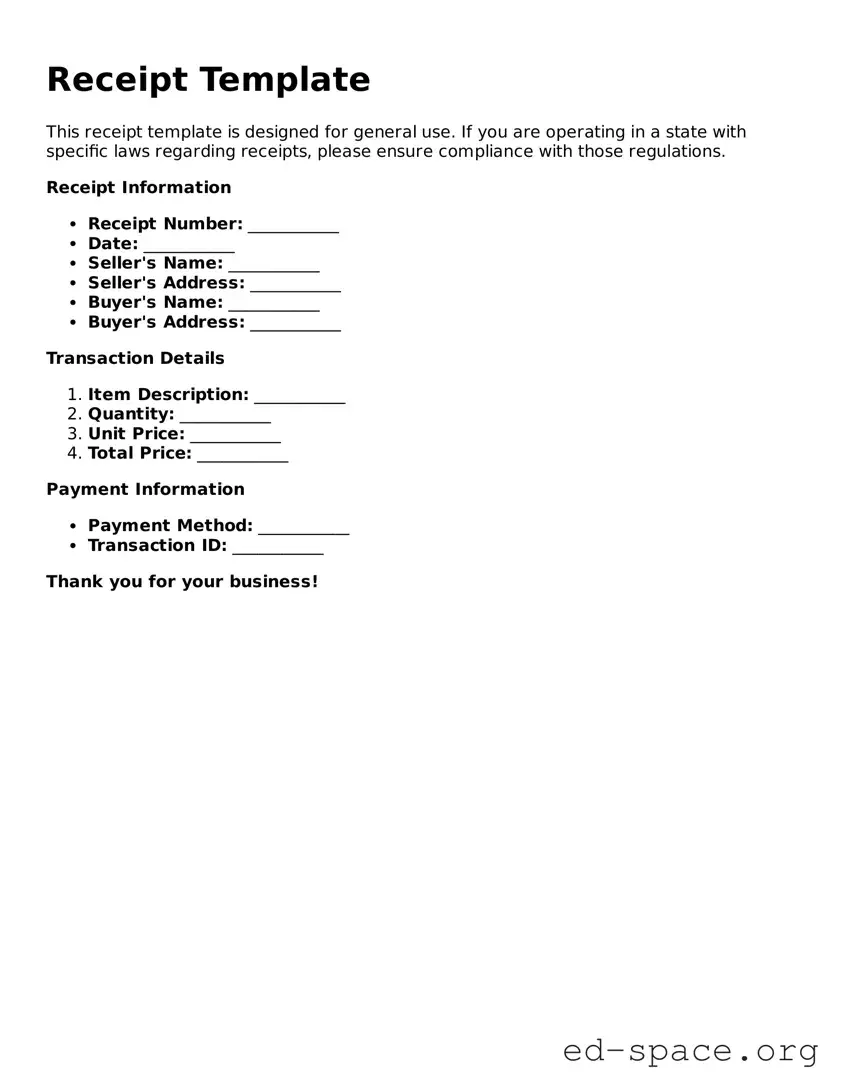
In the realm of financial transactions, the Receipt Template form plays a crucial role in documenting exchanges between buyers and sellers. This simple yet effective tool ensures that both parties have a clear record of the transaction, detailing essential information such as the date, amount, and nature of the goods or services provided. By incorporating fields for the seller's and buyer's contact information, the form fosters transparency and accountability. Additionally, it often includes sections for payment methods, which can range from cash to credit card transactions, thereby accommodating various preferences. The Receipt Template not only serves as proof of purchase but also aids in bookkeeping and tax reporting, making it an invaluable asset for individuals and businesses alike. Understanding how to effectively utilize this form can streamline financial interactions and enhance overall organizational efficiency.
Receipt Template
This receipt template is designed for general use. If you are operating in a state with specific laws regarding receipts, please ensure compliance with those regulations.
Receipt Information
Transaction Details
Payment Information
Thank you for your business!
| Fact Name | Description |
|---|---|
| Purpose | The Receipt Template form serves as a written acknowledgment of payment received for goods or services. |
| Components | Typically includes the date, payer's name, payee's name, amount received, and purpose of payment. |
| Format | Can be customized to fit specific business needs, often available in digital and paper formats. |
| Record Keeping | Essential for both the payer and payee for accurate financial record-keeping and tax purposes. |
| State-Specific Forms | Some states may have specific requirements for receipts; check local regulations for compliance. |
| Governing Law (California) | California Civil Code Section 1624 requires receipts for transactions exceeding $500. |
| Governing Law (New York) | New York General Obligations Law Section 5-701 mandates written receipts for certain types of transactions. |
| Digital Use | Many businesses now utilize electronic receipts, which can enhance efficiency and reduce paper waste. |
Filling out the Receipt Template form is a straightforward process. Follow these steps carefully to ensure all necessary information is included.
What is the Receipt Template form?
The Receipt Template form is a standardized document that allows individuals and businesses to create and issue receipts for transactions. It serves as proof of payment and can be used for various purposes, such as record-keeping or tax documentation.
Who can use the Receipt Template form?
Anyone who needs to provide a receipt for goods or services can use the Receipt Template form. This includes small business owners, freelancers, and individuals selling items. It is a versatile tool suitable for both personal and professional transactions.
What information should be included in the Receipt Template?
A complete receipt should include the date of the transaction, the name of the buyer and seller, a description of the goods or services provided, the amount paid, and any applicable tax information. Including a unique receipt number can also help with organization and tracking.
Is the Receipt Template form customizable?
Yes, the Receipt Template form can be customized to fit your specific needs. You can add your business logo, change the layout, or modify the fields to capture additional information relevant to your transactions.
How can I use the Receipt Template form for digital transactions?
For digital transactions, you can fill out the Receipt Template form electronically and send it via email to your customer. This method provides an efficient way to deliver receipts while maintaining a professional appearance.
Can I use the Receipt Template form for international transactions?
Yes, the Receipt Template form can be used for international transactions. However, it is essential to ensure that the currency and any applicable taxes are clearly stated. Additionally, consider including any necessary information required by the other party's country.
Where can I find the Receipt Template form?
The Receipt Template form is typically available online through various business resource websites. You may also find templates in word processing software or accounting programs. Ensure that you choose a reputable source to obtain a reliable and professional-looking template.
Failing to include all necessary information. Many individuals overlook essential details such as the date of the transaction, the amount paid, and the purpose of the payment.
Not using clear and legible handwriting. When filling out the form by hand, unclear writing can lead to misunderstandings or errors in processing.
Omitting signatures. Some people forget to sign the receipt, which is crucial for validating the transaction.
Using incorrect or outdated templates. Using a template that does not match the current requirements can lead to confusion and potential rejection of the receipt.
Not keeping a copy. Failing to retain a copy of the completed receipt can create issues if proof of payment is needed later.
Ignoring specific instructions. Each receipt template may have unique guidelines. Not following these can result in incomplete or invalid forms.
When managing financial transactions, various forms and documents complement the Receipt Template. Each serves a specific purpose, ensuring clarity and accountability in financial dealings. Here’s a brief overview of some commonly used documents.
Utilizing these documents alongside the Receipt Template can enhance financial management and ensure that all parties have a clear understanding of transactions. Keeping accurate records is essential for both personal and business finances.
Invoice: An invoice is a document issued by a seller to a buyer that outlines the products or services provided, along with the amount due. Like a receipt, it serves as proof of a transaction but is typically sent before payment is received.
Bill of Sale: A bill of sale is a legal document that transfers ownership of goods from one party to another. Similar to a receipt, it provides proof of purchase but is often used for significant items like vehicles or real estate.
Payment Confirmation: This document confirms that a payment has been received for a specific transaction. It shares similarities with a receipt as both serve as proof of payment, but a payment confirmation may be issued electronically.
Purchase Order: A purchase order is a document created by a buyer to request goods or services from a seller. While it initiates a transaction, it is similar to a receipt in that it details what has been ordered.
Credit Note: A credit note is issued by a seller to a buyer, indicating a reduction in the amount owed. It is similar to a receipt in that it serves as documentation of a transaction, but it specifically addresses returns or adjustments.
Sales Agreement: A sales agreement outlines the terms of a sale between a buyer and seller. It is similar to a receipt in that both documents confirm a transaction, but the sales agreement includes more detailed terms and conditions.
Shipping Receipt: A shipping receipt is provided by a shipping company to confirm that goods have been dispatched. Like a receipt, it serves as proof of a transaction but focuses on the shipping process rather than the sale itself.
Service Agreement: A service agreement details the terms under which services will be provided. It is akin to a receipt in that both confirm an agreement, but the service agreement elaborates on the scope and terms of the service.
Deposit Receipt: A deposit receipt is issued when a deposit is made for a future transaction, such as renting property. It is similar to a receipt in that it acknowledges a payment, but it specifically pertains to a partial payment.
Transaction Record: A transaction record is a general document that logs details of a financial transaction. It shares similarities with a receipt as both serve to document financial exchanges, but a transaction record may not always confirm payment.
When filling out the Receipt Template form, attention to detail is crucial. Here are some guidelines to help ensure accuracy and completeness.
By following these simple dos and don'ts, you can help ensure that your receipt is processed smoothly and efficiently.
Understanding the Receipt Template form is essential for accurate record-keeping. However, several misconceptions can lead to confusion. Here are six common myths about the Receipt Template form:
Many people believe that only businesses need a receipt template. In reality, individuals can also benefit from using receipts for personal transactions, such as selling items or providing services.
Some think that receipts must be printed to be valid. Digital receipts are acceptable and can be sent via email or text, making them convenient and environmentally friendly.
Not all receipts are identical. The format can vary based on the purpose and the provider. A receipt template allows customization to suit specific needs.
While receipts are important for tax documentation, they also serve as proof of purchase, warranty validation, and expense tracking for personal or business finances.
Many assume that creating a receipt template requires advanced skills. In fact, numerous user-friendly templates are available online, making it easy for anyone to use.
Some people think that small transactions do not require receipts. However, keeping a record of all transactions, regardless of size, is a good practice for maintaining accurate financial records.
By dispelling these misconceptions, you can make better use of the Receipt Template form and improve your financial documentation.
When using the Receipt Template form, there are several important points to keep in mind. These takeaways will help ensure that your receipts are filled out accurately and serve their intended purpose effectively.
By following these guidelines, you can create effective and useful receipts that will serve you well in various situations.