In the world of real estate, confidentiality plays a crucial role in maintaining trust and protecting sensitive information. The Real Estate Non-Disclosure Agreement (NDA) serves as a vital tool for parties involved in property transactions, ensuring that proprietary information remains secure. This form outlines the obligations of the parties to keep specific details confidential, which may include financial data, business plans, and other proprietary insights. By clearly defining what constitutes confidential information, the NDA helps to prevent unauthorized disclosure that could jeopardize negotiations or lead to competitive disadvantages. Additionally, the agreement typically specifies the duration of confidentiality, the permissible uses of the information, and the consequences of a breach. Understanding these key aspects is essential for anyone engaging in real estate transactions, as it fosters a professional environment where trust can thrive.
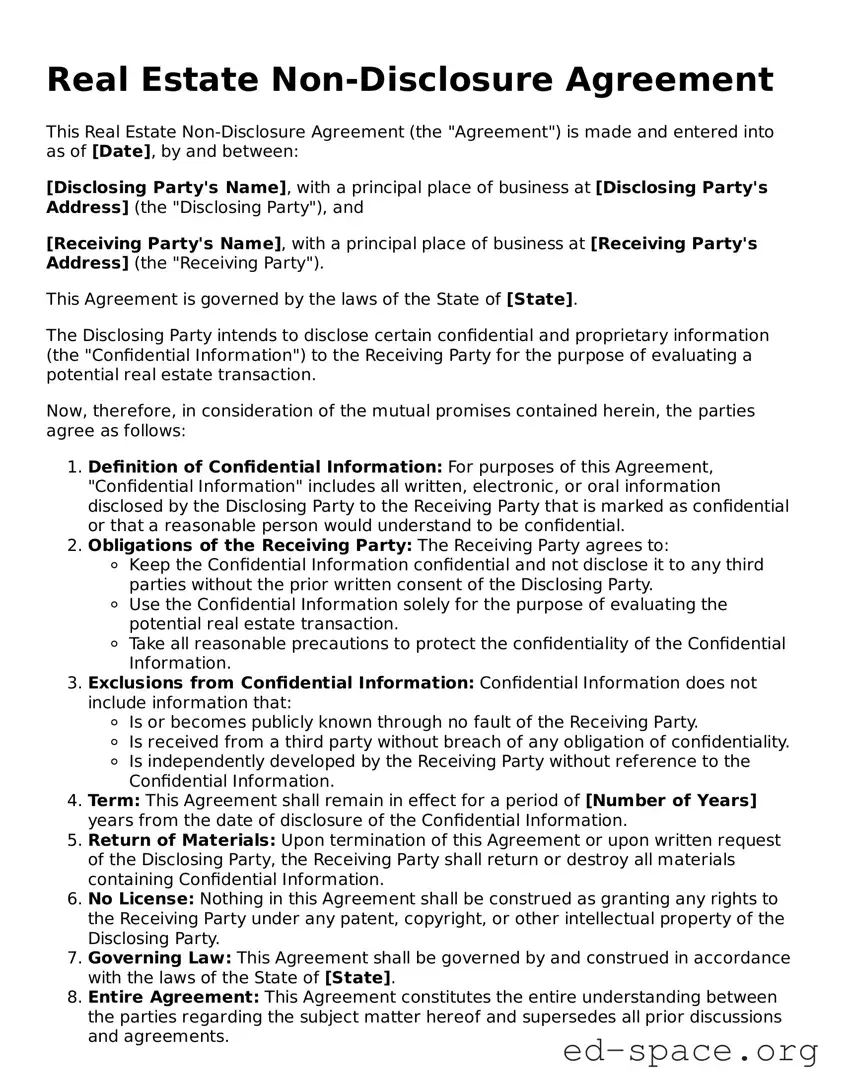
Real Estate Non-Disclosure Agreement
This Real Estate Non-Disclosure Agreement (the "Agreement") is made and entered into as of [Date], by and between:
[Disclosing Party's Name], with a principal place of business at [Disclosing Party's Address] (the "Disclosing Party"), and
[Receiving Party's Name], with a principal place of business at [Receiving Party's Address] (the "Receiving Party").
This Agreement is governed by the laws of the State of [State].
The Disclosing Party intends to disclose certain confidential and proprietary information (the "Confidential Information") to the Receiving Party for the purpose of evaluating a potential real estate transaction.
Now, therefore, in consideration of the mutual promises contained herein, the parties agree as follows:
IN WITNESS WHEREOF, the parties hereto have executed this Non-Disclosure Agreement as of the date first above written.
Disclosing Party:
______________________________
[Disclosing Party's Name]
Date: ______________________
Receiving Party:
______________________________
[Receiving Party's Name]
Date: ______________________
| Fact Name | Description |
|---|---|
| Purpose | A Real Estate Non-Disclosure Agreement (NDA) protects confidential information shared between parties during a real estate transaction. |
| Parties Involved | The agreement typically involves at least two parties: the disclosing party (who shares information) and the receiving party (who agrees to keep it confidential). |
| Duration of Confidentiality | Most NDAs specify a duration for which the information must remain confidential, often ranging from one to five years. |
| Governing Law | The governing law varies by state. For example, California law governs NDAs executed in California, while Texas law applies to those executed in Texas. |
| Exclusions | Common exclusions from confidentiality include information that is publicly available or independently developed by the receiving party. |
| Enforcement | If a party breaches the NDA, the other party may seek legal remedies, including damages or injunctive relief, depending on the terms outlined in the agreement. |
Filling out the Real Estate Non-Disclosure Agreement form is a straightforward process. Following these steps will help ensure that all necessary information is accurately provided. Once completed, the form will be ready for signatures and can be used to protect sensitive information in a real estate transaction.
What is a Real Estate Non-Disclosure Agreement (NDA)?
A Real Estate Non-Disclosure Agreement is a legal contract designed to protect sensitive information exchanged between parties involved in a real estate transaction. This agreement ensures that confidential information, such as financial details, property specifications, or business strategies, is not disclosed to unauthorized individuals or entities. By signing the NDA, parties can share necessary information with confidence, knowing that their interests are safeguarded.
Who typically uses a Real Estate Non-Disclosure Agreement?
Real estate professionals, including agents, brokers, investors, and developers, often utilize NDAs. Buyers and sellers may also find it beneficial to protect their proprietary information during negotiations. In any situation where sensitive information is shared, an NDA serves as a crucial tool to maintain confidentiality and trust among all parties involved.
What are the key components of a Real Estate Non-Disclosure Agreement?
A typical NDA includes several important elements. First, it defines the confidential information that will be protected. Next, it outlines the obligations of the parties involved, specifying how the information can be used and the duration of the confidentiality obligation. Additionally, the agreement may include clauses regarding the consequences of a breach, dispute resolution methods, and any exclusions from confidentiality, such as information already in the public domain.
How long does the confidentiality obligation last?
The duration of the confidentiality obligation can vary based on the agreement's terms. Generally, NDAs specify a time frame, which can range from a few years to an indefinite period, depending on the nature of the information and the preferences of the parties involved. It is essential to clearly state this duration in the NDA to avoid misunderstandings in the future.
What happens if someone breaches the NDA?
If a party breaches the NDA, several consequences may arise. The injured party can pursue legal action to seek remedies, which may include monetary damages or injunctive relief to prevent further disclosure. The specific consequences should be outlined in the NDA itself, emphasizing the importance of adhering to the agreement to avoid potential legal disputes.
Failing to read the entire agreement before signing. It's crucial to understand all terms and conditions.
Not including all parties involved. Ensure that everyone who needs to be bound by the agreement is listed.
Leaving out important dates. Specify the effective date and duration of the confidentiality obligations.
Using vague language. Be clear and specific about what information is considered confidential.
Neglecting to define the purpose of the disclosure. Clearly state why the confidential information is being shared.
Not addressing the consequences of breach. Outline what happens if the agreement is violated.
Overlooking the inclusion of governing law. Specify which state's laws will govern the agreement.
Failing to initial or sign all required pages. Ensure that every page requiring a signature is properly completed.
Not keeping a copy for personal records. Always retain a signed copy for your files.
Ignoring the need for legal advice. Consulting with a legal professional can help avoid costly mistakes.
In the realm of real estate transactions, a Non-Disclosure Agreement (NDA) serves as a vital tool to protect sensitive information. However, several other documents are often used in conjunction with the NDA to ensure a smooth and legally sound process. Below is a list of commonly associated forms and documents.
Each of these documents plays a crucial role in real estate transactions, ensuring clarity and protection for all parties involved. Understanding their purpose can help streamline the process and mitigate potential disputes.
The Real Estate Non-Disclosure Agreement (NDA) is a crucial document that helps protect sensitive information in real estate transactions. Several other documents share similarities with the NDA in terms of purpose and function. Below are eight such documents:
When filling out a Real Estate Non-Disclosure Agreement (NDA), it’s essential to approach the process with care. Here are some important dos and don’ts to keep in mind:
The Real Estate Non-Disclosure Agreement (NDA) is a vital tool in the real estate industry, yet several misconceptions can lead to misunderstandings. Here are four common misconceptions about this important document:
Many believe that NDAs are only necessary for high-value deals. In reality, any transaction involving sensitive information can benefit from an NDA, regardless of size. Protecting confidential details is crucial at all levels.
Some think that signing an NDA completely restricts communication. However, most NDAs allow discussions with certain parties, such as legal advisors or business partners, as long as they are also bound by confidentiality.
This misconception overlooks the fact that NDAs can vary significantly. Each agreement should be tailored to the specific situation and the nature of the information being protected. Generic forms may not provide adequate protection.
While many people think NDAs are only relevant during the negotiation phase, they can also be important after a deal is closed. Ongoing confidentiality can protect proprietary information even after the transaction is finalized.
Understanding these misconceptions can help you navigate the complexities of real estate transactions more effectively. Always consider seeking professional advice to ensure you are adequately protected.
When dealing with sensitive information in real estate transactions, a Non-Disclosure Agreement (NDA) is essential. Here are some key takeaways for filling out and using this form:
Using the Real Estate Non-Disclosure Agreement properly can safeguard sensitive information and foster trust between parties in a transaction.