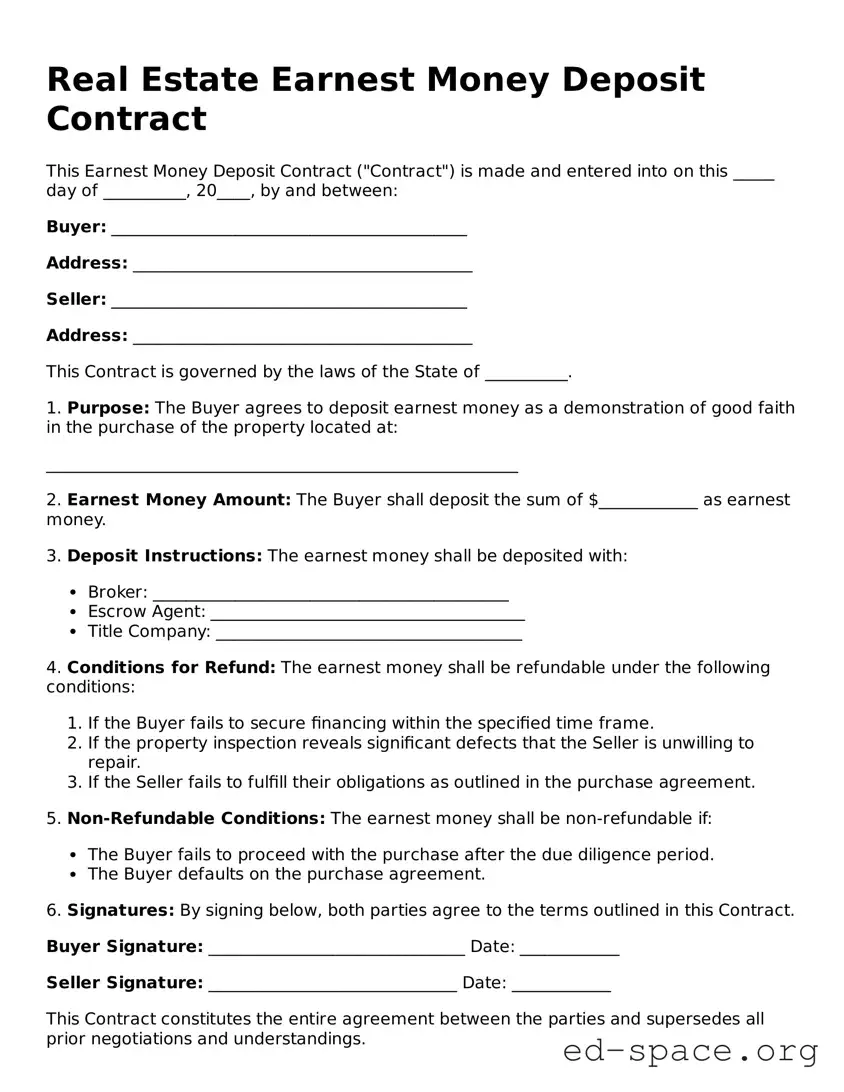
When buying a home, one of the first steps involves making an earnest money deposit. This deposit shows the seller that the buyer is serious about the purchase. The Real Estate Earnest Money Deposit Contract form plays a crucial role in this process. It outlines the terms and conditions surrounding the deposit, including the amount, how it will be held, and the circumstances under which it can be refunded. Typically, the deposit is a percentage of the purchase price and is held in escrow until the sale is finalized. If the deal falls through due to contingencies outlined in the purchase agreement, the buyer may recover their deposit. However, if the buyer backs out without a valid reason, the seller may keep the earnest money. Understanding this form is essential for both buyers and sellers, as it sets the stage for a successful real estate transaction.
Real Estate Earnest Money Deposit Contract
This Earnest Money Deposit Contract ("Contract") is made and entered into on this _____ day of __________, 20____, by and between:
Buyer: ___________________________________________
Address: _________________________________________
Seller: ___________________________________________
Address: _________________________________________
This Contract is governed by the laws of the State of __________.
1. Purpose: The Buyer agrees to deposit earnest money as a demonstration of good faith in the purchase of the property located at:
_________________________________________________________
2. Earnest Money Amount: The Buyer shall deposit the sum of $____________ as earnest money.
3. Deposit Instructions: The earnest money shall be deposited with:
4. Conditions for Refund: The earnest money shall be refundable under the following conditions:
5. Non-Refundable Conditions: The earnest money shall be non-refundable if:
6. Signatures: By signing below, both parties agree to the terms outlined in this Contract.
Buyer Signature: _______________________________ Date: ____________
Seller Signature: ______________________________ Date: ____________
This Contract constitutes the entire agreement between the parties and supersedes all prior negotiations and understandings.
| Fact Name | Description |
|---|---|
| Definition | An earnest money deposit is a sum of money a buyer offers to demonstrate their commitment to purchasing a property. |
| Purpose | This deposit serves to secure the buyer's intent and may be applied toward the purchase price at closing. |
| Amount | The amount of the earnest money deposit can vary, typically ranging from 1% to 3% of the purchase price. |
| State-Specific Forms | Different states have their own specific forms and requirements for earnest money deposits. For instance, California requires compliance with the California Civil Code. |
| Refund Conditions | Buyers may receive a refund of the earnest money deposit if the sale falls through due to contingencies outlined in the purchase agreement. |
| Default Consequences | If the buyer defaults without valid reasons, the seller may retain the earnest money as compensation for their time and effort. |
| Escrow Process | The earnest money is typically held in an escrow account until the transaction is finalized or terminated. |
Completing the Real Estate Earnest Money Deposit Contract form is an essential step in the real estate transaction process. This form helps establish the buyer's commitment to purchasing a property by outlining the terms related to the earnest money deposit. Below are the steps to fill out the form accurately.
After completing the form, ensure that all parties involved receive a copy for their records. This will help maintain transparency and facilitate the next steps in the transaction process.
What is an Earnest Money Deposit?
An earnest money deposit is a sum of money that a buyer offers to a seller to demonstrate their commitment to purchasing a property. This deposit shows the seller that the buyer is serious about the transaction and helps to secure the property while the purchase agreement is being finalized.
How much should the earnest money deposit be?
The amount of the earnest money deposit can vary, but it typically ranges from 1% to 3% of the purchase price of the home. In some cases, it can be higher, depending on the local market conditions or the seller's preferences. It's important to discuss this amount with your real estate agent to determine what is appropriate for your situation.
What happens to the earnest money deposit after it is made?
Once the earnest money deposit is made, it is usually held in an escrow account until the sale is completed. If the transaction goes through, the deposit is applied to the buyer's closing costs or down payment. However, if the deal falls through due to specific contingencies outlined in the contract, the buyer may be entitled to a refund of the deposit.
What contingencies can affect the earnest money deposit?
Common contingencies include financing, home inspections, and appraisal results. If any of these contingencies are not met, the buyer can often withdraw from the contract and receive their earnest money back. It's crucial to clearly outline these contingencies in the purchase agreement to protect the buyer's interests.
Can the seller keep the earnest money deposit?
If the buyer fails to fulfill the terms of the contract without a valid reason, the seller may have the right to keep the earnest money deposit. This is often referred to as "liquidated damages." However, the specific terms regarding this situation should be clearly defined in the contract to avoid disputes.
Is an earnest money deposit required?
While an earnest money deposit is not legally required, it is a common practice in real estate transactions. Many sellers expect a deposit as a sign of good faith. Without it, a buyer may find it challenging to convince a seller to accept their offer, especially in a competitive market.
How do I submit the earnest money deposit?
The earnest money deposit is typically submitted in the form of a check or wire transfer. Your real estate agent will provide guidance on how to make the deposit and where to send it. Ensure that you keep a copy of the receipt for your records.
Not including the correct buyer and seller names. It's crucial to ensure that all parties are accurately identified.
Forgetting to specify the amount of earnest money. This detail is essential for the contract's validity.
Leaving out the property address. A complete and precise address helps avoid confusion.
Not stating the closing date. This date is important for both parties to know when the transaction will finalize.
Failing to include any contingencies. These are conditions that must be met for the sale to proceed.
Overlooking the method of payment for the earnest money. Specify whether it’s a check, wire transfer, or another form.
Not providing clear instructions for handling the earnest money. This can lead to disputes later.
Neglecting to sign the contract. Without signatures, the agreement is not legally binding.
Using ambiguous language that could lead to misunderstandings. Clarity is key in legal documents.
Not keeping a copy of the signed contract. Always retain a copy for your records.
When engaging in a real estate transaction, several documents complement the Real Estate Earnest Money Deposit Contract. These documents help clarify terms, protect parties involved, and ensure a smooth process. Below are five key forms often used alongside the earnest money deposit contract.
Understanding these documents can significantly aid in navigating the complexities of real estate transactions. Always consider consulting with a legal or real estate professional for guidance tailored to your specific situation.
When filling out the Real Estate Earnest Money Deposit Contract form, attention to detail is crucial. Here are six important do's and don'ts to consider:
When it comes to the Real Estate Earnest Money Deposit Contract form, many people hold misconceptions that can lead to confusion or even legal issues. Here are ten common misunderstandings:
This is not always true. While earnest money is intended to show good faith, there are circumstances under which it can be refunded, such as if the sale falls through due to contingencies outlined in the contract.
While it is primarily the buyer who provides earnest money, sellers can also be required to put down a deposit in certain situations, particularly in competitive markets.
Providing earnest money does not guarantee that the transaction will be completed. Various factors, including inspections and financing, can lead to the deal falling apart.
There is no standard amount for earnest money. It can vary based on local customs, the price of the home, and the agreement between the buyer and seller.
These are different concepts. Earnest money is a small deposit to show commitment, while a down payment is a larger sum that contributes to the purchase price of the home.
Earnest money is important in any market. It shows the seller that the buyer is serious, regardless of whether the market favors buyers or sellers.
Buyers have ongoing obligations throughout the transaction, including adhering to timelines and fulfilling contingencies outlined in the contract.
Typically, earnest money is held in an escrow account by a neutral third party, such as a real estate agent or title company, until the transaction is finalized.
Failing to adhere to the terms of the earnest money agreement can lead to disputes and potential legal action, which underscores the importance of understanding the contract.
Each earnest money agreement can vary based on the specific terms negotiated between the buyer and seller, as well as local laws and practices.
Understanding these misconceptions can help buyers and sellers navigate the real estate process more effectively. Always consider seeking professional advice when dealing with earnest money deposits to ensure a smooth transaction.
When dealing with the Real Estate Earnest Money Deposit Contract form, understanding its components and implications is crucial. Here are some key takeaways to consider:
By keeping these points in mind, buyers can navigate the earnest money process with confidence and clarity.