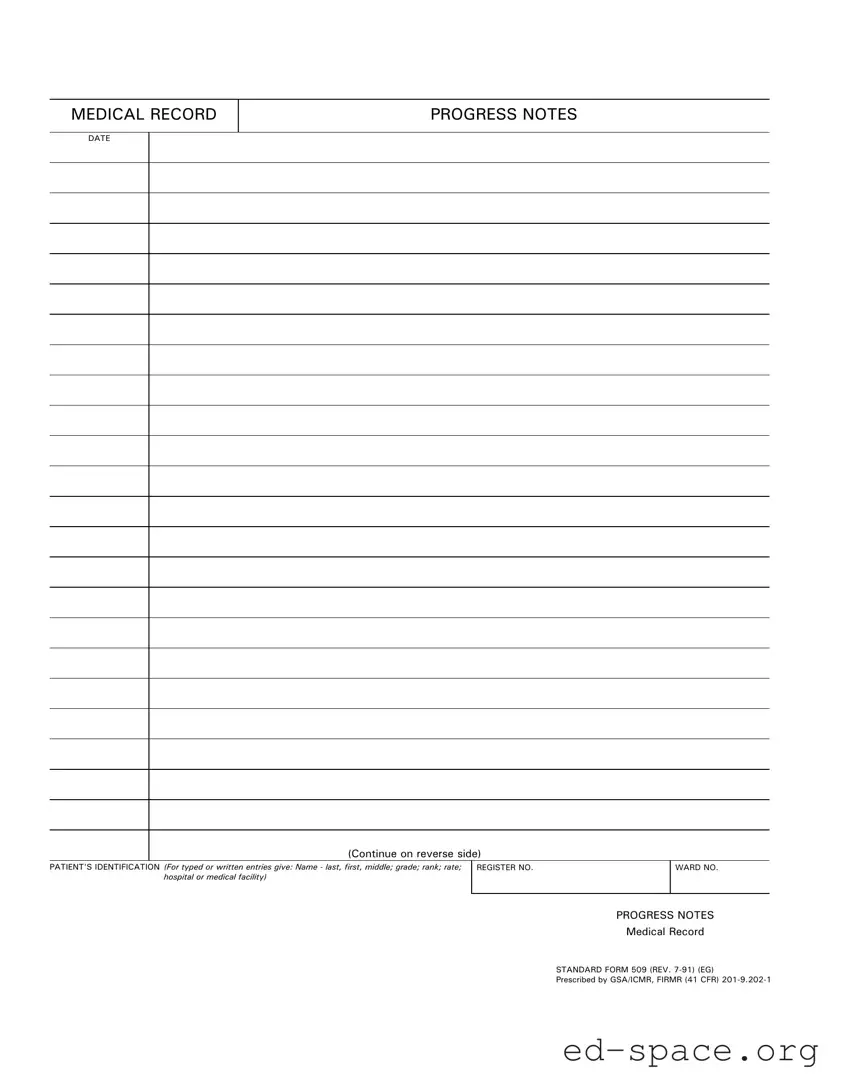
The Progress Notes form plays a crucial role in the documentation of patient care within medical facilities. It serves as a structured way for healthcare providers to record significant details about a patient's condition, treatment, and progress over time. Each entry includes essential information such as the patient's identification, which encompasses their name, grade, rank, and the hospital or medical facility where they are receiving care. This ensures that every note is accurately attributed to the correct individual, maintaining clarity in the medical record. The form is standardized, identified as Standard Form 509, and was last revised in July 1991. It is prescribed by the General Services Administration, ensuring compliance with federal regulations. The format allows for a systematic approach to documenting patient interactions, facilitating effective communication among healthcare teams. This structured documentation is vital for continuity of care and supports the overall management of patient health records.

MEDICAL RECORD
PROGRESS NOTES
DATE
(Continue on reverse side)
PATIENT'S IDENTIFICATION (For typed or written entries give: Name - last, first, middle; grade; rank; rate; hospital or medical facility)
REGISTER NO. |
WARD NO. |
|
|
PROGRESS NOTES
Medical Record
STANDARD FORM 509 (REV.
Prescribed by GSA/ICMR, FIRMR (41 CFR)

PROGRESS NOTES
DATE
STANDARD FORM 509 (REV.
| Fact Name | Description |
|---|---|
| Form Purpose | The Progress Notes form is used to document a patient's ongoing medical care and treatment in a structured format. |
| Governing Law | In many states, the use of Progress Notes is governed by healthcare regulations, such as HIPAA, which ensures patient privacy and data security. |
| Standardization | This form is a standardized document, specifically Standard Form 509, which helps maintain consistency in medical record-keeping across facilities. |
| Patient Identification | It requires detailed patient identification information, including name, grade, rank, rate, and the medical facility where care is provided. |
| Documentation Requirements | Healthcare providers must accurately and thoroughly document patient progress on this form to ensure continuity of care. |
| Revocation Date | The current version of the form is noted as being revised in July 1991, indicating its long-standing use in medical documentation. |
| Reverse Side Usage | There is an option to continue notes on the reverse side of the form, allowing for more detailed entries if needed. |
Completing the Progress Notes form accurately is essential for maintaining clear and effective medical records. Follow these steps to ensure that all necessary information is captured correctly.
Once the form is filled out, it can be submitted as part of the patient's medical record. Make sure to review the information for accuracy before finalizing the submission.
What is the purpose of the Progress Notes form?
The Progress Notes form is used to document a patient's medical history, treatment, and progress during their stay in a medical facility. It provides a structured way for healthcare providers to record observations, changes in condition, and any interventions performed. This documentation is crucial for maintaining accurate medical records and ensuring continuity of care.
What information is required on the Progress Notes form?
The form requires specific patient identification details, including the patient's name (last, first, middle), grade, rank, rate, and the name of the hospital or medical facility. Additionally, the date of the entry must be included. These details help to ensure that the records are correctly attributed to the right patient.
How should the Progress Notes be filled out?
Entries on the Progress Notes form can be made either by typing or writing. It is important to provide clear and legible information to avoid any misunderstandings. Each entry should be dated and should reflect the patient's current status, treatment provided, and any relevant observations made by the healthcare provider.
Is there a specific format to follow for the Progress Notes?
While the Progress Notes form is standardized, the actual content can vary based on the patient's condition and the healthcare provider's observations. Providers should follow any specific guidelines set by their medical facility regarding the format and detail of the notes. Consistency in documentation is key to effective communication among care teams.
What should be done if additional space is needed on the form?
If more space is needed for additional notes, healthcare providers are encouraged to continue writing on the reverse side of the form. This allows for comprehensive documentation without losing important information. It is essential to ensure that all entries are clearly marked and dated.
Who has access to the Progress Notes?
Access to the Progress Notes is typically limited to authorized healthcare personnel involved in the patient's care. This includes doctors, nurses, and other relevant staff. Patient confidentiality must be maintained at all times, in accordance with privacy regulations.
How often should Progress Notes be updated?
Progress Notes should be updated regularly, especially after any significant changes in the patient's condition or after treatment interventions. Frequent updates ensure that all members of the healthcare team have the most current information, which is vital for effective patient care.
Neglecting to Include the Date: Failing to write the date on the Progress Notes form can lead to confusion about when the notes were made.
Incomplete Patient Identification: Omitting critical information such as the patient's last name, first name, middle name, grade, rank, or rate can hinder proper record-keeping.
Incorrect Register or Ward Number: Entering an incorrect register number or ward number can misplace the patient’s records within the medical system.
Using Unclear Language: Writing vague or ambiguous notes can lead to misunderstandings about the patient's condition or treatment plan.
Failing to Document Changes: Not noting changes in the patient's condition or treatment can result in inadequate care and oversight.
Inconsistent Formatting: Using different formats for entries can make it difficult for others to read and understand the notes.
Not Following the Standard Form: Deviating from the prescribed Standard Form 509 can lead to incomplete or unusable documentation.
Omitting Signature: Failing to sign the form can create questions about the authenticity and accountability of the notes.
Not Using Professional Language: Including informal language or personal opinions can compromise the professionalism of the medical record.
Ignoring the Reverse Side: Not utilizing the reverse side of the form for additional notes can result in missed opportunities to provide comprehensive information.
The Progress Notes form is a crucial document in the medical record, providing a detailed account of a patient's treatment and progress. Alongside this form, several other documents are commonly used to ensure comprehensive patient care and accurate record-keeping. Below are four such forms.
These documents work together with the Progress Notes form to create a comprehensive view of a patient's medical journey. Proper documentation ensures that healthcare providers can deliver effective and informed care.
The Progress Notes form is a crucial document in the medical field, used to track a patient's treatment and progress. Several other documents share similarities with the Progress Notes form in terms of purpose and content. Here are nine documents that are similar:
When it comes to filling out the Progress Notes form, attention to detail is crucial. Here’s a list of 10 things you should and shouldn't do to ensure accuracy and clarity.
By following these guidelines, you can ensure that your Progress Notes are both effective and compliant with standards. Proper documentation not only supports patient care but also upholds the integrity of medical records.
Understanding the Progress Notes form is crucial for effective medical record-keeping. However, several misconceptions can cloud its purpose and usage. Here are five common misunderstandings:
By addressing these misconceptions, healthcare professionals can enhance their understanding and utilization of the Progress Notes form, ultimately benefiting patient care.
When filling out the Progress Notes form, it is essential to keep several key points in mind. Here are some important takeaways:
By keeping these points in mind, you can ensure that the Progress Notes form is filled out effectively and serves its intended purpose.