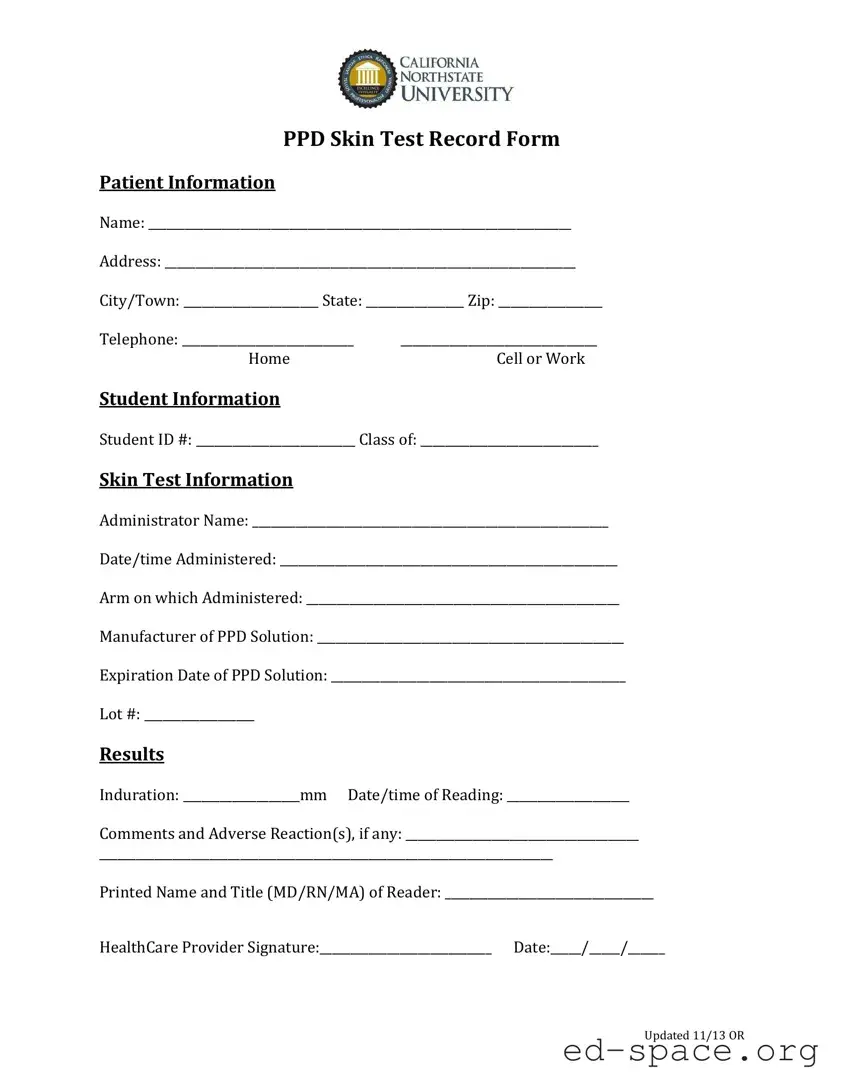
The PPD Skin Test Record Form is an essential document used to track and manage tuberculosis screening. This form collects vital patient information, including the patient's name, address, and contact details. For students, it captures their student ID and class year, ensuring that their health records are accurately linked to their academic profiles. The skin test section of the form requires details about the administrator, such as their name, and the specifics of the test, including the date and time it was given, as well as the arm on which it was administered. Important information about the PPD solution, like the manufacturer, expiration date, and lot number, is also recorded. The results section is crucial, as it notes the induration measurement, the date and time of reading, and any comments or adverse reactions. Finally, the form concludes with the printed name and title of the healthcare provider who reads the results, along with their signature and date. This comprehensive approach ensures that all necessary information is documented for effective patient care.

PPD SKIN TEST RECORD FORM
PATIENT INFORMATION
Name: _____________________________________________________________________
Address: ___________________________________________________________________
City/Town: ______________________ State: ________________ Zip: _________________
Telephone: ____________________________ |
________________________________ |
Home |
Cell or Work |
STUDENT INFORMATION
Student ID #: __________________________ Class of: _____________________________
SKIN TEST INFORMATION
Administrator Name: __________________________________________________________
Date/time Administered: _______________________________________________________
Arm on which Administered: ___________________________________________________
Manufacturer of PPD Solution: __________________________________________________
Expiration Date of PPD Solution: ________________________________________________
Lot #: __________________
RESULTS
Induration: ___________________mm Date/time of Reading: ____________________
Comments and Adverse Reaction(s), if any: ______________________________________
__________________________________________________________________________
Printed Name and Title (MD/RN/MA) of Reader: __________________________________
HealthCare Provider Signature:____________________________ Date:_____/_____/______
Updated 11/13 OR
| Fact Name | Description |
|---|---|
| Purpose | The PPD skin test is used to determine if someone has been exposed to tuberculosis (TB). |
| Patient Information | Essential details such as name, address, and contact information must be collected for accurate record-keeping. |
| Student Information | For students, a Student ID number and class year are required to track test results effectively. |
| Administration Details | The form requires the administrator's name, the date and time the test was given, and the arm used for the test. |
| PPD Solution Information | Details about the PPD solution, including the manufacturer, expiration date, and lot number, must be recorded. |
| Results Section | The test results include the size of induration and the date/time the results were read. |
| Legal Compliance | In many states, specific laws govern the administration of PPD tests, including documentation requirements. Check local regulations for compliance. |
After completing the PPD Skin Test form, it will be submitted to the appropriate healthcare provider for evaluation. The next steps typically involve a follow-up appointment to review the results and discuss any necessary actions.
What is a PPD skin test?
A PPD skin test, also known as a tuberculin skin test, is a method used to determine if a person has been exposed to the bacteria that causes tuberculosis (TB). The test involves injecting a small amount of purified protein derivative (PPD) into the skin, usually on the forearm. After 48 to 72 hours, a healthcare professional examines the injection site for any reaction, which helps indicate whether the person has been infected with TB.
How is the PPD skin test administered?
The test is typically administered by a trained healthcare provider. They will clean the area on your forearm and then inject a small amount of PPD solution just beneath the skin's surface. This creates a small raised bump. After the injection, you will be instructed to return within two to three days for the reading of the test results.
What do the results of the PPD skin test mean?
The results are read by measuring the induration, or swelling, at the injection site. A certain size of induration indicates a positive result, which may suggest that you have been exposed to TB bacteria. However, a positive result does not necessarily mean you have active TB disease; further evaluation may be needed. Conversely, a negative result typically indicates no exposure, but it is important to consider other factors, such as recent exposure or immune status.
Are there any side effects or reactions to the PPD skin test?
Most people experience minimal side effects from the PPD skin test. Common reactions may include mild redness or itching at the injection site. In rare cases, individuals may have a more significant reaction or an allergic response. It is essential to inform the healthcare provider about any adverse reactions you experience following the test.
What should I do if I have a positive PPD skin test result?
If your test result is positive, it is important to follow up with your healthcare provider for further evaluation. They may recommend additional tests, such as a chest X-ray or a sputum test, to determine if you have active TB disease. Early detection and treatment are crucial for managing TB effectively.
Incomplete Patient Information: Many individuals forget to fill in all sections of the patient information, such as the address or telephone number. This can lead to difficulties in contacting them for follow-up or clarifications.
Missing Student Information: Students often overlook the student ID number or class year. This information is crucial for tracking purposes and ensuring the test is associated with the correct individual.
Incorrect Administration Details: Failing to accurately record the name of the administrator or the date and time the test was given can create confusion. It’s important to have precise documentation for both legal and medical reasons.
Improper Induration Measurement: Some people may not measure the induration correctly or may leave this section blank. Accurate measurement is vital for interpreting the results of the skin test.
Omitting Comments and Reactions: If there are any adverse reactions or comments, they must be documented. Neglecting to include this information can lead to misunderstandings about the patient's health status.
The PPD Skin Test form is an essential document used to record the details of a tuberculosis skin test. It’s often accompanied by other forms that help ensure proper documentation and follow-up care. Here are four commonly used forms that work alongside the PPD Skin Test form:
Using these forms together with the PPD Skin Test form helps create a comprehensive view of the patient’s health status and ensures that all necessary information is documented for effective care. Proper documentation is crucial for accurate diagnosis and treatment.
The PPD Skin Test form serves a specific purpose in documenting skin test results for tuberculosis exposure. Several other documents share similarities in structure and function. Below is a list of six such documents:
When filling out the PPD Skin Test form, there are important guidelines to follow. Here’s a list of things you should and shouldn’t do to ensure accuracy and clarity.
By following these guidelines, you can help ensure that the PPD Skin Test form is completed accurately, which is essential for proper health assessments.
Misconceptions about the PPD Skin Test can lead to confusion and anxiety. Here are five common misunderstandings:
This is false. The PPD test uses a small amount of a protein derived from the bacteria that cause tuberculosis. It does not contain live bacteria, so it cannot cause the disease.
A positive result indicates that you have been exposed to the bacteria at some point, but it does not confirm that you have active tuberculosis. Further testing is necessary to determine if the disease is present.
The PPD skin test is used for screening individuals who may be at risk for tuberculosis, even if they do not show symptoms. It is a preventive measure.
Results must be read within 48 to 72 hours after the test is given. Reading the test outside this window may lead to inaccurate results.
While trained healthcare providers typically administer the PPD test, other qualified personnel may also be authorized to perform this procedure, depending on local regulations.
When completing and utilizing the PPD Skin Test form, it is essential to ensure accuracy and clarity. Below are key takeaways to consider: