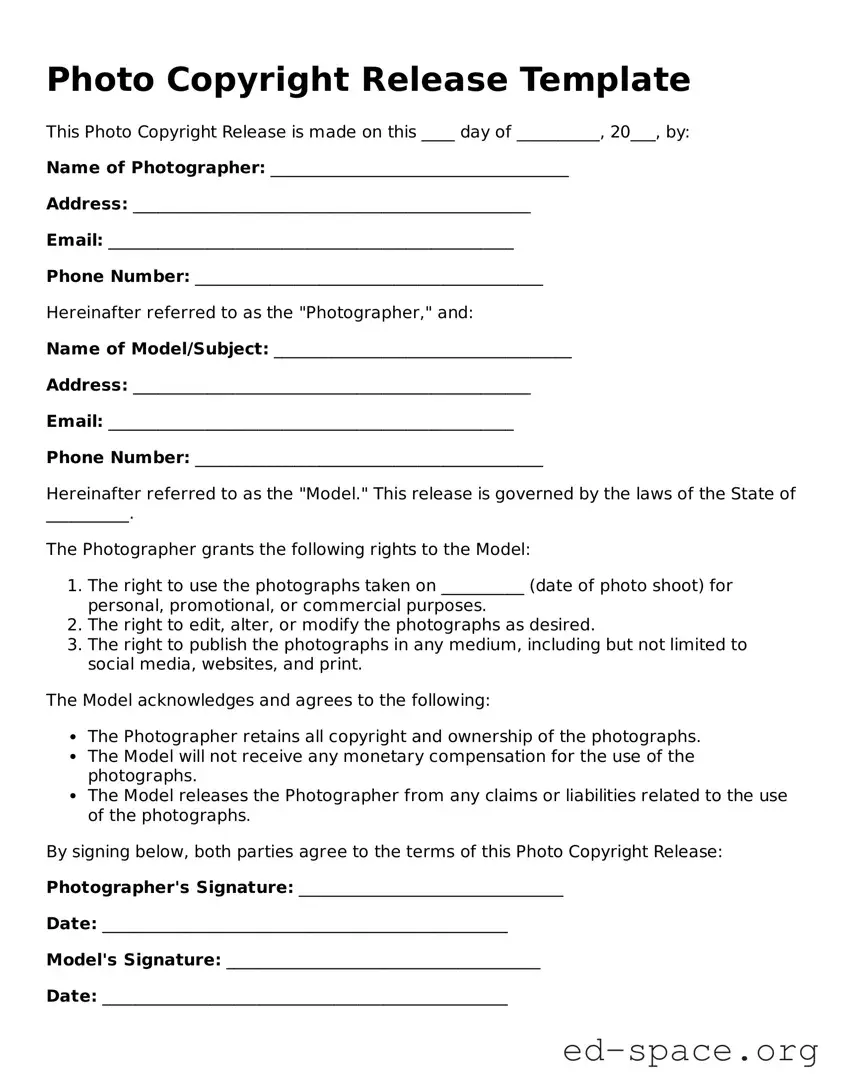
The Photo Copyright Release form plays a crucial role in the relationship between photographers and their subjects. This document serves as a legal agreement that grants permission to photographers to use images of individuals or their property for various purposes, including commercial use, advertising, or portfolio displays. By signing this form, the subject acknowledges that they relinquish certain rights to the images, allowing the photographer to reproduce, distribute, and publicly display the photos without further consent. It typically includes essential details such as the names of the parties involved, the date of the agreement, and a description of the images covered. Additionally, the form often outlines any compensation or terms of use, ensuring that both the photographer and the subject have a clear understanding of their rights and responsibilities. This clarity helps prevent disputes and protects the interests of all parties involved, making it an essential tool in the photography industry.
Photo Copyright Release Template
This Photo Copyright Release is made on this ____ day of __________, 20___, by:
Name of Photographer: ____________________________________
Address: ________________________________________________
Email: _________________________________________________
Phone Number: __________________________________________
Hereinafter referred to as the "Photographer," and:
Name of Model/Subject: ____________________________________
Address: ________________________________________________
Email: _________________________________________________
Phone Number: __________________________________________
Hereinafter referred to as the "Model." This release is governed by the laws of the State of __________.
The Photographer grants the following rights to the Model:
The Model acknowledges and agrees to the following:
By signing below, both parties agree to the terms of this Photo Copyright Release:
Photographer's Signature: ________________________________
Date: _________________________________________________
Model's Signature: ______________________________________
Date: _________________________________________________
| Fact Name | Description |
|---|---|
| Definition | A Photo Copyright Release form is a legal document that grants permission for the use of photographs taken of an individual or their property. |
| Purpose | This form protects the rights of both the photographer and the subject by clearly outlining how the images can be used. |
| Consent | By signing this form, the individual gives explicit consent for their image to be used in specified ways, such as for marketing or promotional purposes. |
| Revocation | Once signed, the release can typically not be revoked, making it important to read and understand the terms before signing. |
| State-Specific Forms | Some states may have specific requirements for Photo Copyright Release forms. For example, California law emphasizes the need for clear and explicit consent. |
| Duration | The rights granted in a Photo Copyright Release can last indefinitely unless otherwise specified in the document. |
| Legal Implications | Failure to obtain a signed release can result in legal disputes over the unauthorized use of an individual's likeness. |
Completing the Photo Copyright Release form is an important step in ensuring that all parties involved have a clear understanding of the rights associated with the photographs. After filling out the form, it will be submitted to the relevant parties for processing. Follow the steps below to accurately complete the form.
Once the form is filled out, review all entries for accuracy before submitting it to the appropriate party. Make sure to keep a copy for your records.
What is a Photo Copyright Release form?
A Photo Copyright Release form is a legal document that allows photographers to transfer the rights of their photographs to another party. This form typically grants permission for the use, reproduction, and distribution of the images by the recipient, ensuring that the photographer is properly credited and compensated if applicable.
Why do I need a Photo Copyright Release form?
If you are a photographer, this form protects your work and clarifies how your images can be used. For individuals or organizations using the images, it provides legal assurance that they have the right to use the photographs without infringing on copyright laws. This can prevent potential disputes over image usage in the future.
Who should sign the Photo Copyright Release form?
The form should be signed by the photographer, who holds the copyright to the images, and the party receiving the rights. This could be a client, a business, or any individual who intends to use the photographs. Both parties must agree to the terms outlined in the document.
What rights are typically transferred in a Photo Copyright Release?
The rights transferred can vary based on the agreement. Commonly, the photographer grants the recipient the right to use the images for specific purposes, such as marketing, advertising, or publication. It may also specify whether the rights are exclusive or non-exclusive, and if the images can be altered or modified.
Can I revoke a Photo Copyright Release form once it is signed?
Once a Photo Copyright Release form is signed, it generally cannot be revoked unless both parties agree to the change. This emphasizes the importance of understanding the terms before signing. If you have concerns, it's advisable to discuss them with the other party or seek legal advice prior to signing.
Is there a standard format for a Photo Copyright Release form?
While there is no universal standard, many forms include key elements such as the names of the parties involved, a description of the photographs, the rights being transferred, and any limitations on usage. It is essential to ensure that the form is clear and comprehensive to avoid misunderstandings.
Do I need to pay for a Photo Copyright Release?
Typically, there is no fee for the release itself, but there may be costs associated with the transaction, such as photography fees or licensing fees. These costs should be discussed and agreed upon prior to signing the release. It’s important to ensure that all financial aspects are clear to both parties.
What happens if I don’t use a Photo Copyright Release form?
Without a Photo Copyright Release form, you risk legal issues regarding the use of the images. The photographer retains full copyright, and the recipient may not have the legal right to use the images. This can lead to disputes, potential lawsuits, and financial penalties for unauthorized use.
Can I use a Photo Copyright Release form for digital images?
Yes, a Photo Copyright Release form is applicable to both digital and printed images. Regardless of the format, the rights and permissions outlined in the form remain valid. It is crucial to document any agreements concerning the use of digital images to protect both parties.
Where can I find a template for a Photo Copyright Release form?
Templates for Photo Copyright Release forms can often be found online through legal websites, photography associations, or by consulting with a legal professional. It is important to ensure that any template you use is tailored to your specific needs and complies with local laws.
Incomplete Information: Many individuals fail to provide all required details, such as their full name, contact information, or the date of the photo shoot. This can lead to delays in processing the release.
Incorrect Signatures: Some people sign the form without ensuring they are the rightful owner of the copyright or the authorized representative. This mistake can invalidate the release.
Failure to Understand Terms: Not reading or comprehending the terms of the release can result in misunderstandings about how the images will be used. This can lead to disputes later on.
Omitting Additional Permissions: Individuals sometimes forget to specify any additional permissions or limitations regarding the use of the photos. This can create confusion for both parties involved.
The Photo Copyright Release form is an important document that allows photographers and subjects to agree on the use of images. Along with this form, there are several other documents that may be used to clarify rights and responsibilities. Below is a list of these forms and documents.
These forms help clarify the relationship between photographers, models, and clients. They ensure that everyone understands their rights and responsibilities regarding the use of images.
When it comes to filling out a Photo Copyright Release form, there are several key points to keep in mind. This form is essential for ensuring that the rights to the photographs are clearly defined. Below is a list of things you should and shouldn't do to make the process smoother and more effective.
By following these guidelines, you can ensure that the Photo Copyright Release form is filled out correctly and efficiently. Proper attention to detail can save you from potential issues down the line.
Understanding the Photo Copyright Release form is essential for photographers and clients alike. However, several misconceptions can lead to confusion. Here are seven common misconceptions:
Being informed about these misconceptions can help ensure proper use of the Photo Copyright Release form and protect both parties involved.
When it comes to using a Photo Copyright Release form, understanding its purpose and how to fill it out correctly is essential. Here are some key takeaways to keep in mind:
By keeping these points in mind, you can effectively navigate the process of using a Photo Copyright Release form and protect your creative work.