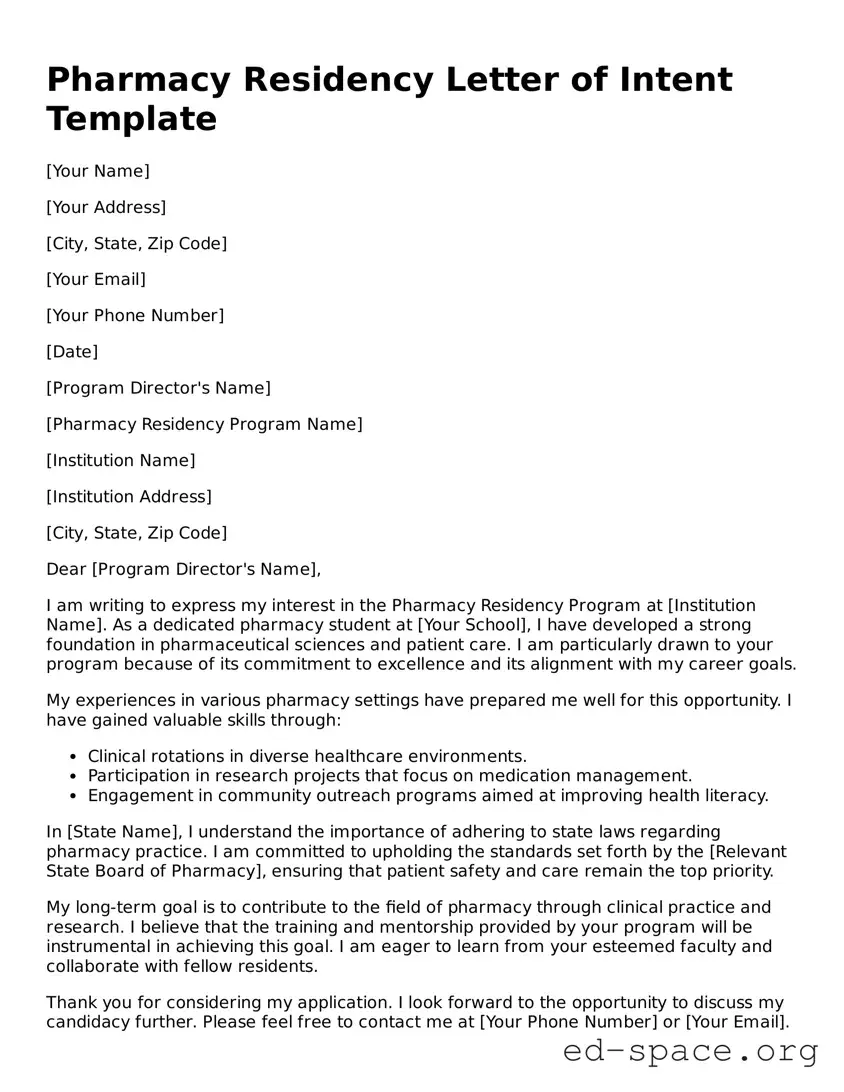
Applying for a pharmacy residency can be a pivotal moment in a pharmacist's career. One of the key components of this application process is the Pharmacy Residency Letter of Intent form. This document serves as a personal introduction to the selection committee, allowing applicants to express their motivations, aspirations, and qualifications. It typically includes a brief overview of the applicant's background, highlighting relevant experiences and achievements in the field of pharmacy. Moreover, the letter should convey the applicant's specific interest in the residency program and how it aligns with their career goals. A well-crafted letter not only showcases the applicant's skills but also reflects their passion for pharmacy practice and commitment to patient care. It is essential to strike a balance between professionalism and authenticity, ensuring that the letter resonates with the readers while providing a clear picture of the applicant's dedication to the profession.
Pharmacy Residency Letter of Intent Template
[Your Name]
[Your Address]
[City, State, Zip Code]
[Your Email]
[Your Phone Number]
[Date]
[Program Director's Name]
[Pharmacy Residency Program Name]
[Institution Name]
[Institution Address]
[City, State, Zip Code]
Dear [Program Director's Name],
I am writing to express my interest in the Pharmacy Residency Program at [Institution Name]. As a dedicated pharmacy student at [Your School], I have developed a strong foundation in pharmaceutical sciences and patient care. I am particularly drawn to your program because of its commitment to excellence and its alignment with my career goals.
My experiences in various pharmacy settings have prepared me well for this opportunity. I have gained valuable skills through:
In [State Name], I understand the importance of adhering to state laws regarding pharmacy practice. I am committed to upholding the standards set forth by the [Relevant State Board of Pharmacy], ensuring that patient safety and care remain the top priority.
My long-term goal is to contribute to the field of pharmacy through clinical practice and research. I believe that the training and mentorship provided by your program will be instrumental in achieving this goal. I am eager to learn from your esteemed faculty and collaborate with fellow residents.
Thank you for considering my application. I look forward to the opportunity to discuss my candidacy further. Please feel free to contact me at [Your Phone Number] or [Your Email].
Sincerely,
[Your Name]
| Fact Name | Description |
|---|---|
| Purpose | The Pharmacy Residency Letter of Intent serves as a formal introduction to your application, outlining your interest in a specific residency program. |
| Content Requirements | The letter typically includes your academic background, professional experiences, and reasons for pursuing the residency. |
| Length | Most letters should be concise, usually ranging from 1 to 2 pages, ensuring clarity and focus. |
| Personalization | It's important to tailor your letter to each residency program, highlighting specific aspects that attract you to that particular site. |
| Submission Guidelines | Each program may have unique submission guidelines, so reviewing their specific requirements is essential. |
| Governing Laws | While there are no specific laws governing the letter itself, residency programs must comply with accreditation standards set by the Accreditation Council for Pharmacy Education (ACPE). |
| Review Process | Your letter will be reviewed alongside other application materials, making it a crucial component of your overall candidacy. |
After obtaining the Pharmacy Residency Letter of Intent form, you are ready to begin the application process. Completing this form accurately is essential for presenting your qualifications and intentions clearly. Follow these steps to ensure you fill out the form correctly.
After submission, you will await feedback from the residency program. Ensure you check your email regularly for any updates or additional requirements.
What is a Pharmacy Residency Letter of Intent?
A Pharmacy Residency Letter of Intent is a formal document that expresses your interest in a specific pharmacy residency program. It allows you to communicate your career goals, experiences, and reasons for choosing that particular program. This letter is an important part of your application and helps residency directors understand your motivations and qualifications.
Why is the Letter of Intent important?
The Letter of Intent serves as a critical component of your application. It gives you an opportunity to showcase your personality and passion for pharmacy. By articulating your goals and experiences, you can differentiate yourself from other candidates. This letter can significantly influence the selection committee’s decision.
What should I include in my Letter of Intent?
Your Letter of Intent should include several key elements: an introduction that states your interest in the program, a summary of your relevant experiences and achievements, your career goals, and a conclusion that reiterates your enthusiasm for the program. Personal anecdotes can help illustrate your commitment and suitability for the residency.
How long should the Letter of Intent be?
Typically, a Letter of Intent should be one page long, or about 300-500 words. This length allows you to convey your message clearly without overwhelming the reader. Focus on being concise and to the point while still providing enough detail to make a strong impression.
Is it necessary to address the Letter of Intent to a specific person?
If possible, addressing the letter to a specific individual, such as the program director, can demonstrate your attention to detail and genuine interest. However, if you are unsure of the recipient's name, a general greeting such as "Dear Residency Selection Committee" is acceptable.
Should I proofread my Letter of Intent?
Absolutely! Proofreading is essential. Spelling and grammatical errors can create a negative impression. Take the time to review your letter multiple times. Consider asking a mentor or peer to read it as well. Fresh eyes can catch mistakes you may have overlooked.
Can I use a template for my Letter of Intent?
While templates can provide a helpful starting point, it’s important to personalize your letter. Each residency program is unique, and your letter should reflect your individual experiences and motivations. Tailoring your content will make your application stand out.
When should I submit my Letter of Intent?
Submit your Letter of Intent along with your application materials by the program's deadline. Make sure to check the specific requirements for each residency program, as some may have different submission guidelines or preferred formats.
What if I change my mind about a residency program after submitting my Letter of Intent?
If you change your mind, it’s best to communicate this to the program as soon as possible. A polite email expressing your decision can help maintain professionalism. However, be aware that changing your intent may affect your standing with the program.
Neglecting to personalize the letter: Many applicants fail to tailor their letter to the specific residency program. Generic letters can come across as insincere and may not highlight why the candidate is a good fit for that program.
Ignoring formatting guidelines: Some individuals overlook the importance of formatting. Proper structure, including font size and spacing, is crucial for readability and professionalism.
Failing to proofread: Spelling and grammatical errors can detract from the overall quality of the letter. A thorough review is essential to catch mistakes that could create a negative impression.
Being overly vague: Candidates often make the mistake of being too general about their experiences and goals. Specific examples can make a stronger impact and demonstrate genuine interest.
Not expressing enthusiasm: A lack of enthusiasm can make a letter feel flat. Showing genuine passion for the residency and the field of pharmacy is important to convey.
Overloading with unnecessary information: Some applicants include excessive details that are not relevant to the residency. Focus on experiences and skills that directly relate to the program.
Neglecting to discuss future goals: It's vital to articulate how the residency aligns with long-term career aspirations. Failing to do so can leave the reader questioning the applicant's motivation.
Ignoring the importance of a strong closing: A weak conclusion can diminish the impact of the letter. Summarizing key points and expressing gratitude can leave a positive final impression.
The Pharmacy Residency Letter of Intent is a crucial document for applicants seeking a residency position. Along with this letter, several other forms and documents are commonly required to complete the application process. Below is a list of these documents, each accompanied by a brief description.
These documents collectively support the application and provide residency programs with a comprehensive view of the candidate's qualifications and readiness for the position. Proper preparation and submission of these materials are essential for a successful application process.
The Pharmacy Residency Letter of Intent form shares similarities with several other documents commonly used in professional and academic settings. Below is a list detailing these similarities:
When filling out the Pharmacy Residency Letter of Intent form, it is essential to follow certain guidelines to ensure your application stands out. Here are six things you should and shouldn't do:
Misconception 1: The Letter of Intent is just a formality.
Many applicants believe that the Letter of Intent (LOI) carries little weight in the selection process. However, this document is an opportunity to showcase your passion for the residency program and your fit for the position. A well-crafted LOI can make a significant impression on the selection committee.
Misconception 2: The LOI should only restate your CV.
Some candidates think that summarizing their experiences and qualifications is sufficient. In reality, the LOI should complement your CV by providing context and insight into your motivations and goals. Use this opportunity to tell your story and explain why you are drawn to the specific residency program.
Misconception 3: Length is more important than quality.
It's a common belief that a longer LOI will impress the reviewers. In truth, clarity and conciseness are far more valuable. A brief, focused letter that highlights your key attributes and aspirations will resonate more effectively than a lengthy, unfocused one.
Misconception 4: The LOI should be generic for all applications.
Some applicants may think that a one-size-fits-all letter will suffice. However, tailoring your LOI to each specific residency program is crucial. Highlight aspects of the program that attract you and explain how your goals align with their mission. Personalization can set your application apart from others.
Filling out the Pharmacy Residency Letter of Intent form is a crucial step in the application process. Here are some key takeaways to keep in mind:
By following these takeaways, you can craft a compelling Letter of Intent that enhances your residency application.