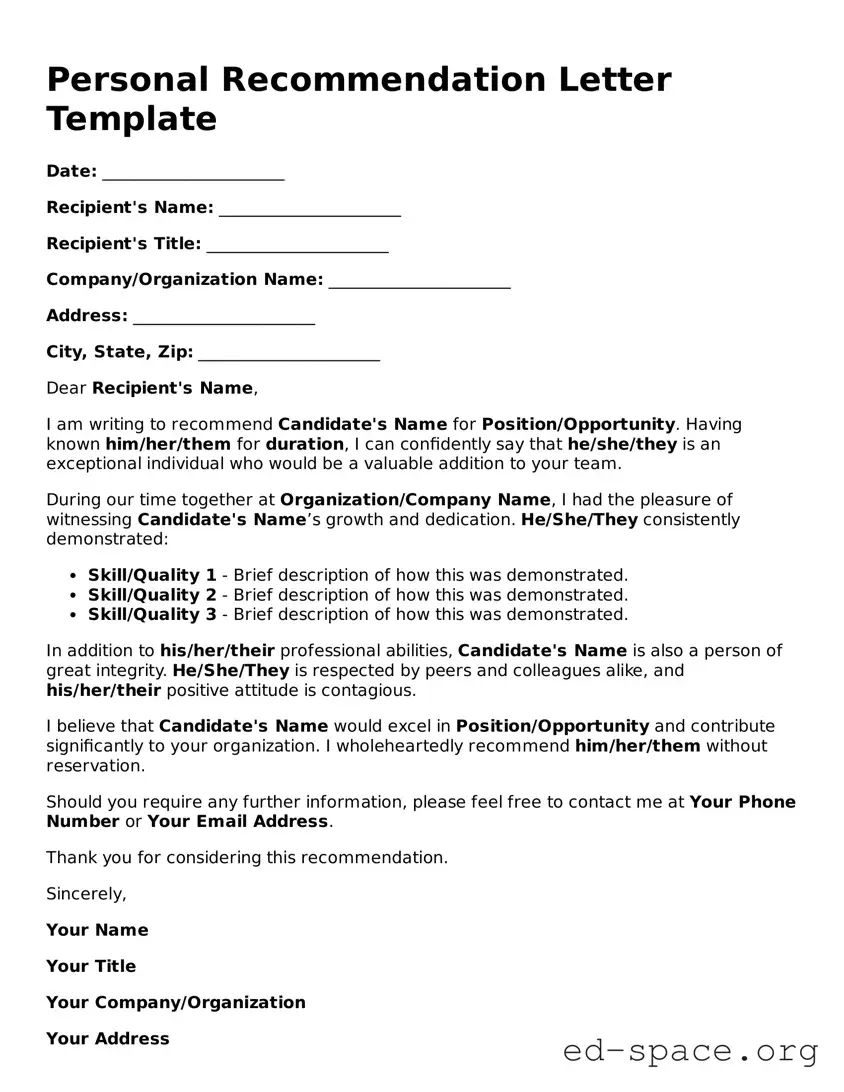
The Personal Recommendation Letter form plays a crucial role in various applications, whether for academic admissions, job opportunities, or professional advancements. This form typically requires detailed information about the individual being recommended, including their qualifications, skills, and personal attributes. It often asks for specific examples of the candidate's achievements and contributions, allowing the recommender to provide a well-rounded view of the individual. Additionally, the form may include sections for the recommender's relationship to the candidate, which helps contextualize the endorsement. Clear instructions guide the recommender in presenting their thoughts effectively, ensuring that the letter meets the expectations of the reviewing party. Overall, this form serves as a vital tool for individuals seeking to showcase their strengths through the eyes of someone who knows them well.
Personal Recommendation Letter Template
Date: ______________________
Recipient's Name: ______________________
Recipient's Title: ______________________
Company/Organization Name: ______________________
Address: ______________________
City, State, Zip: ______________________
Dear Recipient's Name,
I am writing to recommend Candidate's Name for Position/Opportunity. Having known him/her/them for duration, I can confidently say that he/she/they is an exceptional individual who would be a valuable addition to your team.
During our time together at Organization/Company Name, I had the pleasure of witnessing Candidate's Name’s growth and dedication. He/She/They consistently demonstrated:
In addition to his/her/their professional abilities, Candidate's Name is also a person of great integrity. He/She/They is respected by peers and colleagues alike, and his/her/their positive attitude is contagious.
I believe that Candidate's Name would excel in Position/Opportunity and contribute significantly to your organization. I wholeheartedly recommend him/her/them without reservation.
Should you require any further information, please feel free to contact me at Your Phone Number or Your Email Address.
Thank you for considering this recommendation.
Sincerely,
Your Name
Your Title
Your Company/Organization
Your Address
City, State, Zip
| Fact Name | Description |
|---|---|
| Purpose | A Personal Recommendation Letter serves to provide a character reference for an individual, highlighting their skills and qualities. |
| Format | The letter should be structured with a formal greeting, an introduction, the body detailing the individual's strengths, and a closing statement. |
| State-Specific Forms | Some states may have specific guidelines or forms for personal recommendations, which can vary by profession. |
| Governing Laws | In states like California, the Business and Professions Code governs the use of recommendation letters in certain professional contexts. |
Completing the Personal Recommendation Letter form is an important step in providing a comprehensive and supportive endorsement. This process requires attention to detail and thoughtful reflection on the individual's qualities and achievements. Below are the steps to guide you through filling out the form effectively.
What is a Personal Recommendation Letter form?
A Personal Recommendation Letter form is a document that allows individuals to request a letter of recommendation from someone who can speak to their character, skills, or experiences. This letter is often used for college applications, job opportunities, or other professional endeavors.
Who should I ask to write my recommendation letter?
It's best to choose someone who knows you well and can provide a detailed and positive perspective on your abilities. This could be a teacher, employer, mentor, or community leader. Consider individuals who can highlight specific examples of your strengths and contributions.
How do I request a recommendation letter?
Approach your chosen recommender politely, either in person or through a formal email. Clearly explain why you are seeking the recommendation and provide any relevant details about the opportunity you are applying for. It’s also helpful to share your resume or a list of your accomplishments to assist them in writing a more personalized letter.
What information should I provide to my recommender?
Provide your recommender with essential details such as the purpose of the recommendation, deadlines, and any specific points you would like them to address. Additionally, share your resume, personal statement, or other documents that can give context to your request.
How long should I give my recommender to write the letter?
It’s considerate to give your recommender at least two to four weeks to write the letter. This timeframe allows them to reflect on your qualifications and write a thoughtful recommendation. Always check in a week before the deadline to see if they need any additional information.
Can I see the letter before it is submitted?
Typically, letters of recommendation are kept confidential to maintain their integrity. However, you can ask your recommender if they are comfortable sharing a draft with you. Some may prefer to keep it private, while others might be open to providing you with a preview.
What if my recommender declines my request?
If a recommender declines your request, don’t take it personally. They may have time constraints or feel they cannot provide a strong endorsement. In this case, seek out another individual who may be more willing and able to support your application.
Can I use the same recommendation letter for multiple applications?
While you can use the same letter for different applications, it’s best to ensure that it is tailored to each specific opportunity. Some institutions or employers may have unique requirements or values that a generic letter may not address effectively.
What should I do after my recommender submits the letter?
After your recommender submits the letter, it’s important to thank them for their support. A simple thank-you note, whether handwritten or via email, goes a long way in expressing your gratitude. This gesture helps maintain a positive relationship for future interactions.
How can I follow up on the status of my recommendation letter?
If you haven’t heard back from your recommender as the deadline approaches, it’s appropriate to send a gentle reminder. Politely inquire if they need any additional information or if they have completed the letter. Keep your tone friendly and understanding, as they may be busy with other commitments.
Inadequate Personalization: One common mistake is failing to personalize the letter. Generic recommendations lack impact. Each letter should reflect the unique qualities and achievements of the individual being recommended.
Vagueness in Descriptions: Another frequent error is using vague language. Specific examples of the person's skills, experiences, and contributions provide clarity. Without these details, the recommendation may come across as insincere or lacking substance.
Neglecting the Audience: Not considering the audience for the recommendation can lead to misalignment. Different institutions or employers may value different traits. Tailoring the content to meet the expectations of the recipient is essential for effectiveness.
Failure to Proofread: Lastly, many individuals overlook the importance of proofreading. Spelling and grammatical errors can undermine the credibility of the recommendation. A polished letter reflects professionalism and attention to detail.
When seeking a personal recommendation letter, it’s often helpful to gather additional documents that can provide context and support your request. These forms and documents can enhance the overall impression and ensure that the recommender has all the necessary information to write a compelling letter.
By providing these additional documents, you not only make it easier for your recommender but also increase the chances of receiving a strong, personalized letter that can significantly bolster your application.
The Personal Recommendation Letter form serves as an important tool for individuals seeking endorsements for various purposes. Similar documents share the same goal of providing a third-party perspective on a person's qualifications, character, or suitability for a specific role or opportunity. Below are six documents that are similar to the Personal Recommendation Letter form:
When filling out a Personal Recommendation Letter form, it’s important to keep a few key points in mind. Here are five things you should and shouldn’t do:
When it comes to personal recommendation letters, many people have misconceptions that can lead to confusion or missed opportunities. Here are five common misunderstandings:
While friends and family can provide support, a strong recommendation usually comes from someone with relevant experience or authority. This could be a teacher, employer, or mentor who can speak to your skills and character in a meaningful way.
Quality matters more than quantity. A concise letter that highlights key strengths and specific examples can be more impactful than a long, generic one. Focus on what truly makes you stand out.
While they are commonly used in academic settings, personal recommendation letters can also be valuable for job applications, internships, and even volunteer opportunities. They provide insight into your character and work ethic.
While a close relationship can enhance the letter, it’s not always necessary. A writer who knows you well enough to comment on your skills and achievements can still provide a strong recommendation, even if they aren’t a close friend.
While there are general guidelines, each letter should reflect the writer’s style and your unique qualities. Personal touches and specific anecdotes can make a letter more engaging and memorable.
When filling out and using the Personal Recommendation Letter form, keep the following key takeaways in mind: