Homepage Blank Pennsylvania Instant Check System PDF Form
Content Overview

The Pennsylvania Instant Check System (PICS) form, officially known as SP 4-197, serves a critical function in the process of firearm acquisition in Pennsylvania. This form is primarily used to challenge decisions made by PICS regarding background checks for individuals seeking to purchase firearms or obtain a license to carry. If a background check results in a denial, applicants have 30 days to submit a challenge by mail to the Pennsylvania State Police's Firearms Division. The form requires clear and legible completion, including personal information such as name, address, and identification details, as well as specific reasons for the challenge. It also outlines the prohibitions that may disqualify an individual from acquiring a firearm, ranging from felony convictions to mental health adjudications. The process includes a timeline for responses from the Pennsylvania State Police, ensuring applicants receive a written decision within 60 days of their valid challenge submission. Additionally, the form encourages individuals to provide supplementary information that may aid in expediting their case. Understanding the intricacies of this form is essential for anyone navigating the challenges of firearm ownership in Pennsylvania.

Document Preview

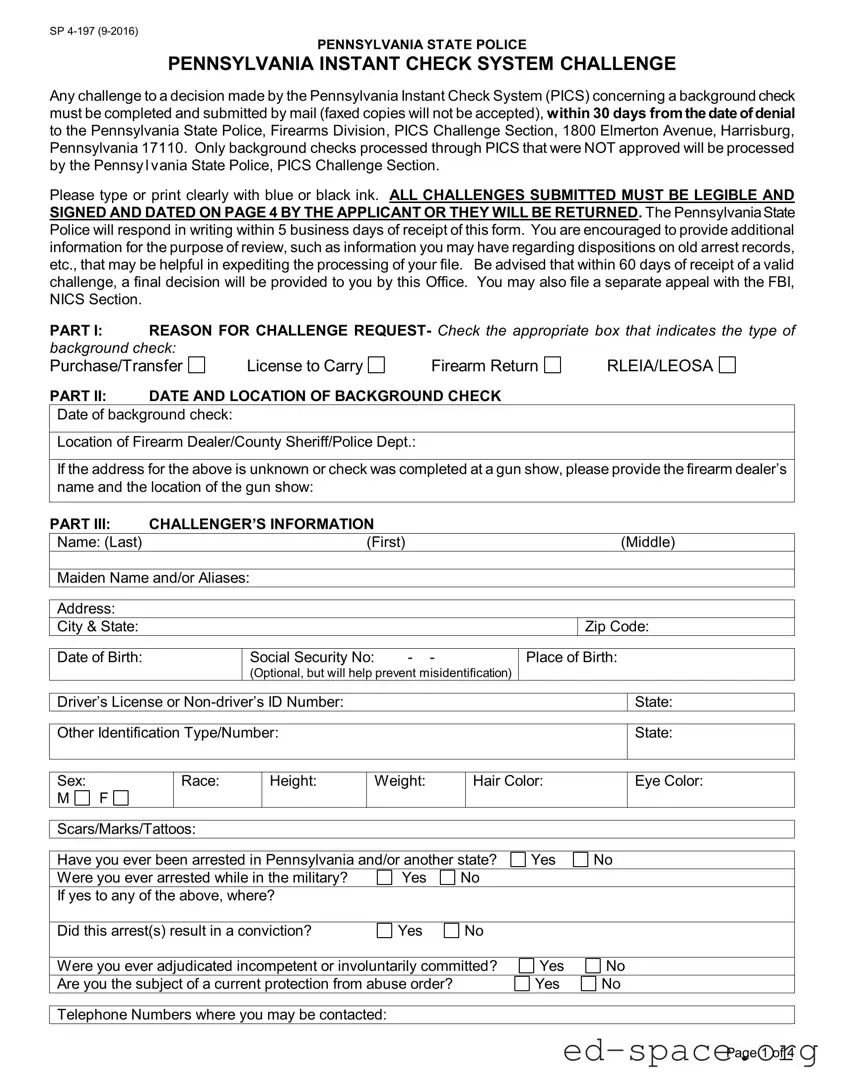
Page 1 of 4
SP 4-197 (9-2016)
PENNSYLVANIA STATE POLICE
PENNSYLVANIA INSTANT CHECK SYSTEM CHALLENGE
Any challenge to a decision made by the Pennsylvania Instant Check System (PICS) concerning a background check
must be completed and submitted by mail (faxed copies will not be accepted), within 30 days from the date of denial
to the Pennsylvania State Police, Firearms Division, PICS Challenge Section, 1800 Elmerton Avenue, Harrisburg,
Pennsylvania 17110. Only background checks processed through PICS that were NOT approved will be processed
by the Pennsylvania State Police, PICS Challenge Section.
Please type or print clearly with blue or black ink. ALL CHALLENGES SUBMITTED MUST BE LEGIBLE AND
SIGNED AND DATED ON PAGE 4 BY THE APPLICANT OR THEY WILL BE RETURNED. The Pennsylvania State
Police will respond in writing within 5 business days of receipt of this form. You are encouraged to provide additional
information for the purpose of review, such as information you may have regarding dispositions on old arrest records,
etc., that may be helpful in expediting the processing of your file. Be advised that within 60 days of receipt of a valid
challenge, a final decision will be provided to you by this Office. You may also file a separate appeal with the FBI,
NICS Section.
PART I: REASON FOR CHALLENGE REQUEST- Check the appropriate box that indicates the type of
background check:
Purchase/Transfer License to Carry Firearm Return RLEIA/LEOSA
PART II: DATE AND LOCATION OF BACKGROUND CHECK
Date of background check:
Location of Firearm Dealer/County Sheriff/Police Dept.:
If the address for the above is unknown or check was completed at a gun show, please provide the firearm dealer’s
name and the location of the gun show:
PART III: CHALLENGER’S INFORMATION
Name: (Last) (First) (Middle)
Maiden Name and/or Aliases:
Address:
City & State:
Zip Code:
Date of Birth:
Social Security No: - -
(Optional, but will help prevent misidentification)
Place of Birth:
Driver’s License or Non-driver’s ID Number:
State:
Other Identification Type/Number:
State:
Race:
Height:
Weight:
Hair Color:
Eye Color:
Scars/Marks/Tattoos:
Have you ever been arrested in Pennsylvania and/or another state? Yes No
Were you ever arrested while in the military? Yes No
If yes to any of the above, where?
Did this arrest(s) result in a conviction? Yes No
Were you ever adjudicated incompetent or involuntarily committed? Yes No
Are you the subject of a current protection from abuse order? Yes No
Telephone Numbers where you may be contacted:
Page 2 of 4
Home: - -
Work: - -
Cell: - -
Page 3 of 4
CHALLENGE PROCESS INFORMATION
The Pennsylvania Instant Check System (PICS) is required to check state and federal databases in order to
determine an individual’s eligibility to acquire a firearm or license to carry a firearm. The following are
prohibitions which at the time of the background check would disqualify an individual from acquiring a
firearm or license to carry a firearm.
1. Conviction of a crime enumerated in 18 Pa. C.S. section 6105(b), or any of the conditions of section 6105(c),
of the Uniform Firearms Act. (See page 3 for specific information.)
2. Charged with or convicted of a crime punishable by imprisonment for a term exceeding one year, not including
offenses pertaining to antitrust, unfair trade practices, restraints of trade, or regulation of business; or state
offenses classified as misdemeanors and punishable by a term of imprisonment not to exceed two years.
3. Under indictment or information in any court for a crime for which the judge could imprison you for more than
one year. An information is a formal accusation of a crime made by a prosecuting attorney. An indictment is a
formal accusation of a crime presented to the court by a grand jury.
4. Conviction of an offense under the act of April 14, 1972 (P.L. 233, No. 64), known as the Controlled
Substance, Drug, Device and Cosmetic Act (CSDDCA). As provided in 18 Pa. C.S. § 6109(1)(ii), any
Pennsylvania drug conviction under the CSDDCA is prohibiting for a license to carry a firearm.
5. Adjudicated delinquent, within the past ten years, for a crime enumerated in 18 Pa.C.S. section 6105 of the
Uniform Firearms Act, or for an offense under the Controlled Substance, Drug, Device and Cosmetic Act.
6. Addicted to or an unlawful user of marijuana or a stimulant, depressant, or narcotic drug.
7. Involuntarily committed to a hospital/health care facility for a mental health condition or other treatment, or
adjudicated incompetent/incapacitated.
8. An alien illegally or unlawfully in the United States.
9. Discharged from the Armed Forces of the United States under dishonorable conditions.
10. Renounced United States citizenship.
11. Subject of a court order restraining you from harassing, stalking, or threatening an intimate partner or child of
such partner.
12. Convicted in any court of a misdemeanor crime of domestic violence. This includes any misdemeanor
conviction involving the use or attempted use of physical force committed by a current or former spouse,
parent or guardian of the victim, or by a person with a similar relationship to the victim.
Section 6105(a)(1), effective November 22, 1995:
A person who has been convicted of an offense enumerated in subsection (b), within or without this Commonwealth,
regardless of the length of sentence or whose conduct meets the criteria in subsection (c) shall not possess, use,
control, sell, transfer or manufacture or obtain a license to possess, use, control, sell, transfer or manufacture a firearm
in this Commonwealth.
Page 4 of 4
Section 6105(b)
§908 Prohibited offensive weapons
§911 Corrupt organizations
§912 Possession of weapon on school property
§2502 Murder
§2503 Voluntary manslaughter
§2504 Involuntary manslaughter, if the offense is based on the
reckless use of a firearm
§2702 Aggravated assault
§2703 Assault by prisoner
§2704 Assault by life prisoner
§2709.1 Stalking
§2716 Weapons of mass destruction
§2901 Kidnapping
§2902 Unlawful restraint
§2910 Luring a child into a motor vehicle or structure
§3121 Rape
§3123 Involuntary deviate sexual intercourse
§3125 Aggravated indecent assault
§3301 Arson and related offenses
§3302 Causing or risking catastrophe
§3502 Burglary
§3503 Criminal trespass, if the offense is graded a felony of the
second degree or higher
§3701 Robbery
§3702 Robbery of motor vehicle
§3921 Theft by unlawful taking or disposition, upon conviction
of the second felony offense
§3923 Theft by extortion, when the offense is accompanied by
threats of violence
§3925 Receiving stolen property, upon conviction of the
second felony offense
§4906 False reports to law enforcement authorities, if the
fictitious report involved the theft of a firearm as
provided in 4906(c)(2)
§4912 Impersonating a public servant, if the person is
impersonating a law enforcement officer
§4952 Intimidation of witnesses or victims
§4953 Retaliation against witness, victim or party
§5121 Escape
§5122 Weapons or implements for escape
§5501(3) Riot
§5515 Prohibiting of paramilitary training
§5516 Facsimile weapons of mass destruction
§6110.1 Possession of firearm by minor
§6301 Corruption of minors
§6302 Sale or lease of weapons and explosives
Any offense equivalent to any of the above-enumerated
offenses under the prior laws of this Commonwealth, or any
offense equivalent to any of the above-enumerated offenses
under the statutes of any other state or of the United States.
Section 6105(c):
Effective November 22, 1995, 18 Pa.C.S. § 6105(c) also prohibits the following persons from possessing, using, controlling, transferring,
manufacturing, or obtaining a license to possess, use, control, transfer, or manufacture a firearm in the Commonwealth of Pen nsylvania.
ARE YOU A PERSON WHO:
1. is a fugitive from justice; or
2. has been convicted of an offense under the act of April 14, 1972 (P.L. 233, No. 64), known as The Controlled Substance, Drug, Device
and Cosmetic Act, or any equivalent Federal statute or equivalent statute of any other state, that may be punishable by a term of
imprisonment exceeding two years; or
3. has been convicted of driving under the influence of alcohol or controlled substance as provided in 75 Pa.C.S. § 3802 (relat ing to
driving under influence of alcohol or controlled substance) or the former 75 Pa.C.S. § 3731, on three or more separate occasions
within a five-year period. For the purposes of this paragraph only, the prohibition of Section 6105(a) shall only apply to transfers or
purchases of firearms after the third conviction; or
4. has been adjudicated as an incompetent or who has been involuntarily committed to a mental institution for inpatient care and
treatment under section 302, 303, or 304 of the provisions of the act of July 9, 1976 (P.L. 817, No. 143), known as the Mental Health
Procedures Act; or
5. being an alien, is illegally or unlawfully in the United States; or
6. is the subject of an active protection from abuse order issued pursuant to 23 Pa.C.S. § 6108 (relating to relief), which order provides for
the relinquishment of firearms during the period of time the order is in effect. This prohibition shall terminate upon the expiration or
vacation of an active protection from abuse order or portion thereof relating to the relinquishment of firearms; or
7. was adjudicated delinquent by a court pursuant to 42 Pa.C.S. § 6341 (relating to adjudication) or under any equivalent Federal statute
or statute of any other state as a result of conduct which if committed by an adult would constitute an offense under 18 Pa.C.S.
sections 2502, 2503, 2702, 2703, 2704, 2901, 3121, 3123, 3301, 3502, 3701, and 3923; or
8. was adjudicated delinquent by a court pursuant to 42 Pa.C.S. § 6341 or under any equivalent Federal statute or statute of any other
state as a result of conduct which if committed by an adult would constitute an offense enumerated in 18 Pa.C.S. § 6105(b) with the
exception of those crimes set forth in paragraph 7. This prohibition shall terminate 15 years after the last applicable deli nquent
adjudication or upon the person reaching the age of 30, whichever is earlier.
9. is prohibited from possessing or acquiring a firearm under 18 U.S.C. § 922(g)(9) (relating to unlawful acts) who has been convicted in
any court of a misdemeanor crime of domestic violence by a person in any of the following relationships: (i) the current or former
spouse, parent or guardian of the victim; (ii) a person with whom the victim shares a child in common; (iii) a person who cohabits
with or has cohabited with the victim as a spouse, parent or guardian; or (iv) a person similarly situated to a spouse, parent, or
guardian of the victim; then the relationship need not be an element of the offense to meet the requirements of this paragraph.
PRIVACY ACT NOTICE
Solicitation of this information is authorized under Title 18 Pa.C.S. § 6111. Disclosure of your social security number is
voluntary. Your social security number, if provided, may be used to verify your identity and prevent misidentification. All
information supplied, including your social security number, is confidential and not subject to public disclosure.
Page 5 of 4
The following information refers to situations most often misunderstood regarding denials.
1. Federal law prohibits a person who is under indictment for, or has been convicted of a crime that would be
punishable by a term of imprisonment exceeding one year, or state misdemeanors punishable by a term of
imprisonment exceeding two years (under current PA law, any offense graded as an M-1 or higher would be
prohibiting). The key issue here is the maximum penalty you could have received for the crime, not the actual
penalty that you did receive.
2. A conviction includes a finding of guilty or the entering of a plea of guilty or nolo contendere, whether or not
judgment of sentence has been imposed, as determined by the law of the jurisdiction in which the prosecution
was held. The term does not include a conviction which has been expunged or overturned or for which an
individual has been pardoned unless the pardon expressly provides that the individual may not possess or
transport firearms. State relief may still be required in order to fully restore firearm rights.
3. There are no time limits on old arrest records. If you have an old conviction for a charge that would be
prohibiting, it will still prohibit you regardless of whether the record is 1 year old or 50 years old.
4. Many times an individual will hit on an old military record regarding AWOL or desertion. In most cases, all that
is needed to clear this up is a copy of the individual’s honorable discharge. Also, military records often do not
contain offense disposition information. If a copy of the official case disposition and a copy of the honorable
discharge are provided, this may expedite research of the challenge.
________________________________________________________________________________
SELF CERTIFICATION
I hereby confirm that I have read all information contained in Form SP 4-197, Pennsylvania
Instant Check System Challenge.
I understand that if I knowingly make any false statements herein, I am subject to penalties
prescribed by law. This certification/acknowledgment is made subject to both the penalties of
section 4904 of the Crimes Code (18 Pa. C.S. § 4904, relating to unsworn falsification to authorities),
a misdemeanor of the third degree, subject to not more than one year of imprisonment and/or a fine
not exceeding $2,500; and the Uniform Firearms Act, which is a felony of the third degree, subject to
not more than 7 years imprisonment and/or a fine not exceeding $15,000.
I hereby authorize the Pennsylvania State Police to receive any documents, including mental
health documents, as well as physician’s determination relating to commitment, necessary to make
a determination with regard to this challenge. I waive any rights to confidentiality in these
documents by signing this certification.
SIGNATURE DATE
NOTE: All challenges submitted must be signed, dated, and complete. Pages 1 through 4 must be
submitted for a challenge to be considered complete. Any challenge received that is not filled out
completely, signed, and dated will be returned.

Form Specifications

Fact Name Details
Form Identifier The Pennsylvania Instant Check System Challenge form is identified as SP 4-197 (9-2016).
Submission Method Challenges must be submitted by mail; faxed copies are not accepted.
Deadline for Submission Challenges must be submitted within 30 days of the denial date.
Response Time The Pennsylvania State Police will respond in writing within 5 business days of receiving the challenge.
Final Decision Timeline A final decision will be provided within 60 days of receipt of a valid challenge.
Governing Law The challenge process is governed by Title 18 Pa.C.S. § 6111 and related sections of the Uniform Firearms Act.
Legibility Requirement All challenges must be legible and signed; otherwise, they will be returned.

Pennsylvania Instant Check System: Usage Guidelines

Once you have completed the Pennsylvania Instant Check System form, you will need to submit it by mail to the appropriate address. Ensure that your submission is legible and includes all required information. The Pennsylvania State Police will review your challenge and respond in writing within a specified timeframe.

  1. Obtain the Pennsylvania Instant Check System Challenge form (SP 4-197).
  2. Type or print clearly using blue or black ink.
  3. In Part I, check the box that corresponds to the reason for your challenge request: Purchase/Transfer, License to Carry Firearm, or Return RLEIA/LEOSA.
  4. In Part II, fill in the date and location of the background check. If the location is unknown, provide the firearm dealer’s name and the location of the gun show.
  5. In Part III, enter your personal information, including your name, address, date of birth, and social security number. Provide additional details as requested, such as driver’s license number and physical characteristics.
  6. Answer the questions regarding past arrests, convictions, mental health status, and any protection from abuse orders.
  7. Provide your contact telephone numbers for follow-up.
  8. Read the challenge process information carefully to understand the prohibitions that may apply to your situation.
  9. Sign and date the certification section at the end of the form.
  10. Make a copy of the completed form for your records.
  11. Mail the completed form to the Pennsylvania State Police, Firearms Division, PICS Challenge Section, 1800 Elmerton Avenue, Harrisburg, Pennsylvania 17110. Ensure it is sent within 30 days of the denial.

Your Questions, Answered

What is the Pennsylvania Instant Check System (PICS) Challenge?

The PICS Challenge is a process that allows individuals to contest a denial resulting from a background check conducted by the Pennsylvania Instant Check System. If your request to purchase or transfer a firearm is denied, you have the right to challenge that decision. This challenge must be submitted in writing to the Pennsylvania State Police within 30 days of the denial.

How do I submit a challenge to a denial?

To submit a challenge, you need to complete the PICS Challenge form (SP 4-197). Ensure that you fill out all required sections clearly and legibly, using blue or black ink. Once completed, mail the form to the Pennsylvania State Police, Firearms Division, PICS Challenge Section, at 1800 Elmerton Avenue, Harrisburg, Pennsylvania 17110. Remember, faxed copies will not be accepted, and your submission must be signed and dated on the last page.

What information should I include with my challenge?

When submitting your challenge, provide as much relevant information as possible. This may include details about any past arrests, court dispositions, or any other records that could help clarify your situation. The more information you provide, the easier it will be for the Pennsylvania State Police to review your case.

How long will it take to receive a response to my challenge?

After the Pennsylvania State Police receive your challenge, they will respond in writing within 5 business days. However, a final decision regarding your challenge will be provided within 60 days of receipt. Be sure to keep an eye on your mailbox for their response.

Can I appeal if my challenge is denied?

If your challenge is denied, you have the option to file a separate appeal with the FBI’s National Instant Criminal Background Check System (NICS) Section. This process is separate from the PICS Challenge and may require additional documentation. Make sure to follow the specific procedures outlined by the NICS for appeals.

Common mistakes

  1. Failing to provide legible information. It's crucial to type or print clearly using blue or black ink. Illegible forms may be returned.

  2. Not signing or dating the form. All challenges must be signed and dated by the applicant on page 4. Omitting this step will lead to the return of the challenge.

  3. Submitting a challenge without including all required pages. The entire form, including pages 1 through 4, must be submitted for the challenge to be complete.

  4. Providing incorrect or incomplete personal information. It is essential to accurately fill out all fields, including name, address, and date of birth, to avoid processing delays.

  5. Not including relevant additional information. If there are old arrest records or other relevant details that could help clarify the situation, they should be included with the challenge.

  6. Missing the 30-day deadline for submission. Challenges must be submitted by mail within 30 days from the date of denial. Late submissions will not be considered.

Documents used along the form

The Pennsylvania Instant Check System (PICS) form is a critical document used in the background check process for firearm purchases and licenses. However, several other forms and documents often accompany this process, providing additional context and information necessary for a thorough review. Below is a list of these documents, each described briefly.

  • Firearm Purchase Application: This document is completed by individuals seeking to purchase a firearm. It collects personal information and details about the firearm being purchased, serving as the initial request for a background check.
  • License to Carry Firearms Application: This application is submitted by individuals who wish to obtain a permit to carry a concealed firearm. It requires personal details, reasons for the request, and may also necessitate character references.
  • Challenge Form for Denied Background Checks: If a background check results in a denial, individuals can submit this form to contest the decision. It requires detailed information about the applicant and the circumstances surrounding the denial.
  • FBI Background Check Request: In some cases, individuals may need to request a federal background check through the FBI. This form is essential for those who wish to appeal a denial from the PICS.
  • Mental Health Certification: This document may be required to verify an individual's mental health status, particularly if there are concerns regarding previous involuntary commitments or adjudications of incompetence.
  • Proof of Identity Documents: Various forms of identification, such as a driver's license or passport, may be needed to confirm an individual's identity during the background check process.

Understanding these documents and their purposes is essential for navigating the firearm purchase and licensing process in Pennsylvania. Each plays a vital role in ensuring that background checks are conducted thoroughly and fairly, protecting both individual rights and public safety.

Similar forms

The Pennsylvania Instant Check System (PICS) form serves a specific purpose in the context of firearm background checks. However, it shares similarities with several other important documents. Each of these documents plays a role in verifying identity, eligibility, or background checks in various contexts. Here’s a closer look at six documents that are similar to the PICS form:

  • Federal Firearms License Application (ATF Form 7): Like the PICS form, this application is used to assess an individual's eligibility to engage in the business of dealing in firearms. Both require detailed personal information and background checks to ensure compliance with federal regulations.
  • National Instant Criminal Background Check System (NICS) Appeal Form: This form is used to challenge a denial from the NICS, similar to how the PICS form allows individuals to contest a background check denial. Both processes require individuals to provide personal information and details surrounding the denial.
  • State Concealed Carry Permit Application: This application assesses an individual's qualifications to carry a concealed firearm. Similar to the PICS form, it requires a background check and personal information to ensure the applicant meets state requirements for firearm possession.
  • Employment Background Check Authorization Form: This document allows employers to conduct background checks on potential employees. Like the PICS form, it involves the collection of personal information and consent for the review of criminal history.
  • Adoption Background Check Application: This application is used to vet potential adoptive parents. Both documents focus on ensuring the safety and suitability of individuals for sensitive roles, requiring extensive personal and background information.
  • Professional License Application (e.g., for healthcare providers): This application requires thorough background checks to ensure that applicants meet professional standards. Similar to the PICS form, it necessitates detailed personal information and may involve challenges to any denials based on background checks.

Understanding these documents helps clarify the processes involved in background checks across various sectors, highlighting the importance of thorough vetting for safety and compliance.

Dos and Don'ts

When filling out the Pennsylvania Instant Check System form, there are important guidelines to follow. Here is a list of things you should and shouldn't do:

  • Do type or print clearly using blue or black ink.
  • Do ensure that all information is legible and complete.
  • Do sign and date the form on the designated page.
  • Do provide additional information if it may help expedite your challenge.
  • Do mail the completed form to the Pennsylvania State Police within 30 days of denial.
  • Don't submit faxed copies of the form; only original documents will be accepted.
  • Don't leave any sections blank; incomplete forms will be returned.
  • Don't forget to check the appropriate box indicating the type of background check.
  • Don't provide false information; this can lead to serious legal consequences.
  • Don't wait too long to submit your challenge; act within the 30-day window.

Following these guidelines can help ensure that your challenge is processed smoothly and efficiently. Take your time and double-check your information before submitting.

Misconceptions

Understanding the Pennsylvania Instant Check System (PICS) can be challenging, and several misconceptions often arise. Here are eight common misunderstandings about the PICS form and process:

  • Misconception 1: All background checks are automatically approved.
  • In reality, not all background checks result in approval. If a check raises any concerns, it may lead to a denial, which can be challenged.

  • Misconception 2: Challenges can be submitted via fax or email.
  • Challenges must be submitted by mail only. Faxed or emailed submissions will not be accepted, so it's important to send the challenge through the postal service.

  • Misconception 3: You have unlimited time to challenge a denial.
  • There is a strict 30-day deadline for submitting a challenge after a denial. Missing this window means you cannot contest the decision.

  • Misconception 4: Old arrest records do not affect your eligibility.
  • Old arrests can still impact your eligibility. Even if the record is decades old, it may still disqualify you from obtaining a firearm.

  • Misconception 5: You can challenge any decision made by PICS.
  • Challenges are only accepted for checks that were not approved. If your background check is approved, you cannot contest that decision.

  • Misconception 6: You don’t need to provide additional information.
  • While not mandatory, providing extra information, such as details on past arrests, can help expedite the review process of your challenge.

  • Misconception 7: Your social security number is mandatory for the challenge.
  • While providing your social security number can help verify your identity, it is not mandatory. You can choose to omit it.

  • Misconception 8: The PICS process is quick and easy.
  • The process can take time. After submitting a valid challenge, you can expect a response within 60 days, but delays can occur depending on the complexity of the case.

Key takeaways

Here are key takeaways regarding the Pennsylvania Instant Check System (PICS) form:

  • Submission Method: Challenges must be mailed to the Pennsylvania State Police, Firearms Division, PICS Challenge Section. Faxed copies are not accepted.
  • Timeframe for Challenges: Submit challenges within 30 days of receiving a denial decision.
  • Legibility Requirement: All forms must be filled out legibly and signed on page 4 by the applicant to avoid being returned.
  • Response Time: The Pennsylvania State Police will respond in writing within 5 business days after receiving the challenge form.
  • Additional Information: Providing extra information, such as old arrest record dispositions, may help expedite the review process.
  • Final Decision Timeline: A final decision will be provided within 60 days of receipt of a valid challenge.
  • Identification Details: Include personal identification details, such as Social Security Number and driver’s license number, to assist in the identification process.
  • Prohibiting Factors: Understand the factors that disqualify individuals from acquiring firearms, including specific convictions and mental health commitments.
  • Privacy Notice: The form includes a privacy notice stating that the information provided is confidential and not subject to public disclosure.