Homepage Blank Pennsylvania Bfr 003 PDF Form
Content Overview

The Pennsylvania BFR 003 form serves as a crucial tool for taxpayers seeking to challenge decisions made by the Board of Appeals or request a refund of taxes they believe were improperly assessed. This form is essential for those navigating the complexities of tax disputes, allowing individuals and businesses to formally present their cases to the Board of Finance and Revenue. Key components of the form include sections for the petitioner’s information, the type of tax involved, and specific details regarding the tax period in question. Additionally, it requires a clear articulation of the relief sought and the arguments supporting the petition. Taxpayers must also provide necessary documentation, such as proof of payment and any relevant notices being appealed. Importantly, the form must be signed by the petitioner or an authorized representative, with notarization required to validate the submission. Understanding the structure and requirements of the BFR 003 form is vital for anyone looking to effectively advocate for their tax rights in Pennsylvania.

Document Preview

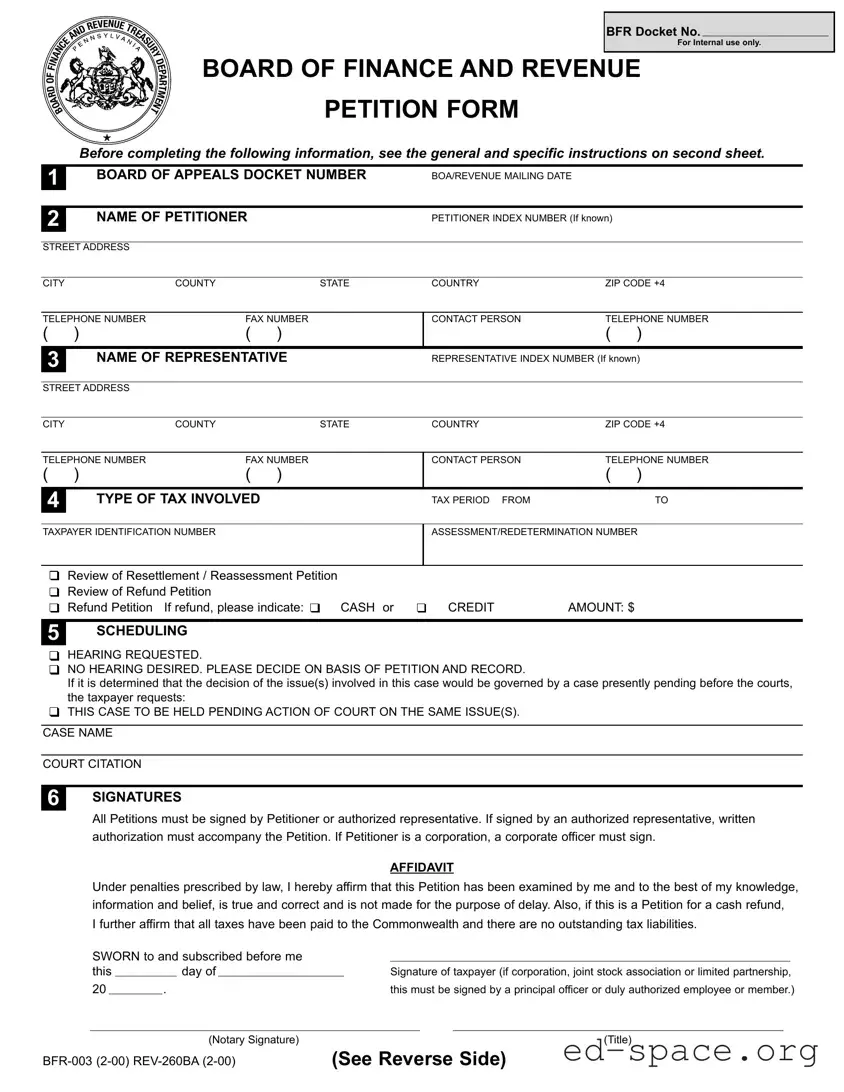
BOARD OF FINANCE AND REVENUE
PETITION FORM
Before completing the following information, see the general and specific instructions on second sheet.
BOARD OF APPEALS DOCKET NUMBER BOA/REVENUE MAILING DATE
NAME OF PETITIONER PETITIONER INDEX NUMBER (If known)
STREET ADDRESS
CITY COUNTY STATE COUNTRY ZIP CODE +4
TELEPHONE NUMBER FAX NUMBER CONTACT PERSON TELEPHONE NUMBER
( ) ( ) ( )
NAME OF REPRESENTATIVE REPRESENTATIVE INDEX NUMBER (If known)
STREET ADDRESS
CITY COUNTY STATE COUNTRY ZIP CODE +4
TELEPHONE NUMBER FAX NUMBER CONTACT PERSON TELEPHONE NUMBER
( ) ( ) ( )
TYPE OF TAX INVOLVED TAX PERIOD FROM TO
TAXPAYER IDENTIFICATION NUMBER ASSESSMENT/REDETERMINATION NUMBER
Review of Resettlement / Reassessment Petition
Review of Refund Petition
Refund Petition If refund, please indicate: CASH or CREDIT AMOUNT: $
SCHEDULING
HEARING REQUESTED.
NO HEARING DESIRED. PLEASE DECIDE ON BASIS OF PETITION AND RECORD.
If it is determined that the decision of the issue(s) involved in this case would be governed by a case presently pending before the courts,
the taxpayer requests:
THIS CASE TO BE HELD PENDING ACTION OF COURT ON THE SAME ISSUE(S).
CASE NAME
COURT CITATION
SIGNATURES
All Petitions must be signed by Petitioner or authorized representative. If signed by an authorized representative, written
authorization must accompany the Petition. If Petitioner is a corporation, a corporate officer must sign.
AFFIDA
VIT
Under penalties prescribed by law, I hereby affirm that this Petition has been examined by me and to the best of my knowledge,
information and belief, is true and correct and is not made for the purpose of delay. Also, if this is a Petition for a cash refund,
I further affirm that all taxes have been paid to the Commonwealth and there are no outstanding tax liabilities.
SWORN to and subscribed before me
this day of Signature of taxpayer (if corporation, joint stock association or limited partnership,
20 . this must be signed by a principal officer or duly authorized employee or member.)
(Notary Signature) (Title)
BFR-003 (2-00) REV-260BA (2-00) (See Reverse Side)
1
2
3
4
5
6
B
O
A
R
D
O
F
F
I
N
A
N
C
E
A
N
D
R
E
V
E
N
U
E
T
R
E
A
S
U
R
Y
D
E
P
A
R
T
M
E
N
T
BFR Docket No.
For Internal use only.
A. RELIEF REQUESTED:
B. ARGUMENT(S):
Explain in detail why the relief requested above should be granted. Attach copy of notice being appealed (BOA Decision or
Revenue Resettlement). Enclose copies of any documents you believe supports your arguments. Petitions for Refund must be
accompanied by proof of payment of the tax to the Commonwealth and any copies of invoices, credit memoranda, exemption
certificates, etc. where relevant. When appealing a Sales and Use Tax, if possible include a copy of the audit assessment, and
REV-39, APPEAL SCHEDULE. When appealing personal income tax, include a copy of your PA-40 and schedules for the
year(s) in question.
MAIL COMPLETED FORM TO:
COMMONWEALTH OF PENNSYLVANIA
BOARD OF FINANCE AND REVENUE
1101 South Front Street, Suite 400
HARRISBURG, PA 17104-2539
(IF ADDITIONAL SPACE IS REQUIRED, ATTACH ADDITIONAL SHEETS.)
7
INSTRUCTIONS FOR THE PREPARATION AND FILING OF PETITIONS
GENERAL INSTRUCTIONS
Please type or print in ink. Petitions filed via U.S. Postal service are considered filed as of the
postmark date. Petitions filed via any other method are considered filed on the date received.
This Petition Form should be used to petition to the Board of Finance and Revenue for:
1. Review of a decision of the Board of Appeals or of an assessment, redetermination,
or resettlement made by the Department of Revenue.
2. Refund of monies paid to an agency of the Commonwealth, other than the Department of
Revenue, to which the Commonwealth is neither rightfully nor equitably entitled.*
*NOTE: As of January 1, 1995, all petitions for the refund of monies paid to the
Department of Revenue, except for refunds of Liquid Fuels Taxes paid by political
sudivisions; nonpublic schools not operated for profit; farmers; volunteer rescue
squads, ambulance services, and fire companies; users of liquid fuel in propeller
driven aircraft or engines; and agencies of the federal government and of the
Commonwealth, must be filed with the Department of Revenue's Board of Appeals.
All petitions must be filed within the time limits and in accordance with the applicable statutory
law for the type of tax involved. Petitions filed via the U.S. Postal Service are considered
filed as of the postmark date. Petitions hand delivered or filed via any other method are
considered filed on the date received.
Any evidence in support of the petition should be submitted along with the petition or as promptly
as possible thereafter. All evidential material must be submitted prior to five working days of the
hearing date.
Hearings before the Board of Finance and Revenue consist of an oral presentation before the six
member Board. No physical evidence or testimony is received during the hearing. Oral presenta-
tions are restricted to five (5) minutes unless prior thereto additional time is requested and it is
clear that more time may be required.
The Board may require, in any case, that a Power of Attorney, signed and executed by the
petitioner or claimant, be filed with the Board before recognizing any person as representing
the petitioner or claimant.
Only an attorney at law representing any petitioner or other applicant or an applicant acting in his
or her own behalf, shall be permitted to argue or discuss any legal questions at a hearing before
the Board.
Granting of continuances, for cause shown, shall be discretionary with the Board.
SPECIFIC INSTRUCTIONS ON OTHER SIDE
BFR-003A (2-00)
REV-260 BA
SPECIFIC INSTRUCTIONS
Each number of the following instructions corresponds to the number of the appropriate
block on the face of the petition form. Complete all information applicable to your case.
If petitioning for review, always include the Board of Appeals Docket Number, and the mailing
date.
Complete all information in Block 2.
To be completed only if petitioner intends to be represented by another. If so, notice of the
hearing will be sent to the representative's address.
Indicate the type of tax; e.g., personal income, sales, corporate net income, etc., and the tax
year or period. Check one of the three blocks indicating type of petition. If petitioning for a
refund, indicate nature of the refund. A separate petition must be filed for each type of tax and
for each tax year or tax period. Fill in the taxpayer I.D. number and any assessment or
redetermination number assigned by the appropriate Bureau of the Department of Revenue
administering the petitioned tax.
Hearings are held in Harrisburg only. A taxpayer or taxpayer's representative need not attend
a hearing. The Board can decide the case based on the Petition and the record. If a hearing
is requested, notice of the hearing date will be sent to the taxpayer's representative or if
none, to the taxpayer. Where the determination of the issue or a taxpayer's case would be
governed by the decision of a case pending before the courts, the taxpayer has the option to:
A. Request that his or her case be continued until the courts render a decision in the
appealed case. After the courts have rendered a decision, the taxpayer's case can then
be listed for hearing or decided on the record.
B. Request that the Board hear the taxpayer's case and render a decision. Should the Board
render a decision adverse to the taxpayer, the taxpayer can then appeal his own case to
the Commonwealth Court.
While the Board does not advocate which of the two options taxpayers should choose,
taxpayers are advised that the Board will usually deny the taxpayer relief while the issue
involved is pending in the courts. This is because the case before the court is generally
challenging a Board decision and thus the Board, until advised to the contrary by the courts,
believes its position to be correct.
All petitions must be signed and notarized.
A. Briefly list all arguments or points of contention.
B. Every petition before the Board must contain a statement of all pertinent facts and/or
points of law upon which the petitioner relies. Any calculations showing how the claimed
proper amount of tax or refund is achieved should be shown. All evidence in support of
the arguments set forth should be submitted with the petition or as soon as possible.
Evidential material received later than five (5) working days prior to the hearing date may
not be considered by the Board in arriving at its decision.
GENERAL INSTRUCTIONS ON OTHER SIDE
1
2
3
4
5
6
7

Form Specifications

Fact Name Details
Governing Law The Pennsylvania BFR 003 form is governed by the Pennsylvania Consolidated Statutes, Title 72, which outlines tax appeals and procedures.
Purpose This form is used to petition the Board of Finance and Revenue for a review of decisions made by the Board of Appeals or for a refund of taxes.
Filing Deadline Petitions must be filed within specific time limits set by law, depending on the type of tax involved. The postmark date is used for submissions via U.S. Postal Service.
Signature Requirement All petitions must be signed by the petitioner or an authorized representative. Notarization is also required to affirm the truthfulness of the petition.

Pennsylvania Bfr 003: Usage Guidelines

Completing the Pennsylvania BFR 003 form involves several steps to ensure all necessary information is accurately provided. This form is used to petition the Board of Finance and Revenue regarding tax matters. Following the steps outlined below will help in submitting a complete and correct petition.

  1. Obtain the Pennsylvania BFR 003 form. Ensure you have the most recent version available.
  2. Fill in the Board of Appeals Docket Number and Mailing Date in the designated area at the top of the form.
  3. Provide your Name, Street Address, City, County, State, Country, and ZIP Code in Block 2. Include your Telephone Number, Fax Number, and Contact Person’s Telephone Number.
  4. If you have a representative, complete Block 3 with their Name, Street Address, City, County, State, Country, and ZIP Code. Include their Telephone Number, Fax Number, and Contact Person’s Telephone Number.
  5. In Block 4, indicate the Type of Tax Involved and the Tax Period by providing the dates From and To. Enter the Taxpayer Identification Number and any Assessment/Redetermination Number.
  6. Select one of the options regarding Scheduling Hearing in Block 5. You can request a hearing or indicate no hearing is desired.
  7. If applicable, fill in information regarding any pending court cases related to your petition in Block 5.
  8. Sign the form in Block 6. If you are an authorized representative, include written authorization. If the petitioner is a corporation, ensure a corporate officer signs.
  9. Provide a brief statement in Block 7A outlining the Relief Requested. Include detailed arguments in Block 7B explaining why the relief should be granted.
  10. Attach any supporting documents, such as proof of payment or relevant notices, to the completed form.
  11. Mail the completed form and attachments to the address specified: Commonwealth of Pennsylvania Board of Finance and Revenue, 1101 South Front Street, Suite 400, Harrisburg, PA 17104-2539.

After submitting the form, you will await further communication from the Board of Finance and Revenue. They may schedule a hearing or make a decision based on the petition and supporting documents provided. It is crucial to keep track of any deadlines and ensure that all necessary materials are submitted on time.

Your Questions, Answered

What is the Pennsylvania BFR 003 form?

The Pennsylvania BFR 003 form is a petition form used to appeal decisions made by the Board of Appeals or to request a review of an assessment, redetermination, or resettlement by the Department of Revenue. Taxpayers can also use this form to seek refunds for taxes they believe were improperly paid to the Commonwealth.

Who can file a BFR 003 petition?

Any taxpayer who feels aggrieved by a decision from the Board of Appeals or who wishes to challenge an assessment or seek a refund can file this petition. This includes individuals, corporations, and other entities that have a tax liability in Pennsylvania.

What information is required to complete the form?

The form requires various details, including the petitioner's name, address, and contact information. You will also need to provide the type of tax involved, the tax period, and any relevant identification numbers. If applicable, details about a representative must be included, along with the specific relief requested and arguments supporting the request.

How do I submit the BFR 003 form?

The completed form should be mailed to the Commonwealth of Pennsylvania Board of Finance and Revenue at the specified address: 1101 South Front Street, Suite 400, Harrisburg, PA 17104-2539. It is important to ensure that the form is sent well before any deadlines to avoid complications.

What is the significance of the hearing request on the form?

On the BFR 003 form, you can indicate whether you want a hearing or if you prefer the Board to decide based on the petition and the record. If a hearing is requested, you will receive a notice of the hearing date. If you do not wish to attend, the Board can still make a decision based on the submitted materials.

Are there any deadlines for filing the BFR 003 form?

Yes, all petitions must be filed within specific time limits established by law for the type of tax involved. If you are mailing the petition, it is considered filed based on the postmark date. Therefore, it is crucial to be mindful of these deadlines to ensure your petition is accepted.

What kind of evidence should accompany my petition?

When submitting your petition, include any supporting evidence that bolsters your arguments. This may consist of copies of notices being appealed, proof of tax payment, invoices, or other relevant documents. It is essential to provide this evidence as soon as possible, ideally before five working days of the hearing date.

What happens if my case involves an issue currently pending in court?

If your case relates to an issue that is pending before the courts, you have the option to request that your case be held until the court reaches a decision. Alternatively, you can choose to proceed with the hearing. However, the Board typically does not grant relief while similar issues are being litigated in court, as they consider their position to be valid until the courts decide otherwise.

What are the signature requirements for the BFR 003 form?

All petitions must be signed by the petitioner or an authorized representative. If someone other than the petitioner is signing, a written authorization must accompany the petition. For corporate petitions, a principal officer or duly authorized employee must sign the form. Additionally, the petition must be notarized to confirm its authenticity.

Common mistakes

  1. Failing to read the general and specific instructions on the second sheet can lead to incorrect submissions.

  2. Omitting the Board of Appeals Docket Number and mailing date when petitioning for review can result in delays.

  3. Not completing all required information in Block 2 may cause the petition to be rejected.

  4. Neglecting to indicate the type of tax involved can create confusion and hinder processing.

  5. Forgetting to check one of the three blocks regarding the type of petition can lead to misclassification.

  6. Submitting multiple petitions for the same tax year or type without separating them may complicate the review process.

  7. Failing to include the taxpayer identification number and any assessment number can delay the case.

  8. Not requesting a hearing when desired can limit the taxpayer's opportunity to present their case.

  9. Neglecting to sign and notarize the petition can result in immediate rejection.

  10. Submitting evidence after the five working days deadline prior to the hearing date may lead to exclusion from consideration.

Documents used along the form

When filing a petition using the Pennsylvania BFR 003 form, several other documents may be necessary to support your case. These documents provide additional context and evidence to strengthen your petition. Below is a list of commonly used forms and documents that may accompany the BFR 003 form.

  • Board of Appeals Decision: This document outlines the decision made by the Board of Appeals regarding your tax issue. It is essential to include this if you are appealing their decision.
  • Proof of Payment: This serves as evidence that you have paid the tax in question. It is crucial for refund petitions to show that you are entitled to a refund.
  • Tax Returns (PA-40): If you are appealing a personal income tax decision, including your PA-40 tax return and any relevant schedules is necessary for clarity on your tax situation.
  • Audit Assessment (REV-39): For sales and use tax appeals, a copy of the audit assessment is helpful. This document provides details on the audit findings that led to the assessment.
  • Invoices and Credit Memoranda: These documents support your claims for refunds by providing a record of transactions and any credits you believe you are owed.
  • Power of Attorney: If you are being represented by someone else, a Power of Attorney form may be required to authorize them to act on your behalf.

Each of these documents plays a vital role in ensuring that your petition is complete and well-supported. By including all necessary paperwork, you enhance your chances of a favorable outcome. It is always advisable to carefully review each document and ensure that they align with the information provided in your BFR 003 form.

Similar forms

  • IRS Form 843: This form is used to claim a refund or request an abatement of certain taxes. Similar to the Pennsylvania BFR 003 form, it requires detailed information about the taxpayer, the type of tax involved, and the reason for the request. Both forms emphasize the importance of supporting documentation to substantiate claims.
  • Form 1120: This is the U.S. Corporation Income Tax Return. Like the BFR 003, it includes sections for identifying the taxpayer and the type of tax being reported. Both documents require accurate completion to avoid delays in processing and may involve additional documentation to support claims made.
  • PA-40: This is the Pennsylvania Personal Income Tax Return. Similar to the BFR 003, it collects personal information and details about income and deductions. Both forms require taxpayers to affirm the accuracy of the information provided, underscoring the importance of honesty in tax matters.
  • Form 8862: This form is used to claim the Earned Income Credit after disallowance. Like the BFR 003, it requires the taxpayer to provide specific information and supporting documentation. Both forms serve to ensure that claims for refunds or credits are legitimate and justified.
  • Form 1040X: This is the Amended U.S. Individual Income Tax Return. Similar to the BFR 003, it allows taxpayers to correct previously filed returns and requires detailed explanations for the amendments. Both forms necessitate careful attention to detail and accurate representation of tax-related information.
  • PA-100: This form is used for registering a business entity in Pennsylvania. Like the BFR 003, it requires detailed information about the entity and its operations. Both forms are essential for compliance with state tax regulations and require accurate and timely submission to avoid penalties.

Dos and Don'ts

When filling out the Pennsylvania BFR 003 form, consider the following dos and don'ts:

  • Do read the general and specific instructions carefully before starting.
  • Do provide all required information, including your name, address, and contact details.
  • Do ensure that all signatures are obtained and notarized as required.
  • Do submit supporting documents with your petition to strengthen your case.
  • Don't leave any sections blank; incomplete forms may be rejected.
  • Don't miss the filing deadlines; late submissions can jeopardize your petition.

Misconceptions

Misconceptions about the Pennsylvania BFR 003 form can lead to confusion and errors in the petition process. Below are some common misconceptions along with clarifications.

  • Only attorneys can file the BFR 003 form. Many believe that only licensed attorneys can submit this form. In reality, taxpayers can represent themselves or designate a representative.
  • A hearing is mandatory for all petitions. Some think that every petition requires a hearing. However, taxpayers can choose to have their case decided based on the petition and supporting documents without a hearing.
  • Filing deadlines are flexible. There is a misconception that deadlines for submitting the form can be ignored. In fact, all petitions must be filed within specific time limits as dictated by law.
  • All types of tax issues can be addressed with this form. Some believe the BFR 003 form can be used for any tax-related issue. It is specifically for petitions regarding certain tax assessments, refunds, and appeals to the Board of Finance and Revenue.
  • Petitioners do not need to provide supporting documents. It is often thought that a simple submission of the form is sufficient. In reality, supporting documents must accompany the petition to substantiate claims.
  • Signatures are not necessary for electronic submissions. There is a belief that electronic filings do not require signatures. However, all petitions must be signed and, if applicable, notarized, regardless of submission method.
  • The Board of Finance and Revenue decides cases quickly. Some expect rapid resolutions. The decision-making process can take time, depending on the complexity of the case and the Board's schedule.
  • Petitions can be filed without a valid taxpayer identification number. Many think they can submit the form without this number. However, providing a taxpayer ID is essential for processing the petition.
  • Once submitted, the petition cannot be amended. Some assume that changes cannot be made after filing. In fact, petitioners can submit additional information or amendments as long as they adhere to the guidelines.

Key takeaways

Filling out the Pennsylvania BFR 003 form requires careful attention to detail. Here are five key takeaways to consider:

  • Understand the Purpose: This form is primarily used to petition the Board of Finance and Revenue for a review of decisions made by the Board of Appeals or to request a refund of taxes paid.
  • Complete All Sections: Ensure that every applicable section of the form is filled out. Missing information can lead to delays or rejections of your petition.
  • File Timely: Petitions must be filed within specific time limits as dictated by the type of tax involved. Be mindful of postmark dates when using the U.S. Postal Service.
  • Gather Supporting Documents: Attach all necessary documentation that supports your petition. This includes proof of payment and any relevant correspondence.
  • Sign and Notarize: All petitions must be signed by the petitioner or an authorized representative. If signed by a representative, include written authorization. Notarization is also required.

By keeping these points in mind, you can navigate the process more effectively and increase the likelihood of a favorable outcome.