Homepage Blank Pennsylvania 243 PDF Form
Content Overview

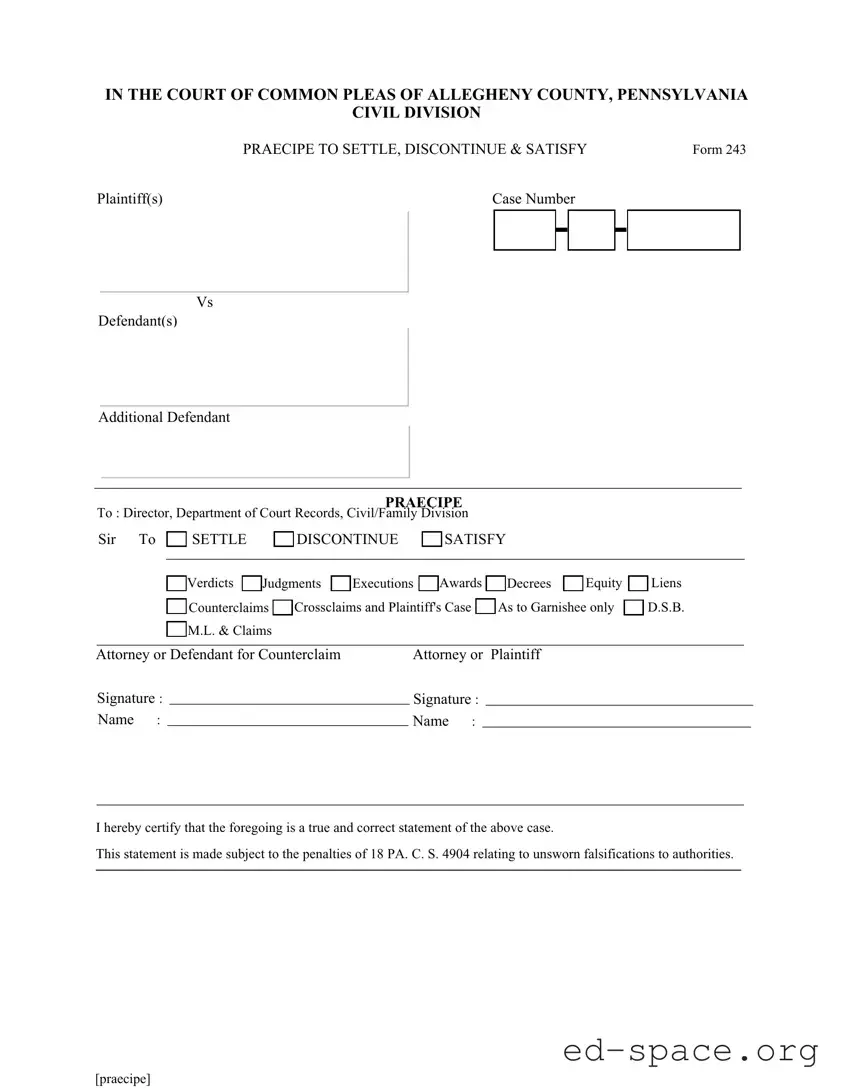
The Pennsylvania 243 form, officially known as the Praecipe to Settle, Discontinue, and Satisfy, serves a critical role in the legal landscape of Allegheny County's Court of Common Pleas. This form is primarily used by plaintiffs and defendants alike to formally request the court to settle a case, discontinue proceedings, or satisfy a judgment. When completing this document, parties must provide essential information, including the case number and the names of all involved parties. The form also allows for the resolution of various legal matters, such as verdicts, judgments, executions, and counterclaims, making it a versatile tool in civil litigation. Additionally, the signatures of both the attorney and the party involved are required, ensuring that all parties acknowledge the contents and implications of the request. Importantly, the form includes a certification clause, which emphasizes the necessity of truthful representation under penalty of law. Understanding the nuances of the Pennsylvania 243 form is vital for anyone navigating the complexities of civil cases in this jurisdiction.
Document Preview

IN THE COURT OF COMMON PLEAS OF ALLEGHENY COUNTY, PENNSYLVANIA
CIVIL DIVISION
PRAECIPE TO SETTLE, DISCONTINUE & SATISFY Form 243
Plaintiff(s) Case Number
Vs
Defendant(s)
To : Director, Department of Court Records, Civil/Family Division
Signature : _______________________________________
Name : _______________________________________
______________________________________________________________________________________________
______________________________________________________________________________________________
[praecipe]
Additional Defendant
PRAECIPE
Sir To SETTLE DISCONTINUE SATISFY
Verdicts
As to Garnishee onlyCrossclaims and Plaintiff's Case
Counterclaims
Liens
Equity
Decrees
Awards
Executions
Judgments
Signature : ___________________________________
Name : ___________________________________
I hereby certify that the foregoing is a true and correct statement of the above case.
This statement is made subject to the penalties of 18 PA. C. S. 4904 relating to unsworn falsifications to authorities.
M.L. & Claims
D.S.B.
______________________________________________________________________________________________
Attorney or Plaintiff
Attorney or Defendant for Counterclaim
____________________________________________________________________________________
- -

Form Specifications

Fact Name Description
Form Title Pennsylvania 243 Form is officially titled "Praecipe to Settle, Discontinue & Satisfy." It is used in civil cases.
Governing Law This form is governed by the Pennsylvania Rules of Civil Procedure, specifically Rule 236.
Purpose The form is utilized to formally request the court to settle, discontinue, or satisfy a case or judgment.
Jurisdiction This form is specifically applicable in the Court of Common Pleas of Allegheny County, Pennsylvania.
Parties Involved The form requires signatures from either the plaintiff or the defendant, including any additional defendants.
Signature Requirement A signature from the attorney or the party representing the counterclaim is mandatory for the form to be valid.
Certification Statement The form includes a certification statement, affirming the accuracy of the information provided, subject to penalties for false statements.
Filing Location The completed form must be submitted to the Director of the Department of Court Records, Civil/Family Division.
Additional Claims The form allows for the inclusion of various claims such as counterclaims, crossclaims, and liens.

Pennsylvania 243: Usage Guidelines

Completing the Pennsylvania 243 form requires attention to detail to ensure that all necessary information is accurately provided. After filling out the form, it will be submitted to the appropriate court department for processing. Below are the steps to guide you through the completion of the form.

  1. Begin by entering the name of the court at the top of the form: IN THE COURT OF COMMON PLEAS OF ALLEGHENY COUNTY, PENNSYLVANIA.
  2. Next, indicate the division by writing CIVIL DIVISION.
  3. Fill in the case number in the designated space labeled Case Number.
  4. Write the names of the plaintiff(s) in the section marked Plaintiff(s).
  5. List the defendant(s) in the area labeled Vs Defendant(s).
  6. If applicable, include the name of any additional defendant in the space provided.
  7. In the section titled PRAECIPE To :, write Director, Department of Court Records, Civil/Family Division.
  8. Choose the appropriate action by marking one or more of the following options: SETTLE, DISCONTINUE, or SATISFY.
  9. Specify the type of case or claims being addressed, such as Verdicts, Judgments, Executions, Awards, Counterclaims, Crossclaims, Decrees, Equity, As to Garnishee only, or Liens.
  10. Provide the name of the attorney or defendant for the counterclaim, if applicable.
  11. Sign the form in the section labeled Signature : and print your name beneath your signature.
  12. Have the opposing party or their attorney sign in the appropriate section, including their printed name.
  13. Finally, include a certification statement confirming the accuracy of the information provided, which is subject to legal penalties for false statements.

Your Questions, Answered

What is the Pennsylvania 243 form?

The Pennsylvania 243 form, also known as the Praecipe to Settle, Discontinue, and Satisfy, is a legal document used in the Court of Common Pleas of Allegheny County. It allows parties involved in a civil case to formally notify the court that they wish to settle or discontinue their case. The form can also be used to satisfy judgments, awards, or claims related to the case.

Who needs to file the Pennsylvania 243 form?

The form is typically filed by the plaintiff or the defendant in a civil case. If the parties have reached a settlement or wish to discontinue the case, either party can submit the form. It is essential for both parties to agree on the terms before filing to ensure a smooth process.

What information is required on the Pennsylvania 243 form?

The form requires several pieces of information, including the case number, names of the parties involved, and the specific actions being taken (settle, discontinue, or satisfy). Additionally, signatures from the attorney or the parties involved must be included to validate the submission.

What happens after the Pennsylvania 243 form is filed?

Once the form is filed with the Director of the Department of Court Records, the court will process the request. If approved, the case will be officially settled or discontinued, and any judgments or claims will be marked as satisfied. The court will then update its records accordingly.

Are there any penalties for filing the Pennsylvania 243 form incorrectly?

Yes, there are penalties for providing false information on the form. The individual signing the form certifies that the information is true and correct, and any misrepresentation can lead to legal consequences under Pennsylvania law, specifically under 18 PA. C. S. 4904, which addresses unsworn falsifications to authorities.

Common mistakes

  1. Incomplete Information: One common mistake is failing to fill out all required fields. Missing details such as the case number, names of parties involved, or specific claims can lead to delays in processing.

  2. Incorrect Signatures: Signatures must be provided by the appropriate parties. If the wrong person signs the form, it may be rejected. Always ensure that the plaintiff or their attorney signs where indicated.

  3. Not Certifying the Statement: The form requires a certification that the information is true and correct. Omitting this certification can result in legal penalties and may invalidate the form.

  4. Failure to Specify the Action: It is essential to clearly indicate whether you are settling, discontinuing, or satisfying the case. Ambiguity in this section can lead to confusion and complications in the case's resolution.

  5. Ignoring Local Rules: Each court may have specific rules regarding the submission of forms. Not adhering to these local rules, such as filing deadlines or formatting requirements, can cause the form to be rejected.

Documents used along the form

The Pennsylvania 243 form is a critical document used in the legal process to settle, discontinue, and satisfy various claims within the court system. Alongside this form, several other documents may be required to ensure a comprehensive resolution of the case. Below is a list of commonly associated forms that may be necessary.

  • Notice of Appeal: This document is filed to indicate that a party intends to appeal a court's decision. It must be submitted within a specific timeframe following the ruling.
  • Judgment Order: This form outlines the court's final decision regarding the case. It provides details about the judgment awarded, including any monetary amounts or specific actions required by the parties involved.
  • Settlement Agreement: A written agreement between the parties that outlines the terms of the settlement. This document is essential for ensuring that all parties understand their rights and obligations following the resolution of the case.
  • Motion to Dismiss: This request is made to the court to dismiss a case or a specific claim within a case. It often includes reasons for the dismissal and is typically filed by the defendant.
  • Affidavit of Service: This document serves as proof that legal documents have been delivered to the appropriate parties. It includes details such as the date of service and the method used to deliver the documents.

Each of these documents plays an important role in the legal process, ensuring that all necessary steps are taken for a fair resolution. It is essential to be aware of these forms and their purposes as you navigate through the legal system.

Similar forms

  • Praecipe for Entry of Judgment: Similar to the Pennsylvania 243 form, this document is used to formally request that a judgment be entered in a case. It serves to notify the court of the desired outcome and ensures that all parties are aware of the judgment being sought.
  • Notice of Settlement: This document informs the court and all parties involved that a settlement has been reached. Like the Pennsylvania 243 form, it aims to officially communicate the resolution of a case, ensuring that the court can update its records accordingly.
  • Motion to Dismiss: This document requests the court to dismiss a case. While the Pennsylvania 243 form is used to settle a case, the motion to dismiss serves a different purpose but also seeks to conclude legal proceedings, albeit without a settlement.
  • Stipulation of Dismissal: This document is an agreement between parties to dismiss a case. Similar to the Pennsylvania 243 form, it signifies that the parties have reached an understanding, allowing the court to finalize the dismissal of the case.

Dos and Don'ts

When filling out the Pennsylvania 243 form, it’s important to follow certain guidelines to ensure accuracy and compliance. Here are ten things to keep in mind:

  • Do read the instructions carefully before starting.
  • Don't leave any required fields blank.
  • Do provide accurate case numbers to avoid delays.
  • Don't use abbreviations unless specified in the instructions.
  • Do sign the form where indicated to validate your submission.
  • Don't forget to include your name and contact information.
  • Do double-check for spelling errors, especially in names.
  • Don't submit the form without reviewing it for completeness.
  • Do keep a copy of the completed form for your records.
  • Don't assume the form will be processed without confirmation.

By adhering to these guidelines, you can help ensure that your filing is processed smoothly and efficiently.

Misconceptions

Understanding the Pennsylvania 243 form is essential for anyone involved in legal proceedings in Allegheny County. However, several misconceptions often arise regarding this form. Here are seven common misunderstandings:

  1. The form is only for attorneys. Many believe that only licensed attorneys can file the Pennsylvania 243 form. In reality, individuals can also submit this form if they are representing themselves in court.
  2. It is used only for settling cases. Some think the Pennsylvania 243 form is exclusively for settling disputes. While it can be used to settle cases, it is also applicable for discontinuing and satisfying judgments, making it versatile in its use.
  3. Filing the form guarantees case closure. There is a misconception that submitting the form automatically closes a case. Although it is a step toward closure, the court must officially approve the request for it to be finalized.
  4. All cases require a Pennsylvania 243 form. Not every legal matter necessitates this form. It is specifically designed for civil cases in the Common Pleas Court of Allegheny County, so other types of cases may require different forms.
  5. There are no penalties for incorrect information. Some individuals believe that they can submit the form without concern for accuracy. However, providing false information can lead to penalties under Pennsylvania law, emphasizing the importance of truthfulness.
  6. Signature from both parties is mandatory. While having signatures from both parties is beneficial, it is not always a strict requirement. The form can still be filed with just one party's signature, depending on the circumstances.
  7. The form must be filed in person. Many think that the Pennsylvania 243 form can only be submitted in person at the courthouse. In fact, it may also be possible to file it electronically or by mail, depending on the court's policies.

By clearing up these misconceptions, individuals can navigate the legal process more confidently and effectively. Always ensure that you have the correct information before proceeding with any legal documentation.

Key takeaways

When dealing with the Pennsylvania 243 form, it's essential to keep a few key points in mind to ensure a smooth process. Here are some important takeaways:

  • Purpose of the Form: The Pennsylvania 243 form is used to officially settle, discontinue, or satisfy a case in the Court of Common Pleas of Allegheny County. Understanding its purpose helps streamline the process.
  • Accurate Information: Ensure that all names, case numbers, and details are filled out accurately. Mistakes can lead to delays or complications in your case.
  • Signatures Required: Both the attorney and the plaintiff (or defendant in the case of a counterclaim) must sign the form. This step is crucial for the form to be valid and accepted by the court.
  • Certification Statement: The form includes a certification statement that asserts the truthfulness of the information provided. Be aware that providing false information can lead to serious legal consequences.