Homepage Blank Pcm 209 Michigan PDF Form
Content Overview

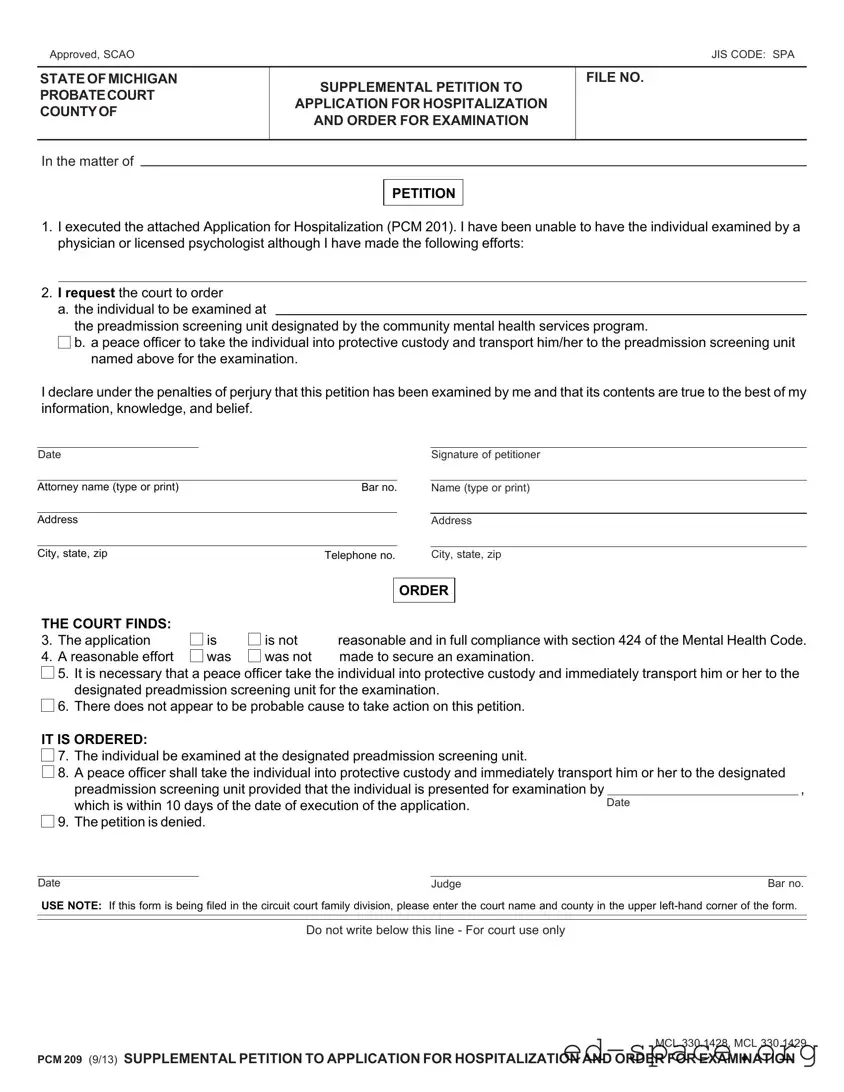
The PCM 209 form is a crucial document used in Michigan's legal system, specifically within the probate court, to facilitate the process of hospitalization for individuals who may require mental health evaluation. This form serves multiple purposes, including a supplemental petition to an application for hospitalization and an order for examination. When someone believes that an individual needs to be assessed by a physician or licensed psychologist but faces challenges in arranging such an examination, they can utilize this form to formally request the court's intervention. The form outlines the petitioner's efforts to secure an examination and requests the court to order a peace officer to take the individual into protective custody if necessary. Additionally, it includes sections for the court to determine the reasonableness of the application and the need for immediate action. The document is structured to ensure that all pertinent information is captured, allowing the court to make informed decisions regarding the individual’s mental health needs. By understanding the components and requirements of the PCM 209 form, petitioners can navigate the legal landscape more effectively, ensuring that individuals receive the care and attention they may require.

Document Preview

PETITION
1. I executed the attached Application for Hospitalization (PCM 201). I have been unable to have the individual examined by a
physician or licensed psychologist although I have made the following efforts:
2. I request the court to order
a. the individual to be examined at
the preadmission screening unit designated by the community mental health services program.
b. a peace officer to take the individual into protective custody and transport him/her to the preadmission screening unit
named above for the examination.
I declare under the penalties of perjury that this petition has been examined by me and that its contents are true to the best of my
information, knowledge, and belief.
ORDER
THE COURT FINDS:
3. The application is is not reasonable and in full compliance with section 424 of the Mental Health Code.
4. A reasonable effort was was not made to secure an examination.
5. It is necessary that a peace officer take the individual into protective custody and immediately transport him or her to the
designated preadmission screening unit for the examination.
6. There does not appear to be probable cause to take action on this petition.
IT IS ORDERED:
7. The individual be examined at the designated preadmission screening unit.
8. A peace officer shall take the individual into protective custody and immediately transport him or her to the designated
preadmission screening unit provided that the individual is presented for examination by ,
which is within 10 days of the date of execution of the application.
9. The petition is denied.
USE NOTE: If this form is being filed in the circuit court family division, please enter the court name and county in the upper left-hand corner of the form.
In the matter of
JIS CODE: SPAApproved, SCAO
FILE NO.
PCM 209 (9/13) SUPPLEMENTAL PETITION TO APPLICATION FOR HOSPITALIZATION AND ORDER FOR EXAMINATION
SUPPLEMENTAL PETITION TO
APPLICATION FOR HOSPITALIZATION
AND ORDER FOR EXAMINATION
MCL 330.1428, MCL 330.1429
Date Signature of petitioner
Name (type or print)
Address
City, state, zip
Do not write below this line - For court use only
Date
Judge
Bar no.
Attorney name (type or print)
Address
City, state, zip
Telephone no.
Bar no.
Date
STATE OF MICHIGAN
PROBATE COURT
COUNTY OF

Form Specifications

Fact Name Description
Form Title This form is officially titled "Supplemental Petition to Application for Hospitalization and Order for Examination." It is used in Michigan's probate courts.
Governing Laws The form is governed by Michigan's Mental Health Code, specifically MCL 330.1428 and MCL 330.1429.
Purpose The purpose of this form is to request a court order for the examination of an individual who may require hospitalization due to mental health issues.
Petitioner's Declaration The petitioner must declare under penalty of perjury that the information contained in the petition is accurate to the best of their knowledge.
Examination Request The form allows the petitioner to request that the individual be examined at a designated preadmission screening unit, emphasizing the need for timely intervention.
Protective Custody The form includes provisions for a peace officer to take the individual into protective custody if necessary, ensuring their immediate transport for examination.

Pcm 209 Michigan: Usage Guidelines

Filling out the PCM 209 form is an essential step in the process of requesting a court-ordered examination for an individual. This form requires specific information and declarations to ensure that the request is clear and complete. Follow these steps carefully to fill out the form correctly.

  1. Begin by entering the county where you are filing the form in the upper left-hand corner.
  2. Fill in the file number associated with your case, if applicable.
  3. In the section labeled In the matter of, write the name of the individual for whom you are filing the petition.
  4. For item 1, confirm that you have executed the attached Application for Hospitalization (PCM 201). If you have made efforts to have the individual examined, list those efforts in the provided space.
  5. In item 2, select either option a or b to indicate your request to the court. Option a requests an examination at a preadmission screening unit, while option b requests a peace officer to take the individual into protective custody.
  6. Sign and date the petition, ensuring that your name is printed clearly. Include your address, city, state, zip code, and telephone number.
  7. If you are an attorney, provide your name, bar number, and address as well.
  8. In the ORDER section, the court will fill in findings regarding the application and whether the petition is granted or denied. You do not need to fill this part out.
  9. Ensure that the form is completed without writing below the designated line for court use only.

Your Questions, Answered

What is the purpose of the PCM 209 form?

The PCM 209 form is used to petition the court for the hospitalization of an individual who may require mental health examination and treatment. It serves as a supplemental petition to the initial application for hospitalization, allowing the petitioner to request that the court order a mental health examination if previous efforts to secure one have been unsuccessful.

Who can file the PCM 209 form?

Any individual who believes that someone requires a mental health examination can file the PCM 209 form. This is often a family member, friend, or guardian who has made reasonable efforts to have the individual examined by a physician or licensed psychologist but has been unable to do so.

What information is required on the PCM 209 form?

The form requires details such as the name of the individual being petitioned for, the efforts made to secure an examination, and the specific request for the court to order a peace officer to take the individual into protective custody if necessary. Additionally, the petitioner must provide their own contact information and sign the form to affirm the truthfulness of the information provided.

What happens after the PCM 209 form is submitted?

Once the PCM 209 form is filed, the court will review the petition. The court may either grant the request, allowing for the individual to be examined at a designated preadmission screening unit, or deny the petition if it does not meet the necessary criteria. If granted, a peace officer may be ordered to take the individual into protective custody for the examination.

What are the potential outcomes of a petition filed using the PCM 209 form?

The court can either approve the petition, leading to an examination of the individual, or deny it. If the petition is denied, the court will provide reasons for the denial. If approved, the individual will be examined within a specified timeframe, typically within 10 days of the petition being executed.

Is there a deadline for filing the PCM 209 form?

While there is no specific deadline for filing the PCM 209 form itself, it is crucial to act promptly. The form should be filed as soon as the petitioner realizes that the individual requires examination and treatment. If the court grants the petition, the examination must occur within 10 days of the application date.

Can the PCM 209 form be used in any county in Michigan?

Yes, the PCM 209 form is applicable throughout Michigan. However, if you are filing in the circuit court family division, it is important to enter the specific court name and county in the designated area on the form to ensure proper processing.

What should I do if my petition is denied?

If your petition is denied, you may want to consider seeking legal advice to understand the reasons for the denial and explore any possible options for re-filing or appealing the decision. It's essential to address any concerns raised by the court to improve the chances of a successful petition in the future.

Common mistakes

  1. Not providing complete information in the Application for Hospitalization. Make sure to fill out all required sections fully.

  2. Failing to specify the efforts made to secure an examination. Clearly list all attempts to have the individual evaluated by a physician or psychologist.

  3. Omitting the name of the designated preadmission screening unit. This detail is crucial for the court's understanding.

  4. Incorrectly filling out the petitioner’s information. Double-check the name, address, and contact details for accuracy.

  5. Not signing the petition. Ensure that the signature is present where required.

  6. Missing the date of execution. This date is important for tracking the timeline of the petition.

  7. Ignoring the court’s requirements for filing. If this form is for the circuit court family division, remember to include the court name and county at the top.

Documents used along the form

The PCM 209 form is a crucial document in the process of seeking hospitalization for individuals with mental health concerns in Michigan. Alongside this form, several other documents are often required to ensure a comprehensive approach to the situation. Here is a list of related forms and documents that may be used in conjunction with the PCM 209:

  • Application for Hospitalization (PCM 201): This form initiates the process for requesting an examination and potential hospitalization. It outlines the reasons for seeking help and the efforts made to secure an evaluation.
  • Order for Examination (PCM 202): This document is issued by the court to authorize a mental health evaluation. It specifies the details of the examination and the individual to be evaluated.
  • Peace Officer's Report (PCM 203): This report provides details from the peace officer who takes the individual into custody. It includes observations and the circumstances surrounding the transport to the examination facility.
  • Consent for Treatment (PCM 204): This form is necessary when the individual agrees to undergo treatment after the examination. It outlines the rights of the individual and the nature of the treatment being proposed.
  • Notice of Hearing (PCM 205): This document informs all parties involved about the scheduled court hearing related to the hospitalization petition. It ensures that everyone has the opportunity to present their case.
  • Physician's Evaluation Report (PCM 206): After the examination, this report is completed by the examining physician or psychologist. It provides insights into the individual's mental health status and recommendations for treatment.
  • Order of Commitment (PCM 207): If the court decides that hospitalization is necessary, this order formalizes the commitment. It outlines the terms and conditions of the individual's stay in the facility.

Each of these documents plays a vital role in the process of addressing mental health needs. It is essential to ensure that all forms are filled out accurately and submitted in a timely manner to facilitate the best possible outcome for the individual involved.

Similar forms

The PCM 209 Michigan form is related to several other legal documents that serve similar purposes in the context of mental health and hospitalization. Here are nine documents that share similarities with the PCM 209:

  • PCM 201 - Application for Hospitalization: This document initiates the process for hospitalization by requesting an examination of the individual. Like the PCM 209, it requires details about the efforts made to secure an examination.
  • PCM 202 - Petition for Hospitalization: This form is used to formally petition the court for hospitalization, emphasizing the necessity of treatment. It mirrors the PCM 209 in its intent to protect individuals who may not seek help voluntarily.
  • PCM 203 - Order for Examination: This document is issued by the court to mandate an examination of the individual. Similar to the PCM 209, it reflects the court's authority to ensure that necessary evaluations occur.
  • PCM 204 - Petition for Involuntary Treatment: This petition seeks court approval for involuntary treatment. It parallels the PCM 209 in addressing situations where individuals cannot make decisions regarding their mental health.
  • PCM 205 - Notice of Hearing: This document provides notice to involved parties about a hearing related to hospitalization. It shares the procedural elements of the PCM 209 in ensuring that all parties are informed.
  • PCM 206 - Consent for Treatment: This form is used to obtain consent for treatment from individuals who are capable of giving it. While the PCM 209 focuses on those unable to consent, both address the need for appropriate care.
  • PCM 207 - Report of Examination: This report documents the findings of the examination conducted as a result of the petition. It is similar to the PCM 209 in its role in the decision-making process regarding hospitalization.
  • PCM 208 - Petition for Reexamination: This document requests a reexamination of an individual already under care. It connects to the PCM 209 by allowing for ongoing assessment of an individual's mental health needs.
  • PCM 210 - Discharge Petition: This form is used to petition for the discharge of an individual from a facility. It relates to the PCM 209 in the context of ensuring the rights and needs of individuals are addressed throughout their treatment journey.

Dos and Don'ts

When filling out the PCM 209 Michigan form, it’s essential to follow certain guidelines to ensure your submission is accurate and complete. Here are some important dos and don’ts:

  • Do read the entire form carefully before you start filling it out.
  • Do provide accurate and truthful information to the best of your knowledge.
  • Do include all required signatures, especially from the petitioner.
  • Do ensure that you have the correct court name and county in the upper left-hand corner if applicable.
  • Don't leave any sections blank unless instructed to do so.
  • Don't use abbreviations or shorthand that may confuse the reader.
  • Don't forget to check the date on your application to ensure it is current.

By following these guidelines, you can help ensure that your petition is processed smoothly and efficiently.

Misconceptions

Understanding the PCM 209 Michigan form is crucial for anyone involved in mental health proceedings. However, several misconceptions often arise. Here are ten common misunderstandings about this form:

  • The PCM 209 is the only form needed for hospitalization. Many believe this is the sole document required. In reality, it is often accompanied by the Application for Hospitalization (PCM 201).
  • Only family members can file the PCM 209. While family members frequently initiate the process, any concerned individual can file the petition if they believe someone needs evaluation.
  • The court automatically approves all petitions. This is not the case. The court reviews each petition carefully and may deny it if there is insufficient evidence or probable cause.
  • The form guarantees immediate hospitalization. Completion of the PCM 209 does not ensure that the individual will be hospitalized. The court must first find it necessary.
  • All petitions are treated the same. Each petition is unique, and the court considers various factors, including the specific circumstances surrounding each case.
  • Legal representation is mandatory to file the PCM 209. While having an attorney can be beneficial, individuals can file the form without legal representation.
  • The individual must consent to the examination. In cases where a peace officer is involved, consent may not be necessary if the court orders protective custody for examination.
  • The form is only for adults. The PCM 209 can be used for minors as well, provided the proper legal guardianship or parental consent is in place.
  • Filing the PCM 209 is a lengthy process. While there are timelines involved, the actual filing can be completed relatively quickly, depending on the circumstances.
  • The form is only relevant for mental health issues. Although primarily used for mental health evaluations, it can also relate to individuals facing substance abuse issues.

Addressing these misconceptions helps clarify the purpose and process of the PCM 209 form, ensuring that individuals seeking help understand their rights and responsibilities.

Key takeaways

The PCM 209 Michigan form is a crucial document for initiating the process of hospitalization for individuals requiring mental health evaluation. Below are key takeaways regarding its completion and use:

  • Application Requirement: The form must be accompanied by the Application for Hospitalization (PCM 201), which outlines efforts made to secure a physician or psychologist's examination.
  • Court Order Request: The petitioner can request the court to order an examination at a designated preadmission screening unit or for a peace officer to take the individual into protective custody.
  • Verification of Information: The petitioner must declare under penalty of perjury that the information provided in the petition is accurate to the best of their knowledge.
  • Timeliness: The examination must occur within 10 days of the application execution date to ensure compliance with legal requirements.