Homepage Blank Pc 591 Michigan PDF Form
Content Overview

The PC 591 form is an essential document used in Michigan's probate court system, specifically designed for personal representatives seeking to close an unsupervised estate administration. This form allows the personal representative to formally declare that they have completed the necessary steps to administer the estate, ensuring that all claims, taxes, and expenses have been addressed. To proceed with this process, the personal representative must affirm that more than five months have elapsed since their appointment and that any required notices to creditors have been published, allowing sufficient time for claims to be presented. It is crucial that the representative certifies the full administration of the estate, including the payment of all debts and the distribution of assets to the rightful heirs. Additionally, the form requires the personal representative to provide evidence of any taxes paid, ensuring compliance with state regulations. After filing the sworn statement, interested parties have the opportunity to object within a specified timeframe, promoting transparency and accountability in the estate closure process. Ultimately, this form serves as a vital tool for personal representatives to fulfill their duties while protecting the interests of all parties involved.

Document Preview

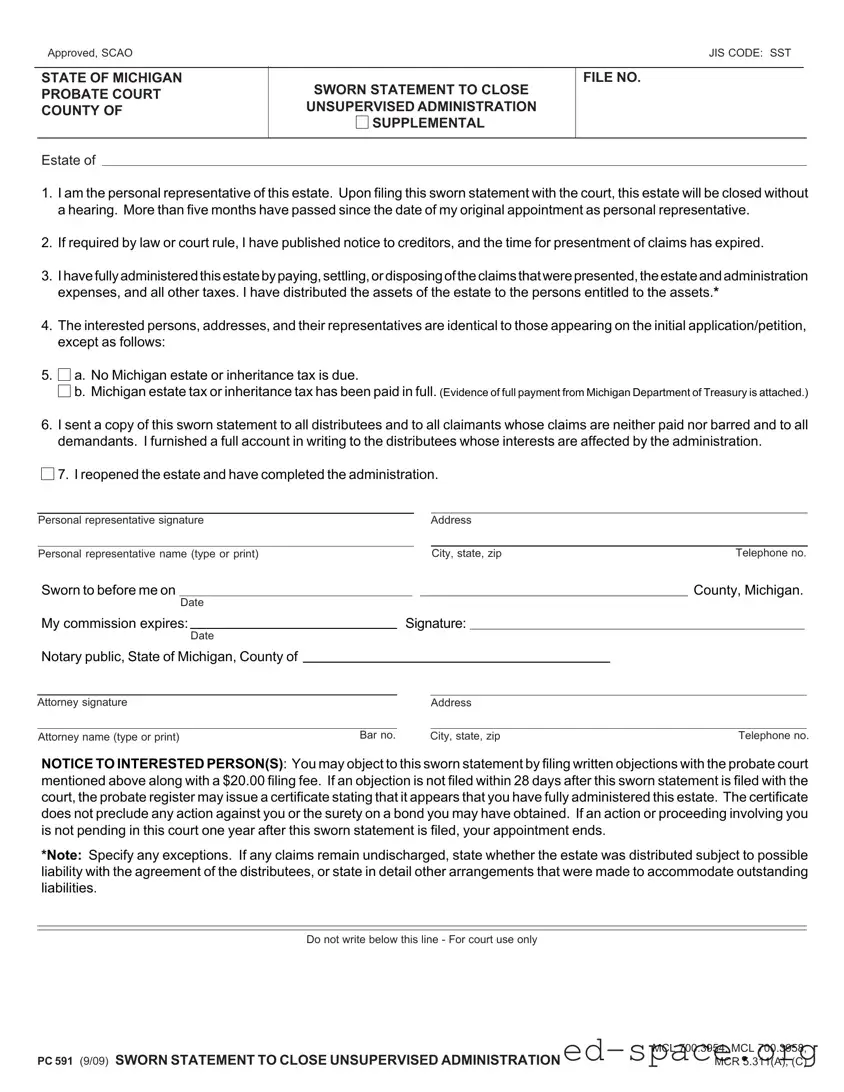
1. I am the personal representative of this estate. Upon filing this sworn statement with the court, this estate will be closed without
a hearing. More than five months have passed since the date of my original appointment as personal representative.
2. If required by law or court rule, I have published notice to creditors, and the time for presentment of claims has expired.
3. I have fully administered this estate by paying, settling, or disposing of the claims that were presented, the estate and administration
expenses, and all other taxes. I have distributed the assets of the estate to the persons entitled to the assets.*
4. The interested persons, addresses, and their representatives are identical to those appearing on the initial application/petition,
except as follows:
5. a. No Michigan estate or inheritance tax is due.
b. Michigan estate tax or inheritance tax has been paid in full. (Evidence of full payment from Michigan Department of Treasury is attached.)
6. I sent a copy of this sworn statement to all distributees and to all claimants whose claims are neither paid nor barred and to all
demandants. I furnished a full account in writing to the distributees whose interests are affected by the administration.
7. I reopened the estate and have completed the administration.
Sworn to before me on County, Michigan.
My commission expires: Signature:
Notary public, State of Michigan, County of
NOTICE TO INTERESTED PERSON(S): You may object to this sworn statement by filing written objections with the probate court
mentioned above along with a $20.00 filing fee. If an objection is not filed within 28 days after this sworn statement is filed with the
court, the probate register may issue a certificate stating that it appears that you have fully administered this estate. The certificate
does not preclude any action against you or the surety on a bond you may have obtained. If an action or proceeding involving you
is not pending in this court one year after this sworn statement is filed, your appointment ends.
*Note: Specify any exceptions. If any claims remain undischarged, state whether the estate was distributed subject to possible
liability with the agreement of the distributees, or state in detail other arrangements that were made to accommodate outstanding
liabilities.
STATE OF MICHIGAN
PROBATE COURT
COUNTY OF
Estate of
Approved, SCAO JIS CODE: SST
FILE NO.
PC 591 (9/09) SWORN STATEMENT TO CLOSE UNSUPERVISED ADMINISTRATION
Do not write below this line - For court use only
SWORN STATEMENT TO CLOSE
UNSUPERVISED ADMINISTRATION
SUPPLEMENTAL
MCL 700.3954, MCL 700.3958,
MCR 5.311(A), (C)
Attorney signature
Attorney name (type or print)
Bar no.
City, state, zip
Address
Telephone no.
City, state, zip
Address
Personal representative name (type or print)
Telephone no.
Personal representative signature
Date
Date

Form Specifications

Fact Name Details
Purpose of Form The PC 591 form is used to close an estate under unsupervised administration in Michigan without a hearing, provided certain conditions are met.
Requirements for Filing More than five months must have passed since the personal representative's appointment, and notice to creditors must have been published if required by law.
Legal References The form is governed by Michigan Compiled Laws (MCL) 700.3954 and 700.3958, as well as Michigan Court Rules (MCR) 5.311(A), (C).
Objection Process Interested persons can object to the sworn statement by filing written objections within 28 days of its submission, along with a $20 filing fee.

Pc 591 Michigan: Usage Guidelines

Filling out the PC 591 Michigan form is a straightforward process. It involves providing necessary information regarding the estate you are managing. After completing the form, you will submit it to the probate court. This will allow for the closure of the estate without a hearing, assuming all requirements are met.

  1. Begin by entering the name of the estate at the top of the form.
  2. Confirm that you are the personal representative of the estate. Write your name and title in the appropriate section.
  3. Indicate that more than five months have passed since your original appointment as personal representative.
  4. State whether you have published notice to creditors, if required, and confirm that the time for presenting claims has expired.
  5. Provide details on how you have administered the estate. This includes paying, settling, or disposing of claims, expenses, and taxes.
  6. List the individuals entitled to the assets of the estate. Ensure this information matches what was provided in the initial application or petition, noting any exceptions.
  7. Confirm that no Michigan estate or inheritance tax is due, or that such taxes have been paid in full. Attach evidence of payment from the Michigan Department of Treasury, if applicable.
  8. Indicate that you have sent a copy of the sworn statement to all distributees and claimants whose claims are neither paid nor barred.
  9. Provide a full written account to the distributees whose interests are affected by the administration.
  10. Sign the form as the personal representative, including your address, city, state, zip code, and telephone number.
  11. Have the form notarized. The notary public will sign and date the form, and provide their commission expiration date.
  12. If applicable, have your attorney sign the form, and include their address, city, state, zip code, telephone number, and bar number.

Once you have completed the form, make sure to review it for accuracy before submitting it to the probate court. This will help ensure a smooth process in closing the estate.

Your Questions, Answered

What is the purpose of the PC 591 Michigan form?

The PC 591 form, also known as the Sworn Statement to Close Unsupervised Administration, is used to officially close an estate without the need for a court hearing. This form is typically filed by the personal representative of the estate after they have completed all necessary administrative tasks, such as settling claims and distributing assets to beneficiaries.

Who can file the PC 591 form?

Only the personal representative of the estate can file the PC 591 form. This individual is appointed by the probate court to manage the estate's affairs. They must have completed their responsibilities, including paying debts and distributing assets, before submitting this form to the court.

What conditions must be met before filing the PC 591?

Before filing the PC 591, the personal representative must ensure that more than five months have passed since their appointment. Additionally, they must have published notice to creditors if required, and the time for presenting claims must have expired. All claims should be settled, and the estate's assets must be fully distributed to the entitled individuals.

What happens after the PC 591 form is filed?

Once the PC 591 form is filed, the probate court will review it. If no objections are raised within 28 days, the probate register may issue a certificate indicating that the estate has been fully administered. This certificate does not prevent future legal actions against the personal representative or any surety on a bond they may have obtained.

What if there are outstanding claims against the estate?

If there are any outstanding claims that remain undischarged, the personal representative must specify this in the form. They should indicate whether the estate was distributed with the understanding of potential liabilities or if other arrangements were made to address these claims. Transparency is crucial to protect both the personal representative and the beneficiaries.

Is there a fee associated with filing the PC 591?

There is no direct fee for filing the PC 591 form itself. However, if any interested person wishes to object to the sworn statement, they must file written objections with the probate court, which requires a $20.00 filing fee. It is important for all parties involved to be aware of this potential cost.

Common mistakes

  1. Missing Signature: One of the most common mistakes is forgetting to sign the form. Without your signature, the document is incomplete and cannot be processed.

  2. Incorrect Personal Information: Ensure that your name, address, and contact details are accurate. Errors in this section can lead to delays in processing.

  3. Failure to Notify Interested Parties: It is crucial to send a copy of the sworn statement to all interested parties. Failing to do so can result in objections and complications.

  4. Not Providing Evidence of Tax Payment: If applicable, attach proof of payment for any estate or inheritance taxes. Missing this documentation can stall the process.

  5. Neglecting to List Exceptions: If there are any exceptions or claims that remain undischarged, these must be specified. Omitting this information can lead to legal issues later.

  6. Ignoring the Filing Deadline: Remember that interested persons have 28 days to file objections. If you miss this window, the estate may be closed without your input.

  7. Inaccurate Claim Presentment Dates: Make sure to check that the time for presentment of claims has indeed expired. Incorrect dates can invalidate your statement.

  8. Not Keeping Copies: Always keep a copy of the completed form for your records. This is important for your own reference and for any future inquiries.

  9. Overlooking Notary Requirements: Don’t forget that the document must be notarized. A missing notary signature can render the form invalid.

Documents used along the form

When dealing with the closing of an estate in Michigan, several forms and documents may accompany the PC 591 form, which is the sworn statement to close unsupervised administration. Each of these documents serves a specific purpose in the probate process, ensuring that all legal requirements are met. Understanding these forms can help streamline the estate closure process and clarify responsibilities.

  • PC 580 - Petition for Probate: This form initiates the probate process. It outlines the deceased's assets and beneficiaries, allowing the court to appoint a personal representative to manage the estate.
  • PC 585 - Acceptance of Appointment: After being appointed, the personal representative must complete this form to officially accept their role. It confirms their willingness to administer the estate according to Michigan law.
  • PC 591 - Sworn Statement to Close Unsupervised Administration: This is the primary form used to close the estate without a hearing, provided that all claims and taxes have been settled and the estate has been fully administered.
  • PC 592 - Certificate of Completion: This document certifies that the personal representative has completed all necessary steps in the administration of the estate. It is often filed with the court to finalize the estate closure.
  • Form 1040 - U.S. Individual Income Tax Return: If the estate generated income during administration, a tax return may need to be filed. This ensures that any income tax obligations are satisfied before the estate is closed.
  • Form 706 - United States Estate (and Generation-Skipping Transfer) Tax Return: If the estate exceeds a certain value, this form may be required to report and pay any federal estate taxes owed.

Each of these documents plays a critical role in ensuring that the estate is handled properly and in compliance with the law. Being aware of these forms can help personal representatives navigate the probate process more effectively and avoid potential legal issues down the line.

Similar forms

  • PC 594 - Petition for Appointment of Personal Representative: This document initiates the probate process by requesting the court to appoint a personal representative for the estate. Like the PC 591, it involves the administration of an estate, but it is focused on starting the process rather than closing it.
  • PC 558 - Inventory of the Estate: The inventory form provides a detailed list of the estate's assets. Similar to the PC 591, it is an essential part of estate administration, ensuring that all assets are accounted for before closing the estate.
  • PC 586 - Final Account: This document outlines the financial activities of the estate, including income, expenses, and distributions. Both the PC 591 and PC 586 are related to the final stages of estate administration, focusing on settling all matters before closing.
  • PC 580 - Notice of Hearing: This form notifies interested parties about upcoming hearings related to the estate. While the PC 591 allows for closing without a hearing, the PC 580 ensures that all parties are informed about proceedings, highlighting the importance of communication in the probate process.
  • PC 587 - Petition for Determination of Heirs: This document is used to identify the rightful heirs of the estate. Similar to the PC 591, it plays a crucial role in the administration process, ensuring that assets are distributed to the correct individuals before the estate can be officially closed.

Dos and Don'ts

When filling out the PC 591 Michigan form, it’s essential to get it right. Here’s a list of things you should and shouldn’t do:

  • Do ensure you are the personal representative of the estate before signing the form.
  • Do confirm that more than five months have passed since your appointment as personal representative.
  • Do publish notice to creditors if required by law or court rule.
  • Do include evidence of any taxes paid in full, especially if there are no outstanding Michigan estate or inheritance taxes.
  • Don’t forget to send a copy of the sworn statement to all distributees and claimants whose claims are not paid or barred.
  • Don’t leave out any details about the distribution of the estate assets; be thorough in your accounting.
  • Don’t ignore the filing fee for objections; ensure you understand the $20.00 fee requirement.
  • Don’t submit the form without reviewing it for accuracy; mistakes can lead to delays or issues.

Misconceptions

Misconceptions about the PC 591 Michigan form can lead to confusion for personal representatives and interested parties. Here are nine common misunderstandings:

  • It requires a hearing to close the estate. Many believe that a hearing is mandatory. In fact, filing the PC 591 allows for closing without a hearing if certain conditions are met.
  • All claims must be settled before filing. Some think that all claims must be resolved prior to filing. However, the form allows for the estate to be closed even if some claims remain, as long as they are disclosed.
  • The form is only for supervised administrations. There is a misconception that this form applies only to supervised estates. It is specifically designed for unsupervised administrations.
  • There is no need to notify interested parties. Some assume that notifying interested parties is unnecessary. In reality, the personal representative must send a copy of the sworn statement to all relevant parties.
  • Filing is free of charge. Many people think that filing the PC 591 incurs no costs. A filing fee of $20.00 is required when submitting objections.
  • It can be filed at any time. Some believe there are no time constraints. In fact, the form can only be filed after more than five months have passed since the personal representative's appointment.
  • No taxes are owed if the form is filed. It is a common belief that filing the form absolves the estate of tax obligations. The form requires confirmation that all taxes have been paid.
  • Objections have no consequences. Some think that objections filed against the sworn statement are inconsequential. However, if objections are filed, they can delay the closing of the estate.
  • Once filed, the estate is permanently closed. There is a misconception that filing the PC 591 permanently closes the estate. The appointment can end, but actions against the personal representative may still occur.

Key takeaways

Here are some key takeaways about filling out and using the PC 591 Michigan form:

  • Personal Representative Role: Only the personal representative of the estate can file this sworn statement. Ensure you are in this role before proceeding.
  • Time Requirement: More than five months must have passed since your appointment as personal representative. This is crucial for the closure process.
  • Notice to Creditors: If required, you must publish notice to creditors. Make sure the time for presenting claims has expired before filing.
  • Full Administration: You need to have fully administered the estate. This includes settling claims and distributing assets to the rightful heirs.
  • Objection Process: Interested persons can object to your sworn statement within 28 days. Be aware of this timeline to avoid complications.

Using this form correctly can help streamline the process of closing an estate. Take your time to ensure all information is accurate and complete.