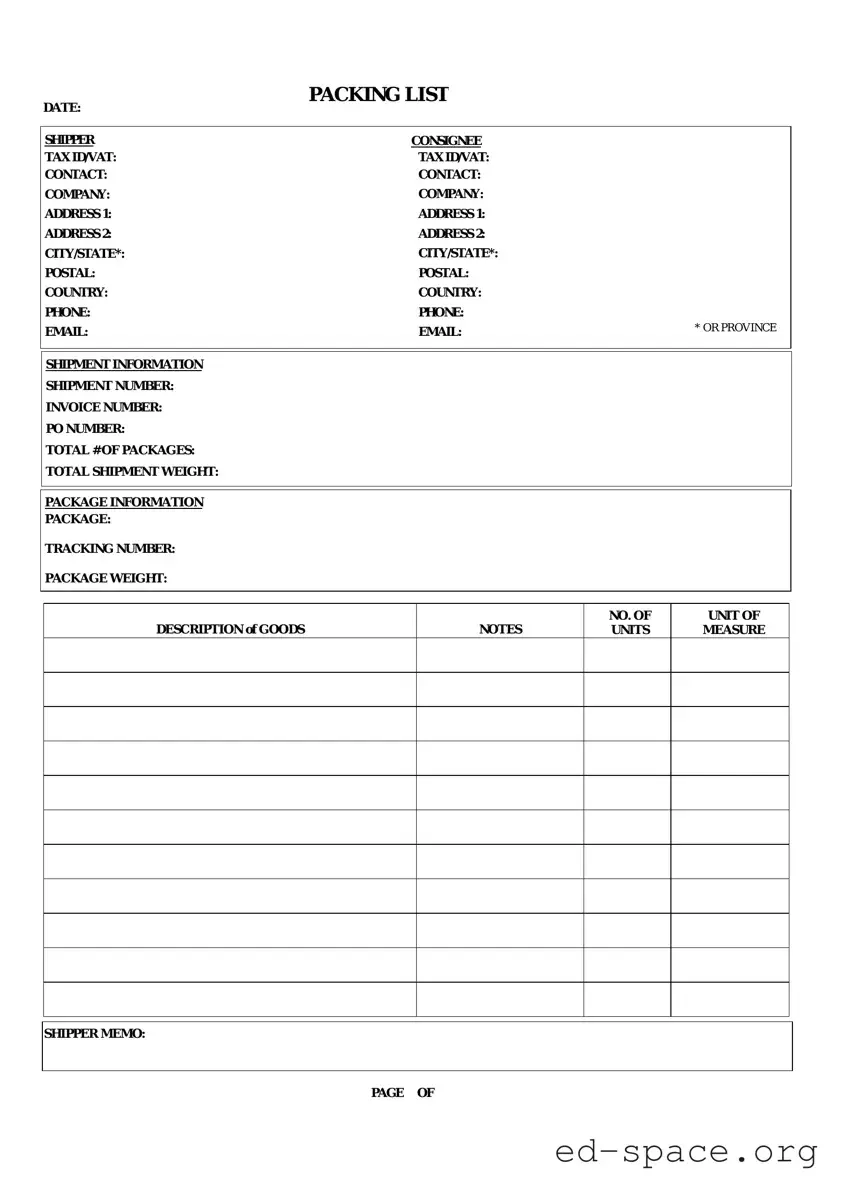
The Packing List form plays a crucial role in the logistics and shipping industries, serving as a vital document for both senders and recipients. This form provides a detailed inventory of items being shipped, ensuring that all parties involved are aware of the contents of the shipment. It typically includes essential information such as item descriptions, quantities, and weights, which helps in verifying the accuracy of the shipment upon arrival. Additionally, the Packing List may contain shipping instructions and details about the sender and recipient, facilitating smooth communication and coordination. By using this form, businesses can minimize disputes over missing or incorrect items and streamline the customs clearance process. Overall, the Packing List form is not just a simple checklist; it is an integral part of effective supply chain management that enhances transparency and efficiency in shipping operations.
| Fact Name | Description |
|---|---|
| Purpose | The Packing List form is used to itemize goods being shipped, ensuring all items are accounted for during transit. |
| Importance | This document helps prevent disputes over missing or damaged items by providing a clear record of what was sent. |
| State-Specific Forms | Some states may require specific formats or additional information on the Packing List, depending on local regulations. |
| Governing Laws | Shipping laws vary by state; for instance, California's Uniform Commercial Code governs shipping transactions. |
| Retention | It is advisable to keep a copy of the Packing List for your records, as it may be needed for future reference or audits. |
Once you have the Packing List form in front of you, it's time to proceed with filling it out accurately. This form plays a crucial role in ensuring that all items are accounted for during the packing process. By following the steps outlined below, you can ensure that your form is completed correctly and efficiently.
What is the purpose of the Packing List form?
The Packing List form serves as a detailed inventory of items being shipped or transported. It helps ensure that all necessary items are accounted for before departure and assists in the smooth processing of goods upon arrival. This form is especially useful for customs purposes and can help avoid delays or misunderstandings during transit.
Who needs to complete the Packing List form?
Typically, the sender or shipper of the items is responsible for completing the Packing List form. This could be an individual, a business, or a logistics provider. It is important that whoever fills out the form has a clear understanding of the contents being shipped to provide accurate and complete information.
What information is required on the Packing List form?
The Packing List form usually requires details such as the description of each item, quantity, weight, and dimensions. Additionally, it may ask for the sender’s and recipient’s contact information. Providing precise information helps ensure that the shipment is handled correctly and reaches its destination without complications.
How can I ensure that my Packing List form is accurate?
To ensure accuracy, double-check the items you are including in the shipment. Count each item and verify that the descriptions match the actual goods. It may also be helpful to have a second person review the form before finalizing it. Keeping a copy of the Packing List for your records can also be beneficial for tracking purposes.
What should I do if I realize there is an error on my Packing List form after submission?
If you notice an error after submitting the Packing List form, it is important to act quickly. Contact the shipping company or logistics provider immediately to inform them of the mistake. They may be able to correct the information on their end. Depending on the nature of the error, it might also be necessary to submit a revised Packing List to avoid issues during transit.
Failing to include all necessary items. It is important to list everything you plan to bring. Leaving out essential items can lead to inconvenience.
Not checking the form for accuracy. Mistakes in spelling or item descriptions can create confusion later on.
Using vague descriptions. Instead of writing "clothes," specify the type, such as "shirts" or "pants." This helps in packing and unpacking.
Overpacking or underpacking. Take time to assess what you truly need. Both can lead to unnecessary stress.
Ignoring weight limits. Some forms may require adherence to specific weight restrictions. Check these limits to avoid extra fees.
Not updating the list. If plans change, update your packing list accordingly. This ensures you have the most current information.
Forgetting to categorize items. Group similar items together, such as toiletries or electronics. This makes it easier to locate them when needed.
Neglecting to double-check items after packing. Once packed, review the list again to confirm everything is included.
Failing to consider the destination's climate. Adjust your packing list based on the weather conditions of your travel location.
Not allowing for personal preferences. Everyone has unique needs. Include items that cater to your specific comfort or convenience.
When preparing for shipping or transporting goods, the Packing List form is an essential document that provides a detailed inventory of the items being shipped. However, it is often accompanied by several other forms and documents that serve various purposes in the logistics and transportation process. Here are some commonly used documents that complement the Packing List:
Understanding these documents and their functions is crucial for anyone involved in shipping and logistics. Each plays a specific role in ensuring that goods are transported efficiently and legally, providing protection and clarity for all parties involved.
The Packing List form is an important document used in shipping and logistics. It shares similarities with several other documents. Here’s a list of eight documents that are similar to the Packing List form:
When filling out the Packing List form, it’s important to be thorough and accurate. Here are some helpful tips on what to do and what to avoid:
Following these guidelines can help make the process smoother and more efficient. Being organized and clear in your packing list will benefit everyone involved.
Misconceptions about the Packing List form can lead to confusion and inefficiencies. Below is a list of common misunderstandings regarding this important document.
The Packing List form is only necessary for international shipments. This is not true. The Packing List is essential for both domestic and international shipments, as it provides a detailed account of the items being transported.
It is the same as an invoice. While both documents may contain similar information, the Packing List serves a different purpose. It lists the contents of a shipment without detailing prices or payment information, which is typically found on an invoice.
All items must be listed on the Packing List. Although it is advisable to include all items, there may be exceptions for certain shipments. However, omitting items can lead to complications during transit.
The Packing List is not required for small shipments. Regardless of the shipment size, a Packing List is beneficial. It helps ensure that all items are accounted for and can facilitate the customs process if necessary.
Only the sender needs a copy of the Packing List. In fact, multiple parties may require a copy, including the recipient and customs officials, depending on the shipment's destination.
The Packing List can be handwritten. While a handwritten list may be acceptable in some informal situations, it is generally recommended to use a printed or typed format for clarity and professionalism.
Once created, the Packing List does not need to be updated. This is a misconception. If there are changes to the shipment, such as additional items or substitutions, the Packing List should be revised accordingly.
It is only relevant for commercial shipments. Personal shipments also benefit from a Packing List, as it helps to clarify the contents and can assist in avoiding delays.
The Packing List is only for the sender’s records. The Packing List serves multiple purposes and is crucial for both the sender and the recipient, as well as for any third parties involved in the shipping process.
When it comes to filling out and using a Packing List form, several important points can enhance your experience. Here are some key takeaways:
By following these takeaways, you can streamline your packing process and ensure a smoother experience, whether you’re moving, traveling, or shipping items.