Homepage Fillable PA School Letter of Recommendation Template
Content Overview

The PA School Letter of Recommendation form plays a crucial role in the application process for aspiring physician assistants. This form serves as a vital tool for candidates to present their qualifications through the eyes of those who have observed their skills and character. Typically, it requires detailed information about the recommender, including their relationship to the applicant, their professional background, and the context in which they have interacted with the candidate. Furthermore, the form often prompts recommenders to evaluate specific attributes such as clinical experience, communication skills, and overall readiness for the rigors of a PA program. By providing a structured way for recommenders to share their insights, this form helps admissions committees gain a deeper understanding of each applicant's potential. It is essential for candidates to choose recommenders who can provide thoughtful and comprehensive assessments, as these letters can significantly influence the decision-making process. In essence, the PA School Letter of Recommendation form not only facilitates a meaningful connection between the applicant and the recommender but also serves as a bridge to the future of healthcare professionals.

Document Preview

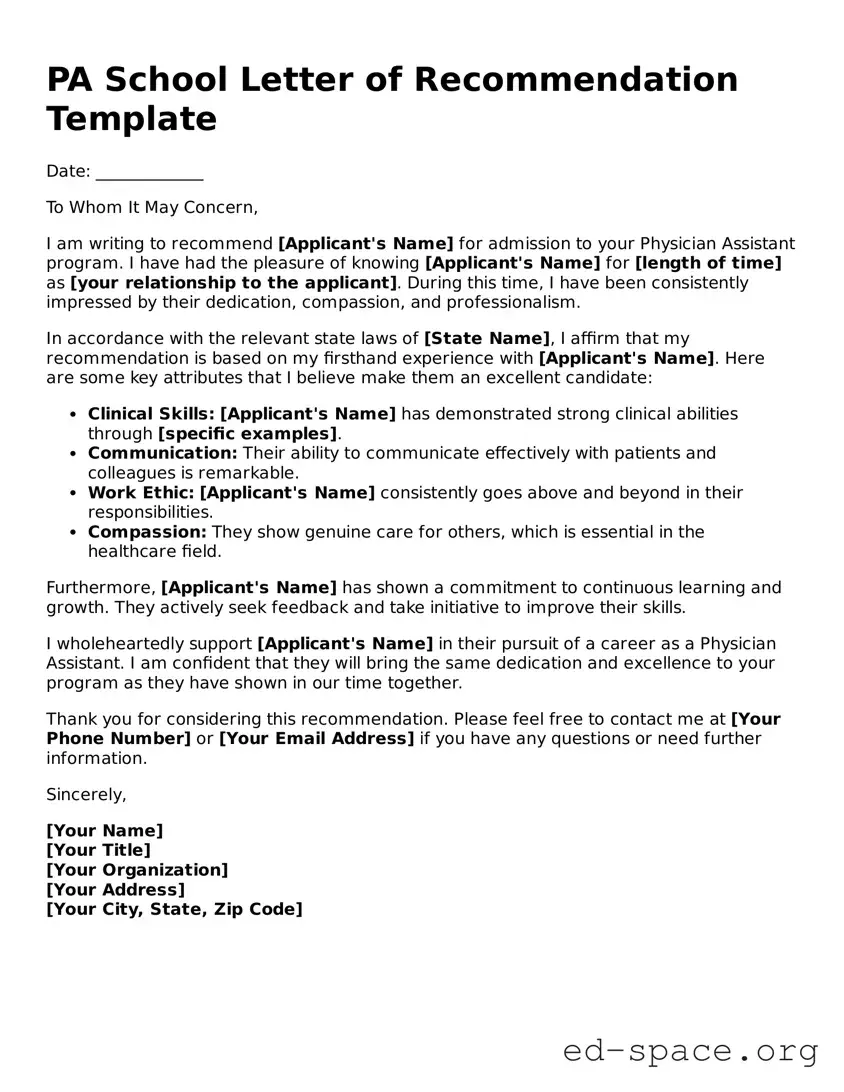
PA School Letter of Recommendation Template

Date: _____________

To Whom It May Concern,

I am writing to recommend [Applicant's Name] for admission to your Physician Assistant program. I have had the pleasure of knowing [Applicant's Name] for [length of time] as [your relationship to the applicant]. During this time, I have been consistently impressed by their dedication, compassion, and professionalism.

In accordance with the relevant state laws of [State Name], I affirm that my recommendation is based on my firsthand experience with [Applicant's Name]. Here are some key attributes that I believe make them an excellent candidate:

  • Clinical Skills: [Applicant's Name] has demonstrated strong clinical abilities through [specific examples].
  • Communication: Their ability to communicate effectively with patients and colleagues is remarkable.
  • Work Ethic: [Applicant's Name] consistently goes above and beyond in their responsibilities.
  • Compassion: They show genuine care for others, which is essential in the healthcare field.

Furthermore, [Applicant's Name] has shown a commitment to continuous learning and growth. They actively seek feedback and take initiative to improve their skills.

I wholeheartedly support [Applicant's Name] in their pursuit of a career as a Physician Assistant. I am confident that they will bring the same dedication and excellence to your program as they have shown in our time together.

Thank you for considering this recommendation. Please feel free to contact me at [Your Phone Number] or [Your Email Address] if you have any questions or need further information.

Sincerely,

[Your Name]
[Your Title]
[Your Organization]
[Your Address]
[Your City, State, Zip Code]

PDF Form Details

Fact Name Description
Purpose The PA School Letter of Recommendation form is designed to provide insight into an applicant's qualifications and character from a professional perspective.
Eligibility Typically, recommenders should be professionals in the healthcare field, such as physicians, physician assistants, or supervisors.
Submission Process Recommenders must complete the form and submit it directly to the PA school, often via an online portal.
Content Requirements The form usually requires information about the applicant’s skills, work ethic, and ability to handle the rigors of PA school.
State-Specific Forms Some states may have additional requirements or specific forms that must be completed, depending on local regulations.
Confidentiality Many PA schools prefer confidential letters of recommendation, meaning the applicant should not see the content of the letter.
Governing Laws While specific governing laws may vary by state, general privacy laws regarding personal information apply across the board.

PA School Letter of Recommendation: Usage Guidelines

Completing the PA School Letter of Recommendation form is an important step in the application process. Once the form is filled out, it will be submitted to the appropriate institutions as part of your application package. Follow these steps to ensure that the form is completed accurately and efficiently.

  1. Obtain a copy of the PA School Letter of Recommendation form from the designated source.
  2. Read the instructions carefully to understand the requirements for the recommendation.
  3. Fill in your personal information, including your name, contact information, and any other requested details.
  4. Provide the name and contact information of the individual writing the recommendation.
  5. Indicate the relationship between you and the recommender, such as teacher, employer, or mentor.
  6. Include specific details about your qualifications, experiences, and skills that the recommender should highlight.
  7. Review the completed form for any errors or omissions.
  8. Sign and date the form, if required.
  9. Submit the form according to the provided instructions, whether electronically or by mail.

Your Questions, Answered

What is the purpose of the PA School Letter of Recommendation form?

The PA School Letter of Recommendation form serves to provide admissions committees with insights into an applicant's qualifications, character, and potential for success in a physician assistant program. It allows recommenders to highlight specific experiences and attributes that make the candidate a strong fit for the profession. A well-crafted letter can significantly enhance an applicant's chances of being accepted into a competitive program.

Who should I ask to write my letter of recommendation?

Choose individuals who can speak to your skills, experiences, and character in a meaningful way. Ideal recommenders include supervisors from healthcare settings, professors who know your academic work well, or professionals in the medical field. Ensure that these individuals can provide specific examples of your abilities and contributions. Personal connections matter, so select people who genuinely support your application and can articulate why you would excel in a PA program.

How many letters of recommendation do I need to submit?

What information should I provide to my recommenders?

How should I follow up with my recommenders after requesting a letter?

Common mistakes

  1. Failing to provide specific examples of the candidate's skills and experiences. Generic statements do not effectively showcase the applicant's qualifications.

  2. Neglecting to tailor the recommendation to the specific program. Each PA school may have unique qualities they value, and a one-size-fits-all approach can diminish the impact of the letter.

  3. Overlooking the importance of a professional tone. A casual or overly familiar tone can undermine the seriousness of the recommendation.

  4. Submitting the letter without proofreading. Spelling and grammatical errors can detract from the credibility of the recommendation.

  5. Not adhering to the submission guidelines provided by the PA school. Each program may have specific requirements regarding format, length, and delivery method.

Documents used along the form

When applying to Physician Assistant (PA) schools, candidates often need to submit various forms and documents alongside the PA School Letter of Recommendation. Each of these documents plays a crucial role in presenting a comprehensive view of the applicant's qualifications and experiences. Below is a list of common documents that are typically required or recommended in the application process.

  • Personal Statement: This document allows applicants to express their motivations for pursuing a career as a PA, highlighting personal experiences and aspirations.
  • Resume or Curriculum Vitae (CV): A detailed account of an applicant's educational background, work experience, and relevant skills, providing a snapshot of their professional journey.
  • Transcripts: Official records from all post-secondary institutions attended, showing courses taken and grades earned, which reflect academic performance.
  • CASPA Application: The Centralized Application Service for Physician Assistants is a standardized application platform that streamlines the submission process for multiple PA programs.
  • Standardized Test Scores: Many PA programs require scores from tests like the GRE or MCAT to assess an applicant's academic readiness.
  • Healthcare Experience Documentation: A record of direct patient care or healthcare-related experiences, demonstrating the applicant's commitment to the field.
  • Supplemental Application: Some PA programs have their own additional application forms that require specific information or essays tailored to their institution.
  • Recommendation Letters: Besides the PA School Letter of Recommendation, additional letters from other professionals or educators may be requested to provide a broader perspective on the applicant.
  • Interview Preparation Materials: While not a formal document, applicants often prepare materials to help them succeed in interviews, such as practice questions and answers.

Each of these documents contributes to a well-rounded application, allowing PA schools to evaluate candidates effectively. Ensuring that all materials are complete and submitted on time is essential for a successful application process.

Similar forms

The PA School Letter of Recommendation form serves a specific purpose in the application process for Physician Assistant programs. However, it shares similarities with several other documents that are commonly used in various educational and professional contexts. Below are nine documents that resemble the PA School Letter of Recommendation form in terms of purpose and structure:

  • Medical School Letter of Recommendation: This document is similar in that it provides insights into a candidate's suitability for medical school, focusing on their academic performance, character, and relevant experiences.
  • Graduate School Letter of Recommendation: Like the PA School form, this letter highlights a student's qualifications for advanced study, emphasizing research skills, academic achievements, and potential for success in a graduate program.
  • Job Reference Letter: This document serves a comparable role in the employment sector, where it endorses a candidate's skills and work ethic, often reflecting on their contributions and achievements in previous positions.
  • Internship Recommendation Letter: Similar to the PA School form, this letter assesses a candidate's readiness for an internship, often detailing their abilities, experiences, and how they may benefit from the opportunity.
  • Scholarship Recommendation Letter: This letter supports a student's application for financial aid, focusing on their academic performance and character, much like the PA School recommendation emphasizes a candidate's qualifications.
  • Undergraduate Admissions Letter of Recommendation: This document provides insight into a high school student's readiness for college, paralleling the PA School form's goal of evaluating a candidate's preparedness for advanced training.
  • Professional License Recommendation: In fields requiring licensure, this letter verifies a candidate's qualifications and ethical standing, similar to how the PA School form assesses a candidate's readiness for the profession.
  • Fellowship Recommendation Letter: This document supports applications for specialized training programs, assessing a candidate's skills and potential in a manner akin to the PA School recommendation.
  • Character Reference Letter: While broader in scope, this letter evaluates a person's character and integrity, much like the PA School form addresses personal attributes relevant to a medical career.

Each of these documents plays a critical role in evaluating a candidate's qualifications and readiness for their respective fields, sharing a common goal of providing a well-rounded view of the individual in question.

Dos and Don'ts

When filling out the PA School Letter of Recommendation form, it's crucial to approach the task with care. Here are some key dos and don'ts to keep in mind:

  • Do provide specific examples of the applicant's skills and experiences.
  • Do use clear and concise language to convey your thoughts.
  • Do ensure that you meet the submission deadline.
  • Do maintain a professional tone throughout the letter.
  • Don't exaggerate the applicant's qualifications or experiences.
  • Don't include irrelevant information that does not pertain to the applicant's suitability.
  • Don't use overly complex language or jargon that may confuse the reader.
  • Don't forget to proofread your letter for any spelling or grammatical errors.

Following these guidelines can help ensure that your recommendation is effective and impactful.

Misconceptions

There are several misconceptions surrounding the Physician Assistant (PA) School Letter of Recommendation form. Understanding these can help applicants navigate the process more effectively.

  • All letters must come from healthcare professionals. While letters from healthcare providers are valuable, PA programs often accept recommendations from professors, employers, or anyone who can speak to the applicant's character and abilities.
  • Letters must be submitted in a specific format. Most programs do not require a specific format for letters of recommendation. However, they should be professional and clearly outline the recommender's relationship with the applicant.
  • Only one letter is required. Many PA programs request multiple letters of recommendation. Applicants should check the specific requirements of each program to ensure they meet the criteria.
  • Recommenders must be well-known figures. While having a well-known recommender can be beneficial, what matters more is the content of the letter. A strong letter from someone who knows the applicant well can carry more weight than a generic letter from a prominent figure.
  • Letters can be generic and not personalized. A personalized letter that highlights specific experiences and qualities of the applicant is far more effective. Programs look for insight into the applicant's skills and potential.
  • Submitting letters late is acceptable. Timeliness is crucial. Late submissions can negatively impact an application. Applicants should ensure their recommenders are aware of deadlines and submit their letters on time.

By addressing these misconceptions, applicants can better prepare their materials and improve their chances of acceptance into a PA program.

Key takeaways

When filling out and utilizing the Physician Assistant (PA) School Letter of Recommendation form, it is crucial to keep several key points in mind. These insights can significantly enhance the effectiveness of your recommendations.

  • Choose the Right Recommenders: Select individuals who know you well and can speak to your skills, experiences, and character. Ideally, they should have a background in healthcare or academia.
  • Provide Context: Share your goals, experiences, and why you are pursuing a PA career with your recommenders. This helps them tailor their letters to reflect your aspirations.
  • Be Mindful of Deadlines: Ensure that your recommenders are aware of submission deadlines. It is advisable to give them ample time to write a thoughtful letter.
  • Follow Instructions: Carefully adhere to the guidelines provided by the PA program. This includes formatting, length, and any specific questions that need to be addressed.
  • Request Feedback: After your recommenders have drafted their letters, consider asking for feedback or a copy. This allows you to ensure that the content aligns with your application narrative.
  • Express Gratitude: Regardless of the outcome, thank your recommenders for their time and effort. A simple thank-you note can go a long way in maintaining professional relationships.
  • Keep Communication Open: Maintain an open line of communication with your recommenders throughout the process. This can help address any questions or concerns that may arise.

By following these key takeaways, applicants can improve the quality of their letters of recommendation, ultimately enhancing their chances of admission into PA programs.