Homepage Blank P 45 It PDF Form
Content Overview

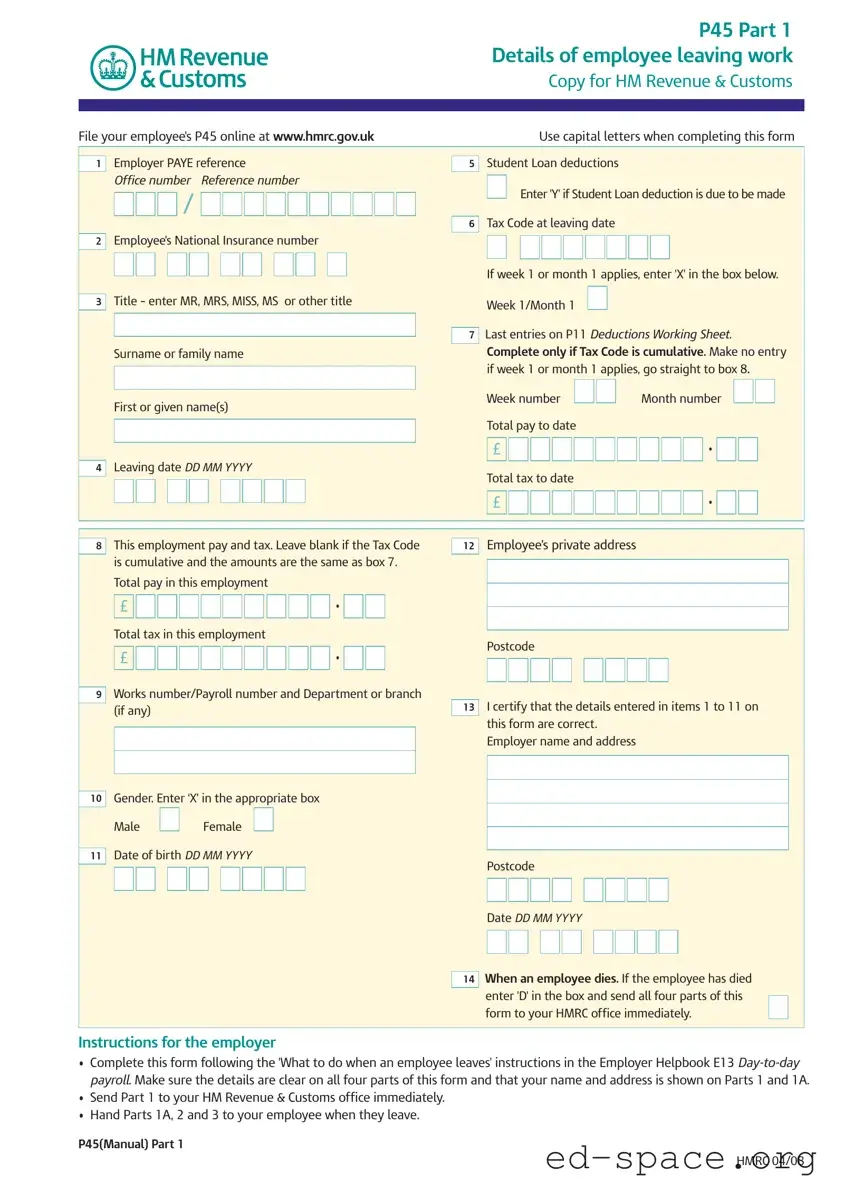
The P45 form is an essential document for both employers and employees in the United Kingdom, particularly during the transition between jobs. It serves multiple purposes, providing crucial information about an employee's tax status and earnings at the time of leaving a job. The form is divided into three parts, with each part designated for different stakeholders: HM Revenue & Customs (HMRC), the departing employee, and the new employer. When an employee leaves a job, the employer must complete the P45, detailing the employee's total pay and tax deductions to date, along with their National Insurance number and leaving date. Employers are responsible for sending the first part of the form to HMRC promptly, while the remaining parts are handed to the employee. This documentation is vital for the employee, as it helps ensure that they are taxed correctly in their new role or when claiming benefits. The P45 also includes specific instructions for handling situations such as student loan deductions and what to do if the employee has passed away. Understanding the P45 form is important for maintaining accurate tax records and ensuring a smooth transition in employment.

Document Preview

P45 Part 1
Details of employee leaving work
Copy for HM Revenue & Customs
P45(Manual) Part 1
HMRC 04/08
Employer PAYE reference
Office number Reference number
Employee's National Insurance number
Title – enter MR, MRS, MISS, MS or other title
Surname or family name
First or given name(s)
Leaving date
DD MM YYYY
4
3
2
/
1
Student Loan deductions
Enter 'Y' if Student Loan deduction is due to be made
Tax Code at leaving date
If week 1 or month 1 applies, enter 'X' in the box below.
Week 1/Month 1
Last entries on P11 Deductions Working Sheet.
Complete only if Tax Code is cumulative. Make no entry
if week 1 or month 1 applies, go straight to box 8.
Week number Month number
Total pay to date
Total tax to date
£
£
7
6
5
This employment pay and tax. Leave blank if the Tax Code
is cumulative and the amounts are the same as box 7.
Total pay in this employment
Total tax in this employment
Works number/Payroll number and Department or branch
(if any)
Gender. Enter ‘X’ in the appropriate box
Male Female
Date of birth DD MM YYYY
11
10
9
£
£
8
Employees private address
Postcode
I certify that the details entered in items 1 to 11 on
this form are correct.
Employer name and address
Postcode
Date DD MM YYYY
When an employee dies. If the employee has died
enter 'D' in the box and send all four parts of this
form to your HMRC office immediately.
14
13
12
File your employee's P45 online at www.hmrc.gov.uk Use capital letters when completing this form
Instructions for the employer
Complete this form following the 'What to do when an employee leaves' instructions in the Employer Helpbook E13 Day-to-day
payroll. Make sure the details are clear on all four parts of this form and that your name and address is shown on Parts 1 and 1A.
Send Part 1 to your HM Revenue & Customs office immediately.
Hand Parts 1A, 2 and 3 to your employee when they leave.
P45 Part 1A
Details of employee leaving work
Copy for employee
P45(Manual) Part 1A HMRC 04/08
To the employee
The P45 is in three parts. Please keep this part (Part 1A) safe.
Copies are not available. You might need the information in
Part 1A to fill in a Tax Return if you are sent one.
Please read the notes in Part 2 that accompany Part 1A.
The notes give some important information about what you
should do next and what you should do with Parts 2 and 3 of
this form.
Tax credits
Tax credits are flexible. They adapt to changes in your life, such
as leaving a job. If you need to let us know about a change in
your income, phone 0845 300 3900.
To the new employer
If your new employee gives you this Part 1A, please return
it to them. Deal with Parts 2 and 3 as normal.
Employer PAYE reference
Office number Reference number
Employee's National Insurance number
Title – enter MR, MRS, MISS, MS or other title
Surname or family name
First or given name(s)
Leaving date
DD MM YYYY
4
3
2
/
1
Student Loan deductions
Student Loan deductions to continue
Tax Code at leaving date
If week 1 or month 1 applies, enter 'X' in the box below.
Week 1/Month 1
Last entries on P11 Deductions Working Sheet.
Complete only if Tax Code is cumulative. If there is an ‘X’
at box 6 there will be no entries here.
Week number Month number
Total pay to date
Total tax to date
£
£
7
6
5
This employment pay and tax. If no entry here, the amounts
are those shown at box 7.
Total pay in this employment
Total tax in this employment
Works number/Payroll number and Department or branch
(if any)
Gender. Enter ‘X’ in the appropriate box
Male Female
Date of birth DD MM YYYY
11
10
9
£
£
8
Employees private address
Postcode
I certify that the details entered in items 1 to 11 on
this form are correct.
Employer name and address
Postcode
Date DD MM YYYY
13
12
P45 Part 2
Details of employee leaving work
Copy for new employer
P45(Manual) Part 2 HMRC 04/08
To the employee
This form is important to you. Take good care of it and
keep it safe. Copies are not available. Please keep
Parts 2 and 3 of the form together and do not alter them
in any way.
Going to a new job
Give Parts 2 and 3 of this form to your new employer,
or you will have tax deducted using the emergency
code and may pay too much tax. If you do not want
your new employer to know the details on this form,
send it to your HM Revenue & Customs (HMRC) office
immediately with a letter saying so and giving the
name and address of your new employer. HMRC can
make special arrangements, but you may pay too
much tax for a while as a result of this.
Going abroad
If you are going abroad or returning to a country
outside the UK ask for form P85 Leaving the United Kingdom
from any HMRC office or Enquiry Centre.
Becoming self-employed
You must register with HMRC within three months of
becoming self-employed or you could incur a penalty.
To register as newly self-employed see The Phone Book
under HM Revenue & Customs or go to www.hmrc.gov.uk
to get a copy of the booklet SE1 Are you thinking of working
for yourself?
Claiming Jobseeker's Allowance or
Employment and Support Allowance (ESA)
Take this form to your Jobcentre Plus office. They will pay you
any tax refund you may be entitled to when your claim ends,
or at 5 April if this is earlier.
Not working and not claiming Jobseeker's Allowance or
Employment and Support Allowance (ESA)
If you have paid tax and wish to claim a refund ask for
form P50 Claiming Tax back when you have stopped
working from any HMRC office or Enquiry Centre.
Help
If you need further help you can contact any HMRC office
or Enquiry Centre. You can find us in The Phone Book under
HM Revenue & Customs or go to www.hmrc.gov.uk
To the new employer
Check this form and complete boxes 8 to 18 in Part 3
and prepare a form P11 Deductions Working Sheet.
Follow the instructions in the Employer Helpbook E13
Day-to-day payroll, for how to prepare a P11 Deductions
Working Sheet. Send Part 3 of this form to your HMRC office
immediately. Keep Part 2.
Employer PAYE reference
Office number Reference number
Employee's National Insurance number
Title - enter MR, MRS, MISS, MS or other title
Surname or family name
First or given name(s)
Leaving date
DD MM YYYY
4
3
2
/
1
Student Loan deductions
Student Loan deductions to continue
Tax Code at leaving date
If week 1 or month 1 applies, enter 'X' in the box below.
Week 1/Month 1
Last entries on P11 Deductions Working Sheet.
Complete only if Tax Code is cumulative. If there is an ‘X’
at box 6, there will be no entries here.
Week number Month number
Total pay to date
Total tax to date
£
£
7
6
5
P45 Part 3
New employee details
For completion by new employer
P45(Manual) Part 3 HMRC 04/08
New employer PAYE reference
Office number Reference number
Date new employment started DD MM YYYY
Works number/Payroll number and Department or branch
(if any)
Enter 'P' here if employee will not be paid by you
between the date employment began and the
next 5 April.
Enter Tax Code in use if different to the Tax Code at box 6
If week 1 or month 1 applies, enter 'X' in the box below.
Week 1/Month 1
If the tax figure you are entering on P11 Deductions
Working Sheet differs from box 7 (see the E13 Employer
Helpbook Day-to-day payroll) please enter the
figure here.
New employee's job title or job description
14
£
13
12
11
10
9
/
8
Employee's private address
Postcode
Gender. Enter ‘X’ in the appropriate box
Male Female
Date of birth DD MM YYYY
Declaration
I have prepared a P11 Deductions Working Sheet
in accordance with the details above.
Employer name and address
Postcode
Date DD MM YYYY
18
17
16
15
To the new employer Complete boxes 8 to 18 and send P45 Part 3 only to your HMRC office immediately.
Employer PAYE reference
Office number Reference number
Employee's National Insurance number
Title – enter MR, MRS, MISS, MS or other title
Surname or family name
First or given name(s)
Leaving date
DD MM YYYY
4
3
2
/
1
Student Loan deductions
Student Loan deductions to continue
Tax Code at leaving date
If week 1 or month 1 applies, enter 'X' in the box below.
Week 1/Month 1
Last entries on P11 Deductions Working Sheet.
Complete only if Tax Code is cumulative. If there is an ‘X’
at box 6, there will be no entries here.
Week number Month number
Total pay to date
Total tax to date
£
£
7
6
5
File your employee's P45 online at www.hmrc.gov.uk Use capital letters when completing this form

Form Specifications

Fact Name Details
Purpose The P45 form is used when an employee leaves a job to provide tax and pay information to HM Revenue & Customs (HMRC).
Parts The P45 consists of three parts: Part 1 for HMRC, Part 1A for the employee, and Parts 2 and 3 for the new employer.
Employee Information It includes essential employee details such as name, National Insurance number, and leaving date.
Tax Code The form captures the employee's tax code at the time of leaving, which affects tax deductions in future employment.
Student Loan Deductions The form indicates if student loan deductions are applicable and whether they should continue with the new employer.
Filing Requirement Employers must file Part 1 with HMRC immediately after an employee leaves.
Emergency Tax Code If Parts 2 and 3 are not provided to the new employer, the employee may be taxed under an emergency tax code.
Record Keeping Employees should keep Part 1A for their records, as copies are not available.
Legal Compliance Failure to properly complete and submit the P45 can result in penalties for the employer under UK tax law.
State-Specific Laws The P45 form is governed by UK tax law, specifically the Income Tax (Earnings and Pensions) Act 2003.

P 45 It: Usage Guidelines

Filling out the P45 It form is essential for accurately documenting an employee's departure from a job. After completing the form, you will need to submit it to HM Revenue & Customs (HMRC) and provide the necessary parts to the employee. Here are the steps to complete the form correctly.

  1. Begin with Part 1. Enter the Employer PAYE reference in the designated box.
  2. Fill in the Office number and Reference number.
  3. Input the employee's National Insurance number.
  4. Specify the employee's Title (e.g., MR, MRS, MISS, MS).
  5. Enter the Surname and First or given name(s).
  6. Document the Leaving date in the format DD MM YYYY.
  7. Record the Total pay to date and Total tax to date.
  8. Indicate if the Tax Code at leaving date is cumulative or if Week 1/Month 1 applies by marking the appropriate box.
  9. Provide the employee’s private address and Postcode.
  10. Complete the Employer name and address section.
  11. Mark the employee's Gender by entering ‘X’ in the appropriate box.
  12. Fill in the Date of birth in the format DD MM YYYY.
  13. Sign and date the form, certifying that the details entered are correct.

Once you have completed Part 1, send it to HMRC immediately. Hand Parts 1A, 2, and 3 to the employee as they leave. Ensure that all information is accurate to avoid complications later on.

Your Questions, Answered

What is the P45 form and why is it important?

The P45 form is a crucial document issued when an employee leaves a job. It contains essential details such as the employee's total pay and tax deducted during their employment. This information is vital for both the employee and the new employer. The P45 helps ensure that the employee pays the correct amount of tax in their next job, preventing issues like overpayment or underpayment of taxes. Additionally, it serves as proof of employment for various purposes, including applying for benefits or loans.

What should an employee do with their P45 form after leaving a job?

After receiving the P45 form, the employee should keep it safe, as copies are not available. They will need to provide Parts 2 and 3 of the form to their new employer. This ensures that the new employer can process their tax correctly and avoid using an emergency tax code, which may result in higher tax deductions. If the employee is not starting a new job immediately, they should retain the P45 for their records, as it may be necessary for future tax returns or claims.

How does the P45 form affect tax codes?

The P45 form plays a significant role in determining an employee's tax code. When an employee leaves a job, the P45 indicates whether their tax code is cumulative or if they are on a week 1 or month 1 basis. If the tax code is cumulative, it means that the employee's tax deductions are calculated based on their total earnings for the year. Conversely, if the employee is on a week 1 or month 1 basis, tax calculations are based only on the current pay period, which may lead to higher tax deductions. Understanding this distinction is essential for employees to manage their tax obligations accurately.

What should an employer do when an employee leaves and provides a P45?

When an employee leaves and presents a P45, the employer must complete the necessary sections of the form and ensure all details are accurate. The employer should send Part 1 of the P45 to HM Revenue & Customs (HMRC) immediately. Parts 1A, 2, and 3 should be provided to the employee. It is also important for the employer to retain records of the employee's information for their own payroll purposes. Following these steps helps maintain compliance with tax regulations and ensures a smooth transition for the departing employee.

Common mistakes

  1. Incorrect Personal Information: Many people fail to provide accurate personal details, such as their National Insurance number or date of birth. This can lead to significant issues with tax records.

  2. Missing Signatures: Forgetting to sign the form is a common mistake. Without a signature, the form may not be considered valid.

  3. Incorrect Tax Code: Entering the wrong tax code can result in incorrect tax deductions. Always double-check the tax code before submission.

  4. Failure to Indicate Student Loan Status: Not marking the box for Student Loan deductions can lead to unexpected deductions later. If applicable, ensure to indicate this clearly.

  5. Leaving Fields Blank: Some individuals leave important sections blank, thinking they are not necessary. Every section should be filled out as required to avoid complications.

  6. Incorrect Dates: Entering the wrong leaving date or using the wrong format can cause confusion. Always use the correct format and verify the date before submitting the form.

Documents used along the form

The P45 form is crucial for employees transitioning from one job to another. However, it is often accompanied by several other important documents that help ensure a smooth transition and proper handling of tax matters. Below is a list of related forms that individuals may encounter alongside the P45.

  • P60: This document summarizes an employee's total pay and deductions for the entire tax year. Employers issue it at the end of each tax year, providing a comprehensive overview of earnings and taxes paid. It's essential for employees when filing their tax returns.
  • P50: This form is used to claim a tax refund when an individual has stopped working. Employees who believe they have overpaid taxes can request this form from HM Revenue & Customs (HMRC) to initiate the refund process.
  • P85: If an employee is leaving the UK to work abroad, they must fill out this form. It informs HMRC of their departure and helps manage tax responsibilities while living outside the UK. This is particularly important for those who may still have tax obligations in the UK.
  • P11D: This form is used to report benefits and expenses provided to employees. Employers complete it to detail any non-cash benefits received by employees, which may affect the employee's tax liability.

Understanding these forms is essential for both employees and employers. Each document plays a significant role in ensuring compliance with tax regulations and facilitating a seamless transition between jobs. It is advisable to keep these forms organized and accessible, as they may be needed for future tax-related activities.

Similar forms

  • P60 - This document summarizes an employee's total pay and deductions for the tax year. Similar to the P45, it provides essential information for tax purposes and is issued by the employer at the end of the tax year.
  • P11D - This form is used to report benefits and expenses provided to employees. Like the P45, it is important for tax calculations and must be filed with HMRC.
  • P85 - This form is for individuals leaving the UK to claim a tax refund. It shares similarities with the P45 in that it addresses tax matters when employment ends.
  • P50 - This document is used to claim a tax refund after stopping work. It is similar to the P45 as both relate to tax obligations after employment cessation.
  • P60U - This is a simplified version of the P60 for certain employees. It provides similar information regarding pay and tax for the year.
  • P46 - This form is used when an employee starts a new job without a P45. It collects similar information regarding tax codes and deductions.
  • Tax Return (Self Assessment) - Individuals use this to report income and calculate tax owed. Like the P45, it requires accurate reporting of earnings and taxes paid.
  • W-2 Form - In the US context, this form provides similar information to the P45 by detailing an employee's earnings and tax withholdings for the year.
  • Form 1099 - This form is used for reporting income received by non-employees. It serves a similar purpose to the P45 in documenting earnings for tax purposes.
  • Employee Verification Form - This document may be used by employers to verify an employee's identity and employment status, similar to the P45's function in confirming employment details.

Dos and Don'ts

When filling out the P45 form, it's important to follow certain guidelines to ensure accuracy and compliance. Here’s a helpful list of things you should and shouldn't do:

  • Do use capital letters for all entries.
  • Do ensure that the employee's National Insurance number is correct.
  • Do enter the correct leaving date in the specified format (DD MM YYYY).
  • Do double-check the tax code at the leaving date to avoid errors.
  • Do send Part 1 to HM Revenue & Customs immediately after completion.
  • Don't leave any required fields blank unless specifically instructed to do so.
  • Don't alter any part of the form once it has been completed.
  • Don't forget to provide Parts 1A, 2, and 3 to the employee upon their departure.
  • Don't use outdated information from previous employment records.
  • Don't ignore the instructions regarding student loan deductions if applicable.

By adhering to these guidelines, you can help ensure a smooth process for both the employee and the employer. Keeping accurate records is crucial for tax purposes and for the employee’s future employment opportunities.

Misconceptions

  • Misconception 1: The P45 form is only necessary for employees who leave their job voluntarily.
  • This is not true. The P45 is required for any employee leaving a job, regardless of the circumstances. This includes resignations, layoffs, and even situations like retirement or death.

  • Misconception 2: The P45 form is only for tax purposes.
  • While the P45 does play a significant role in tax calculations, it also provides important information for future employers. It helps them understand your previous earnings and tax deductions, ensuring you are taxed correctly in your new job.

  • Misconception 3: Employees do not need to keep their P45 once they start a new job.
  • It's crucial to keep your P45 safe, even after starting a new job. You may need it for tax returns or if you need to claim a refund in the future. Copies are not available, so treat it like an important document.

  • Misconception 4: Employers can fill out the P45 form at their convenience.
  • This is misleading. Employers must complete and submit the P45 promptly after an employee leaves. Delays can lead to complications for the employee, such as incorrect tax deductions in their new job.

  • Misconception 5: The P45 form is the same for all employees.
  • Each P45 is unique to the individual employee. It includes specific details such as the employee's National Insurance number, tax code, and earnings to date. This personal information is vital for accurate tax handling.

  • Misconception 6: You do not need to provide a P45 if you are moving to self-employment.
  • This is incorrect. Even if you are transitioning to self-employment, you should still have your P45. It helps in understanding your previous tax situation and can be beneficial if you need to claim tax refunds.

Key takeaways

  • Complete the form accurately. Use capital letters and ensure all required fields are filled out correctly, including the employee's National Insurance number and PAYE reference.
  • Distribute the parts correctly. After completing the form, send Part 1 to HM Revenue & Customs and provide Parts 1A, 2, and 3 to the employee.
  • Keep a copy of Part 1A. The employee should retain this part for their records, as it may be needed for future tax returns or claims.
  • Understand the implications of the form. If the employee is moving to a new job, they must provide Parts 2 and 3 to their new employer to avoid emergency tax codes.