Homepage Blank Ohio Ust 1 PDF Form
Content Overview

The Ohio UST 1 form serves as a crucial tool for businesses operating within the state, particularly those engaged in sales that are subject to state, county, and transit sales tax. This form is designed to report gross sales, exempt sales, and net taxable sales over a specified reporting period. Businesses must calculate their tax liability based on reportable taxable sales, while also accounting for any discounts or additional charges. The form also allows vendors to indicate if they are making payments electronically or if they are submitting an amended return. Additionally, it provides a section for businesses to report any accelerated payments and carryovers from previous periods. Completing this form accurately is essential, as it ensures compliance with Ohio tax laws and facilitates the proper remittance of sales tax to the state. Furthermore, businesses can opt for a paperless experience by filing their returns online through the Ohio Business Gateway, simplifying the process and enhancing efficiency.

Document Preview

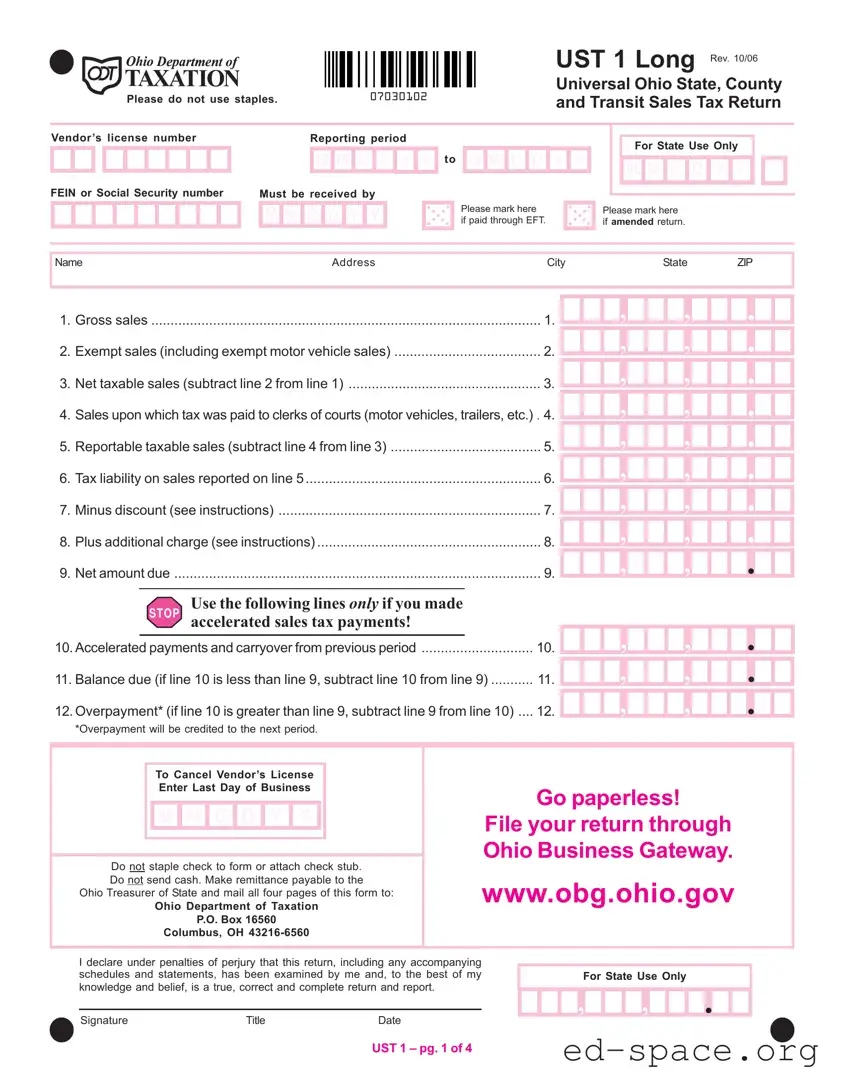
1. Gross sales ..................................................................................................... 1.
2. Exempt sales (including exempt motor vehicle sales) ...................................... 2.
3. Net taxable sales (subtract line 2 from line 1) .................................................. 3.
4. Sales upon which tax was paid to clerks of courts (motor vehicles, trailers, etc.) . 4.
5. Reportable taxable sales (subtract line 4 from line 3) ....................................... 5.
6. Tax liability on sales reported on line 5 ............................................................. 6.
7. Minus discount (see instructions) .................................................................... 7.
8. Plus additional charge (see instructions) .......................................................... 8.
9. Net amount due ............................................................................................... 9.
10. Accelerated payments and carryover from previous period ............................. 10.
11. Balance due (if line 10 is less than line 9, subtract line 10 from line 9) ........... 11.
12. Overpayment* (if line 10 is greater than line 9, subtract line 9 from line 10) .... 12.
*Overpayment will be credited to the next period.
Do not staple check to form or attach check stub.
Do not send cash. Make remittance payable to the
Ohio Treasurer of State and mail all four pages of this form to:
Ohio Department of Taxation
P.O. Box 16560
Columbus, OH 43216-6560
Go paperless!
File your return through
Ohio Business Gateway.
www.obg.ohio.gov
,,
Q
,,
Q
,,
Q
,,
Q
,,
Q
,,
Q
,,
Q
,,
Q
,,
Q
Q
,,
Q
,,
,,
UST 1 – pg. 1 of 4
Q
Q
Name Address City State ZIP
FEIN or Social Security number
Must be received by
Please mark here
if paid through EFT.
Please mark here
if amended return.
Signature Title Date
I declare under penalties of perjury that this return, including any accompanying
schedules and statements, has been examined by me and, to the best of my
knowledge and belief, is a true, correct and complete return and report.
Use the following lines only if you made
accelerated sales tax payments!
STOP
Vendor’s license number
Reporting period
to
MDDM YY
For State Use Only
MDDYMY
Please do not use staples.
UST 1 Long
Universal Ohio State, County
and Transit Sales Tax Return
Rev. 10/06
MDDM
YY
MDDM
YY
To Cancel Vendor’s License
Enter Last Day of Business
M MDDY Y
For State Use Only
,,
Q
07030102
UST 1 – pg. 2 of 4
Vendor’s license number
Reporting period
to
MDDM
YY
MDDM YY
Supporting schedule must be completed showing
taxable sales and the combined state, county and
transit authority taxes on a county-by-county basis.
Please do not use staples.
UST 1 Long
Universal Ohio State, County
and Transit Sales Tax Return
Rev. 10/06
Adams 01
Allen 02
Ashland 03
Ashtabula 04
Athens 05
Auglaize 06
Belmont 07
Brown 08
Butler 09
Carroll 10
Champaign 11
Clark 12
Clermont 13
Clinton 14
Columbiana 15
Coshocton 16
Crawford 17
Cuyahoga 18
Darke 19
Defiance 20
Delaware 21
Delaware (COTA) 96
Erie 22
Fairfield 23
Fairfield (COTA) 93
Fayette 24
Franklin 25
Fulton 26
Gallia 27
Geauga 28
Greene 29
Guernsey 30
Hamilton 31
County Name
*If this amount is a negative, please mark an “X” in the box provided.
Tax Liability*Taxable Sales*
County Number
.
,,
.
,,
.
,,
.
,,
.
,,
.
,,
.
,,
.
,,
.
,,
.
,,
.
,
.
,,
,
.
,,
.
,,
.
,,
.
,,
.
,,
.
,,
.
,,
.
,,
.
,,
.
,,
.
,,
.
,,
.
,,
.
,,
.
,,
.
,,
.
,,
.
,,
.
,,
.
,,
.
,,
.
,,
.
,,
.
,,
.
,,
.
,,
.
,,
.
,,
.
,,
.
,,
.
,,
.
,,
.
,,
.
,,
.
,,
.
,,
.
,,
.
,,
.
,,
.
,,
.
,,
.
,,
.
,,
.
,,
.
,,
.
,,
.
,,
.
,,
.
,,
.
,,
.
,,
.
,,
.
,,
.
,,
Page 2 subtotal
,, ,,
.
.
07030202
UST 1 – pg. 3 of 4
Vendor’s license number
Reporting period
to
MDDM
YY
MDDM
YY
Please do not use staples.
UST 1 Long
Universal Ohio State, County
and Transit Sales Tax Return
Rev. 10/06
County Name
*If this amount is a negative, please mark an “X” in the box provided.
Tax Liability*Taxable Sales*
County Number
.
,,
.
,,
.
,,
.
,,
.
,,
.
,,
.
,,
.
,,
.
,,
.
,,
.
,
.
,,
,
.
,,
.
,,
.
,,
.
,,
.
,,
.
,,
.
,,
.
,,
.
,,
.
,,
.
,,
.
,,
.
,,
.
,,
.
,,
.
,,
.
,,
.
,,
.
,,
.
,,
.
,,
.
,,
.
,,
.
,,
.
,,
.
,,
.
,,
.
,,
.
,,
.
,,
.
,,
.
,,
.
,,
.
,,
.
,,
.
,,
.
,,
.
,,
.
,,
.
,,
.
,,
.
,,
.
,,
.
,,
.
,,
.
,,
.
,,
.
,,
.
,,
.
,,
.
,,
.
,,
.
,,
.
,,
,
Hancock 32
Hardin 33
Harrison 34
Henry 35
Highland 36
Hocking 37
Holmes 38
Huron 39
Jackson 40
Jefferson 41
Knox 42
Lake 43
Lawrence 44
Licking 45
Licking (COTA) 94
Logan 46
Lorain 47
Lucas 48
Madison 49
Mahoning 50
Marion 51
Medina 52
Meigs 53
Mercer 54
Miami 55
Monroe 56
Montgomery 57
Morgan 58
Morrow 59
Muskingum 60
Noble 61
Ottawa 62
Paulding 63
Page 3 subtotal
,, ,,
.
.
Supporting schedule must be completed showing
taxable sales and the combined state, county and
transit authority taxes on a county-by-county basis.
07030302
UST 1 – pg. 4 of 4
Vendor’s license number
Reporting period
to
MDDM
YY
MDDM
YY
Please do not use staples.
UST 1 Long
Universal Ohio State, County
and Transit Sales Tax Return
Rev. 10/06
County Name
*If this amount is a negative, please mark an “X” in the box provided.
Tax Liability*Taxable Sales*
County Number
.
,,
.
,,
.
,,
.
,,
.
,,
.
,,
.
,,
.
,,
.
,,
.
,,
.
,
.
,,
,
.
,,
.
,,
.
,,
.
,,
.
,,
.
,,
.
,,
.
,,
.
,,
.
,,
.
,,
.
,,
.
,,
.
,,
.
,,
.
,,
.
,,
.
,,
.
,,
.
,,
.
,,
.
,,
.
,,
.
,,
.
,,
.
,,
.
,,
.
,,
.
,,
.
,,
.
,,
.
,,
.
,,
.
,,
.
,,
.
,,
.
,,
.
,,
.
,,
.
,,
.
,,
.
,,
.
,,
.
,,
.
,,
.
,,
Perry 64
Pickaway 65
Pike 66
Portage 67
Preble 68
Putnam 69
Richland 70
Ross 71
Sandusky 72
Scioto 73
Seneca 74
Shelby 75
Stark 76
Summit 77
Trumbull 78
Tuscarawas 79
Union 80
Van Wert 81
Vinton 82
Warren 83
Washington 84
Wayne 85
Williams 86
Wood 87
Wyandot 88
Supporting schedule must be completed showing
taxable sales and the combined state, county and
transit authority taxes on a county-by-county basis.
,
Subtotal this page
Page 2 subtotal
Page 3 subtotal
Grand total*
*Enter totals on lines 5 and 6 on the front page of this return.
.
,,
,,
.
,,
.
,,
.
,,
,,
,,
.
,,
.
,,
.
,,
..
07030402
.
,,
.
,,

Form Specifications

Fact Name Description
Form Purpose The Ohio UST 1 form is used for reporting sales and transit sales tax for vendors operating in Ohio.
Filing Deadline The form must be received by the Ohio Department of Taxation by the specified due date indicated on the form.
Governing Laws This form is governed by the Ohio Revised Code, particularly sections related to sales and use tax regulations.
Payment Instructions Payments should be made payable to the Ohio Treasurer of State, and cash should not be sent with the form.

Ohio Ust 1: Usage Guidelines

Completing the Ohio UST 1 form involves several steps to ensure that all necessary information is accurately reported. After filling out the form, it will need to be submitted to the Ohio Department of Taxation by mail or electronically. The following steps outline the process for filling out the form correctly.

  1. Obtain the Ohio UST 1 form, ensuring you have the latest version.
  2. Do not staple the form. Keep it flat and organized.
  3. Fill in the vendor's license number at the top of the form.
  4. Enter the reporting period using the format MM/DD/YYYY.
  5. Provide your FEIN (Federal Employer Identification Number) or Social Security number.
  6. Mark if the payment was made through EFT (Electronic Funds Transfer) or if this is an amended return.
  7. Complete the name and address sections, including city, state, and ZIP code.
  8. Calculate and enter the gross sales amount on line 1.
  9. Enter the exempt sales amount on line 2.
  10. Subtract line 2 from line 1 to get the net taxable sales and enter this amount on line 3.
  11. Report any sales on which tax was paid to clerks of courts on line 4.
  12. Subtract line 4 from line 3 to find reportable taxable sales, entering the result on line 5.
  13. Calculate the tax liability on the sales reported on line 5 and enter this amount on line 6.
  14. If applicable, apply any discount on line 7.
  15. Include any additional charges on line 8.
  16. Calculate the net amount due by adjusting for discounts and additional charges, and enter this on line 9.
  17. If accelerated payments were made, enter them on line 10.
  18. Calculate the balance due or overpayment on lines 11 and 12, respectively.
  19. If canceling a vendor's license, enter the last day of business.
  20. Sign and date the form to certify its accuracy.
  21. Mail the completed form and payment to the Ohio Department of Taxation, ensuring that checks are not stapled to the form.

Once the form is submitted, it will be processed by the Ohio Department of Taxation. If there are any discrepancies or issues, the department may reach out for clarification. It is advisable to keep a copy of the completed form for your records.

Your Questions, Answered

What is the Ohio UST 1 form?

The Ohio UST 1 form is a Universal State, County, and Transit Sales Tax Return. It is used by vendors to report their gross sales, exempt sales, and taxable sales to the Ohio Department of Taxation. Completing this form accurately is essential for compliance with state tax laws.

Who needs to file the UST 1 form?

Any business or vendor that sells goods or services subject to sales tax in Ohio is required to file the UST 1 form. This includes retailers, wholesalers, and service providers who collect sales tax from customers. If your business has a vendor's license, you must submit this form for each reporting period.

How often must the UST 1 form be filed?

The frequency of filing the UST 1 form depends on your business's sales volume. Some vendors are required to file monthly, while others may file quarterly or annually. Check with the Ohio Department of Taxation for specific guidelines related to your situation.

What information is required on the UST 1 form?

The UST 1 form requires various pieces of information, including your vendor’s license number, reporting period, gross sales, exempt sales, and net taxable sales. Additionally, you must calculate your tax liability and any applicable discounts or additional charges. Accurate reporting is crucial to avoid penalties.

What if I made an error on my UST 1 form?

If you discover an error after submitting your UST 1 form, you can file an amended return. Mark the appropriate box on the form to indicate that it is an amended return, and provide the corrected information. It’s important to address errors promptly to prevent complications with your tax obligations.

How do I pay the tax due with my UST 1 form?

When submitting your UST 1 form, you should make your payment payable to the Ohio Treasurer of State. Do not staple your check to the form or include cash. Mail the completed form and payment to the Ohio Department of Taxation at the specified address.

Can I file the UST 1 form electronically?

Yes, you can file your UST 1 form electronically through the Ohio Business Gateway. This option allows for a more streamlined process and helps reduce paperwork. Consider going paperless to save time and resources.

What happens if I don’t file the UST 1 form?

Failing to file the UST 1 form can result in penalties and interest on any unpaid taxes. The Ohio Department of Taxation may take enforcement actions, including audits or assessments, to recover owed taxes. It is crucial to file on time to avoid these consequences.

What should I do if I no longer have a vendor's license?

If you have ceased operations or no longer require a vendor's license, you must indicate the last day of business on the UST 1 form. This will officially cancel your license and stop any further tax obligations. Ensure that you file any outstanding returns for periods prior to cancellation.

Where can I find additional resources or assistance regarding the UST 1 form?

The Ohio Department of Taxation provides resources and guidance on completing the UST 1 form. You can visit their website or contact their office directly for assistance. They offer support to help you navigate the filing process and ensure compliance.

Common mistakes

  1. Incorrect Vendor’s License Number: Ensure the vendor’s license number is accurate. An incorrect number can lead to processing delays.

  2. Missing Reporting Period: Clearly indicate the reporting period. Failure to do so can result in the form being returned for correction.

  3. Improper Signature: The form must be signed by the appropriate person. An unsigned form is considered incomplete.

  4. Omitting Taxable Sales Information: All taxable sales must be reported. Missing this information can lead to inaccurate tax calculations.

  5. Failure to Include All Required Pages: Submit all four pages of the form. Incomplete submissions may delay processing.

  6. Incorrect Payment Method Indication: Clearly mark if payment was made through EFT or if the return is amended. Miscommunication can lead to processing errors.

  7. Using Staples: Do not staple the form or attach checks with staples. This can interfere with scanning and processing.

Documents used along the form

When dealing with the Ohio UST 1 form, several other documents and forms may come into play, especially for businesses navigating sales tax obligations. Understanding these forms can help streamline your reporting process and ensure compliance with state regulations. Here’s a brief overview of some commonly used forms alongside the UST 1:

  • Ohio Vendor's License Application (ST-1): This form is essential for businesses that sell tangible personal property or taxable services in Ohio. It allows you to obtain a vendor's license, which is necessary for collecting sales tax.
  • Ohio Sales Tax Exemption Certificate (ST-2): If your business qualifies for sales tax exemptions, this certificate allows you to make tax-exempt purchases. It’s crucial for maintaining compliance and preventing overpayment of taxes.
  • Ohio Sales Tax Return (ST-103): This form is used by vendors to report sales tax collected during a reporting period. It is similar to the UST 1 but focuses specifically on state sales tax obligations.
  • Ohio Business Gateway (OBG) Registration: This online platform allows businesses to file various tax returns electronically. Registering on the OBG can simplify the filing process and provide access to multiple tax-related services.
  • Ohio Income Tax Return (IT 1040): If your business is structured as a pass-through entity, you may need to file this form to report income earned and taxes owed on personal income tax.
  • Form W-2: Employers must provide this form to employees, reporting wages and taxes withheld. It’s essential for employees’ tax filings and for maintaining accurate payroll records.
  • Form 1099-MISC: If your business pays independent contractors, this form reports payments made to them. It's vital for compliance with IRS regulations regarding non-employee compensation.
  • Sales Tax Audit Notice: This document may be issued by the Ohio Department of Taxation if they wish to audit your sales tax records. Being prepared with accurate records can ease the audit process.
  • Ohio Tax Payment Voucher (ST-1V): When making payments for sales tax, this voucher can accompany your payment, ensuring it is properly credited to your account.
  • Ohio Business Registration (Form 533A): This form is necessary for registering a new business in Ohio. It includes information about the business structure and is essential for legal recognition.

Being aware of these forms and their purposes can significantly aid in managing your business's tax obligations. Each document plays a role in ensuring compliance with state laws, and understanding them can lead to smoother operations and reduced stress during tax season. Always keep your records organized and consult with a professional if you have questions regarding your specific situation.

Similar forms

  • Sales Tax Return Form (ST-1): This document is used for reporting sales tax in various states. Like the Ohio UST 1 form, it requires details on gross sales, exempt sales, and net taxable sales.
  • Vendor's License Application: This form is necessary for businesses to obtain a vendor's license. Similar to the UST 1, it involves providing business details and tax identification numbers.
  • Income Tax Return (1040): This federal form is used for individual income tax reporting. Both forms require accurate reporting of financial data and tax liabilities.
  • Business Personal Property Tax Return: This document reports personal property owned by a business. Like the UST 1, it requires detailed information about assets and their values.
  • Monthly Sales Tax Report: Similar to the UST 1, this report summarizes sales and taxes collected over a month, providing a snapshot of tax obligations.
  • Annual Franchise Tax Report: This form is used by businesses to report franchise taxes. It shares similarities with the UST 1 in that it requires comprehensive financial data.
  • Exempt Use Certificate: This document certifies that certain purchases are exempt from sales tax. It aligns with the UST 1 by addressing tax exemptions and compliance.
  • Tax Clearance Certificate: This certificate verifies that a business has paid all taxes owed. Like the UST 1, it is essential for maintaining compliance with tax regulations.

Dos and Don'ts

When filling out the Ohio UST 1 form, it's essential to be thorough and accurate. Here are some key dos and don’ts to keep in mind:

  • Do ensure all fields are filled out completely, including your vendor’s license number and FEIN or Social Security number.
  • Do double-check your calculations for gross sales, exempt sales, and net taxable sales.
  • Do mark the appropriate boxes for payment methods, such as if you paid through EFT or if it’s an amended return.
  • Do mail all four pages of the form to the Ohio Department of Taxation at the specified address.
  • Don't use staples on the form; it can cause processing issues.
  • Don't send cash with your form; checks should be made payable to the Ohio Treasurer of State.
  • Don't forget to sign and date the form; your declaration is important for accuracy.
  • Don't leave any required fields blank; incomplete forms may be rejected or delayed.

Misconceptions

  • Misconception 1: The UST 1 form is only for large businesses.
  • This form is applicable to all vendors, regardless of size. Small businesses also need to report their sales and tax liabilities using this form.

  • Misconception 2: You must staple your check to the UST 1 form.
  • In fact, the instructions explicitly state not to use staples. This is to ensure that the form is processed smoothly without any issues.

  • Misconception 3: The UST 1 form can be submitted anytime during the year.
  • There are specific reporting periods for which the form must be submitted. Timely submission is crucial to avoid penalties.

  • Misconception 4: You can send cash with your UST 1 form.
  • Cash should never be sent with the form. Instead, payments should be made via check, and the instructions clearly outline how to do this.

Key takeaways

Here are key takeaways for filling out and using the Ohio UST 1 form:

  • Do not use staples when submitting the form. This helps prevent damage during processing.
  • Ensure you include your vendor's license number and the correct reporting period on the form.
  • Enter your gross sales accurately on line 1 to reflect total income.
  • Report any exempt sales on line 2, including those for motor vehicles.
  • Calculate your net taxable sales by subtracting exempt sales from gross sales.
  • Complete the section for sales upon which tax was paid to clerks of courts.
  • Determine your tax liability based on reportable taxable sales.
  • Include any applicable discounts and additional charges in your calculations.
  • Make your payment payable to the Ohio Treasurer of State and mail all pages of the form.
  • You can file your return electronically through the Ohio Business Gateway to save time.

Following these guidelines will help ensure accurate and timely submission of your Ohio UST 1 form.