Homepage Blank Ohio Ua 3 PDF Form
Content Overview

The Ohio UA-3 form plays a crucial role in the relationship between Professional Employer Organizations (PEOs) and their clients. This form is essential for notifying the Bureau of Workers' Compensation (BWC) about new client relationships, changes to existing ones, or the termination of a client contract. Timely submission is important; the BWC must receive notifications of new contracts within 30 days and terminations within 14 days of their effective dates. If the BWC does not receive the form within these time frames, they will consider the date the form is received as the effective date. The UA-3 form requires detailed information about both the PEO and the client company, including policy numbers, contact information, and specifics about employee reporting. Additionally, signatures from both parties are necessary, confirming that the information provided is accurate and complete. Failing to include required information or misrepresenting any details could result in serious consequences, including revocation of registration, as outlined in Ohio law. Understanding the importance of this form and its requirements can help ensure compliance and smooth operations for businesses utilizing PEO services.
Document Preview

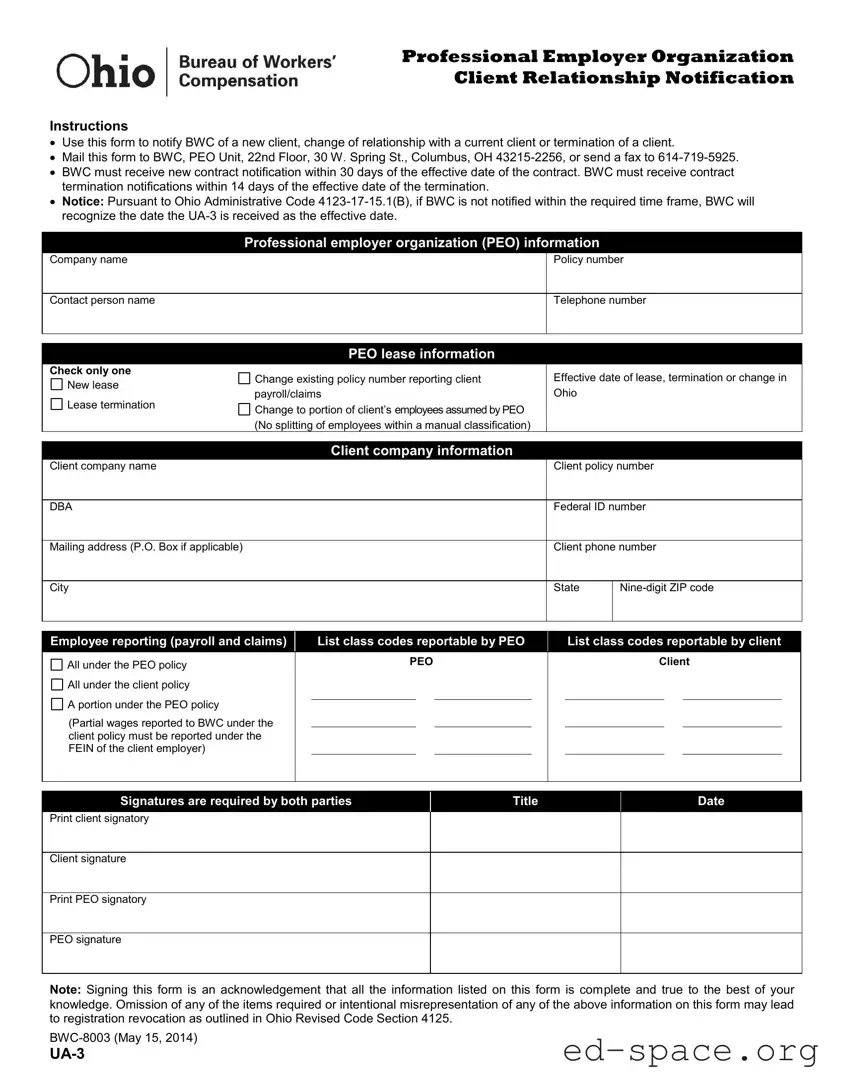
BWC-8003 (May 15, 2014)
UA-3
Professional Employer Organization
Client Relationship Notification
Instructions
Use this form to notify BWC of a new client, change of relationship with a current client or termination of a client.
Mail this form to BWC, PEO Unit, 22nd Floor, 30 W. Spring St., Columbus, OH 43215-2256, or send a fax to 614-719-5925.
BWC must receive new contract notification within 30 days of the effective date of the contract. BWC must receive contract
termination notifications within 14 days of the effective date of the termination.
Notice: Pursuant to Ohio Administrative Code 4123-17-15.1(B), if BWC is not notified within the required time frame, BWC will
recognize the date the UA-3 is received as the effective date.
Professional employer organization (PEO) information
Company name
Policy number
Contact person name
Telephone number
PEO lease information
Check only one
New lease
Lease termination
Change existing policy number reporting client
payroll/claims
Change to portion of client’s employees assumed by PEO
(No splitting of employees within a manual classification)
Effective date of lease, termination or change in
Ohio
Client company information
Client company name
Client policy number
DBA
Federal ID number
Mailing address (P.O. Box if applicable)
Client phone number
City
Nine-digit ZIP code
Signatures are required by both parties
Title
Date
Print client signatory
Client signature
Print PEO signatory
PEO signature
Note: Signing this form is an acknowledgement that all the information listed on this form is complete and true to the best of your
knowledge. Omission of any of the items required or intentional misrepresentation of any of the above information on this form may lead
to registration revocation as outlined in Ohio Revised Code Section 4125.
Employee reporting (payroll and claims)
List class codes reportable by PEO
List class codes reportable by client
All under the PEO policy
All under the client policy
A portion under the PEO policy
(Partial wages reported to BWC under the
client policy must be reported under the
FEIN of the client employer)
PEO
Client

Form Specifications

Fact Name Description
Purpose This form notifies the Bureau of Workers' Compensation (BWC) about new client relationships, changes, or terminations.
Submission Methods Send the form via mail to BWC, PEO Unit, 30 W. Spring St., Columbus, OH 43215-2256, or fax it to 614-719-5925.
Notification Deadlines BWC requires new contract notifications within 30 days and contract termination notifications within 14 days of the effective date.
Effective Date Rule If the BWC does not receive the UA-3 form in the required timeframe, the date of receipt becomes the effective date.
Governing Law This form is governed by Ohio Administrative Code 4123-17-15.1(B) and Ohio Revised Code Section 4125.

Ohio Ua 3: Usage Guidelines

Completing the Ohio UA-3 form is an essential step in notifying the Bureau of Workers' Compensation (BWC) about changes in your Professional Employer Organization (PEO) client relationships. After filling out the form, ensure it is submitted promptly to meet the required deadlines for notification.

  1. Obtain the Ohio UA-3 form from the BWC website or your local BWC office.
  2. Fill in the PEO information section with the following details:
    • Company name: Enter the name of your PEO.
    • Policy number: Provide the relevant policy number.
    • Contact person name: Write the name of the person to contact regarding this form.
    • Telephone number: Include a contact number.
  3. Complete the PEO lease information section by checking only one option:
    • Change existing policy number reporting client
    • New lease payroll/claims
    • Ohio lease termination
    • Change to portion of client’s employees assumed by PEO
  4. Fill in the client company information section with the following details:
    • Client company name: Enter the name of the client company.
    • Client policy number: Provide the client's policy number.
    • DBA: List the Doing Business As name, if applicable.
    • Federal ID number: Include the client's Federal Employer Identification Number.
    • Mailing address: Write the complete mailing address, including P.O. Box if applicable.
    • Client phone number: Provide a contact number for the client.
    • City, State, and Nine-digit ZIP code: Fill in the respective fields.
  5. In the employee reporting section, list the class codes reportable by both the PEO and the client.
  6. Ensure signatures are included:
    • Print client signatory: Write the name of the person signing for the client.
    • Client signature: Obtain the client's signature.
    • Print PEO signatory: Write the name of the person signing for the PEO.
    • PEO signature: Obtain the PEO's signature.
  7. Review the completed form to ensure all information is accurate and complete.
  8. Mail the form to BWC, PEO Unit, 22nd Floor, 30 W. Spring St., Columbus, OH 43215-2256, or fax it to 614-719-5925.

Your Questions, Answered

What is the purpose of the Ohio UA-3 form?

The Ohio UA-3 form serves as a notification tool for the Bureau of Workers' Compensation (BWC) regarding changes in the relationship between a Professional Employer Organization (PEO) and its client. This includes informing the BWC about new clients, changes to existing client relationships, or the termination of a client. It ensures that the BWC is updated on who is responsible for employee payroll and claims under the relevant policies.

How should I submit the Ohio UA-3 form?

You can submit the Ohio UA-3 form either by mail or by fax. If you choose to mail it, send the completed form to the BWC, PEO Unit, located at 22nd Floor, 30 W. Spring St., Columbus, OH 43215-2256. Alternatively, you can fax the form to 614-719-5925. Make sure to keep a copy for your records.

What are the deadlines for submitting the Ohio UA-3 form?

Timeliness is crucial when submitting the UA-3 form. For new contracts, the BWC must receive the notification within 30 days of the contract's effective date. If you are terminating a contract, you must notify the BWC within 14 days of the termination date. Failing to meet these deadlines means the BWC will recognize the date they receive the form as the effective date of the change.

What information is required on the Ohio UA-3 form?

The form requires detailed information about both the PEO and the client company. This includes the company name, policy numbers, contact information, and specific lease details. You will also need to provide class codes for employee reporting. Both parties must sign the form, confirming that all information is accurate and complete. Misrepresentation or omission of required information can lead to serious consequences, including the potential revocation of registration.

Common mistakes

When filling out the Ohio UA-3 form, it is essential to be meticulous and accurate. Mistakes can lead to delays or complications in your relationship with the Bureau of Workers' Compensation (BWC). Here are six common mistakes people make:

  1. Incorrect or Incomplete Information:

    Providing inaccurate details, such as the company name or policy number, can result in processing issues. Ensure that all fields are filled out completely and correctly.

  2. Missing Signatures:

    Both the client and PEO must sign the form. Failing to include signatures will delay the processing of your notification.

  3. Not Meeting Deadlines:

    Notifications must be sent within specific time frames. New contract notifications need to be received within 30 days, while terminations must be submitted within 14 days. Missing these deadlines can lead to the BWC recognizing a different effective date.

  4. Improper Submission Method:

    Forms should be mailed or faxed to the correct address. Sending the form to the wrong location can cause significant delays.

  5. Omitting Required Class Codes:

    It is crucial to list all applicable class codes for both the PEO and the client. Omitting these can lead to misclassification and potential penalties.

  6. Failing to Review for Accuracy:

    Before submitting the form, review all information carefully. Errors may seem minor but can have serious implications for your coverage and compliance.

By avoiding these common mistakes, you can help ensure a smoother process with the BWC. Taking the time to carefully complete the Ohio UA-3 form can save you from potential complications down the line.

Documents used along the form

The Ohio UA-3 form is essential for notifying the Bureau of Workers' Compensation (BWC) about changes in your relationship with a Professional Employer Organization (PEO). Alongside this form, several other documents may be needed to ensure compliance and proper communication with the BWC. Here’s a brief overview of those documents.

  • Ohio BWC Policy Application: This form is used to apply for a workers' compensation policy through the BWC. It collects necessary information about the business and its employees.
  • Client Agreement: This document outlines the terms and conditions of the relationship between the client and the PEO. It details responsibilities, services provided, and payment terms.
  • Payroll Reporting Form: This form is used to report employee wages and claims to the BWC. Accurate payroll reporting is crucial for determining the correct premium rates.
  • Change of Ownership Form: If there is a change in ownership of the client company, this form must be submitted to update the BWC records accordingly.
  • Employee Classification Codes: This document lists the classification codes for the employees under the PEO and the client. Proper classification is important for accurate premium calculation.
  • Termination Notice: When a client relationship is ending, this notice informs the BWC of the termination. It must be submitted within the required time frame to avoid issues.
  • Annual Renewal Form: This form is submitted yearly to renew the workers' compensation policy. It includes updated information about payroll and employee classifications.

Having these documents ready can streamline the process and help ensure compliance with BWC regulations. Always double-check the requirements to avoid any delays or complications.

Similar forms

The Ohio UA-3 form serves as a crucial document for notifying the Bureau of Workers' Compensation (BWC) about changes in relationships between professional employer organizations (PEOs) and their clients. Several other documents share similarities with the UA-3 form in purpose and function. Below is a list of six such documents, each accompanied by a brief explanation of how they relate to the UA-3 form.

  • Form W-2: This form reports wages paid to employees and the taxes withheld. Similar to the UA-3, it is essential for compliance with state and federal regulations regarding employee reporting and tax obligations.
  • Form 1099-MISC: Used for reporting payments made to independent contractors, this form shares the UA-3's purpose of documenting financial relationships. Both forms ensure that the appropriate parties are recognized for their contributions and obligations.
  • Employer's Quarterly Federal Tax Return (Form 941): This document is filed to report income taxes, Social Security tax, and Medicare tax withheld from employee paychecks. Like the UA-3, it is vital for maintaining accurate records of employer-employee relationships and compliance with tax regulations.
  • Ohio Employer's Annual Payroll Report: This report summarizes the payroll for the year and is similar to the UA-3 in that it helps the BWC track employment data for insurance and benefits purposes. Both documents are essential for ensuring proper reporting and compliance.
  • Notice of Change in Ownership (NCO): This form is used to inform the BWC about changes in the ownership of a business. It parallels the UA-3 in its role of keeping the BWC informed about significant changes in business structure that affect liability and insurance coverage.
  • Form I-9: This document verifies the identity and employment authorization of individuals hired for employment. While it serves a different primary function, both the I-9 and UA-3 are critical for ensuring that the necessary information about employment relationships is collected and maintained.

Understanding these documents can help streamline the process of maintaining compliance with various regulations and ensure that all parties involved are properly informed and protected.

Dos and Don'ts

When filling out the Ohio UA-3 form, follow these guidelines to ensure a smooth process.

  • Do provide accurate and complete information for all required fields.
  • Do submit the form to the correct address: BWC, PEO Unit, 22nd Floor, 30 W. Spring St., Columbus, OH 43215-2256.
  • Do send the form within the specified time frame: 30 days for new contracts and 14 days for terminations.
  • Do have both parties sign the form to acknowledge the information is true and complete.
  • Don't omit any required information, as this could lead to complications.
  • Don't submit the form via email; use mail or fax only.
  • Don't split employees within a manual classification; report them under one policy only.

Misconceptions

Understanding the Ohio UA-3 form is crucial for businesses working with Professional Employer Organizations (PEOs). However, several misconceptions can lead to confusion. Here are ten common misunderstandings about this form:

  1. It is optional to notify BWC about changes. Many believe that notifying the Bureau of Workers' Compensation (BWC) is optional. In reality, timely notification is required to avoid complications.
  2. Any method of submission is acceptable. Some think they can submit the form in any manner. The form must be mailed or faxed to the specified BWC address to be valid.
  3. There is no deadline for notifications. A common misconception is that there are no deadlines. BWC must receive notifications of new contracts within 30 days and terminations within 14 days.
  4. Only the PEO needs to sign the form. It is mistakenly assumed that only the PEO's signature is necessary. Both parties, the client and the PEO, must sign the form for it to be valid.
  5. All employees must be reported under the PEO policy. Some believe all employees fall under the PEO policy. In fact, only a portion of employees can be reported under the PEO, depending on the agreement.
  6. The form can be submitted after the effective date. Many think they can submit the form after the effective date of the contract or termination. However, late submissions can result in the BWC recognizing the received date as the effective date.
  7. Misrepresentation on the form is not serious. Some may underestimate the consequences of providing false information. Misrepresentation can lead to serious penalties, including registration revocation.
  8. Only the policy number needs to be updated. It is often believed that updating the policy number is sufficient. However, all relevant client and PEO information must be accurately reported.
  9. There is no need for a contact person. Some assume that a contact person is not necessary. Including a contact person helps streamline communication with the BWC.
  10. Once submitted, the form cannot be changed. Lastly, it is a misconception that the form cannot be amended after submission. Corrections can be made, but they must be communicated to the BWC promptly.

Clarifying these misconceptions can help ensure compliance with the necessary regulations and facilitate smoother operations between clients and PEOs.

Key takeaways

Filling out and using the Ohio UA-3 form is an important process for Professional Employer Organizations (PEOs) and their clients. Here are some key takeaways to keep in mind:

  • Purpose of the Form: This form is used to notify the Bureau of Workers' Compensation (BWC) about new client relationships, changes in existing relationships, or terminations of clients.
  • Submission Guidelines: Mail the completed form to the BWC at the specified address or send it via fax. Ensure that it reaches them within the required time frames.
  • Timely Notifications: New contract notifications must be submitted within 30 days of the contract's effective date. For terminations, notifications are due within 14 days.
  • Effective Date Considerations: If the BWC does not receive the form within the required time frame, they will consider the date the form is received as the effective date of the notification.
  • Required Information: Fill in all necessary details, including company names, policy numbers, and contact information for both the PEO and the client.
  • Signatures Matter: Both parties must sign the form. This signature confirms that all information provided is accurate and complete, which is crucial to avoid potential issues with registration.

By following these guidelines, PEOs and their clients can ensure a smooth process when dealing with the Ohio UA-3 form.