Homepage Blank Ohio Traffic Crash Report PDF Form
Content Overview

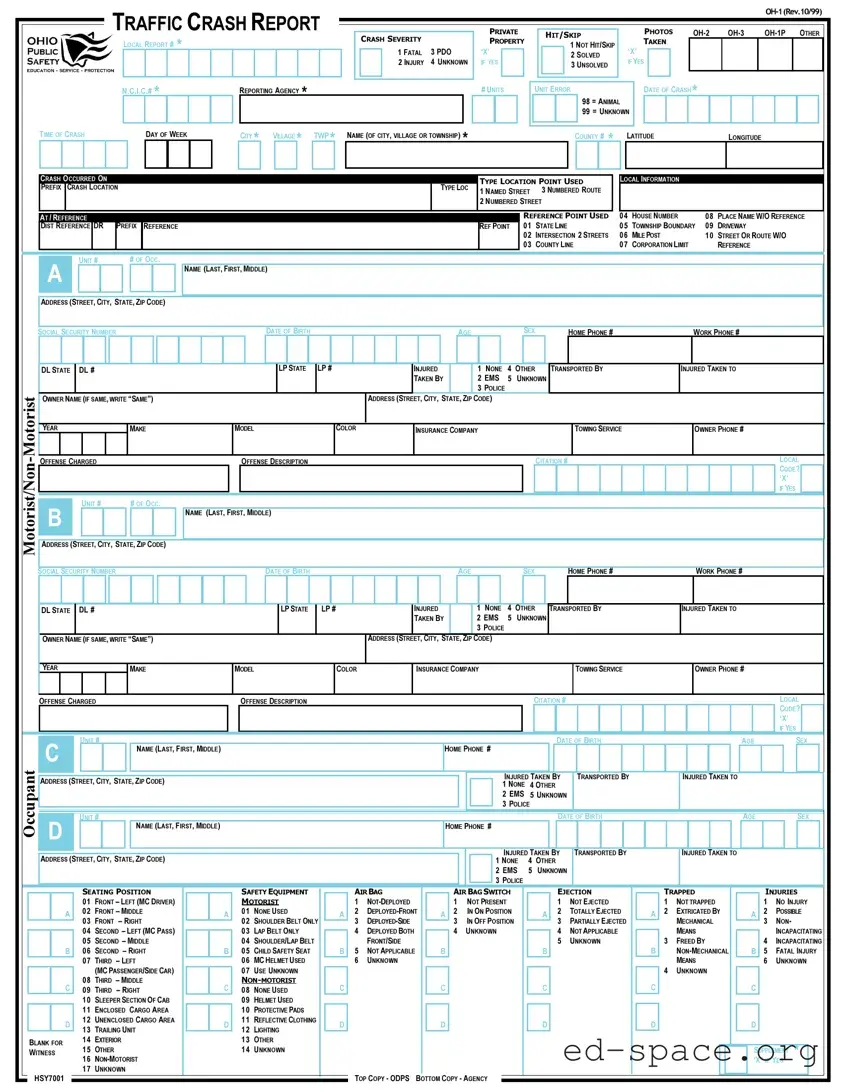
The Ohio Traffic Crash Report form is a critical document utilized by law enforcement and other agencies to record essential details surrounding traffic accidents. This comprehensive form captures a wide range of information, including the time and date of the crash, the severity of injuries, and the types of vehicles involved. It requires specific details about the location, such as street names and coordinates, ensuring accurate reporting. Additionally, the form gathers personal information about the drivers and passengers, including names, addresses, and insurance details. Important sections address the circumstances of the crash, such as contributing factors and the presence of any witnesses. Each aspect of the form is designed to provide a clear picture of the incident, facilitating investigations and aiding in the collection of statistics related to traffic safety. Completing this form accurately and promptly is vital, as it serves not only for legal purposes but also for improving road safety measures across Ohio.
Document Preview

REFERENCE POINT USED
01 STATE LINE
02 INTERSECTION 2 STREETS
03 COUNTY LINE
04 HOUSE NUMBER
05 TOWNSHIP BOUNDARY
06 MILE POST
07 CORPORATION LIMIT
08 PLACE NAME W/O REFERENCE
09 DRIVEWAY
10 STREET OR ROUTE W/O
REFERENCE
OH-1 (Rev.10/99)
LOCAL REPORT #
DATE OF CRASH
TIME OF CRASH
LONGITUDE
LATITUDE
LOCAL INFORMATION
CRASH LOCATION
TYPE LOC
CRASH OCCURRED ON
REFERENCE
DIST REFERENCE DR PREFIX
REF POINT
AT / REFERENCE
N.C.I.C.#
REPORTING AGENCY
# UNITS
COUNTY #
NAME (OF CITY, VILLAGE OR TOWNSHIP)
VILLAGE
CITY
TWP
A
UNIT #
# OF OCC .
ADDRESS (STREET, CITY, STATE, ZIP CODE)
NAME (LAST, FIRST, MIDDLE)
B
UNIT #
# OF OCC.
NAME (LAST, FIRST, MIDDLE)
ADDRESS (STREET, CITY, STATE, ZIP CODE)
1 FATAL
2 INJURY
3 PDO
4 UNKNOWN
CRASH SEVERITY
HIT/SKIP
1 NOT HIT/SKIP
2 SOLVED
3 UNSOLVED
TYPE LOCATION POINT USED
1 NAMED STREET
2 NUMBERED STREET
3 NUMBERED ROUTE
NAME (LAST, FIRST, MIDDLE)HOME PHONE #
ADDRESS (STREET, CITY, STATE, ZIP CODE)
C
AGE
SEX
SEATING POSITION
01 FRONT LEFT (MC DRIVER)
02 FRONT MIDDLE
03 FRONT  RIGHT
04 SECOND LEFT (MC PASS)
05 SECOND  MIDDLE
06 SECOND  RIGHT
07 THIRD  LEFT
(MC PASSENGER/SIDE CAR)
08 THIRD  MIDDLE
09 THIRD  RIGHT
10 SLEEPER SECTION OF CAB
11 ENCLOSED CARGO AREA
12 UNENCLOSED CARGO AREA
13 TRAILING UNIT
14 EXTERIOR
15 OTHER
16 NON-MOTORIST
17 UNKNOWN
A
B
C
D
AIR BAG
1NOT-DEPLOYED
2DEPLOYED-FRONT
3DEPLOYED-SIDE
4DEPLOYED BOTH
FRONT/SIDE
5NOT APPLICABLE
6UNKNOWN
A
B
C
D
AIR BAG S WITCH
1 NOT PRESENT
2 IN ON POSITION
3 IN OFF P OSITION
4UNKNOWN
A
B
C
D
EJECTION
1NOT EJECTED
2TOTALLY EJECTED
3PARTIALLY EJECTED
4NOT APPLICABLE
5UNKNOWN
A
B
C
D
TRAPPED
1NOT TRAPPED
2EXTRICATED BY
MECHANICAL
MEANS
3FREED BY
NON-MECHANICAL
MEANS
4UNKNOWN
A
B
C
D
INJURIES
1NO INJURY
2POSSIBLE
3NON-
INCAPACITATING
4INCAPACITATING
5FATAL INJURY
6UNKNOWN
A
B
C
D
UNIT #
BLANK FOR
WITNESS
Occupant Motorist/Non-Motorist
NAME (LAST, FIRST, MIDDLE)
HOME PHONE #
ADDRESS (STREET, CITY, STATE, ZIP CODE)
DATE OF BIRTH AGE SEX
UNIT #
D
TRAFFIC CRASH REPORT
OH-2 OH-3 OH-1P OTHER
UNIT ERROR
98 = ANIMAL
99 = UNKNOWN
DAY OF WEEK
*
*
*
*
*
SUPPLEMENT
X IF YES
HSY7001
*
*
*
*
*
LOCAL
CODE?
X
IF YES
CITATION #
OFFENSE CHARGED OFFENSE DESCRIPTION
LOCAL
CODE?
X
IF YES
CITATION #
OFFENSE CHARGED OFFENSE DESCRIPTION
SAFETY EQUIPMENT
MOTORIST
01 NONE USED
02 SHOULDER BELT ONLY
03 LAP BELT ONLY
04 SHOULDER/LAP BELT
05 CHILD SAFETY SEAT
06 MC HELMET USED
07 USE UNKNOWN
NON-MOTORIST
08 NONE USED
09 HELMET USED
10 PROTECTIVE PADS
11 REFLECTIVE CLOTHING
12 LIGHTING
13 OTHER
14 UNKNOWN
A
B
C
D
DATE OF BIRTH
PRIVATE
PROPERTY
X
IF YES
PHOTOS
TAKEN
X
IF YES
SOCIAL SECURITY NUMBER
DATE OF BIRTH
AGE
SEX
HOME PHONE # WORK PHONE #
ADDRESS (STREET, CITY, STATE, ZIP CODE)
OWNER NAME (IF SAME, WRITESAME)
DL STATE
DL #
LP STATE LP #
TOWING SERVICE
YEAR
MAKE
MODEL
COLOR
INSURANCE COMPANY
INJURED TRANSPORTED BY INJURED TAKEN TO
TAKEN BY
1 NONE
2 EMS
3 POLICE
4 OTHER
5 UNKNOWN
OWNER PHONE #
SOCIAL SECURITY NUMBER
DATE OF BIRTH AGE SEX
HOME PHONE # WORK PHONE #
ADDRESS (STREET, CITY, STATE, ZIP CODE)
OWNER NAME (IF SAME, WRITESAME)
DL STATE
DL #
LP STATE LP #
TOWING SERVICE
YEAR
MAKE MODEL COLOR INSURANCE COMPANY
INJURED TRANSPORTED BY INJURED TAKEN TO
TAKEN BY
1 NONE
2 EMS
3 POLICE
4 OTHER
5 UNKNOWN
OWNER PHONE #
INJURED TAKEN BY TRANSPORTED BY INJURED TAKEN TO
1 NONE
2 EMS
3 POLICE
4 OTHER
5 UNKNOWN
INJURED TAKEN BY TRANSPORTED BY INJURED TAKEN TO
1 NONE
2 EMS
3 POLICE
4 OTHER
5 UNKNOWN
TOP COPY - ODPS BOTTOM COPY - AGENCY
PREFIX
ACTION
1NON-CONTACT
2NON-COLLISION
3 STRIKING
4STRUCK
5BOTH STRIKING AND STRUCK
6UNKNOWN
A B
DAMAGE SCALE
1NONE
2NON-FUNCTIONAL DAMAGE
3FUNCTIONAL DAMAGE
4DISABLING DAMAGE
5SEVERE
6UNKNOWN
A B
POINT OF IMPACT
01 NONE
02 CENTER FRONT
03 RIGHT FRONT
04 RIGHT SIDE
05 RIGHT REAR
06 REAR CENTER
07 LEFT REAR
08 LEFT SIDE
09 LEFT FRONT
10 TOP AND WINDOWS
11 UNDERCARRIAGE
12 LOAD/TRAILER
13 TOTAL (A LL AREAS)
14 OTHER
15 UNKNOWN
A B
MOST HARMFUL EVENT
OF THE SEQUENCE OF EVENTS  WHICH
ONE IS THE MOST HARMFUL EVENT (1-4)
A B
TRAFFIC CONTROL
01 NO CONTROLS
02 STOP SIGN
03 YIELD SIGN
04 TRAFFIC SIGNAL
05 TRAFFIC FLASHERS
06 SCHOOL ZONE
07 RAILROAD CROSSBUCKS
08 RAILROAD FLASHERS
09 RAILROAD GATES
10 CONSTRUCTION BARRICADE
11 POLICE OFFICER
12 PAVEMENT MARKINGS
13 CROSSWALK LINES
14 WALK/DONT WALK SIGNAL
15 TRAFFIC CONTROL DEVICE INOPERATIVE,
MISSING, OBSCURED
16 OTHER
A B
STRIKING VEHICLE:
OVERRIDE/ UNDERRIDE
1NO UNDERRIDE OR OVERRIDE
2 UNDERRIDE, COMPARTMENT
INTRUSION
3 UNDERRIDE, NO COMPARTMENT
INTRUSION
4UNDERRIDE, COMPARTMENT
INTRUSION UNKNOWN
5OVERRIDE, MOTOR VEHICLE IN
TRANSPORT
6OVERRIDE, OTHER VEHICLE
7UNKNOWN
A B
CONTRIBUTING CIRCUMSTANCES
MOTORIST
01 NONE
02 FAILURE TO YIELD
03 RAN RED LIGHT, OR STOP SIGN
04 EXCEEDED SPEED LIMIT
05 UNSAFE SPEED
06 IMPROPER TURN
07 LEFT OF CENTER
08 FOLLOWED TOO CLOSELY/ACDA
09 IMPROPER LANE CHANGE/
DROVE OFF ROAD/
IMPROPER PASSING
10 IMPROPER BACKING
11 IMPROPER START FROM PARKED POSITION
12 STOPPED OR PARKED ILLEGALLY
13 OPERATING VEHICLE IN ERRATIC,
RECKLESS, CARELESS, NEGLIGENT OR
AGGRESSIVE MANNER
14 SWERVING TO AVOID (DUE TO WIND,
SLIPPERY SURFACE, VEHICLE, OBJECT,
NON-MOTORIST IN ROADWAY, ETC)
15 FAILURE TO CONTROL
16 VISION OBSTRUCTION
17 DRIVER INATTENTION
18 FATIGUE/ASLEEP
19 OPERATING DEFECTIVE EQUIPMENT
20 LOAD SHIFTING /FALLING/SPILLING
21 OTHER IMPROPER ACTION
22 UNKNOWN
NON-MOTORIST
23 NONE
24 IMPROPER CROSSING
25 DARTING
26 LYING AND/OR ILLEGALLY IN ROADWAY
27 FAILURE TO YIELD RIGHT OF WAY
28 NOT VISIBLE (D ARK CLOTHING)
29 INATTENTIVE
30 FAILURE TO OBEY TRAFFIC SIGNS,
SIGNALS, OR OFFICER
31 WRONG SIDE OF THE ROAD
32 OTHER
33 UNKNOWN
A B
FIRST HARMFUL EVENT
OF THE SEQUENCE OF EVENTS  WHICH
ONE IS THE FIRST HARMFUL EVENT (1-4)
A B
01 NOT AN INTERSECTION
02 FOUR-WAY INTERSECTION
03 T-INTERSECTION
04 Y-INTERSECTION
05 TRAFFIC CIRCLE/ROUNDABOUT
06 FIVE-POINT, OR MORE
07 ON RAMP
08 OFF RAMP
09 CROSSOVER
10 DRIVEWAY/ACCESS
11 RAILWAY G RADE C ROSSING
12 SHARED-USE PATHS OR TRAILS
13 UNKNOWN
TYPE OF INTERSECTION
OCCURRENCE
1ON ROADWAY
2ON SHOULDER
3 IN MEDIAN
4ON ROADSIDE
5ON GORE
6OUTSIDE TRAFFICWAY
7UNKNOWN
ROAD CONTOUR
1STRAIGHT LEVEL
2STRAIGHT GRADE
3CURVE LEVEL
4CURVE GRADE
01 SUB-COMPACT
02 COMPACT
03 MID SIZE
04 FULL SIZE
05 MINIVAN
06 SPORT U TILITY VEHICLE
07 PICKUP
08 PANEL/VAN
09 SINGLE UNIT TRUCK;
2 AXLES, 6 TIRES
10 SINGLE UNIT TRUCK; 3+ AXLES
11 TRUCK/TRAILER
12 TRUCK TRACTOR (BOBTAIL)
13 TRACTOR/SEMI-TRAILER
14 TRACTOR/DOUBLE SHORT
15 TRACTOR/DOUBLE LONG
16 FIFTH WHEEL OR
CONVERTER DOLLY
17 TRACTOR/TRIPLES
18 MOTORCYCLE
19 MOTORIZED BICYCLE
20 SCHOOL BUS
21 CHURCH BUS
22 PUBLIC BUS
23 OTHER BUS
24 POLICE VEHICLE
25 FIRE TRUCK
26 AMBULANCE/RESCUE
27 TAXI
28 MOTOR HOME
29 TRAIN
30 FARM VEHICLE
31 FARM EQUIPMENT
32 SNOWMOBILE
33 CONSTRUCTION EQUIPMENT
34 ALL OTHERS
35 ANIMAL W/RIDER
36 ANIMAL W/BUGGY
37 BICYCLE
38 PEDESTRIAN
39 PEDALCYCLIST
40 SKATER
41 OTHER-NON MOTORIST
42 UNKNOWN
A B
PRE-CRASH ACTIONS
MOTORIST
01 MOVEMENTS ESSENTIALLY
STRAIGHT AHEAD
02 BACKING
03 CHANGING LANES
04 OVERTAKING/PASSING
05 TURNING RIGHT
06 TURNING LEFT
07 MAKING U-TURN
08 ENTERING TRAFFIC LANE
09 LEAVING TRAFFIC LANE
10 PARKED
11 SLOWING/STOPPED IN TRAFFIC
12 DRIVERLESS
13 OTHER
14 UNKNOWN
NON-MOTORIST
15 ENTERING/CROSSING IN SPECIFIED
LOCATION
16 WALKING, RUNNING, JOGGING,
PLAYING, CYCLING
17 WORKING
18 PUSHING VEHICLE
19 APPROACHING/LEAVING VEHICLE
20 PLAYING/WORKING ON VEHICLE
21 STANDING
22 OTHER
23 UNKNOWN
A B
IN EMERGENCY RESPONSE
1NO
2YES
3UNKNOWN
A B
A B
NON-MOTORIST LOCATION
01 MARKED CROSSWALK AT
INTERSECTION
02 INTERSECTION/ NO CROSSWALK
03 NON-INTERSECTION CROSSWALK
04 DRIVEWAY A CCESS CROSSWALK
05 IN ROADWAY
06 NOT IN ROADWAY
07 MEDIAN (BUT NOT SHOULDER)
08 ISLAND
09 SHOULDER
10 SIDEWALK
11 WITHIN 10 FEET OF ROADWAY
(NOT SHOULDER, MEDIAN,
SIDEWALK, ISLAND)
12 BEYOND 10 FEET OF ROADWAY
(WITHIN TRAFFICWAY)
13 OUTSIDE TRAFFICWAY
14 SHARED USE PATHS OR TRAILS
15 UNKNOWN
CONDITION
1APPARENTLY NORMAL
2PHYSICAL IMPAIRMENT
3EMOTIONAL
4ILLNESS
5FELL ASLEEP, FAINTED, FATIGUED, ETC
6UNDER THE INFLUENCE OF
MEDICATIONS/DRUGS/ALCOHOL
7OTHER
8UNKNOWN
A B
VEHICLE DEFECT
CODE ONLY IF 19
SELECTED ABOVE
01 TURN SIGNALS
02 HEAD LAMPS
03 TAIL LAMPS
04 BRAKES
05 STEERING
06 TIRE BLOWOUT
07 WORN OR SLICK TIRES
08 TRAILER EQUIPMENT
DEFECTIVE
09 MOTOR TROUBLE
10 DISABLED FROM PRIOR
CRASH
11 OTHER DEFECTS
A B
SPEED
A
B
SEQUENCE OF EVENTS
A B
NON-COLLISION
01 OVERTURN/ROLLOVER
02 FIRE/EXPLOSION
03 IMMERSION
04 JACKKNIFE
05 CARGO/EQUIPMENT LOSS/SHIFT
06 EQUIPMENT FAILURE
07 SEPARATION OF UNITS
08 RAN OFF ROAD RIGHT
09 RAN OFF ROAD LEFT
10 CROSS MEDIAN/CENTERLINE
11 DOWNHILL RUNAWAY
12 OTHER NON-COLLISION
13 UNKNOWN NON-COLLISION
COLLISION W/PERSON, VEHICLE,
OR OBJECT NOT FIXED
14 PEDESTRIAN
15 PEDALCYCLE
16 RAILWAY VEHICLE
17 ANIMAL  FARM
18 ANIMAL  DEER
19 ANIMAL  OTHER
20 MOTOR VEHICLE IN TRANSPORT
21 PARKED MOTOR VEHICLE
22 WORK ZONE MAINTENANCE EQUIPMENT
23 OTHER MOVABLE OBJECT
24 UNKNOWN MOVABLE OBJECT
COLLISION WITH FIXED OBJECT
25 IMPACT ATTENUATOR/CRASH CUSHION
26 BRIDGE OVERHEAD STRUCTURE
27 BRIDGE PIER OR ABUTMENT
28 BRIDGE PARAPET
29 BRIDGE RAIL
30 GUARDRAIL FACE
31 GUARDRAIL END
32 MEDIAN BARRIER
33 HIGHWAY TRAFFIC SIGN POST
34 OVERHEAD SIGN POST
35 LIGHT/LUMINARIES SUPPORT
36 UTILITY POLE
37 OTHER POST, POLE OR SUPPORT
38 CULVERT
39 CURB
40 DITCH
41 EMBANKMENT
42 FENCE
43 MAILBOX
44 TREE
45 OTHER FIXED OBJECT
46 WORK ZONE MAINTENANCE EQUIPMENT
47 UNKNOWN FIXED OBJECT
48 OTHER
49 UNKNOWN
1
2
3
4
1
2
3
4
UNIT NUMBERS
A B
A B
SPEED DETECTED
1STATED
2ESTIMATED SPEED
ALCOHOL/DRUG SUSPECTED
1NONE
2YES ALCOHOL SUSPECTED
3YES  HBD NOT IMPAIRED
4YES DRUGS S USPECTED
5YES ALCOHOL / DRUGS SUSPECTED
6UNKNOWN
A B
ALCOHOL TEST STATUS
1NONE
2TEST R EFUSED
3TEST GIVEN, CONTAMINATED
SAMPLE/UNUSABLE
4TEST GIVEN , RESULTS KNOWN
5TEST GIVEN, RESULTS UNKNOWN
6UNKNOWN
A B
A B
DRUG TEST TYPE
1NONE
2BLOOD
3URINE
4OTHER
A B
DRUG TEST STATUS
1NONE
2TEST R EFUSED
3TEST GIVEN, CONTAMINATED
SAMPLE/UNUSABLE
4TEST G IVEN, RESULTS KNOWN
5TEST GIVEN, RESULTS UNKNOWN
6UNKNOWN
POSTED SPEED
A B
A B
DIRECTION
FROM TO FROM TO
1NORTH
2SOUTH
3EAST
4WEST
5NORTHEAST
6NORTHWEST
7SOUTHEAST
8SOUTHWEST
9UNKNOWN
LOCAL REPORT #
1 2 1 2
DRUG TEST 1&2 RESULT
A B
1NONE
2MARIJUANA
3COCAINE
4OPIATES
5AMPHETAMINES
6 PCP
7OTHER
8UNKNOWN AT TIME OF REPORTING
DAMAGE A REA
A
B
MOST DAMAGED AREA
01 NONE
02 CENTER FRONT
03 RIGHT FRONT
04 RIGHT SIDE
05 RIGHT REAR
06 REAR CENTER
07 LEFT REAR
08 LEFT SIDE
09 LEFT FRONT
10 TOP AND WINDOWS
11 UNDERCARRIAGE
12 LOAD/TRAILER
13 TOTAL (A LL AREAS)
14 OTHER
15 UNKNOWN
A B
ALCOHOL TEST TYPE
1NONE
2BLOOD
3URINE
A B
4BREATH
5OTHER
SUPPLEMENT
X IF YES
A
B
ALCOHOL TEST R ESULT
.
.
*
*
MOTORIST
NON-MOTORIST
TYPE O F UNIT
ROAD CONDITIONS
PRIMARY SECONDARY
01 DRY
02 WET
03 SNOW
04 ICE
05 SAND, MUD, DIRT, OIL, GRAVEL
06 WATER (STANDING, MOVING)
07 SLUSH
08 DEBRIS**
09 RUT, HOLES, BUMPS, UNEVEN
PAVEMENT **
10 OTHER
11 UNKNOWN
* *SECONDARY ROAD CONDITIONS ONLY
TOP COPY - ODPS BOTTOM COPY - AGENCY
WEATHER
01 CLEAR
02 CLOUDY
03 FOG, SMOG, SMOKE
04 RAIN
05 SLEET, HAIL (FREEZING RAIN DRIZZLE)
06 SNOW
07 SEVERE CROSSWINDS
08 BLOWING SAND,SOIL, DIRT,SNOW
09 OTHER
10 UNKNOWN
SCHOOL B US RELATED
1NO
2YES, DIRECTLY INVOLVED
3YES, INDIRECTLY INVOLVED
4UNKNOWN
WORKERS PRESENT
1NO
2YES
3UNKNOWN
TYPE O F WORK ZONE
1LANE CLOSURE
2LANE SHIFT/CROSSOVER
3WORK ON SHOULDER OR MEDIAN
4INTERMITTENT/ MOVING WORK
5OTHER
WORK ZONE RELATED
1NO
2YES
3UNKNOWN
LOCATION OF CRASH IN
WORK Z ONE
1BEFORE FIRST WORK ZONE
WARNING SIGN
2ADVANCE WARNING AREA
3TRANSITION AREA
4ACTIVITY AREA
TIME REC CALLDATE CRASH REPORTED TOTAL MINUTES
OFFICERS NAME
BADGE #
CHECKED BY
CDL Class
1CLASS A
2CLASS B
3CLASS C
4CLASS M
5CLASS D
01 NOT APPLICABLE
02 BUS (9-15 INCLUDING DRIVER)
03 VAN/ENCLOSED BOX
04 GRAIN/CHIPS/GRAVEL
09 CONCRETE MIXER
10 AUTO TRANSPORTER
11 GARBAGE/REFUSE
12 OTHER
13 UNKNOWN
CARGO BODY TYPE
DISPATCH
ARRIVED CLEARED OTHER
DATE REPORT FILED
LIGHT CONDITIONS
PRIMARY SECONDARY
1DAYLIGHT
2DAWN
3DUSK
4DARK  LIGHTED ROADWAY
5DARK NOT LIGHTED
6DARK UNKNOWN LIGHTING
7GLARE
8OTHER
9UNKNOWN
LOCAL REPORT #
SUPPLEMENT
X IF YES
1NOT COLLISION BETWEEN
TWO VEHICLES IN TRANSPORT
2REAR-END
3HEAD-ON
4REAR-TO-REAR
5BACKING
6ANGLE
7SIDESWIPE, SAME DIRECTION
8SIDESWIPE, OPPOSITE DIRECTION
9UNKNOWN
MANNER OF COLLISION OR IMPACT
Weight (GVWR)
1LESS/EQUAL 10,000
2 10,001 - 26,000
3MORE THAN 26,000
Hazardous
Materials Placard
1NO
2YES
3UNKNOWN
*
*
*
*
*
05 POLE
06 CARGO TANK
07 FLATBED
08 DUMP
Hazardous
Material Released
1NO
2YES
3NOT APPLICABLE
4UNKNOWN
UNIT #
ADDRESS (STREET, CITY, ST, ZIP CODE)
COMPANY (F ROM SHIPPING PAPERS)
COMPANY PHONE
US DOT ICC MC PUCO TRAILER LP ST. TRAILER LP YEAR TRAILER LP #
PLACARD # # DIA.
THE CRASH INVOLVED ONE OR MORE OF THE FOLLOWING:
A TRUCK (MOTOR VEHICLE) WITH A GVWR MORE THAN 10,000 POUNDS; OR
A TRUCK (MOTOR VEHICLE) WITH A HAZARDOUS MATERIALS PLACARD; OR
A BUS DESIGNED FOR AT LEAST 8 PERSONS, INCLUDING DRIVER .
A
N
D
THE CRASH RESULTED IN ONE OR MORE OF THE FOLLOWING:
A FATALITY; OR
AN INJURY REQUIRING TRANSPORTATION FOR IMMEDIATE MEDICAL TREATMENT; OR
AT LEAST ONE VEHICLE WAS TOWED DUE TO DISABLING DAMAGE OR REQUIRED INTERVENING ASSISTANCE BEFORE PROCEEDING UNDER ITS OWN POWER.
Write an N
on the compass
diagram to indicate
the direction of
north.
REPORT TAKEN BY 1 POLICE AGENCY
2 MOTORIST
REPORT TAKEN AT 1 SCENE
2 STATION
3 OTHER
TOP COPY - ODPS BOTTOM COPY - AGENCY
Police Action
Truck/Bus
Narrative
Diagram

Form Specifications

Fact Name Details
Form Title The official title of the form is the "Ohio Traffic Crash Report." This document is essential for documenting traffic incidents in the state.
Local Report Number Each report includes a unique Local Report Number, which helps in tracking and referencing specific incidents.
Governing Law The Ohio Traffic Crash Report is governed by Ohio Revised Code § 5502.11, which mandates the reporting of traffic accidents.
Crash Severity Options The form categorizes crashes based on severity, including options for fatal, injury, and property damage only (PDO) incidents.
Data Collection Information collected includes the time and date of the crash, location, and details about the vehicles and individuals involved.
Witness Information The form allows for the collection of witness details, which can be crucial in determining the circumstances surrounding the crash.
Injury Reporting It includes sections for reporting injuries, specifying whether individuals were transported by emergency services or police.
Insurance Information Details about the insurance coverage of the involved vehicles are required, which aids in claims processing.
Supplemental Reports There is a provision for supplemental reports, allowing additional information to be added after the initial report is filed.
Diagram Section The form includes a diagram area where officers can illustrate the positions of vehicles and the direction of travel, enhancing clarity.

Ohio Traffic Crash Report: Usage Guidelines

Filling out the Ohio Traffic Crash Report form is an important step in documenting the details of a traffic incident. This report provides essential information that can be used for insurance claims, legal matters, and statistical analysis. Ensure that you have all necessary details at hand before beginning the process. Below are the steps to complete the form accurately.

  1. Begin with the Local Report Number at the top of the form. This number is usually provided by the reporting agency.
  2. Indicate the Time of Crash and the Day of the Week when the incident occurred.
  3. Fill in the Reporting Agency details, including the name and contact number.
  4. Provide the Date of Crash and the County where the crash took place.
  5. Enter the Latitude and Longitude of the crash location.
  6. Specify the Type of Location where the crash occurred, selecting from the provided options (e.g., named street, numbered route).
  7. List the Units involved in the crash. For each unit, provide the Owner's Name, Address, and Vehicle Details (year, make, model, color).
  8. Document the Injured Parties by providing their names, addresses, dates of birth, and details of their injuries.
  9. Indicate the Offense Charged and any citations issued, including the Citation Number.
  10. Complete the Witness Information section if applicable, including their names and contact details.
  11. Fill out the Sequence of Events and Pre-Crash Actions to describe how the incident occurred.
  12. Provide details about the Weather Conditions and Road Conditions at the time of the crash.
  13. Sign and date the report at the bottom of the form to certify that the information provided is accurate.

Once the form is completed, it should be submitted to the appropriate agency or insurance company as required. Keep a copy for your records, as it may be needed for future reference or follow-up actions.

Your Questions, Answered

What is the Ohio Traffic Crash Report form?

The Ohio Traffic Crash Report form is a standardized document used by law enforcement agencies in Ohio to record details about traffic accidents. This form captures essential information such as the time and location of the crash, involved parties, vehicle details, and any injuries sustained. It serves as an official record for insurance claims and legal proceedings.

Who needs to fill out the Ohio Traffic Crash Report?

The report is typically completed by law enforcement officers who respond to the scene of a traffic accident. In cases where no police are present, involved parties may need to fill out a report for their insurance companies. However, it is recommended that law enforcement be notified to ensure proper documentation.

What information is required on the form?

Key information required includes the date and time of the crash, the names and contact details of all involved parties, vehicle information (make, model, year), and details about any injuries. Additionally, the form requires the crash location, weather conditions, and any contributing factors leading to the accident.

How is the Ohio Traffic Crash Report used?

This report is used by various parties, including insurance companies, legal entities, and law enforcement agencies. It provides a factual account of the incident, which can be vital in determining fault, processing claims, and understanding traffic patterns for safety improvements.

Can I obtain a copy of the Ohio Traffic Crash Report?

Yes, individuals involved in the crash or their insurance representatives can request a copy of the report. Requests can typically be made through the law enforcement agency that filed the report or through the Ohio Department of Public Safety, depending on the agency's policies.

What should I do if I disagree with the report's findings?

If there are discrepancies in the report, the involved party should contact the law enforcement agency that completed the report. They can request a review or correction of the information. It may also be beneficial to gather additional evidence, such as witness statements or photographs, to support any claims of inaccuracies.

Is there a fee for filing or obtaining the Ohio Traffic Crash Report?

There may be a fee associated with obtaining a copy of the report, which varies by agency. It is advisable to check with the specific law enforcement agency or the Ohio Department of Public Safety for details regarding any applicable fees.

Common mistakes

  1. Failing to provide accurate location details. It is crucial to specify the exact location of the crash, including street names and relevant landmarks. Incomplete or incorrect information can delay investigations.

  2. Neglecting to include all involved parties. Ensure that every driver, passenger, and pedestrian involved is listed with complete information. Omitting details can lead to complications in liability determination.

  3. Not documenting the time and date of the crash correctly. This information is essential for legal and insurance purposes. Always double-check the accuracy before submission.

  4. Using vague or unclear descriptions of the crash. Provide specific details about the events leading up to the crash. This clarity can significantly impact the outcome of any investigations or claims.

  5. Omitting information about injuries. If anyone was injured, it must be clearly stated. This includes details about the severity of injuries and whether medical assistance was sought.

  6. Failing to check for insurance information. It is vital to include the insurance details of all involved parties. Missing this can complicate claims and legal proceedings.

  7. Not signing the report or failing to date it. A signature and date validate the report. Without these, the report may be considered incomplete or invalid.

Documents used along the form

The Ohio Traffic Crash Report form is an essential document used to record details of traffic accidents. Along with this form, several other documents are often necessary to complete the reporting process. Below is a list of commonly used forms and documents that accompany the Ohio Traffic Crash Report.

  • Private Photos (OH-2): This document allows individuals involved in the crash to submit photographs of the accident scene, vehicle damage, and any relevant evidence. These images can provide crucial context for the investigation.
  • Supplemental Report (OH-3): This form is used to provide additional information that may not have been included in the initial report. It is helpful for clarifying details or adding new findings after the crash report has been filed.
  • Witness Statements: Collecting statements from witnesses can offer valuable insights into the events leading up to the crash. These statements can help corroborate or challenge the accounts given by the involved parties.
  • Insurance Information: This document includes details about the insurance coverage for each vehicle involved in the crash. It is vital for processing claims and determining liability.
  • Traffic Citations: If any traffic violations occurred during the crash, citations issued by law enforcement can be included. These documents can influence the outcome of liability determinations and insurance claims.

Gathering and submitting these documents promptly can significantly impact the resolution of any claims or legal issues arising from the crash. Ensure that all relevant forms are completed accurately to facilitate a smoother process.

Similar forms

  • Accident Report Form: Similar to the Ohio Traffic Crash Report, this form collects information about the details of an accident, including involved parties, damages, and circumstances surrounding the event.
  • Incident Report Form: This document is used to report any unusual or criminal events. Like the traffic report, it includes details about people involved, location, and descriptions of the incident.
  • Insurance Claim Form: This form is often required by insurance companies after a traffic accident. It gathers information similar to the crash report, such as the date, time, and nature of the incident, as well as the parties involved.
  • Police Report: Generated by law enforcement after responding to a traffic crash, this report includes many of the same details as the Ohio Traffic Crash Report, such as witness statements and evidence collected at the scene.
  • Motor Vehicle Accident Report: This document is used by insurance companies and may include similar data points as the Ohio report, focusing on the specifics of the crash and the vehicles involved.
  • Vehicle Damage Report: This report details the damages sustained by vehicles in an accident. It often includes photographs and descriptions, akin to the damage assessment in the traffic crash report.
  • Witness Statement Form: Used to collect testimonies from bystanders, this form captures information about the accident and its circumstances, similar to the witness sections in the traffic crash report.

Dos and Don'ts

When filling out the Ohio Traffic Crash Report form, adhere to the following guidelines to ensure accuracy and compliance:

  • Do: Provide clear and legible handwriting to avoid misinterpretation.
  • Do: Include all required information, such as date, time, and location of the crash.
  • Do: Use accurate details regarding the vehicles involved, including make, model, and license plate numbers.
  • Do: Report any injuries or fatalities clearly and accurately.
  • Don't: Leave any sections blank; incomplete forms may delay processing.
  • Don't: Provide false information or estimates; stick to the facts as you know them.
  • Don't: Use abbreviations that could confuse the reader.
  • Don't: Forget to sign and date the report before submission.

Misconceptions

Misconceptions about the Ohio Traffic Crash Report Form

  • Misconception 1: The form is only for serious accidents.
  • This is not true. The Ohio Traffic Crash Report form is required for all traffic crashes, regardless of severity. This includes minor accidents, where no injuries occur. Proper documentation is essential for insurance and legal purposes.

  • Misconception 2: Only police officers can fill out the form.
  • While law enforcement typically completes the report at the scene, involved parties can also provide information. This ensures that all perspectives are captured. However, the final report must be filed by an authorized agency.

  • Misconception 3: The report is only useful for legal cases.
  • The Ohio Traffic Crash Report serves multiple purposes. It aids in accident analysis, helps improve road safety, and informs insurance claims. It is a valuable tool for various stakeholders, not just in legal contexts.

  • Misconception 4: You can submit the report anytime after the accident.
  • There are strict timelines for submitting the report. Typically, it must be filed within a certain period after the crash. Delays can complicate legal and insurance processes, so timely submission is crucial.

Key takeaways

  • Accurate Information is Key: When filling out the Ohio Traffic Crash Report form, ensure all details are accurate and complete. This includes names, addresses, and the specifics of the crash.

  • Report All Injuries: Be sure to document any injuries sustained during the crash. This includes those who may not have been immediately transported to a hospital.

  • Understand the Crash Severity: The form categorizes crash severity into fatal, injury, and property damage only. Make sure to select the correct category based on the incident.

  • Document Witnesses: If there were any witnesses to the crash, include their information on the report. Their accounts can be valuable in understanding the circumstances of the accident.

  • Include Vehicle Details: Each vehicle involved should have its make, model, color, and insurance information clearly listed. This helps in processing claims and understanding liability.

  • Use Clear Diagrams: If applicable, use the diagram section of the report to illustrate the crash scene. This visual representation can provide clarity on how the accident occurred.

  • Submit Timely: It’s important to submit the completed form promptly. Delays can complicate investigations and insurance claims.

  • Keep Copies: Always retain a copy of the submitted report for your records. This can be useful for future reference or if disputes arise.