Homepage Blank Ohio Power Statutory PDF Form
Content Overview

The Ohio Statutory Power of Attorney form is a crucial legal document that empowers an individual, referred to as the agent, to make decisions regarding financial matters on behalf of another individual, known as the principal. This form allows the agent to manage a wide range of subjects, including real property, personal assets, stocks, and bank accounts. Importantly, it does not extend authority over healthcare decisions. To ensure clarity and specificity, the principal must initial each subject they wish to include in the agent's authority, or they can opt for blanket authority by initialing "All Preceding Subjects." For the form to be valid in real estate transactions, it must be signed before a notary public and recorded with the county recorder. The document also emphasizes the importance of selecting a trustworthy agent, as their authority typically remains in effect until the principal revokes it or passes away. Additionally, it includes provisions for naming successor agents and outlines actions that require explicit authorization. Understanding these elements is essential for anyone considering granting power of attorney in Ohio.


Document Preview

_______________________________________________________________________
Ohio Statutory Form Power Of Attorney Cover Letter 1 | Page
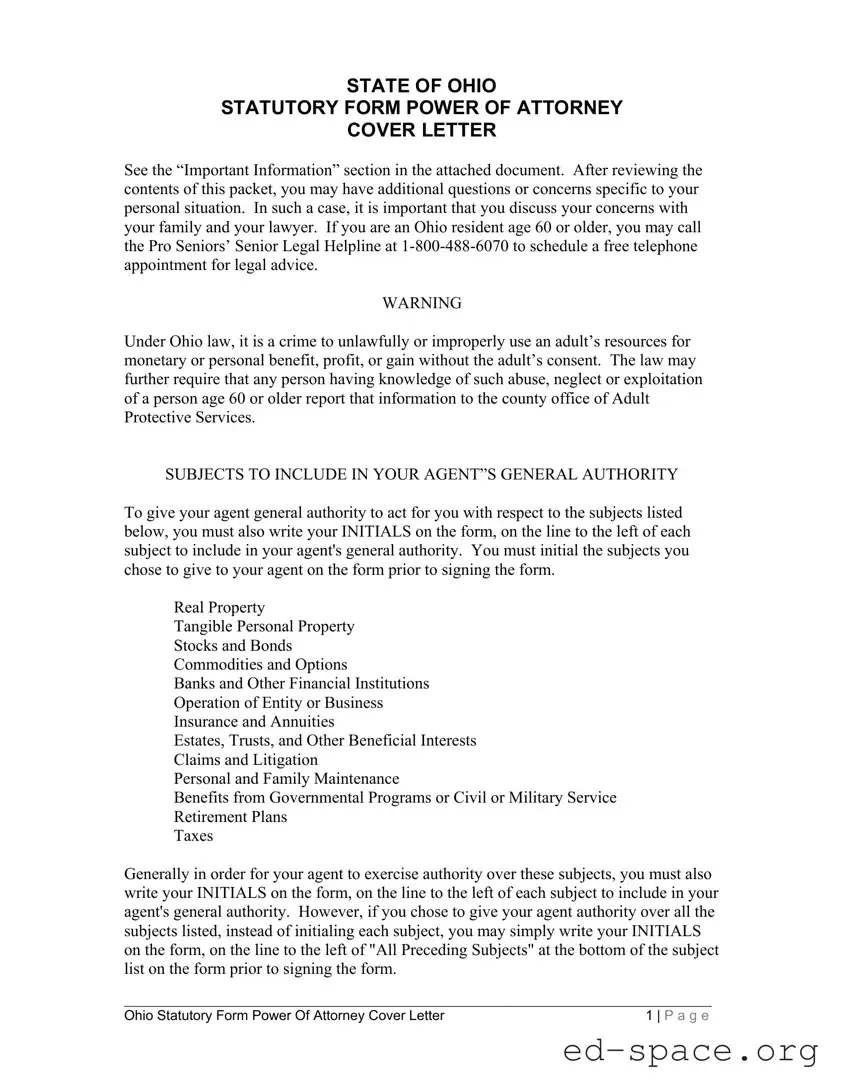
STATE OF OHIO
STATUTORY FORM POWER OF ATTORNEY
COVER LETTER
See the “Important Information” section in the attached document. After reviewing the
contents of this packet, you may have additional questions or concerns specific to your
personal situation. In such a case, it is important that you discuss your concerns with
your family and your lawyer. If you are an Ohio resident age 60 or older, you may call
the Pro Seniors’ Senior Legal Helpline at 1-800-488-6070 to schedule a free telephone
appointment for legal advice.
WARNING
Under Ohio law, it is a crime to unlawfully or improperly use an adult’s resources for
monetary or personal benefit, profit, or gain without the adult’s consent. The law may
further require that any person having knowledge of such abuse, neglect or exploitation
of a person age 60 or older report that information to the county office of Adult
Protective Services.
SUBJECTS TO INCLUDE IN YOUR AGENT”S GENERAL AUTHORITY
To give your agent general authority to act for you with respect to the subjects listed
below, you must also write your INITIALS on the form, on the line to the left of each
subject to include in your agent's general authority. You must initial the subjects you
chose to give to your agent on the form prior to signing the form.
Real Property
Tangible Personal Property
Stocks and Bonds
Commodities and Options
Banks and Other Financial Institutions
Operation of Entity or Business
Insurance and Annuities
Estates, Trusts, and Other Beneficial Interests
Claims and Litigation
Personal and Family Maintenance
Benefits from Governmental Programs or Civil or Military Service
Retirement Plans
Taxes
Generally in order for your agent to exercise authority over these subjects, you must also
write your INITIALS on the form, on the line to the left of each subject to include in your
agent's general authority. However, if you chose to give your agent authority over all the
subjects listed, instead of initialing each subject, you may simply write your INITIALS
on the form, on the line to the left of "All Preceding Subjects" at the bottom of the subject
list on the form prior to signing the form.
_______________________________________________________________________
Ohio Statutory Form Power Of Attorney Cover Letter 2 | Page
SIGNING AND RECORDING THE FORM
In order for this form to be used in connection with real property transactions, you must
sign and acknowledge the form before a notary public and the form must also be recorded
in the office of the county recorder of the county in which the real property is located
prior to using the form in connection with a real property transaction. (R.C. 1337.04).
Another benefit to signing and acknowledging the form before a notary public is that
your signature on the statutory form power of attorney is presumed to be genuine if you
acknowledge your signature before a notary public and this will greatly facilitate the
form’s acceptance by businesses, banks and other financial institutions. (R.C. 1337.25).
Note that recording the completed statutory form power of attorney in the office of the
county recorder is permitted but not required unless the form will be used in connection
with a real estate transaction. The recording and indexing fees set by the Ohio Revised
Code (R.C. 317.32) are twenty-eight dollars for the first two pages and eight dollars for
each additional page.
StateofOhio‐StatutoryFormPowerofAttorney 1|Page
STATE OF OHIO
STATUTORY FORM POWER OF ATTORNEY
IMPORTANT INFORMATION
1) This power of attorney authorizes another person (your agent) to make decisions
concerning your property for you (the principal). Your agent will be able to make
decisions and act with respect to your property (including your money) whether or not
you are able to act for yourself. The meaning of authority over subjects listed on this
form is explained in the Uniform Power of Attorney Act (sections 1337.21 to 1337.64 of
the Revised Code).
2) This power of attorney does not authorize the agent to make health-care decisions for
you.
3) You should select someone you trust to serve as your agent. Unless you specify
otherwise, generally the agent's authority will continue until you die or revoke the
power of attorney or the agent resigns or is unable to act for you.
4) Your agent is entitled to reasonable compensation unless you state otherwise in the
Special Instructions.
5) This form provides for designation of one agent. If you wish to name more than one
agent you may name a coagent in the Special Instructions. Coagents are not required
to act together unless you include that requirement in the Special Instructions.
6) If your agent is unable or unwilling to act for you, your power of attorney will end
unless you have named a successor agent. You may also name a second successor
agent.
7) This power of attorney becomes effective immediately unless you state otherwise in
the Special Instructions.
ACTIONS REQUIRING EXPRESS AUTHORITY
Unless expressly authorized and initialed by me in the Special Instructions, this power
of attorney does not grant authority to my agent to do any of the following:
(1) Create a trust;
(2) Amend, revoke, or terminate an inter vivos trust, even if specific authority to do so
is granted to the agent in the trust agreement;
(3) Make a gift;
(4) Create or change rights of survivorship;
(5) Create or change a beneficiary designation;
(6) Delegate authority granted under the power of attorney;
(7) Waive the principal's right to be a beneficiary of a joint and survivor annuity,
including a survivor benefit under a retirement plan;
(8) Exercise fiduciary powers that the principal has authority to delegate.
StateofOhio‐StatutoryFormPowerofAttorney 2|Page
CAUTION: Granting any of the above eight powers will give your agent the authority
to take actions that could significantly reduce your property or change how your property is
distributed at your death.
If you have questions about the power of attorney or the authority you are granting to
your agent, you should seek legal advice before signing this form.
STATE OF OHIO
STATUTORY FORM POWER OF ATTORNEY
DESIGNATION OF AGENT
I, _________________________________________________ name the following
person as my agent:
Name of Agent: ____________________________________________________________
Agent’s Address: ___________________________________________________________
Agent’s Telephone Number: ( ) _____________________________________
DESIGNATION OF SUCCESSOR AGENT(S) (OPTIONAL)
If my agent is unable or unwilling to act for me, I name as my successor agent:
Name of Successor Agent: ___________________________________________________
Successor Agent’s Address: __________________________________________________
Successor Agent’s Telephone Number: ( ) ____________________________
If my successor agent is unable or unwilling to act for me, I name as my second
successor agent:
Name of Second Successor Agent: _____________________________________________
Second Successor Agent’s Address: ____________________________________________
Second Successor Agent’s Telephone Number: ( ) ______________________
StateofOhio‐StatutoryFormPowerofAttorney 3|Page
GRANT OF GENERAL AUTHORITY
I grant my agent and any successor agent general authority to act for me with respect
to the following subjects as defined in the Uniform Power of Attorney Act (sections 1337.21 to
1337.64 of the Revised Code):
(INITIAL each subject you want to include in the agent's general authority. If you wish
to grant general authority over all of the subjects you may initial "All Preceding Subjects"
instead of initialing each subject.)
____________ Real Property
____________ Tangible Personal Property
____________ Stocks and Bonds
____________ Commodities and Options
____________ Banks and Other Financial Institutions
____________ Operation of Entity or Business
____________ Insurance and Annuities
____________ Estates, Trusts, and Other Beneficial Interests
____________ Claims and Litigation
____________ Personal and Family Maintenance
____________ Benefits from Governmental Programs or Civil or Military Service
____________ Retirement Plans
____________ Taxes
____________ All Preceding Subjects
LIMITATION ON AGENT'S AUTHORITY
An agent that is not my ancestor, spouse, or descendant MAY NOT use my property
to benefit the agent or a person to whom the agent owes an obligation of support unless I
have included that authority in the Special Instructions.
StateofOhio‐StatutoryFormPowerofAttorney 4|Page
SPECIAL INSTRUCTIONS (OPTIONAL)
You may give special instructions on the following lines:
__________________________________________________________________________
__________________________________________________________________________
__________________________________________________________________________
__________________________________________________________________________
__________________________________________________________________________
__________________________________________________________________________
__________________________________________________________________________
__________________________________________________________________________
__________________________________________________________________________
EFFECTIVE DATE
This power of attorney is effective immediately unless I have stated otherwise in the
Special Instructions.
NOMINATION OF GUARDIAN (OPTIONAL)
If it becomes necessary for a court to appoint a guardian of my estate or my person, I
nominate the following person(s) for appointment:
Name of Nominee for guardian of my estate: _____________________________________
Nominee’s Address: _________________________________________________________
Nominee’s Telephone Number: ( ) ___________________________________
Name of Nominee for guardian of my person: _____________________________________
Nominee’s Address: _________________________________________________________
Nominee’s Telephone Number: ( ) ___________________________________
StateofOhio‐StatutoryFormPowerofAttorney 5|Page
RELIANCE ON THIS POWER OF ATTORNEY
Any person, including my agent, may rely upon the validity of this power of attorney or
a copy of it unless that person knows it has terminated or is invalid.
SIGNATURE AND ACKNOWLEDGMENT
_________________________________________ ________________________________
Your Signature Date
_________________________________________
Your Name Printed
__________________________________________________________________________
Your Address
(___________)_____________________________
Your Telephone Number
STATE OF OHIO
COUNTY OF ______________________________
This document was acknowledged before me on __________________________ (Date), by
__________________________________________________________ (Name of Principal).
_________________________________________
Signature of Notary
My commission expires: ______________________________________________________
This document prepared by:
_________________________________________
_________________________________________
_________________________________________
_________________________________________
StateofOhio‐StatutoryFormPowerofAttorney 6|Page
IMPORTANT INFORMATION FOR AGENT
AGENT'S DUTIES
When you accept the authority granted under this power of attorney, a special legal
relationship is created between you and the principal. This relationship imposes upon you
legal duties that continue until you resign or the power of attorney is terminated or revoked.
You must:
(1) Do what you know the principal reasonably expects you to do with the principal's
property or, if you do not know the principal's expectations, act in the principal's
best interest;
(2) Act in good faith;
(3) Do nothing beyond the authority granted in this power of attorney;
(4) Attempt to preserve the principal's estate plan if you know the plan and preserving
the plan is consistent with the principal's best interest;
(5) Disclose your identity as an agent whenever you act for the principal by writing or
printing the name of the principal and signing your own name as “agent” in the
following manner:
(Principal's Name) by (Your Signature) as Agent
Unless the Special Instructions in this power of attorney state otherwise, you must
also:
(1) Act loyally for the principal's benefit;
(2) Avoid conflicts that would impair your ability to act in the principal's best interest;
(3) Act with care, competence, and diligence;
(4) Keep a record of all receipts, disbursements, and transactions made on behalf of
the principal;
(5) Cooperate with any person that has authority to make health-care decisions for the
principal to do what you know the principal reasonably expects or, if you do not
know the principal's expectations, to act in the principal's best interest.
StateofOhio‐StatutoryFormPowerofAttorney 7|Page
TERMINATION OF AGENT'S AUTHORITY
You must stop acting on behalf of the principal if you learn of any event that terminates
this power of attorney or your authority under this power of attorney. Events that terminate a
power of attorney or your authority to act under a power of attorney include:
(1) The death of the principal;
(2) The principal's revocation of the power of attorney or your authority;
(3) The occurrence of a termination event stated in the power of attorney;
(4) The purpose of the power of attorney is fully accomplished;
(5) If you are married to the principal, a legal action is filed with a court to end your
marriage, or for your legal separation, unless the Special Instructions in this power
of attorney state that such an action will not terminate your authority.
LIABILITY OF AGENT
The meaning of the authority granted to you is defined in the Uniform Power of
Attorney Act (sections 1337.21 to 1337.64 of the Revised Code). If you violate the Uniform
Power of Attorney Act or act outside the authority granted, you may be liable for any
damages caused by your violation.
If there is anything about this document or your duties that you do not understand, you
should seek legal advice.

Form Specifications

Fact Name Fact Description
Governing Law The Ohio Power of Attorney is governed by the Uniform Power of Attorney Act, specifically sections 1337.21 to 1337.64 of the Ohio Revised Code.
Agent's Authority This form allows an agent to make decisions regarding the principal's property, including financial matters, even if the principal is unable to act on their own.
Health Care Decisions It is important to note that this power of attorney does not grant the agent authority to make health care decisions for the principal.
Notarization Requirement For the form to be valid in real property transactions, it must be signed and acknowledged before a notary public and recorded with the county recorder.
Initialing Subjects The principal must initial each subject area to grant authority to the agent. Alternatively, they can initial "All Preceding Subjects" to give authority over all listed areas.

Ohio Power Statutory: Usage Guidelines

Filling out the Ohio Power of Attorney statutory form is an important step in designating someone to manage your financial matters. This guide will help you navigate the process smoothly. Once the form is completed, it will be essential to have it signed and possibly recorded, depending on your specific needs.

  1. Begin by clearly writing your full name at the top of the form where it asks for the principal's name.
  2. Next, identify the person you wish to appoint as your agent. Write their full name, address, and telephone number in the designated section.
  3. If you want to name a successor agent, fill in their details in the optional section provided. You can also add a second successor agent if desired.
  4. Move to the section titled "Grant of General Authority." Here, you will see a list of subjects. For each subject you want your agent to have authority over, write your initials on the line next to it. If you prefer to grant authority over all subjects, you can simply initial next to "All Preceding Subjects."
  5. Review the "Limitations on Agent's Authority" section. Make sure you understand the restrictions and decide if you want to include any special instructions regarding your agent's authority.
  6. After filling out all necessary sections, sign the form in the designated area. Ensure your signature matches the name you provided at the top.
  7. To finalize the form, you must acknowledge your signature before a notary public. This step adds credibility and may help in the acceptance of the form by institutions.
  8. If the form will be used for real property transactions, take it to the county recorder's office to record it. This step is not required unless it pertains to real estate.

Your Questions, Answered

What is the Ohio Power Statutory form?

The Ohio Power Statutory form is a legal document that allows you to appoint someone else, known as your agent, to make decisions about your property and finances on your behalf. This authority can be exercised even if you become unable to make decisions for yourself.

Who can be my agent?

Your agent should be someone you trust, such as a family member or close friend. This person will have the authority to manage your property and financial matters. You can also name a successor agent in case your primary agent is unable or unwilling to act.

What types of authority can I grant my agent?

You can grant your agent general authority over various subjects, including real estate, bank accounts, investments, and personal maintenance. You have the option to initial specific subjects or grant authority over all subjects by indicating "All Preceding Subjects."

Do I need to sign the form in front of a notary?

Yes, to use the form for real estate transactions, you must sign and acknowledge it before a notary public. This step helps verify the authenticity of your signature and makes it easier for financial institutions to accept the document.

Is it necessary to record the form?

Recording the form is not required unless it will be used for real estate transactions. However, recording it can provide additional legal protection and may be beneficial in other contexts.

Can my agent make healthcare decisions for me?

No, the Ohio Power Statutory form does not grant your agent the authority to make healthcare decisions. If you want someone to make medical decisions on your behalf, you need a separate healthcare power of attorney.

What happens if my agent cannot act on my behalf?

If your agent is unable or unwilling to act, your power of attorney will end unless you have named a successor agent. You can also designate a second successor agent for additional security.

Are there any limitations on my agent's authority?

Yes, there are limitations. For example, your agent cannot use your property to benefit themselves or someone they owe support to unless you specifically grant that authority in the Special Instructions section of the form.

What should I do if I have questions about the form?

If you have any questions or concerns about the Ohio Power Statutory form or the authority you are granting, it is advisable to seek legal advice. Discussing your situation with a lawyer can help ensure that your wishes are clearly understood and documented.

Common mistakes

  1. Not Initialing Required Subjects: Many people forget to initial next to each subject they want their agent to have authority over. This step is crucial. Without the initials, the agent may not have the power to act in those areas.

  2. Failing to Sign Before a Notary: Some individuals neglect to have the form signed and acknowledged by a notary public. This can lead to complications, especially when dealing with real property transactions. Notarization helps verify the authenticity of the signature.

  3. Ignoring the Need for Recording: If the power of attorney involves real estate, it must be recorded in the county recorder's office. Failing to do so can render the document ineffective for those transactions.

  4. Not Specifying Successor Agents: When individuals do not name a successor agent, they risk losing continuity in decision-making if the primary agent is unable or unwilling to act. Including a backup agent can prevent potential issues.

Documents used along the form

The Ohio Power Statutory form is a critical document for granting authority to an agent regarding financial and property matters. Along with this form, several other documents are commonly used to ensure clarity and legal compliance in various situations. Below are four such documents.

  • Durable Power of Attorney: This document allows an agent to make decisions on behalf of the principal even if the principal becomes incapacitated. It remains in effect until the principal revokes it or passes away.
  • Health Care Power of Attorney: This form designates an agent to make medical decisions for the principal if they are unable to do so. It specifically focuses on health care matters and is separate from financial powers.
  • Living Will: A living will outlines the principal's preferences regarding medical treatment in situations where they cannot communicate their wishes. It is often used in conjunction with a health care power of attorney.
  • Financial Disclosure Statement: This document provides a detailed account of the principal's financial situation. It can help the agent understand the principal's assets and liabilities, ensuring informed decision-making.

Each of these documents serves a unique purpose and can complement the Ohio Power Statutory form. It is advisable to consider them carefully based on individual needs and circumstances.

Similar forms

  • General Power of Attorney: Similar to the Ohio Power Statutory form, a General Power of Attorney allows an agent to make decisions on behalf of the principal regarding financial and legal matters. Both documents grant broad authority, but the General Power of Attorney may not have the same specific statutory guidelines as the Ohio form.
  • Durable Power of Attorney: Like the Ohio Power Statutory form, a Durable Power of Attorney remains effective even if the principal becomes incapacitated. Both documents ensure that the agent can continue to act on behalf of the principal in such situations.
  • Limited Power of Attorney: This document restricts the agent's authority to specific tasks or time periods. While the Ohio Power Statutory form grants general authority, a Limited Power of Attorney is more focused, similar in that both require the principal to specify the extent of the agent's powers.
  • Healthcare Power of Attorney: Though primarily focused on health-related decisions, this document is similar in that it designates an agent to act on behalf of the principal. Both forms require trust in the chosen agent, but the Ohio Power Statutory form does not allow for healthcare decisions.
  • Financial Power of Attorney: This document is specifically designed for financial matters, much like the Ohio Power Statutory form. Both allow the agent to manage financial affairs, but the Ohio form includes a wider range of subjects, as outlined in its provisions.

Dos and Don'ts

When filling out the Ohio Power Statutory form, it is essential to follow specific guidelines to ensure that the document is valid and serves its intended purpose. Here are seven recommendations on what to do and what to avoid:

  • Do read the entire form carefully before filling it out to understand your rights and responsibilities.
  • Do choose an agent you trust, as they will have significant authority over your property and financial matters.
  • Do initial next to each subject you wish to grant authority over, ensuring clarity in your agent's powers.
  • Do sign the form in front of a notary public, as this adds an extra layer of authenticity to your document.
  • Don't leave any sections blank; incomplete forms may lead to confusion or disputes later on.
  • Don't assume that your agent can make healthcare decisions; this power of attorney does not cover health-related matters.
  • Don't overlook the importance of discussing your choices with family or a legal advisor, especially if you have questions or concerns.

Misconceptions

Misconceptions about the Ohio Power Statutory form can lead to confusion regarding its use and implications. Here are seven common misunderstandings:

  • It allows agents to make healthcare decisions. The Ohio Power of Attorney specifically does not grant agents authority to make healthcare decisions. This is a separate legal document.
  • All agents are required to act together. Unless specified in the Special Instructions, coagents do not have to act jointly. Each can make decisions independently.
  • The form must always be recorded. Recording the form is only necessary if it is used for real property transactions. For other purposes, recording is not required.
  • Agents can do anything without restrictions. Certain actions, such as creating a trust or making gifts, require explicit authorization and must be initialed in the Special Instructions.
  • Once signed, the power of attorney cannot be revoked. The principal can revoke the power of attorney at any time as long as they are mentally competent.
  • Agents must be family members. While many choose family members, anyone can be designated as an agent, provided they are trusted to act in the principal's best interest.
  • The agent's authority ends upon the principal's incapacity. This is incorrect unless the principal specifies that the authority should only be effective during their competency. Otherwise, the authority remains until revoked.

Understanding these misconceptions can help individuals make informed decisions when creating and using the Ohio Power Statutory form.

Key takeaways

Here are key takeaways about filling out and using the Ohio Power Statutory form:

  • Initial Each Subject: You must initial next to each subject you want your agent to handle. If you want to grant authority over all subjects, you can simply initial "All Preceding Subjects."
  • Notarization Required: To use the form for real property transactions, sign and acknowledge it before a notary public. This step helps ensure acceptance by banks and other institutions.
  • Recording Optional: Recording the form with the county recorder is necessary only if it will be used for real estate transactions. Recording fees apply.
  • Choose a Trusted Agent: Select someone you trust as your agent. Their authority continues until you revoke it, die, or they can no longer act.
  • Understand Limitations: The form does not allow your agent to make healthcare decisions. Be aware of the powers you grant, as some actions could significantly affect your property.