Homepage Blank Ohio Petition For Reassessment PDF Form
Content Overview

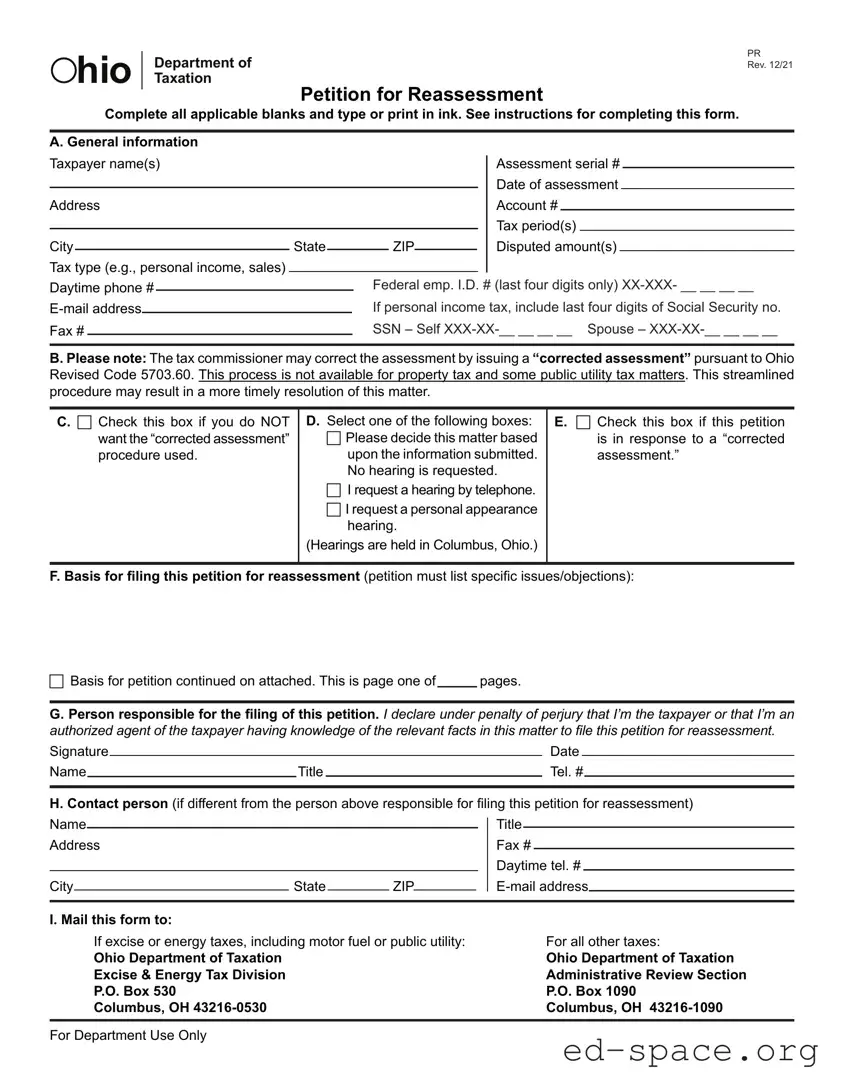
The Ohio Petition For Reassessment form serves as a critical tool for taxpayers seeking to contest a tax assessment issued by the Ohio Department of Taxation. This form requires individuals to provide essential information such as their name, address, and details about the disputed tax assessment, including the type of tax, assessment serial number, and the specific amount being contested. The process allows taxpayers to either request a corrected assessment or opt for a hearing, either by telephone or in person, to present their case. It is important to note that the opportunity for a corrected assessment is not available for property taxes or certain public utility taxes. Taxpayers must also declare their authority to file the petition, either as the taxpayer themselves or as an authorized agent. The form includes sections for the basis of the petition, where individuals can outline their objections to the assessment, and it emphasizes the importance of filing within a specific timeframe—generally within 60 days from the date of the assessment. Clear instructions guide users through the completion process, ensuring that all necessary information is submitted accurately to facilitate a timely resolution of the dispute.


Document Preview

Petition for Reassessment
Complete all applicable blanks and type or print in ink. See instructions for completing this form.
A. General information
Taxpayer name(s) Assessment serial #
Date of assessment
Address Account #
Tax period(s)
City State ZIP Disputed amount(s)
Tax type (e.g., personal income, sales)
Daytime phone #
E-mail address
Fax #
B. Please note: The tax commissioner may correct the assessment by issuing a “corrected assessment” pursuant to Ohio
Revised Code 5703.60. This process is not available for property tax and some public utility tax matters. This streamlined
procedure may result in a more timely resolution of this matter.
E.
F. Basis for ling this petition for reassessment (petition must list specic issues/objections):
Basis for petition continued on attached. This is page one of pages.
G. Person responsible for the ling of this petition. I declare under penalty of perjury that I’m the taxpayer or that I’m an
authorized agent of the taxpayer having knowledge of the relevant facts in this matter to le this petition for reassessment.
Signature Date
Name Title Tel. #
H. Contact person (if di󰀨erent from the person above responsible for ling this petition for reassessment)
Name Title
Address Fax #
Daytime tel. #
City State ZIP E-mail address
I. Mail this form to:
If excise or energy taxes, including motor fuel or public utility: For all other taxes:
Ohio Department of Taxation Ohio Department of Taxation
Excise & Energy Tax Division Administrative Review Section
P.O. Box 530 P.O. Box 1090
Columbus, OH 43216-0530 Columbus, OH 43216-1090
For Department Use Only
PR
Rev. 12/21
C.Check this box if you do NOT
want the “corrected assessment”
procedure used.
D. Select one of the following boxes:
Please decide this matter based
upon the information submitted.
No hearing is requested.
I request a hearing by telephone.
I request a personal appearance
hearing.
(Hearings are held in Columbus, Ohio.)
Check this box if this petition
is in response to a “corrected
assessment.”
hio
Department of
Taxation
Federal emp. I.D. # (last four digits only) XX-XXX- __ __ __ __
If personal income tax, include last four digits of Social Security no.
SSN – Self XXX-XX-__ __ __ __ Spouse – XXX-XX-__ __ __ __
Instructions for Completing Petition for Reassessment
n This is a generic form that may be used to file a Petition for
Reassessment for any tax. For purposes of these instructions,
all assessment notices are covered by the term “assessment,”
regardless of their technical title.
n IMPORTANT: Because di󰀨erent taxes have di󰀨erent ling deadlines,
you may safely le this form NO LATER THAN 60 DAYS from the
date found on the assessment and you will be timely regardless
of the type of tax assessed.
n Laws relating to particular types of assessments are located in Title
57 of the Ohio Revised Code. You are responsible for complying with
all of the requirements of the law. (The on-line link to the Revised
Code is available at tax.ohio.gov. Go to the “Tax Professionals”
tab, then to the heading “Laws/Rules/Rulings.”)
Section-by-Section Instructions
A. General Information
n Most of the information that you need to complete this section can
be found on the assessment. Please use it as a reference.
n Daytime phone: Please provide the number where you can be
reached during business hours.
n E-mail address: Providing your e-mail address will allow us to
communicate with you e󰀩ciently and discreetly.
n Assessment serial number: This number is listed on the
assessment. It is not applicable for personal property, dealer
intangibles or public utility tax assessments.
n Date of assessment: The date found on the assessment
document.
n Tax period(s): List the periods or the tax year(s) assessed.
n Disputed amount: The portion of the assessment that you are
protesting. Usually, this amount does not need to be paid before
this petition is led. However, there are exceptions. For example,
when only the penalty or interest is being protested in the corporate
franchise tax or personal income tax, payment of tax and interest
(but not penalty) is required.
B. Corrected Assessment is NOT available for property and public
utility assessments (except in R.C. 5727.26 and R.C. 5727.89).
n What is a “corrected assessment”? According to R.C. 5703.60,
when a petition for reassessment has been properly led, the Tax
Commissioner may respond by issuing a “corrected assessment.”
This is a more streamlined response to the petition than a nal
determination and it may both simplify and expedite resolution of the
matter. The Notice of Corrected Assessment does not contain the
legal analysis of the tax commissioner. Only a nal determination
(not a corrected assessment) can be appealed to the Board of Tax
Appeals or Ohio courts.
n What if the taxpayer disagrees with the “corrected assessment”?
If a corrected assessment is issued and the taxpayer disagrees with
the result, the taxpayer still has the option of ling a new petition
for reassessment protesting the “corrected assessment.” This same
form is used to le a petition in response to a corrected assessment.
In response to this new petition, the Tax Commissioner will issue a
nal determination.
n What if the taxpayer fails to le a new petition for reassessment
after receiving a “corrected assessment”? According to R.C.
5703.60, the issuance of a corrected assessment nullies the original
petition for reassessment and the original petition is not subject to
further administrative review or appeal. Therefore, the corrected
assessment becomes nal.
C. In Order to Request That the “Corrected Assessment”
Procedure NOT Be Used CHECK THE BOX
n If this box is checked, a nal determination will be issued and the
streamlined procedure will not be used.
Rev. 12/21
D. Select a Box (If a corrected assessment is issued, THERE WILL
BE NO HEARING, even if you requested one.)
n No hearing: All of your information will be carefully reviewed and
considered, but you will not have to participate in a hearing.
n Hearing by telephone: This is an informal discussion to gather facts
and listen to the taxpayer’s (or representative’s) legal arguments.
You may submit information. Please number your pages and retain a
duplicate for yourself so that specic documentation can be reviewed
and discussed during the hearing. You may use a conference call to
include your representative or anyone else you choose.
n Personal appearance hearing: This is an informal face-to-face
meeting centered on gathering facts and listening to the taxpayer’s
(or representative’s) legal arguments. This is also the taxpayer’s
opportunity to present any documentation for review and discussion.
E. Petition in Response to a “Corrected Assessment”
n If you have already received a “corrected assessment” and you are
ling this petition because you disagree with the adjusted amount
on the “corrected assessment,” CHECK THE BOX.
F. Basis for Filing this Petition for Reassessment
n Please list all of the reasons that you think the Ohio Department
of Taxation erred when it issued the assessment or the corrected
assessment. You must be specic with your objections. However,
you are free to present your case in the manner of your choice.
You may make legal arguments. You may cite specic sections of
the Ohio Revised Code or the Ohio Administrative Code. You may
reference and attach specic court or Board of Tax Appeals cases.
You may attach photographs or include any other documentation.
You are not limited. You may attach additional pages, but please
CHECK THE BOX and list the total.
G. Person Responsible for Filing this Petition
n Name/title: This is the individual vouching for the accuracy of the
information presented. This person should be familiar with all of the
facts and issues related to this matter. This may be the individual
petitioner, an employee or owner of the business, or the person
designated as the representative. Whoever is responsible for ling
this request must provide their signature, name, title, date and phone
number.
H. Contact Person (Information required ONLY if di󰀨erent from the
“Person Responsible for Filing this Petition.”)
n This may be the individual petitioner, an employee or owner of the
business, or a separate person chosen to be the representative. A
representative does not need to be an attorney or an accountant,
but the petitioner must authorize them.
n If the contact person is the taxpayer’s representative, the taxpayer
needs to complete form TBOR 1 and return it along with this petition.
Form TBOR 1 authorizes the contact person to represent the claimant
and allows the Ohio Department of Taxation to talk to this person. (An
on-line link is available at tax.ohio.gov. Go to the “Tax Professionals”
tab, then to the heading “Taxpayer Representation.”)
I. Mail This Form To:
n Di󰀨erent taxes must be mailed to di󰀨erent addresses. If in doubt use
the address provided for “all other taxes.”
n The petition may be hand delivered to:
– 4485 Northland Ridge Blvd., Columbus, OH 43229

Form Specifications

Fact Name Details
Form Title Ohio Department of Taxation Petition for Reassessment
Form Revision Date Revised December 2021
Filing Deadline Must be filed no later than 60 days from the date on the assessment.
Governing Law Ohio Revised Code 5703.60
Corrected Assessment This process allows the Tax Commissioner to issue a corrected assessment in response to a filed petition.
Hearing Options Taxpayers can request a hearing by telephone or a personal appearance hearing.
Disputed Amount Only the portion of the assessment being protested needs to be listed.
Signature Requirement The person filing the petition must declare under penalty of perjury that they are authorized to do so.
Mailing Addresses Different addresses are designated for excise taxes and all other taxes.

Ohio Petition For Reassessment: Usage Guidelines

After completing the Ohio Petition for Reassessment form, the next step is to submit it to the appropriate department. Make sure to follow the instructions carefully to ensure your petition is processed without delay.

  1. Gather necessary information: Collect details from your assessment notice, including taxpayer name, address, tax type, assessment serial number, and disputed amounts.
  2. Complete the General Information section: Fill in all applicable blanks, including your daytime phone number and email address.
  3. Select the appropriate options: Check the box if you do not want the “corrected assessment” procedure. Choose how you want the matter decided: no hearing, telephone hearing, or personal appearance hearing.
  4. State your basis for filing: Clearly list the specific issues or objections you have regarding the assessment. Attach additional pages if necessary.
  5. Identify the person responsible: Sign the form, providing your name, title, date, and phone number. This person should be knowledgeable about the case.
  6. Provide contact information: If different from the person responsible, include details for the contact person, if applicable.
  7. Mail the form: Send the completed form to the correct address based on the type of tax. Double-check to ensure it goes to the right division.

Your Questions, Answered

What is the Ohio Petition for Reassessment form?

The Ohio Petition for Reassessment form is a document that taxpayers can use to contest an assessment made by the Ohio Department of Taxation. This form allows individuals or businesses to formally request a review of their tax assessment, providing an opportunity to dispute the amount owed based on specific grounds. It is essential for ensuring that taxpayers have a voice in the assessment process.

Who should file a Petition for Reassessment?

Any taxpayer who disagrees with an assessment from the Ohio Department of Taxation should consider filing this petition. This includes individuals and businesses facing assessments on personal income, sales tax, and other tax types. If you believe that the assessment is incorrect, this form is your avenue to seek a correction.

What information do I need to complete the form?

To fill out the Petition for Reassessment, you will need several pieces of information. This includes your name, address, the type of tax being assessed, the assessment serial number, the date of the assessment, the tax period in question, and the disputed amount. You should also provide your contact information, including a daytime phone number and email address, to facilitate communication.

What is a "corrected assessment"?

A corrected assessment is a response issued by the Tax Commissioner after a petition for reassessment has been filed. This streamlined process allows for a quicker resolution of the issue without the need for a lengthy review. However, it’s important to note that only a final determination can be appealed to the Board of Tax Appeals or Ohio courts.

Can I request a hearing when filing this petition?

Yes, you can request a hearing when filing your petition. There are options for a hearing by telephone or a personal appearance hearing in Columbus, Ohio. If you choose to have a hearing, it provides an opportunity for you or your representative to present your case and discuss the issues directly with the tax officials.

What happens if I disagree with the corrected assessment?

If you receive a corrected assessment and disagree with it, you can file a new petition for reassessment. This allows you to contest the adjusted amount. However, be aware that failing to file this new petition after receiving a corrected assessment will nullify your original petition, and the corrected assessment will become final.

How long do I have to file a Petition for Reassessment?

You must file the Petition for Reassessment within 60 days from the date of the assessment notice. This timeline is crucial, as missing this deadline could prevent you from contesting the assessment. Make sure to keep track of the assessment date to ensure timely filing.

Do I need to pay the disputed amount before filing the petition?

In most cases, you do not need to pay the disputed amount before filing the petition. However, there are exceptions, particularly when only penalties or interest are being contested in certain tax types. It’s wise to review your specific situation to understand any payment obligations before proceeding.

Where do I send the completed form?

The completed Petition for Reassessment form must be mailed to the appropriate address based on the type of tax you are contesting. For excise or energy taxes, send it to the Excise & Energy Tax Division. For all other taxes, mail it to the Administrative Review Section. If you're unsure, use the address for “all other taxes.” Hand delivery is also an option at the designated office in Columbus.

Common mistakes

  1. Leaving Blanks Unfilled: Many people forget to fill out all applicable sections of the form. Each blank is important for the processing of your petition.

  2. Incorrect Tax Type: Selecting the wrong tax type can lead to delays. Ensure that you accurately identify the type of tax you are disputing, whether it's personal income or sales tax.

  3. Missing Assessment Serial Number: This number is crucial. Failing to include it can result in your petition being rejected or delayed.

  4. Not Providing Contact Information: Without a daytime phone number or email address, the tax department may struggle to reach you for clarifications or updates.

  5. Ignoring the Deadline: Submitting your petition more than 60 days after the assessment date can lead to automatic rejection. Be mindful of the timeline!

  6. Failure to Specify Disputed Amount: Clearly stating the amount you are disputing is essential. Vague statements can weaken your case.

  7. Not Checking the Correct Boxes: Always double-check that you’ve selected the appropriate options for hearings or reassessment procedures. Missteps here can lead to misunderstandings.

  8. Missing Signatures: The petition must be signed by the taxpayer or an authorized agent. An unsigned petition is invalid.

  9. Inadequate Basis for Filing: Providing vague or insufficient reasons for your reassessment request can hinder your chances of success. Be specific!

  10. Incorrect Mailing Address: Ensure that you send the petition to the correct address. Different taxes require different mailing locations, and mistakes can lead to significant delays.

Documents used along the form

The Ohio Petition for Reassessment form is an important document for taxpayers wishing to challenge an assessment made by the Ohio Department of Taxation. When filing this petition, several other forms and documents may also be required to support the case. Below is a list of commonly used forms and documents that may accompany the petition.

  • Form TBOR 1: This form authorizes a representative to act on behalf of the taxpayer. It allows the Ohio Department of Taxation to communicate with the designated representative regarding the case.
  • Assessment Notice: This is the original notice sent by the Ohio Department of Taxation detailing the assessment. It provides essential information about the disputed tax and serves as a reference for completing the petition.
  • Evidence Documentation: Taxpayers may submit supporting documents, such as financial statements, receipts, or other records, to substantiate their claims and objections listed in the petition.
  • Request for Hearing: If the taxpayer wishes to have a hearing, a separate request may need to be filed. This document indicates the type of hearing requested, whether by telephone or in person.
  • Corrected Assessment Notice: If a corrected assessment has been issued, this notice outlines the adjustments made. It is crucial for taxpayers who wish to challenge the new assessment amount.
  • Taxpayer Identification Information: This document may include additional identification details, such as Social Security numbers or Employer Identification Numbers, necessary for processing the petition.
  • Affidavit of Facts: A sworn statement detailing the facts surrounding the assessment. This document can help clarify the taxpayer's position and support their arguments.
  • Written Legal Arguments: Taxpayers may include a written statement outlining their legal reasoning, citing specific laws or regulations that support their case against the assessment.
  • Correspondence with Tax Authorities: Any previous communications with the Ohio Department of Taxation regarding the assessment may be included to provide context and demonstrate attempts to resolve the issue.
  • Payment Records: If any payments related to the disputed assessment have been made, records of these transactions can be submitted to show compliance or dispute specific amounts.

These forms and documents play a vital role in the reassessment process. They help ensure that the taxpayer's case is thoroughly presented and can significantly influence the outcome of the petition. Properly compiling and submitting these materials can facilitate a more efficient review by the Ohio Department of Taxation.

Similar forms

  • IRS Form 843: This form allows taxpayers to request an abatement of taxes, penalties, or interest. Similar to the Ohio Petition for Reassessment, it requires specific information about the taxpayer and the disputed amounts.
  • IRS Form 911: This form is used to request assistance from the Taxpayer Advocate Service. Like the Ohio petition, it addresses issues related to tax disputes and requires detailed information about the taxpayer's situation.
  • Ohio Board of Tax Appeals Notice of Appeal: This document is used to appeal decisions made by the Ohio Department of Taxation. Both forms require the taxpayer to outline the basis for their dispute and provide supporting information.
  • State Tax Commission Petition for Review: Similar to the Ohio petition, this document allows taxpayers to challenge state tax assessments, requiring specific details about the assessment in question.
  • Ohio Department of Taxation Application for Refund: This form is used to request a refund of overpaid taxes. Both documents require taxpayers to specify the amounts in dispute and provide justification for their claims.
  • IRS Form 1040X: This is an amended tax return form that allows taxpayers to correct errors on their original return. Like the Ohio petition, it requires detailed information about the changes being made and the reasons for them.
  • State Sales Tax Refund Request: This document allows businesses to request refunds for overpaid sales tax. Both forms require the submission of specific amounts and the reasons for the request.
  • Ohio Department of Taxation Notice of Intent to Challenge: This notice is filed when a taxpayer intends to dispute an assessment. Similar to the Ohio petition, it outlines the taxpayer's objections and the basis for the challenge.
  • Taxpayer Representation Authorization (Form TBOR 1): This form authorizes a representative to act on behalf of the taxpayer. It is similar to the Ohio petition in that it requires the taxpayer's consent and details about the representation.
  • IRS Form 8821: This form is used to authorize an individual to receive confidential tax information. Like the Ohio petition, it requires the taxpayer's information and the scope of the authorization.

Dos and Don'ts

When filling out the Ohio Petition For Reassessment form, it is important to follow specific guidelines to ensure your petition is processed smoothly. Below is a list of things to do and avoid during this process.

  • Do complete all applicable blanks and type or print clearly in ink.
  • Do provide accurate contact information, including your daytime phone number and email address.
  • Do list the specific tax type and the assessment serial number as indicated on your assessment notice.
  • Do check the appropriate boxes to indicate whether you want a corrected assessment or a hearing.
  • Do clearly state the basis for your petition, listing specific issues or objections.
  • Do ensure that the person responsible for filing the petition signs and dates the form.
  • Do mail the form to the correct address based on the type of tax being contested.
  • Don't forget to file the petition within 60 days of the assessment date.
  • Don't leave any sections blank; incomplete forms may delay processing.
  • Don't submit irrelevant documents or information that does not support your case.

By adhering to these guidelines, you can enhance the likelihood of a favorable outcome for your reassessment petition.

Misconceptions

  • Misconception 1: The Petition for Reassessment can be filed for any tax type.
  • This is not entirely accurate. While the form can be used for various taxes, certain taxes like property tax and some public utility taxes have specific restrictions and may not qualify for the reassessment process.

  • Misconception 2: A hearing is always guaranteed when filing a petition.
  • This is misleading. If a corrected assessment is issued, there will be no hearing, even if one was initially requested. The process may be more streamlined, but it does not include a hearing in such cases.

  • Misconception 3: You must pay the disputed amount before filing the petition.
  • This is not true for all situations. Generally, you do not need to pay the disputed amount before filing, except in specific circumstances like when only penalties or interest are being contested in certain tax types.

  • Misconception 4: The corrected assessment can be appealed directly.
  • This is incorrect. A corrected assessment cannot be appealed. If you disagree with it, you must file a new petition for reassessment, which will then lead to a final determination that can be appealed.

  • Misconception 5: The petition must be filed within 30 days of the assessment date.
  • This is a common misunderstanding. You actually have up to 60 days from the date on the assessment to file the petition, allowing for a bit more time to prepare your case.

  • Misconception 6: You can submit any documentation without restrictions.
  • While you can submit various types of documentation, it’s essential to be specific about your objections. The form allows for additional pages, but clarity and relevance are key to a successful petition.

  • Misconception 7: Only attorneys can represent you in this process.
  • This is not the case. You can have any authorized representative file the petition on your behalf, not just an attorney or accountant. However, you must complete the necessary authorization form.

  • Misconception 8: You can file the petition at any address.
  • This is misleading. Different taxes require you to mail the petition to specific addresses. If you're unsure, it's best to use the address for "all other taxes" to ensure proper handling.

Key takeaways

When filling out the Ohio Petition for Reassessment form, consider the following key takeaways:

  • Complete All Sections: Ensure that all applicable fields are filled out accurately. Use either typed or printed text in ink.
  • Timely Submission: File the petition within 60 days of the assessment date to ensure it is considered timely.
  • Corrected Assessment: Understand that the corrected assessment process is not available for property taxes or certain public utility tax matters.
  • Specify Disputed Amount: Clearly state the amount you are disputing. This is crucial for the review process.
  • Hearing Options: Decide whether you want a hearing. Options include no hearing, a telephone hearing, or a personal appearance hearing.
  • Signature Required: The person responsible for filing must sign the petition, confirming they have knowledge of the facts involved.
  • Contact Information: Provide a daytime phone number and email address for efficient communication regarding your petition.
  • List Specific Issues: Clearly outline the reasons for your petition. Specific objections will strengthen your case.
  • Mailing Address: Ensure you send the petition to the correct address, which varies based on the type of tax.
  • Documentation: Attach any relevant documents or evidence that supports your claims. This may include legal arguments or references to the Ohio Revised Code.

Following these guidelines will help facilitate a smoother process when filing your petition for reassessment in Ohio.