Homepage Blank Ohio Order Of Protection PDF Form
Content Overview

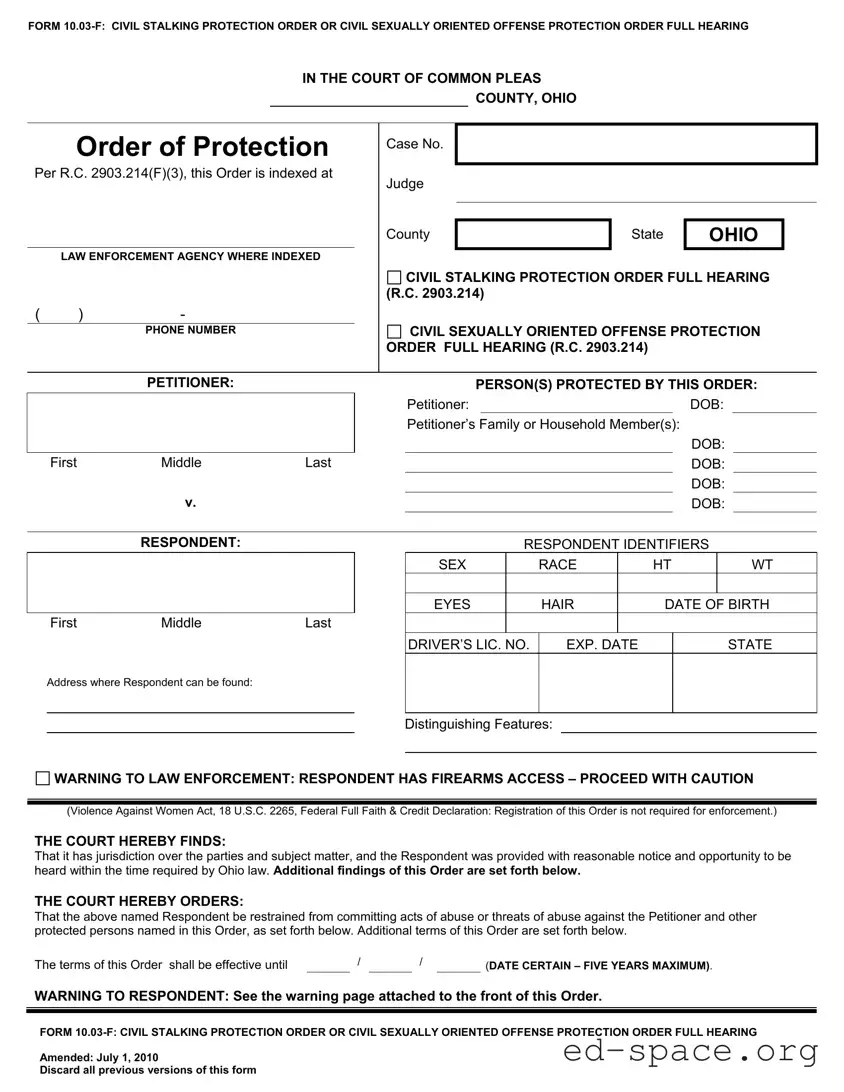
In Ohio, the Order of Protection form serves as a crucial legal tool designed to safeguard individuals from harassment, stalking, or sexually oriented offenses. This form, specifically known as FORM 10.03-F, is utilized in the Court of Common Pleas and encompasses essential details about the petitioner, the respondent, and the specific protections being sought. It outlines the obligations of the respondent, which may include refraining from any form of abuse or contact with the protected individuals, staying away from certain locations, and surrendering firearms if applicable. The court also evaluates the evidence presented, determining whether the respondent poses a threat to the petitioner or their household members. The order can remain in effect for a maximum of five years, providing a sense of security for those affected. Furthermore, it emphasizes the importance of compliance, warning respondents that violations may lead to legal consequences. Understanding the nuances of this form is vital for anyone seeking protection under Ohio law, ensuring that their rights and safety are prioritized.


Document Preview

FORM 10.03-F: CIVIL STALKING PROTECTION ORDER OR CIVIL SEXUALLY ORIENTED OFFENSE PROTECTION ORDER FULL HEARING
IN THE COURT OF COMMON PLEAS
COUNTY, OHIO
Order of Protection
Case No.
Per R.C. 2903.214(F)(3), this Order is indexed at
Judge
County
State
OHIO
LAW ENFORCEMENT AGENCY WHERE INDEXED
( ) -
CIVIL STALKING PROTECTION ORDER FULL HEARING
(R.C. 2903.214)
PHONE NUMBER
CIVIL SEXUALLY ORIENTED OFFENSE PROTECTION
ORDER FULL HEARING (R.C. 2903.214)
PETITIONER:
PERSON(S) PROTECTED BY THIS ORDER:
Petitioner:
DOB:
Petitioner’s Family or Household Member(s):
DOB:
First Middle Last
DOB:
DOB:
v.
DOB:
RESPONDENT:
RESPONDENT IDENTIFIERS
SEX RACE HT WT
EYES HAIR DATE OF BIRTH
First Middle Last
DRIVER’S LIC. NO. EXP. DATE STATE
Address where Respondent can be found:
Distinguishing Features:
WARNING TO LAW ENFORCEMENT: RESPONDENT HAS FIREARMS ACCESS – PROCEED WITH CAUTION
(Violence Against Women Act, 18 U.S.C. 2265, Federal Full Faith & Credit Declaration: Registration of this Order is not required for enforcement.)
THE COURT HEREBY FINDS:
That it has jurisdiction over the parties and subject matter, and the Respondent was provided with reasonable notice and opportunity to be
heard within the time required by Ohio law. Additional findings of this Order are set forth below.
THE COURT HEREBY ORDERS:
That the above named Respondent be restrained from committing acts of abuse or threats of abuse against the Petitioner and other
protected persons named in this Order, as set forth below. Additional terms of this Order are set forth below.
The terms of this Order shall be effective until
/
/
(DATE CERTAIN – FIVE YEARS MAXIMUM).
WARNING TO RESPONDENT: See the warning page attached to the front of this Order.
FORM 10.03-F: CIVIL STALKING PROTECTION ORDER OR CIVIL SEXUALLY ORIENTED OFFENSE PROTECTION ORDER FULL HEARING
Amended: July 1, 2010
Discard all previous versions of this form
[Page 2 of Form 10.03-F]
Case No.__________________________
This proceeding came on for a hearing on
before the Court and the Civil Stalking
Protection Order Ex Parte or Civil Sexually Oriented Offense Protection Order Ex Parte filed on
all in accordance with R.C. 2903.214. The following individuals were present:
The Court hereby makes the following findings of fact:
The Court finds by a preponderance of the evidence that 1) the Respondent has knowingly engaged in a pattern of
conduct that caused Petitioner to believe that the Respondent will cause physical harm or cause or has caused
mental distress; and 2) the following orders are equitable, fair, and necessary to protect the persons named in this
Order from stalking offenses.
The Court finds by a preponderance of the evidence that 1) the Petitioner or Petitioner’s family or household
member(s) are in danger of or have been a victim of a sexually oriented offense as defined in R.C. 2950.01,
committed by Respondent; and 2) the following orders are equitable, fair, and necessary to protect the persons
named in this Order from sexually oriented offenses.
The Court finds by clear and convincing evidence that 1) the Petitioner or Petitioner’s family or household member
reasonably believed the Respondent’s conduct before the filing of the Petition endangered the health, welfare, or
safety of the Petitioner or Petitioner’s family or household member(s); 2) the Respondent presents a continuing
danger to the Petitioner or Petitioner’s family or household member(s); and 3) the following orders are equitable, fair,
and necessary to protect the person(s) named in this Order.
ALL OF THE PROVISIONS CHECKED BELOW APPLY TO THE RESPONDENT
1. RESPONDENT SHALL NOT ABUSE the protected persons named in this Order by harming, attempting to harm,
threatening, following, stalking, harassing, forcing sexual relations upon them, or by committing sexually oriented
offenses against them. [NCIC 01 and 02]
2. RESPONDENT SHALL NOT ENTER the residence, school, business, place of employment, day care centers, or
child care providers of the protected persons named in this Order, including the buildings, grounds,
and parking lots
at those locations. Respondent may not violate this Order even with the permission of a protected person.
[NCIC 03]
3. RESPONDENT SHALL NOT INTERFERE with protected persons' right to occupy the residence including, but not
limited to canceling utilities, insurance, interrupting telephone service, mail delivery, or the delivery of any other
documents or items.
4. RESPONDENT SHALL SURRENDER all keys and garage door openers to the following residence:
at the earliest possible opportunity after service of this Order to the law enforcement agency that serves Respondent
with this Order or as follows:
5. RESPONDENT SHALL STAY AWAY from protected persons named in this Order, and shall not be present
within 500 feet or (distance) of any protected persons, wherever those protected persons may be
FORM 10.03-F: CIVIL STALKING PROTECTION ORDER OR CIVIL SEXUALLY ORIENTED OFFENSE PROTECTION ORDER FULL HEARING
Amended: July 1, 2010
found, or any place the Respondent knows or should know the protected persons are likely to be, even with
protected persons' permission. If Respondent accidentally comes in contact with protected persons in any public or
private place, Respondent must depart immediately. This Order includes encounters on public and private roads,
highways, and thoroughfares. [NCIC 04]
Discard all previous versions of this form
[Page 3 of Form 10.03-F]
Case No.__________________________
6. RESPONDENT SHALL NOT REMOVE, DAMAGE, HIDE, OR DISPOSE OF ANY PROPERTY OR PETS owned or
possessed by the protected persons named in this Order.
7. RESPONDENT SHALL NOT INITIATE OR HAVE ANY CONTACT with the protected persons named in this Order at
their residences, businesses, places of employment, schools, day care centers, or child care providers. Contact
includes, but is not limited to, telephone, fax, e-mail, voice mail, delivery service, writings, or communications by any
other means in person or through another person. Respondent may not violate this Order even with the permission
of a protected person. [NCIC 05]
8. RESPONDENT SHALL NOT CAUSE OR ENCOURAGE ANY OTHER PERSON to do any act prohibited by this
Order.
9. RESPONDENT SHALL NOT POSSESS, USE, CARRY, OR OBTAIN ANY DEADLY WEAPON. Respondent shall
turn over all deadly weapons in Respondent’s possession to the law enforcement agency that serves Respondent
with this Order or as follows:
Any law enforcement agency is authorized to take possession of deadly weapons pursuant to this paragraph and hold
them in protective custody until further Court order. [NCIC 07]
10. IT IS FURTHER ORDERED: [NCIC 08]
11. RESPONDENT IS ORDERED TO COMPLETE the following counseling program:
Respondent shall contact this program within seven days after receiving this Order and immediately arrange
for an initial appointment. The counseling program is requested to provide the Court a written notice when
Respondent attends the initial appointment, if the Respondent fails to attend or is discharged, and when Respondent
completes the program. Respondent is required to sign all necessary waivers to allow the Court to receive information
from the counseling program.
Respondent is ordered to appear before Judge
or Magistrate
on at a.m. / p.m., to review Respondent’s compliance with this
Counseling Order. Respondent is warned: If you fail to attend the program you may be held in contempt of
court. If you fail to appear at this hearing, the Court may issue a warrant for your arrest.
12. RESPONDENT SHALL NOT USE OR POSSESS alcohol or illegal drugs.
13. RESPONDENT SHALL BE SUBJECT TO ELECTRONIC MONITORING. Respondent is ordered to report to
for the placement of a global positioning system for the purpose
of electronic monitoring for the duration of this Order or until
,
whichever expires first. The Court further imposes the following terms and conditions:
14. IT IS FURTHER ORDERED that the Clerk of Court shall cause a copy of the Petition and this Order to be delivered to
the Respondent as required by law. The Clerk of Court shall also provide certified copies of the Petition and this Order
to Petitioner upon request. This Order is granted without bond. Under federal and state law, the Clerk shall not charge
any fees for filing, issuing, registering, or serving this Protection Order.
FORM 10.03-F: CIVIL STALKING PROTECTION ORDER OR CIVIL SEXUALLY ORIENTED OFFENSE PROTECTION ORDER FULL HEARING
Amended: July 1, 2010
Discard all previous versions of this form
[Page 3 of Form 10.03-F]
Case No.__________________________
FORM 10.03-F: CIVIL STALKING PROTECTION ORDER OR CIVIL SEXUALLY ORIENTED OFFENSE PROTECTION ORDER FULL HEARING
Amended: July 1, 2010
Discard all previous versions of this form
15. ALL OF THE TERMS OF THIS ORDER REMAIN IN FULL FORCE AND EFFECT FOR A PERIOD OF FIVE
YEARS FROM ISSUANCE, OR UNTIL
IT IS SO ORDERED. APPROVED and ADOPTED by:
MAGISTRATE JUDGE
NOTICE TO RESPONDENT
: THE PERSONS PROTECTED BY THIS ORDER CANNOT GIVE YOU LEGAL PERMISSION
TO CHANGE OR VIOLATE THIS ORDER. IF YOU VIOLATE ANY TERMS OF THIS ORDER, EVEN WITH THE
PROTECTED PERSON’S PERMISSION, YOU MAY BE ARRESTED. ONLY THE COURT CAN CHANGE THIS ORDER. IF
THERE IS ANY REASON WHY THIS ORDER SHOULD BE CHANGED, YOU MUST ASK THE COURT TO CHANGE IT.
YOU ACT AT YOUR OWN RISK IF YOU DISREGARD THIS WARNING.
NOTICE OF FINAL APPEALABLE ORDER
TO THE CLERK
COPIES OF THIS ORDER SHALL BE DELIVERED TO:
Copies of the foregoing Order, which is a final appealable
Petitioner Attorney for Petitioner
order, were mailed by ordinary U.S. mail or hand-
Respondent Attorney for Respondent
delivered to the parties indicated on the following date:
Police Department Where Petitioner Resides:
,
Police Department Where Petitioner Works:
The
County Sheriff’s Office
By:
Other:
CLERK OF COURT
WAIVER
I, ________________________, understand that I have the right to a full hearing on the Petition for Civil Stalking Protection
Order or Civil Sexually Oriented Offense Protection Order, and acknowledge each of the following:
1. I waive the right to have a full hearing on this Protection Order;
2. I waive the right to cross-examine witnesses and review evidence submitted in support of this Protection Order;
3. I waive the right to present witnesses and evidence on my own behalf;
4. I waive the right to request specific factual findings from the Court concerning the issuance of this Protection Order.
I understand that based on the foregoing waivers a Protection Order will be entered against me.
RESPONDENT: DATE:

Form Specifications

Fact Name Detail
Governing Law R.C. 2903.214 governs Civil Stalking Protection Orders and Civil Sexually Oriented Offense Protection Orders in Ohio.
Order Duration The order can remain in effect for a maximum of five years.
Jurisdiction The court must have jurisdiction over the parties and the subject matter of the case.
Emergency Provisions Emergency protection orders can be issued on an ex parte basis, allowing immediate relief before a full hearing.
Enforcement Under the Violence Against Women Act, federal law requires states to enforce protection orders across state lines.
Petitioner Rights The petitioner is entitled to legal representation and support throughout the process.
Respondent Restrictions The respondent is prohibited from contacting or coming within a specified distance of the protected persons.
Property Protection The order includes provisions to prevent the respondent from removing or damaging property owned by the protected persons.
Legal Fees No fees are charged for filing, issuing, registering, or serving the protection order under federal and state law.

Ohio Order Of Protection: Usage Guidelines

Filling out the Ohio Order of Protection form requires careful attention to detail. This form is essential for those seeking legal protection from harassment or abuse. After completing the form, you will need to submit it to the appropriate court, where a judge will review your request and determine the next steps.

  1. Begin by entering the case number and county at the top of the form.
  2. Fill in the name of the judge who will be overseeing your case.
  3. Indicate whether you are requesting a Civil Stalking Protection Order or a Civil Sexually Oriented Offense Protection Order.
  4. Provide your name, date of birth, and any family or household members who need protection, along with their dates of birth.
  5. Enter the respondent's name and date of birth.
  6. Complete the respondent identifiers section, including sex, race, height, weight, eye color, hair color, driver’s license number, and expiration date.
  7. Provide the address where the respondent can be found and any distinguishing features that may help identify them.
  8. Check the box indicating whether the respondent has access to firearms and proceed with caution.
  9. List the specific acts of abuse or threats of abuse that have occurred, detailing the incidents that justify your request for protection.
  10. Specify the terms of the order, including restrictions on the respondent's behavior, such as contact limitations and distance requirements.
  11. Indicate the duration of the order, which can be up to five years.
  12. Sign and date the form, ensuring all information is accurate and complete.

Your Questions, Answered

What is an Ohio Order of Protection?

An Ohio Order of Protection is a legal tool designed to protect individuals from harassment, stalking, or sexually oriented offenses. This order can restrict the behavior of the person causing harm, known as the respondent, and is issued by the Court of Common Pleas. It aims to provide safety and peace of mind to the petitioner and any protected individuals named in the order.

Who can file for an Order of Protection in Ohio?

Any person who feels threatened or has experienced stalking or sexually oriented offenses can file for an Order of Protection. This includes individuals who are victims of domestic violence or have a family or household member who is at risk. The law provides a clear pathway for those seeking protection, ensuring that their safety is prioritized.

What types of protection orders are available in Ohio?

Ohio offers two main types of protection orders: the Civil Stalking Protection Order and the Civil Sexually Oriented Offense Protection Order. The former is intended for individuals who are being stalked, while the latter addresses offenses of a sexual nature. Each type has specific criteria and processes for filing, but both serve the common goal of safeguarding individuals from harm.

How long does an Order of Protection last?

Typically, an Order of Protection in Ohio can last for a maximum of five years. The duration may vary depending on the circumstances of the case and the judge's discretion. It's essential to be aware of the expiration date and to seek renewal if continued protection is necessary.

What happens if the respondent violates the Order of Protection?

If the respondent violates the terms of the Order of Protection, they may face serious legal consequences, including arrest. It is crucial for the petitioner to document any violations and report them to law enforcement immediately. The court takes these violations seriously and can impose penalties on the respondent to ensure compliance with the order.

Can the terms of the Order of Protection be changed?

Yes, the terms of the Order of Protection can be modified, but only by the court. If there is a need to change any aspect of the order, the respondent must formally request a modification through the court. It's important to note that the protected individuals cannot grant permission for changes or violations of the order.

Is there a fee to file for an Order of Protection in Ohio?

No, there are no fees associated with filing for an Order of Protection in Ohio. Under federal and state law, the Clerk of Court is prohibited from charging any fees for filing, issuing, registering, or serving the protection order. This ensures that financial barriers do not prevent individuals from seeking the protection they need.

Common mistakes

  1. Incomplete Information: Failing to provide all required personal details, such as the full names and dates of birth for both the petitioner and the respondent, can lead to delays or rejections.

  2. Incorrect Case Number: Entering the wrong case number can create confusion and may prevent the order from being properly filed or enforced.

  3. Missing Signatures: Not signing the form where required can invalidate the order. Ensure all necessary parties have signed.

  4. Inaccurate Descriptions: Providing vague or inaccurate descriptions of the incidents that prompted the order can weaken the case. Specific details are crucial.

  5. Omitting Evidence: Failing to attach supporting documents, such as police reports or witness statements, can hinder the petition's strength.

  6. Ignoring Court Instructions: Not adhering to the specific instructions provided by the court can result in the dismissal of the petition.

  7. Neglecting to Update Contact Information: If the petitioner changes their address or phone number after filing, they must update the court to ensure proper communication.

  8. Misunderstanding Terms: Misinterpreting the terms of the protection order can lead to accidental violations, which may result in legal consequences.

  9. Failing to Follow Up: After filing, not following up with the court to confirm that the order has been processed can leave the petitioner unprotected.

  10. Ignoring Legal Advice: Dismissing the importance of seeking legal counsel can lead to mistakes that may have been avoided with professional guidance.

Documents used along the form

The Ohio Order of Protection form is a crucial document for individuals seeking legal protection from stalking or sexually oriented offenses. Alongside this form, several other documents are often necessary to ensure a comprehensive legal approach. Below is a list of these documents, along with a brief description of each.

  • Petition for Civil Stalking Protection Order: This document initiates the process for obtaining a protection order. It outlines the specific incidents of stalking or harassment and requests the court to grant protective measures.
  • Ex Parte Order: This is a temporary order issued by the court without the presence of the respondent. It provides immediate protection to the petitioner until a full hearing can be held.
  • Notice of Hearing: This document informs the respondent of the scheduled court hearing regarding the protection order. It includes details such as the date, time, and location of the hearing.
  • Affidavit of Service: This form confirms that the respondent has been properly served with the petition and any temporary orders. It is essential for the court to have proof of service before proceeding with the case.
  • Request for Hearing: If the respondent wishes to contest the order, they must file this document to formally request a hearing. This ensures that both parties have the opportunity to present their case before the court.

These documents play a vital role in the process of obtaining and enforcing an Ohio Order of Protection. Ensuring that all necessary paperwork is completed accurately and submitted on time can significantly impact the outcome of the case.

Similar forms

  • Temporary Restraining Order (TRO): A TRO is a short-term order that prevents an individual from taking specific actions, similar to the immediate protections offered by the Ohio Order of Protection. Both documents aim to provide immediate relief to individuals facing threats or harassment.
  • Domestic Violence Protection Order: This order is designed to protect individuals from domestic violence. Like the Ohio Order of Protection, it can restrict contact and impose similar restrictions to safeguard the victim and their family members.
  • Harassment Restraining Order: This order addresses cases of harassment, allowing victims to seek protection from unwanted contact. Both orders share the goal of preventing further harassment and ensuring the safety of the protected individuals.
  • No Contact Order: Issued in criminal cases, this order prohibits the defendant from contacting the victim. Similar to the Ohio Order of Protection, it serves to maintain the safety of the victim by limiting interactions.
  • Sexual Assault Protection Order: This type of order is specifically aimed at victims of sexual assault. It shares similarities with the Ohio Order of Protection in that it seeks to prevent further harm and ensure the victim's safety.
  • Child Custody Order: While primarily focused on child custody arrangements, these orders can include provisions for the protection of children from abusive parents. Like the Ohio Order of Protection, they prioritize the safety of individuals involved.
  • Workplace Violence Restraining Order: This order is intended to protect employees from violence or threats in the workplace. Similar to the Ohio Order of Protection, it can impose restrictions on an individual’s presence in certain locations.
  • Order of Protection from Stalking: This order specifically addresses stalking behavior. It shares many characteristics with the Ohio Order of Protection, as both seek to protect individuals from persistent unwanted attention and threats.
  • Ex Parte Order: This is a temporary order granted without the other party's presence. Similar to the Ohio Order of Protection, it provides immediate relief and protection until a full hearing can be held.
  • Injunction Against Harassment: This legal order is designed to stop harassment from occurring. Like the Ohio Order of Protection, it aims to prevent further incidents and protect the victim's well-being.

Dos and Don'ts

When filling out the Ohio Order of Protection form, it is essential to approach the process with care. Below are nine important dos and don'ts to consider.

  • Do provide accurate and complete information about yourself and the respondent.
  • Do clearly describe the incidents that led to the need for protection.
  • Do include details about any witnesses or evidence that support your case.
  • Do specify the type of protection you are seeking and any specific orders you wish the court to issue.
  • Do keep a copy of the completed form for your records.
  • Don't leave any sections of the form blank; incomplete forms may be rejected.
  • Don't exaggerate or provide false information, as this can undermine your case.
  • Don't forget to sign and date the form before submission.
  • Don't submit the form without reviewing it for errors or inconsistencies.

Misconceptions

  • Misconception 1: The Order of Protection is only for physical abuse.

    This form is applicable not just for physical abuse, but also for threats, harassment, and stalking behaviors. It aims to protect individuals from various forms of intimidation and distress.

  • Misconception 2: The process is overly complicated and not user-friendly.

    While the legal system can be daunting, the Ohio Order of Protection form is designed to be straightforward. Many resources are available to assist individuals in completing the form and understanding their rights.

  • Misconception 3: A person must have physical evidence to obtain an Order of Protection.

    It is not necessary to have physical evidence. The court can issue an order based on the testimony and credible accounts of the petitioner regarding their experiences and fears.

  • Misconception 4: The Order of Protection is only effective if the respondent is arrested.

    The Order is effective immediately upon issuance by the court, regardless of whether the respondent has been arrested. Law enforcement agencies are obligated to enforce the order as soon as it is in effect.

  • Misconception 5: The Order of Protection can be ignored if the protected person consents.

    This is not true. The terms of the Order must be followed regardless of any agreement between the parties. Violating the order, even with consent, can result in legal consequences for the respondent.

Key takeaways

  • When filling out the Ohio Order of Protection form, ensure that all personal information is accurate. This includes names, dates of birth, and contact information for both the petitioner and the respondent.

  • Clearly identify the specific acts of abuse or threats that led to the need for the order. Providing detailed information helps the court understand the situation better.

  • It is crucial to note any distinguishing features of the respondent, such as height, weight, and any notable characteristics. This information assists law enforcement in identifying the individual.

  • The order can include various restrictions on the respondent, such as prohibiting them from contacting the protected persons or entering certain locations. Make sure to check all applicable provisions.

  • After the order is issued, it remains in effect for up to five years unless modified by the court. Be aware of the expiration date and any conditions for renewal or modification.

  • If the order is violated, it is essential to report it to law enforcement immediately. Violations can lead to arrest, and the court can take further action to protect the individuals involved.